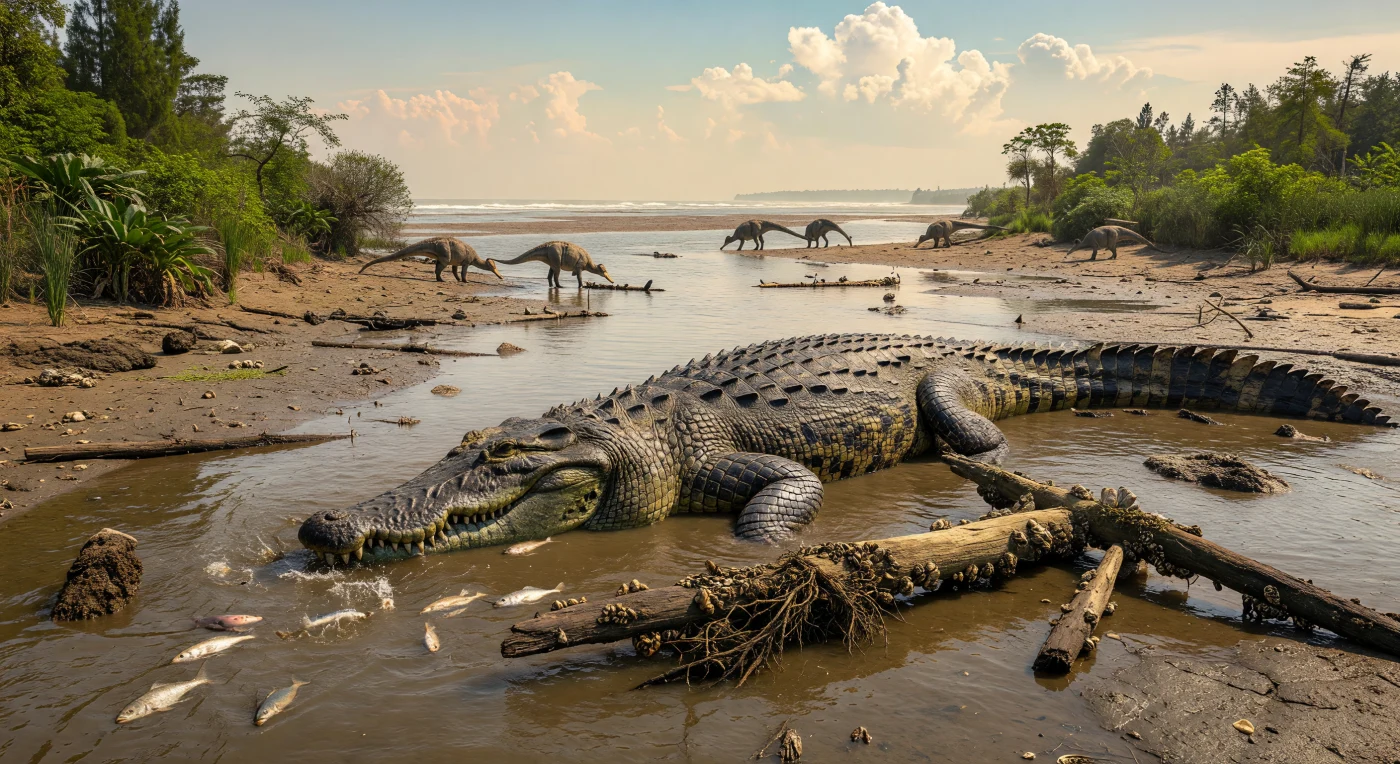
On a seasonal floodplain of the Elrhaz Formation in what is now Niger, about 125–100 million years ago in the Early Cretaceous, the giant crocodyliform Sarcosuchus imperator lies half-submerged in a shrinking muddy channel, its armored back and long, broad snout barely breaking the surface. Nearby, small basal ornithopod dinosaurs edge cautiously toward the remaining water while lungfish and other stranded aquatic life signal the harsh dry season. This scene captures a predator-rich tropical river system of equatorial Africa, where conifers, horsetail-like plants, and patchy fern cover lined channels that periodically swelled and then contracted under a strongly seasonal climate.

In the Cenomanian of northern Africa, about 95 million years ago, a herd of the giant titanosaur Paralititan stromeri wades across a muddy coastal delta under towering monsoon clouds. These enormous sauropods browse among ferns, horsetails, cycads, bennettitaleans, and early flowering plants, while small ornithocheiroid pterosaurs glide overhead above sediment-choked channels and brackish pools near the southern margin of the Tethys Sea. The scene captures a hot equatorial greenhouse world, where floodplain wetlands supported some of the largest land animals of the Cretaceous.

In the blazing midday heat of Cenomanian North Africa, about 95 million years ago, a giant Spinosaurus aegyptiacus wades chest-deep through a muddy river, using its long crocodile-like snout and powerful, paddle-like tail to pursue fish in a predator-rich floodplain ecosystem. Nearby, the saw-bearing fish Onchopristis numidus cuts through the sediment-laden water while freshwater turtles bask on sandy bars among sparse ferns, cycads, and conifers. This scene reflects the Kem Kem-style river systems of the mid-Cretaceous, where semi-aquatic theropods, large fishes, and reptiles thrived under intensely hot equatorial conditions.

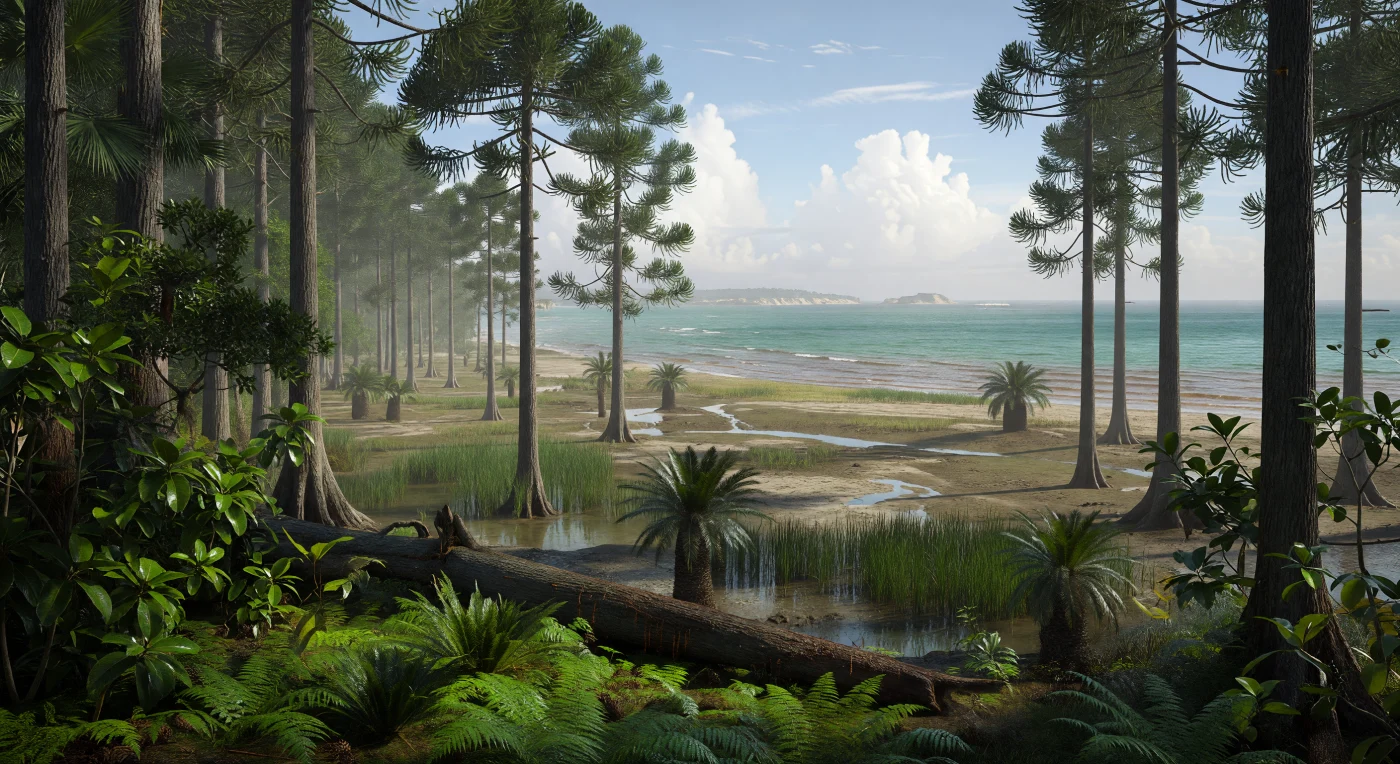
In a humid equatorial forest of the Late Cretaceous, about 100–66 million years ago, towering araucarian and podocarp conifers rise above a shaded understory of early flowering plants, tree ferns, cycads, and moss-covered fallen logs. Small, pale blossoms on magnoliid-grade angiosperms attract beetles, wasps, lacewings, and primitive bee-like pollinators, reflecting the expanding ecological role of flowering plants during this interval. The scene captures a transitional tropical ecosystem, where ancient gymnosperm-dominated canopies still prevailed even as angiosperms were rapidly diversifying below.

A calm, plankton-rich equatorial sea during a mid-Cretaceous Oceanic Anoxic Event is shown in partial cutaway, with bright turquoise surface waters fading downward through a murky chemocline into dark, oxygen-starved depths above a seafloor of black organic mud. Scattered shells of inoceramid bivalves rest on the nearly lifeless bottom, while only a few ammonites and fish occupy the better-oxygenated upper water. Such episodes, common in parts of the Tethys and proto-Atlantic around roughly 120–90 million years ago, helped generate the laminated black shales that record times of exceptional marine productivity and deep-water stagnation.

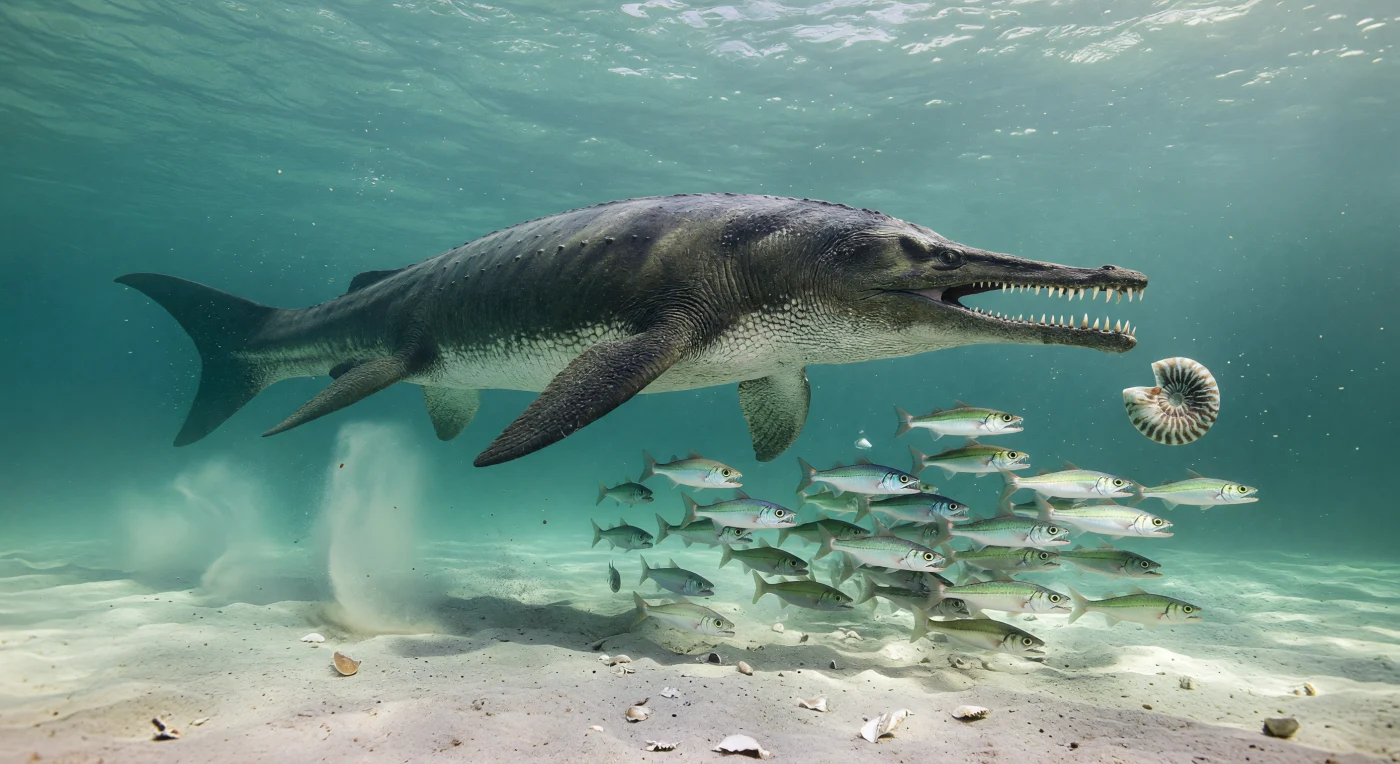
In the warm equatorial seas of the Late Cretaceous, about 100–94 million years ago, ribbed ammonites such as Acanthoceras drift above a carbonate shelf margin alongside smoother-shelled Puzosia, while schools of the predatory fish Enchodus flash through the sunlit water. Below them, a crow shark, Squalicorax, patrols the shell-strewn fore-reef slope, where rudist debris and sponge mounds mark a tropical limestone platform of the Tethyan realm. This scene captures a rich marine ecosystem from a greenhouse world, when ammonites, teleost fishes, and lamniform sharks thrived in warm shallow seas.

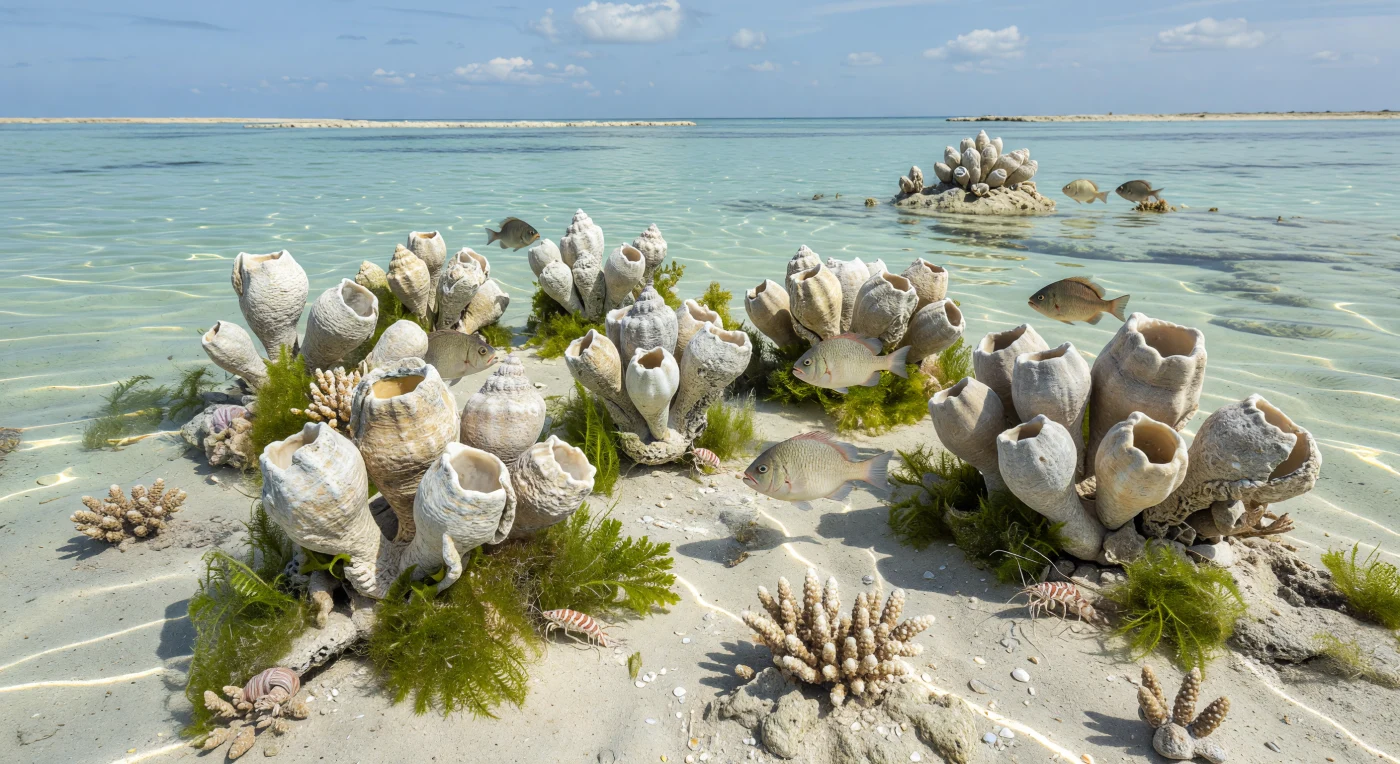
In the warm, shallow seas of the Late Cretaceous, about 100–66 million years ago, equatorial Tethyan reef crests were often built not by corals but by dense thickets of rudist bivalves such as Hippurites, Radiolites, and Toucasia. This scene shows their pale, horn-like shells rising from a carbonate seafloor, with smaller patches of Actinastrea coral and purple-red calcareous algae filling the spaces between them. Deep-bodied pycnodont fishes weave through the reef while spiny cidaroid sea urchins cling to the substrate, illustrating the distinctive structure and ecology of a rudist-dominated Cretaceous reef.

In a warm, shallow sea along the equatorial Tethys during the Late Cretaceous, about 100–66 million years ago, a stocky Globidens mosasaur patrols above a carbonate lagoon floor littered with rudist reef rubble and broken shells. Its short, powerful jaws and rounded crushing teeth were specialized for durophagy, allowing it to crack hard-shelled prey such as ammonites and bivalves. Around it lie characteristic inhabitants of these tropical shelf habitats, including oysters, high-spired Nerinea gastropods, and small crabs among the sunlit lime sands and shell beds.