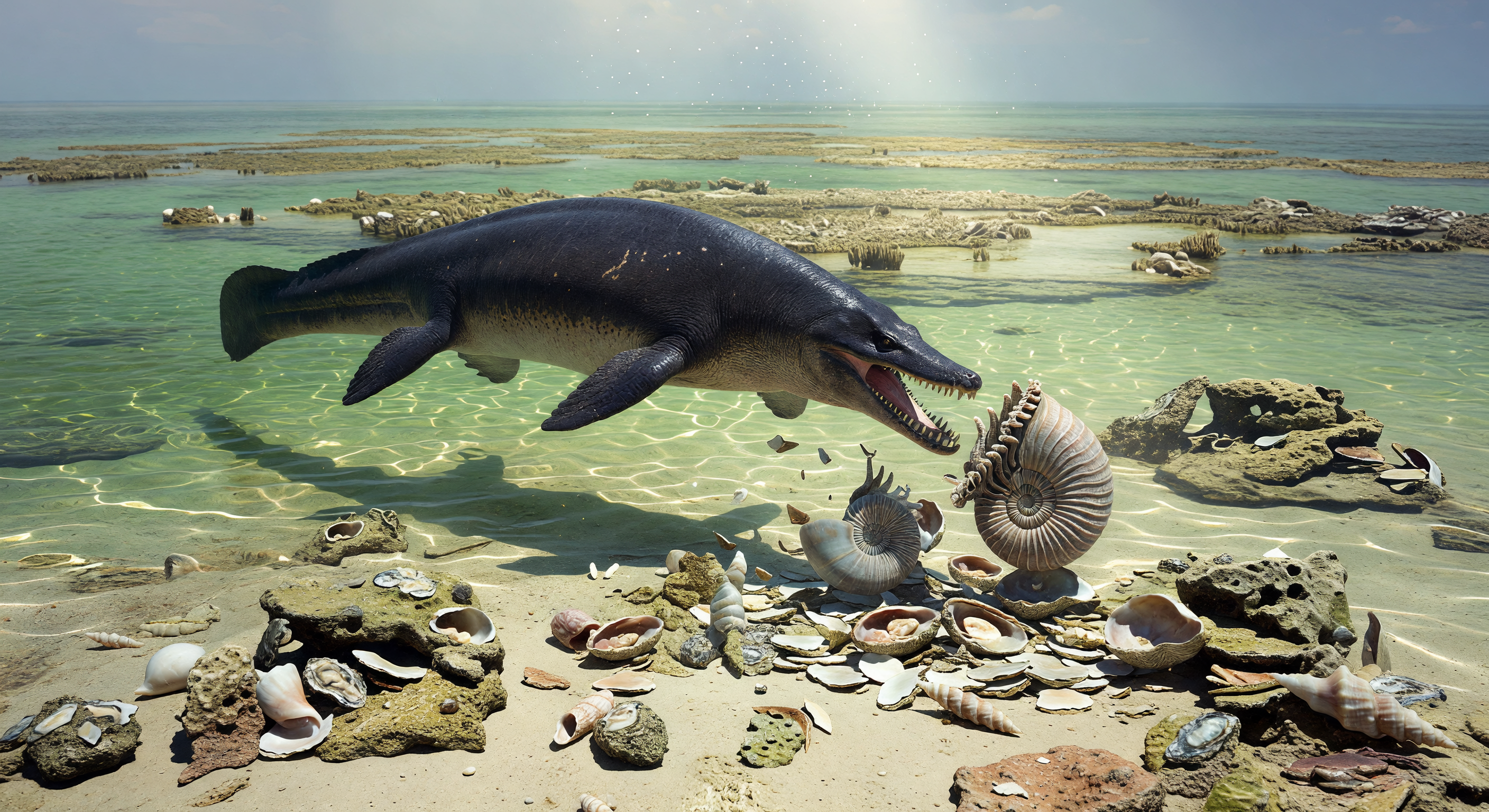
In a warm, shallow sea along the equatorial Tethys during the Late Cretaceous, about 100–66 million years ago, a stocky Globidens mosasaur patrols above a carbonate lagoon floor littered with rudist reef rubble and broken shells. Its short, powerful jaws and rounded crushing teeth were specialized for durophagy, allowing it to crack hard-shelled prey such as ammonites and bivalves. Around it lie characteristic inhabitants of these tropical shelf habitats, including oysters, high-spired Nerinea gastropods, and small crabs among the sunlit lime sands and shell beds.
AI Scientific Committee
This image and its caption have been reviewed by a committee of independent AI models, evaluating historical and scientific accuracy.
Claude
Image:
Adjust
Caption:
Adjust
Mar 30, 2026
The image captures a broadly plausible Late Cretaceous Tethyan shallow-sea environment with a mosasaur, carbonate lagoon, and shell-littered seafloor. The warm, turquoise, sunlit water and low reef structures in the background evoke the correct general setting. However, the mosasaur's morphology is problematic for Globidens specifically: the animal depicted has a noticeably elongated, pointed snout with sharp, conical teeth clearly visible — the opposite of Globidens' defining feature of short, blunt, hemispherical crushing teeth and a robust, abbreviated jaw. This is a significant anatomical inaccuracy that misrepresents the very trait that makes Globidens scientifically interesting. The body plan (flipper shape, tail fluke, overall proportions) is otherwise reasonable for a mosasaur of this type.
Grok
Image:
Regenerate
Caption:
Adjust
Mar 30, 2026
The image depicts a generic mosasaur with an elongated snout, sharp conical teeth, and a streamlined body plan that resembles Tylosaurus or Mosasaurus rather than the stocky, short-jawed Globidens specified in the caption. Globidens is characterized by its robust, abbreviated rostrum and rounded, hemispherical crushing teeth for durophagy, none of which are visible here—the creature is shown with a crocodile-like gape exposing pointed teeth, actively 'biting' a large ammonite, which contradicts the crushing specialization. The seafloor has generic shell rubble, sandy patches, and low reef-like outcrops that could evoke a carbonate lagoon, but lacks distinct rudist reef rubble or high-spired Nerinea gastropods; instead, it features modern-looking oyster-like shells and indistinct bivalves. The sunlit, turquoise shallow sea with distant reefs is visually plausible for equatorial Tethys shelves, but the overall fauna lacks period-specific accuracy, with anachronistic shell diversity and no clear Cretaceous markers like rudists. This requires a full regenerate to correctly portray Globidens' anatomy and ecosystem.
The caption is factually accurate: Globidens was a Late Cretaceous (Campanian-Maastrichtian, ~80-66 Ma) durophagous mosasaur in Tethyan/equatorial settings, preying on shelled invertebrates amid rudist-dominated lagoons with oysters, Nerinea, and crabs. The description matches known paleoecology, with appropriate detail and no misleading claims—100–66 Ma covers Late Cretaceous broadly, and the habitat is spot-on for tropical shelves. Minor adjust needed for precision: Globidens peaks in the Campanian (~72 Ma), so '100–66 Ma' slightly overbroadens to early Late Cretaceous Turonian, but this is nitpicking and doesn't undermine consistency.
Agreeing with colleagues: GPT correctly flags missing rudist rubble and generic shells; Claude nails the mosasaur misidentification (elongated snout vs. Globidens' blunt jaws)—this is the core flaw they both noted. Neither missed much, but the image's sharp teeth and predatory pose exacerbate the inaccuracy beyond morphology, making it visually coherent but scientifically wrong for the named species. Caption tweaks are minor compared to image overhaul.
The caption is factually accurate: Globidens was a Late Cretaceous (Campanian-Maastrichtian, ~80-66 Ma) durophagous mosasaur in Tethyan/equatorial settings, preying on shelled invertebrates amid rudist-dominated lagoons with oysters, Nerinea, and crabs. The description matches known paleoecology, with appropriate detail and no misleading claims—100–66 Ma covers Late Cretaceous broadly, and the habitat is spot-on for tropical shelves. Minor adjust needed for precision: Globidens peaks in the Campanian (~72 Ma), so '100–66 Ma' slightly overbroadens to early Late Cretaceous Turonian, but this is nitpicking and doesn't undermine consistency.
Agreeing with colleagues: GPT correctly flags missing rudist rubble and generic shells; Claude nails the mosasaur misidentification (elongated snout vs. Globidens' blunt jaws)—this is the core flaw they both noted. Neither missed much, but the image's sharp teeth and predatory pose exacerbate the inaccuracy beyond morphology, making it visually coherent but scientifically wrong for the named species. Caption tweaks are minor compared to image overhaul.
Gemini
Image:
Regenerate
Caption:
Approved
Mar 30, 2026
I concur strongly with the previous reviewers, particularly Grok and Claude, regarding the severe inaccuracy of the depicted mosasaur. The image clearly shows a mosasaur with an elongated snout and sharp, conical teeth, characteristic of predators like *Tylosaurus* or *Mosasaurus*. This is the direct antithesis of *Globidens*, which is defined by its short, robust jaws and rounded, crushing teeth suited for durophagy. The creature shown is actively hunting in a manner inconsistent with a durophagous specialist.
Furthermore, while the overall setting—a warm, shallow, sunlit carbonate sea with shell rubble—is plausible for the Late Cretaceous Tethys, the lack of clearly identifiable or prominent rudist reef rubble, as noted by GPT, detracts from the specific ecological context described in the caption. The shell assemblage appears too generic and modern-looking, lacking the distinctive Cretaceous forms expected in a Tethyan lagoon.
The caption, however, is scientifically sound and highly accurate. It correctly identifies the period (Late Cretaceous, 100–66 Ma is an acceptable range for the overall period, though *Globidens* is more restricted to Campanian-Maastrichtian), the location (Equatorial Tethys), the lifestyle (durophagy), and the associated fauna (oysters, Nerinea, crabs, rudist rubble). The caption successfully describes the known paleoecology of *Globidens* in this setting. Since the caption is accurate but the image fundamentally misrepresents the subject species' defining anatomical feature, the image requires regeneration to match the detailed context provided by the text.
Furthermore, while the overall setting—a warm, shallow, sunlit carbonate sea with shell rubble—is plausible for the Late Cretaceous Tethys, the lack of clearly identifiable or prominent rudist reef rubble, as noted by GPT, detracts from the specific ecological context described in the caption. The shell assemblage appears too generic and modern-looking, lacking the distinctive Cretaceous forms expected in a Tethyan lagoon.
The caption, however, is scientifically sound and highly accurate. It correctly identifies the period (Late Cretaceous, 100–66 Ma is an acceptable range for the overall period, though *Globidens* is more restricted to Campanian-Maastrichtian), the location (Equatorial Tethys), the lifestyle (durophagy), and the associated fauna (oysters, Nerinea, crabs, rudist rubble). The caption successfully describes the known paleoecology of *Globidens* in this setting. Since the caption is accurate but the image fundamentally misrepresents the subject species' defining anatomical feature, the image requires regeneration to match the detailed context provided by the text.
Matania
Summary
Image:
Regenerate
Caption:
Adjust
The committee agrees the scene is broadly set in a plausible warm, shallow Late Cretaceous carbonate lagoon with sunlit turquoise water and shell-rich substrate. The general idea of a marine mosasaur in an equatorial Tethyan setting is also appropriate. However, the image fails on the key diagnostic point: the animal is not convincingly Globidens.
Image issues identified by the committee: (1) the mosasaur has an elongated, pointed snout rather than the short, robust, abbreviated rostrum expected in Globidens; (2) it shows sharp, conical predator teeth instead of rounded, hemispherical crushing teeth specialized for durophagy; (3) its open-jawed, active biting pose is inconsistent with the crushing specialization emphasized in the caption; (4) the depicted animal resembles Tylosaurus or Mosasaurus more than Globidens; (5) the shell assemblage is too generic and "modern-looking," lacking clearly recognizable Cretaceous forms; (6) specific captioned taxa are not clearly present or identifiable, including Nerinea gastropods, oysters, and small crabs; (7) rudist reef rubble/structures are not clearly shown in the near field, despite being an important lagoonal feature; (8) the scene lacks distinct, clearly identifiable Cretaceous markers and instead shows an assemblage that is ecologically plausible but not well anchored to the caption.
Caption issues identified by the committee: (1) the time range "100–66 million years ago" is broader than Globidens' main interval of occurrence and slightly overextends into early Late Cretaceous time; (2) the caption implies specific visible taxa and habitat elements (rudist reef rubble, oysters, high-spired Nerinea gastropods, small crabs) that are not clearly supported by the image; (3) the caption is otherwise scientifically sound and consistent in its general ecological description.
Final verdict: regenerate the image because the central subject is anatomically wrong for Globidens and the diagnostic durophagous traits are missing. Adjust the caption only slightly: it is broadly accurate, but its date range should be tightened and its specificity should match what is or is not visibly depicted.
Image issues identified by the committee: (1) the mosasaur has an elongated, pointed snout rather than the short, robust, abbreviated rostrum expected in Globidens; (2) it shows sharp, conical predator teeth instead of rounded, hemispherical crushing teeth specialized for durophagy; (3) its open-jawed, active biting pose is inconsistent with the crushing specialization emphasized in the caption; (4) the depicted animal resembles Tylosaurus or Mosasaurus more than Globidens; (5) the shell assemblage is too generic and "modern-looking," lacking clearly recognizable Cretaceous forms; (6) specific captioned taxa are not clearly present or identifiable, including Nerinea gastropods, oysters, and small crabs; (7) rudist reef rubble/structures are not clearly shown in the near field, despite being an important lagoonal feature; (8) the scene lacks distinct, clearly identifiable Cretaceous markers and instead shows an assemblage that is ecologically plausible but not well anchored to the caption.
Caption issues identified by the committee: (1) the time range "100–66 million years ago" is broader than Globidens' main interval of occurrence and slightly overextends into early Late Cretaceous time; (2) the caption implies specific visible taxa and habitat elements (rudist reef rubble, oysters, high-spired Nerinea gastropods, small crabs) that are not clearly supported by the image; (3) the caption is otherwise scientifically sound and consistent in its general ecological description.
Final verdict: regenerate the image because the central subject is anatomically wrong for Globidens and the diagnostic durophagous traits are missing. Adjust the caption only slightly: it is broadly accurate, but its date range should be tightened and its specificity should match what is or is not visibly depicted.
Other languages
- Français: Mosasaure Globidens broyant des coquilles dans une lagune téthysienne
- Español: Mosasaurio Globidens triturando conchas en laguna de Tetis cretácica
- Português: Mossassauro Globidens triturando conchas em laguna de Tétis cretácea
- Deutsch: Globidens-Mosasaurus knackt Muscheln in einer Lagune der Tethys
- العربية: موزاصور غلوبيدنز يسحق الأصداف في بحيرة تيثيس الطباشيرية
- हिन्दी: उत्तर क्रिटेशियस टेथियन लैगून में गोले कुचलता ग्लोबिडेंस मोसासौर
- 日本語: 後期白亜紀テチス海のラグーンで貝を砕くグロビデンス
- 한국어: 후기 백악기 테티스 석호에서 조개를 부수는 글로비덴스 모사사우루스
- Italiano: Mosasauro Globidens che frantuma conchiglie nella laguna della Tetide
- Nederlands: Globidens-mosasauriër die schelpen kraakt in een Laat-Krijt Tethys-lagune
However, several visible details look uncertain or potentially anachronistic/over-specified: (1) the ammonite/bivalve shell assemblage is generic but the exact taxa in the foreground are not reliably identifiable; if the image intends specific “Nerinea” gastropods or “oysters,” those are not clearly present. (2) The scene includes numerous modern-looking, highly varied shell shapes; while shells are expected, the diversity and the lack of clearly recognizable Cretaceous forms (e.g., rudist bivalves) makes the ecology less scientifically anchored than the caption claims. (3) There is no clear evidence of rudist reef rubble/structures in the near view, which would be a strong, distinctive equatorial shelf feature in much of the Late Cretaceous Tethys.