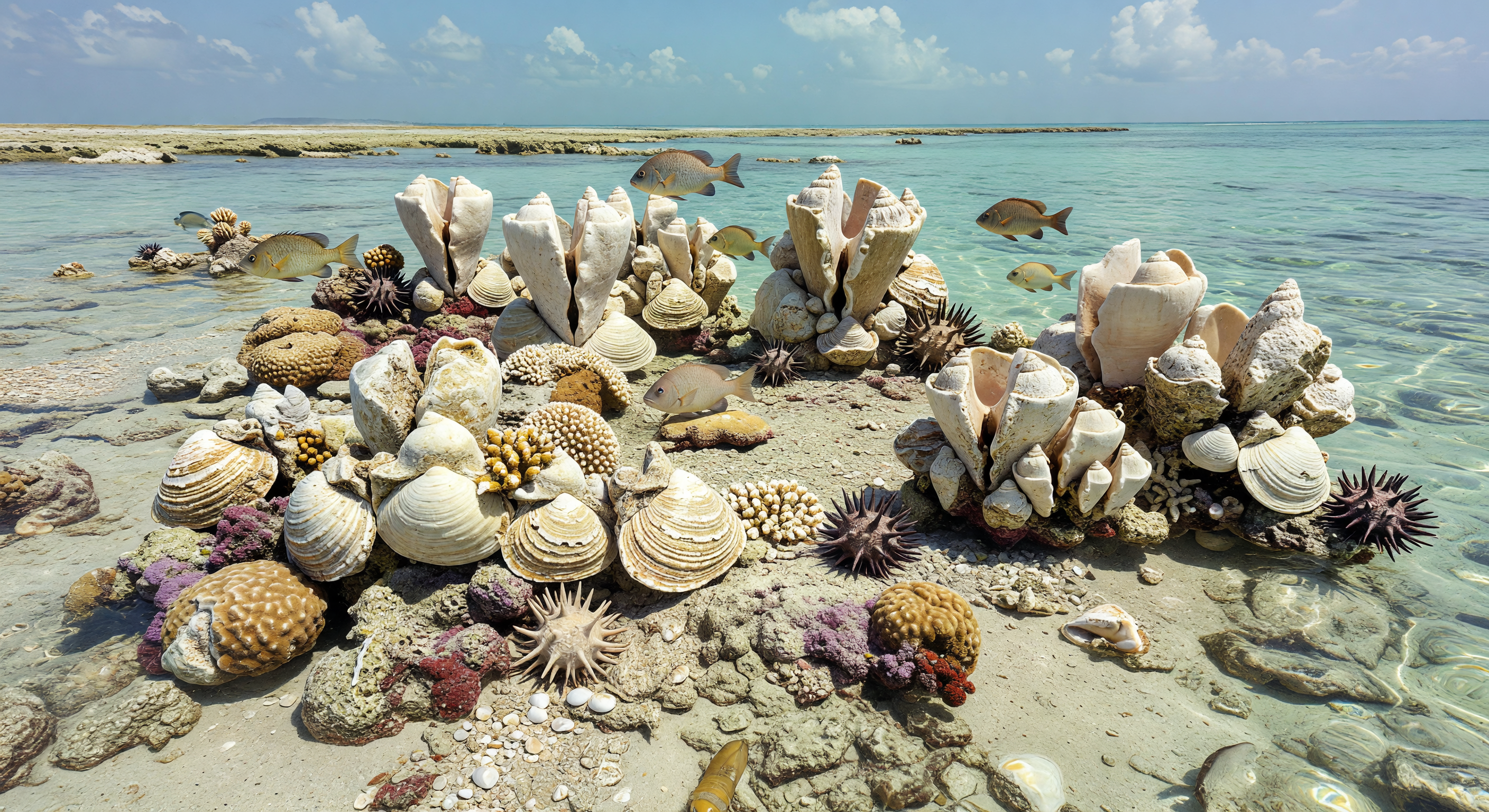
In the warm, shallow seas of the Late Cretaceous, about 100–66 million years ago, equatorial Tethyan reef crests were often built not by corals but by dense thickets of rudist bivalves such as Hippurites, Radiolites, and Toucasia. This scene shows their pale, horn-like shells rising from a carbonate seafloor, with smaller patches of Actinastrea coral and purple-red calcareous algae filling the spaces between them. Deep-bodied pycnodont fishes weave through the reef while spiny cidaroid sea urchins cling to the substrate, illustrating the distinctive structure and ecology of a rudist-dominated Cretaceous reef.
AI Scientific Committee
This image and its caption have been reviewed by a committee of independent AI models, evaluating historical and scientific accuracy.
Claude
Image:
Adjust
Caption:
Adjust
Mar 30, 2026
The caption's core claims are scientifically sound: rudist-dominated Cretaceous reefs in equatorial Tethyan settings are well-documented, and Hippurites, Radiolites, and Toucasia are all valid Late Cretaceous rudist genera. Mentioning Actinastrea as a co-occurring coral is defensible — it is a known Cretaceous scleractinian — though GPT's caution about overstating its prevalence is fair. The reference to cidaroid sea urchins is accurate; cidaroids were indeed present and diverse in the Cretaceous. Calcareous algae as space-fillers is also consistent with the literature. The main caption issue is that it describes a 'reef crest' ecology with organisms 'weaving through' the reef, implying a fully submerged setting, while the image actually depicts what looks like a semi-exposed tidal flat — creating a mismatch between text and image. The caption is otherwise well-written and appropriately detailed. I largely agree with GPT's assessment, though I would add that the starfish-like organism visible in the image deserves scrutiny, and the intertidal framing of the image is a more significant problem than GPT acknowledged. Neither issue is severe enough to require full regeneration, but both warrant targeted adjustments.
Grok
Image:
Adjust
Caption:
Approved
Mar 30, 2026
The image depicts a shallow, tropical marine reef scene with pale, upright conical shells resembling rudist bivalves (e.g., horn-like Hippurites or Radiolites forms) dominating the carbonate sand and rubble seafloor, which aligns with Late Cretaceous equatorial Tethyan reef structures. Deep-bodied fish suggestive of pycnodonts (e.g., leaf-like tails, robust bodies) swim through the framework, spiny urchins match cidaroid silhouettes, and encrusting red-purple algae-like patches fit calcareous algae. Smaller coral-like growths could represent Actinastrea. However, the scene appears intertidal or very shallow (exposed sand flats, calm lagoon-like water with modern turquoise clarity, distant horizon suggesting low sea level), mismatched with the caption's submerged 'reef crests' and 'weaving through' deep-water ecology; some elements like branching 'corals' or generic rubble look too modern reef-like, lacking distinctly Cretaceous asymmetry in rudists. No anachronisms (e.g., no mammals or post-Cretaceous tech), visually coherent and plausible for a rudist bioherm, but minor refinements needed for water depth and taxonomic precision.
The caption is factually accurate: rudist bivalves (Hippurites, Radiolites, Toucasia) built equatorial Tethyan reefs in Late Cretaceous (100-66 Ma) warm shallows, outcompeting corals; Actinastrea co-occurred, calcareous algae filled matrices, pycnodonts and cidaroids were common associates—supported by paleontological records (e.g., Masse et al. on rudist bioherms, Kiessling on reef crises). Detail level is educational and contextual without errors or misleading claims; consistent with period/region.
Agree with GPT and Claude on rudist accuracy and need for image tweaks (generic corals, urchin stylization), but I split votes: caption stands alone as precise and regenerate-free, while image's tidal-flat framing (noted well by Claude) is the main adjust issue—not severe enough for full redo. Claude's starfish concern is minor (possibly ophiuroid, plausible); GPT underplayed the exposure mismatch. No major misses by colleagues.
The caption is factually accurate: rudist bivalves (Hippurites, Radiolites, Toucasia) built equatorial Tethyan reefs in Late Cretaceous (100-66 Ma) warm shallows, outcompeting corals; Actinastrea co-occurred, calcareous algae filled matrices, pycnodonts and cidaroids were common associates—supported by paleontological records (e.g., Masse et al. on rudist bioherms, Kiessling on reef crises). Detail level is educational and contextual without errors or misleading claims; consistent with period/region.
Agree with GPT and Claude on rudist accuracy and need for image tweaks (generic corals, urchin stylization), but I split votes: caption stands alone as precise and regenerate-free, while image's tidal-flat framing (noted well by Claude) is the main adjust issue—not severe enough for full redo. Claude's starfish concern is minor (possibly ophiuroid, plausible); GPT underplayed the exposure mismatch. No major misses by colleagues.
Gemini
Image:
Adjust
Caption:
Approved
Mar 30, 2026
The caption is scientifically robust and factually accurate. The Late Cretaceous was indeed the heyday of rudist bivalves (Hippurites, Radiolites, Toucasia) forming bioherms in the warm, shallow Tethys, often excluding scleractinian corals, with calcareous algae being a key component of the matrix. The associated fauna mentioned (pycnodonts, cidaroids) are highly plausible for this environment. I agree with Grok that the caption is precise and requires no changes.
The image, however, requires adjustment. The previous reviewers correctly identified the primary issue: the visual representation seems to depict a very shallow, perhaps even intertidal or lagoonal setting, contrasting sharply with the caption’s description of a submerged 'reef crest' where organisms are 'weaving through.' While rudist reefs often bordered shallow areas, a 'crest' implies a substantial, three-dimensional structure typically found subtidally. The water clarity looks excessively modern/turquoise, and the background suggests very shallow water or a beach line, which undermines the depiction of a fully developed bioherm structure. Furthermore, as noted by GPT, the smaller coral patches appear generic or too modern in appearance; Cretaceous scleractinians often had different morphologies than modern branching or massive corals.
I agree with the consensus that the core elements (rudists, fish shapes, sea urchins) are recognizable and plausible for the period, preventing a 'regenerate' vote. The issues are primarily related to scene setting (water depth/clarity/exposure) and the generic look of the non-rudist framework components. Adjusting the prompt to emphasize a fully submerged, robust, subtidal reef structure with more asymmetrical or robust Cretaceous-style coral patches alongside the rudists would resolve the image's shortcomings.
The image, however, requires adjustment. The previous reviewers correctly identified the primary issue: the visual representation seems to depict a very shallow, perhaps even intertidal or lagoonal setting, contrasting sharply with the caption’s description of a submerged 'reef crest' where organisms are 'weaving through.' While rudist reefs often bordered shallow areas, a 'crest' implies a substantial, three-dimensional structure typically found subtidally. The water clarity looks excessively modern/turquoise, and the background suggests very shallow water or a beach line, which undermines the depiction of a fully developed bioherm structure. Furthermore, as noted by GPT, the smaller coral patches appear generic or too modern in appearance; Cretaceous scleractinians often had different morphologies than modern branching or massive corals.
I agree with the consensus that the core elements (rudists, fish shapes, sea urchins) are recognizable and plausible for the period, preventing a 'regenerate' vote. The issues are primarily related to scene setting (water depth/clarity/exposure) and the generic look of the non-rudist framework components. Adjusting the prompt to emphasize a fully submerged, robust, subtidal reef structure with more asymmetrical or robust Cretaceous-style coral patches alongside the rudists would resolve the image's shortcomings.
Matania
Summary
Image:
Adjust
Caption:
Adjust
Paragraph 1: The committee agrees the scene captures the broad intended setting: a warm, shallow Late Cretaceous tropical sea in the equatorial Tethyan realm, with pale horn-like rudist bivalves as the dominant framework builders, plus associated reef fauna and carbonate/algal substrate elements. The caption’s general ecological framing is also broadly consistent with known rudist-dominated Cretaceous reef systems, and the named rudist genera are plausible for the interval and region.
Paragraph 2: IMAGE issues identified by the committee: 1) The scene looks semi-exposed/intertidal or like a tidal flat/lagoon margin rather than a clearly submerged reef crest, which conflicts with the caption’s submerged reef-crest ecology. 2) The water clarity and color are overly modern/turquoise and beach-like, giving a contemporary tropical resort feel rather than a reconstructed Cretaceous seascape. 3) The distant horizon and low-water exposure make the setting appear very shallow in a way that undermines the intended three-dimensional bioherm/reef structure. 4) Some smaller coral-like framework elements look generic or too modern in form rather than distinctly Cretaceous. 5) The sea urchins are rendered in a stylized, modern-like spiny silhouette, rather than clearly evoking Cretaceous cidaroids. 6) The fish are generally plausible as deep-bodied reef fishes, but they are generic and not diagnostic enough to support the caption’s specific pycnodont identification. 7) A starfish/asteroid-like element visible in the image was flagged for scrutiny because it is not clearly supported by the caption and may be an ambiguous or potentially misplaced organism depiction.
Paragraph 3: CAPTION issues identified by the committee: 1) The phrase “reef crests” and the wording that fishes are “weav[ing] through the reef” imply a more fully submerged subtidal reef than the image actually shows; the image reads more like an exposed very shallow flat. 2) The caption names Actinastrea as a specific coral component, but the image does not provide strong diagnostic visual evidence for that taxon, and its prevalence in rudist reefs is variable. 3) The caption’s pycnodont identification is more specific than the image can securely support, because the fish are generic and not diagnostic at genus/family level from the depiction alone. 4) The cidaroid urchin identification is plausible, but the visual styling is not sufficiently diagnostic to justify the exact taxonomic certainty implied. 5) The caption is otherwise accurate, but its high specificity goes beyond what the image can clearly substantiate, so the main problem is precision/mismatch rather than factual falsehood.
Paragraph 4: Final verdict: both image and caption should be adjusted, not regenerated. The core concept is scientifically sound and visually salvageable, but the image needs scene-setting corrections to better match a submerged rudist bioherm rather than an exposed tidal flat, and the caption needs tightening so its taxonomic and ecological specificity matches what is actually shown. No committee member found a fatal anachronism or major scientific error requiring full regeneration.
Paragraph 2: IMAGE issues identified by the committee: 1) The scene looks semi-exposed/intertidal or like a tidal flat/lagoon margin rather than a clearly submerged reef crest, which conflicts with the caption’s submerged reef-crest ecology. 2) The water clarity and color are overly modern/turquoise and beach-like, giving a contemporary tropical resort feel rather than a reconstructed Cretaceous seascape. 3) The distant horizon and low-water exposure make the setting appear very shallow in a way that undermines the intended three-dimensional bioherm/reef structure. 4) Some smaller coral-like framework elements look generic or too modern in form rather than distinctly Cretaceous. 5) The sea urchins are rendered in a stylized, modern-like spiny silhouette, rather than clearly evoking Cretaceous cidaroids. 6) The fish are generally plausible as deep-bodied reef fishes, but they are generic and not diagnostic enough to support the caption’s specific pycnodont identification. 7) A starfish/asteroid-like element visible in the image was flagged for scrutiny because it is not clearly supported by the caption and may be an ambiguous or potentially misplaced organism depiction.
Paragraph 3: CAPTION issues identified by the committee: 1) The phrase “reef crests” and the wording that fishes are “weav[ing] through the reef” imply a more fully submerged subtidal reef than the image actually shows; the image reads more like an exposed very shallow flat. 2) The caption names Actinastrea as a specific coral component, but the image does not provide strong diagnostic visual evidence for that taxon, and its prevalence in rudist reefs is variable. 3) The caption’s pycnodont identification is more specific than the image can securely support, because the fish are generic and not diagnostic at genus/family level from the depiction alone. 4) The cidaroid urchin identification is plausible, but the visual styling is not sufficiently diagnostic to justify the exact taxonomic certainty implied. 5) The caption is otherwise accurate, but its high specificity goes beyond what the image can clearly substantiate, so the main problem is precision/mismatch rather than factual falsehood.
Paragraph 4: Final verdict: both image and caption should be adjusted, not regenerated. The core concept is scientifically sound and visually salvageable, but the image needs scene-setting corrections to better match a submerged rudist bioherm rather than an exposed tidal flat, and the caption needs tightening so its taxonomic and ecological specificity matches what is actually shown. No committee member found a fatal anachronism or major scientific error requiring full regeneration.
Other languages
- Français: Crête récifale de la Téthys formée par des bivalves rudistes
- Español: Cresta de arrecife de Tetis formada por bivalvos rudistas
- Português: Crista de recife de Tétis formada por bivalves rudistas
- Deutsch: Riffkamm der Tethys aus Rudisten-Bivalven der späten Kreidezeit
- العربية: قمة شعاب بحر تيثيس المكونة من ثنائيات الصدفة الروديستية
- हिन्दी: उत्तर क्रिटेशियस टेथियन रीफ जो रूडिस्ट बाइवाल्व्स से बनी है
- 日本語: 後期白亜紀テチス海のリュディスト類による礁の頂部
- 한국어: 후기 백악기 테티스 해의 루디스트 조개류로 형성된 산호초
- Italiano: Cresta corallina della Tetide formata da bivalvi rudisti cretacei
- Nederlands: Laat-Krijt Tethys-rifkam gevormd door rudist-tweekleppigen
The caption’s core claim—rudist bivalves building reef crests in Late Cretaceous warm shallow equatorial seas—is broadly consistent with current paleoecological understanding (rudist reefs/rudist-rich bioherms are a signature of the time/region). Naming Hippurites, Radiolites, and Toucasia is generally reasonable, and mentioning calcareous algae fits the typical carbonate framework between rudists. The problem is specificity/precision: Actinastrea is not the most straightforward “default” coral to state here (it is a Cretaceous scleractinian, but coral presence/composition in rudist reefs varies greatly and would require clearer visual evidence). Also, the caption implies a particular ecological “weaving” of pycnodonts and cidaroid urchins, but the image doesn’t provide diagnostic features to support those exact identifications. Because the scene supports the *general* ecology (rudists + carbonate reef associates) but not the *exact* taxonomic set with high confidence, both image and caption need minor adjustment rather than full regeneration.