During the Early Eocene Climatic Optimum, about 53–50 million years ago, Ellesmere Island lay within a surprisingly warm, humid Arctic world. This scene shows a swampy floodplain forest dominated by dawn redwoods (Metasequoia) and swamp cypresses such as Glyptostrobus, their tall trunks rising from dark, tannin-stained channels and peaty ground under persistent mist and low polar sunlight. On the muddy bank rests a crocodilian comparable to Asiatosuchus, evidence that even the high Arctic supported frost-free wetlands and reptile life during one of the warmest intervals of the Paleogene.

At twilight over the early Eocene Messel maar lake of what is now Germany, small primitive bats—Onychonycteris finneyi and Icaronycteris index—flutter above the dark, stagnant water as dragonflies skim the surface. Dating to about 47 million years ago, Messel preserves one of the world’s richest records of early Cenozoic life, capturing a warm paratropical forest ecosystem within a volcanic crater lake. The scene highlights some of the earliest known bats, already capable fliers but still retaining primitive features such as the clawed fingers of Onychonycteris.

On a cool Oligocene morning about 30–28 million years ago, an open woodland on the interior plains of western North America is crossed by two swift mammals: the slender early camel Poebrotherium and the long-legged rhinocerotoid Hyracodon. Patchy grasses, sedges, scattered deciduous trees, and distant White River–style badlands reflect a drier, more seasonal world than the lush forests of the earlier Paleogene. This scene captures the growing importance of open habitats during the Oligocene, when many mammal lineages evolved longer limbs and greater speed for life on increasingly exposed terrain.
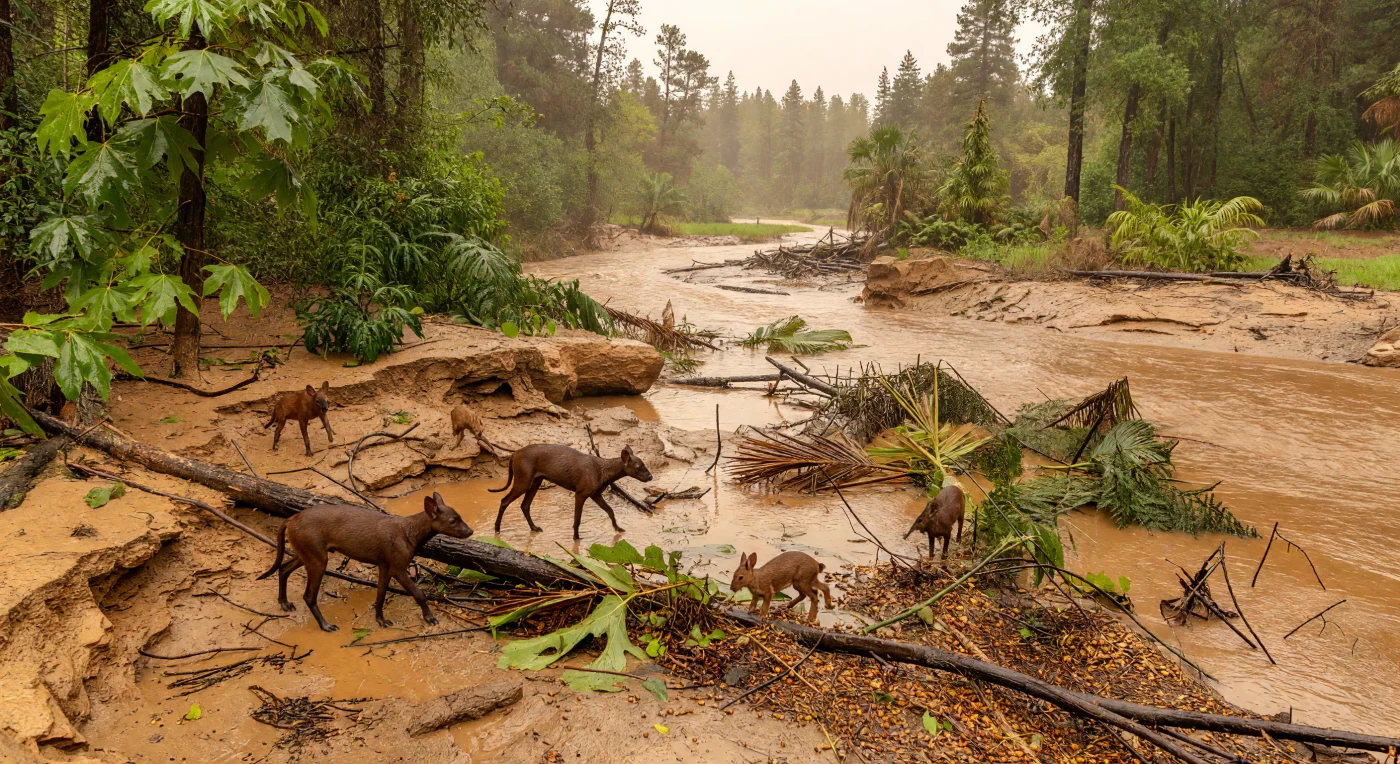
On a rain-soaked floodplain in Wyoming’s Bighorn Basin during the Paleocene–Eocene Thermal Maximum, about 56 million years ago, small early hoofed mammals forage along a swollen, muddy river after torrential flooding. Dog-sized Hyracotherium—an early relative of horses with four toes on the front feet—and rabbit-sized Diacodexis, among the earliest known even-toed ungulates, move cautiously through driftwood and leaf litter beneath lush broadleaf trees, palms, and ferns. The scene captures the PETM’s intensely warm, humid greenhouse climate, when subtropical forests spread across much of western North America.

In the warm outer-shelf seas of the early to middle Eocene, about 56–41 million years ago, the giant lamniform shark Otodus obliquus surges through a school of small teleost fishes, its streamlined body and broad, unserrated teeth marking an early member of the megatooth lineage. Below, a nautilid drifts through plankton-rich water hazed with microscopic foraminifera such as Globigerinatheka, evoking the productive subtropical oceans that spread across much of the Northern Hemisphere during this greenhouse interval.

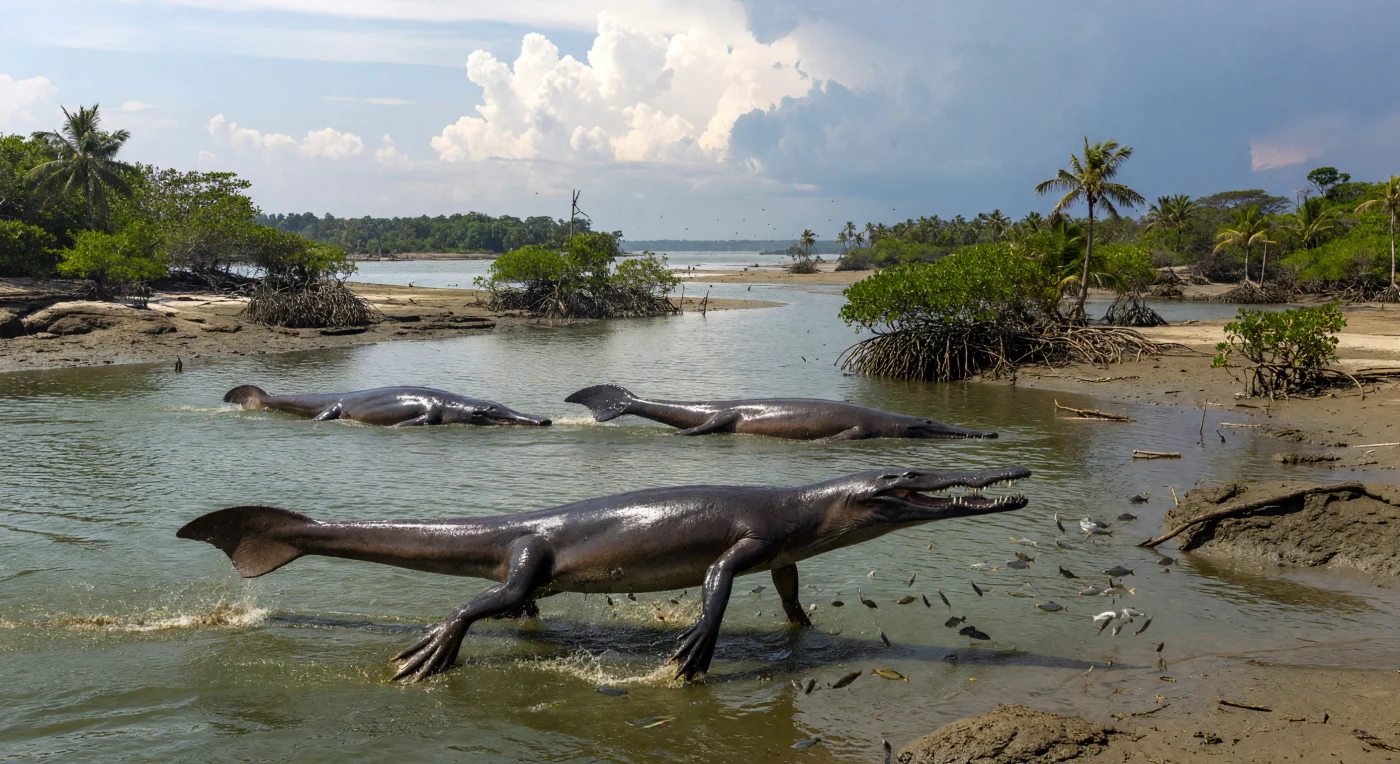
Along the warm Tethyan coast of what is now Pakistan and India, an early whale, Ambulocetus natans, surges through a muddy estuary in pursuit of fish about 50–48 million years ago, during the early Eocene. Its long body, powerful limbs, and broad hind feet reveal a transitional lifestyle: still capable of moving on land, yet increasingly adapted for swimming in shallow coastal waters. Burrow openings of ghost shrimp dot the sandbars nearby, while dense subtropical shoreline vegetation evokes the humid greenhouse world in which some of the first whales evolved.

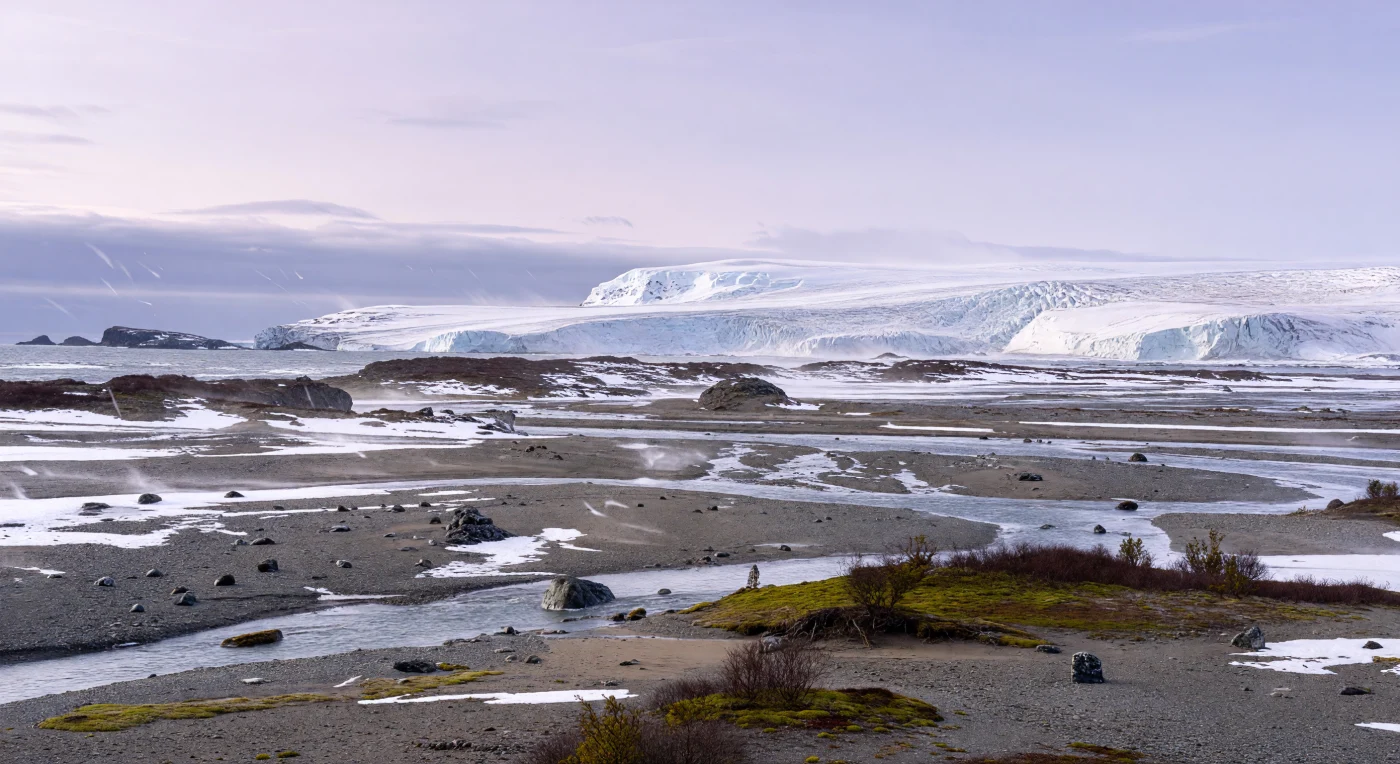
At the Paleocene–Eocene boundary, about 56 million years ago, fissure eruptions in East Greenland’s North Atlantic Igneous Province poured vast rivers of tholeiitic basalt across a newly rifted coastline. The scene shows incandescent lava fountains, black pāhoehoe and ʻaʻā fields, ash-and-gas plumes, fumaroles, and violent steam explosions where fresh lava meets the sea. These flood basalts formed during the opening of the North Atlantic, a major tectonic episode linked to intense volcanism, crustal stretching, and profound environmental change at the dawn of the Eocene.

On the northern margin of the Tethys Sea during the early to middle Eocene, about 56–40 million years ago, a small coral patch reef flourishes in warm, clear shallow water above a carbonate platform. Massive Porites, branching Stylophora, and honeycombed favositid-like corals provide shelter for schools of the moonfish Mene rhombea, while sea turtles such as Eochelone cruise overhead and echinoids and swimming crabs forage among coral rubble and bioclastic sand. This scene reflects the recovery and expansion of reef communities in the Paleogene greenhouse world, when tropical marine ecosystems once again became prominent along the margins of the ancient Tethys Ocean.