On a dry ridge of the Late Pleistocene mammoth steppe, two cave lions, Panthera spelaea, crouch low through cold-season grasses as they stalk a wary band of wild horses, Equus ferus. This scene evokes eastern Europe or southern Siberia roughly 50,000–20,000 years ago, when treeless, wind-scoured loess plains supported rich grazing herds and the predators that hunted them. The lions’ maneless, long-legged build and the horses’ stocky, dun-coated forms reflect classic adaptations to the harsh, seasonal climates of the Ice Age steppe.

In the cold, dry light of the Late Pleistocene mammoth steppe, a woolly rhinoceros, Coelodonta antiquitatis, strides across frost-cracked permafrost beside a line of steppe bison, Bison priscus. This Eurasian scene, dating to roughly 50,000–20,000 years ago, captures a nutrient-rich but treeless loess plain shaped by wind, ice-wedge polygons, and seasonal meltwater. Both animals were among the iconic megaherbivores of the Ice Age, adapted to harsh, open grassland with dense coats, powerful builds, and in the rhino’s case a flattened front horn likely used to sweep snow aside while foraging.

A herd of woolly mammoths, Mammuthus primigenius, moves across a windy loess plain of the Late Pleistocene, roughly 100,000–12,000 years ago, in the vast mammoth steppe of Eurasia. Their shaggy dark coats, reduced ears, sloping backs, and long spiraled tusks reflect adaptations to a cold, dry, periglacial grass-forb biome dominated by feather grass, Artemisia, and windblown silt. This open, dust-streaked landscape was one of the most productive Ice Age ecosystems, supporting great herds of grazing megafauna across northern Eurasia and Beringia.
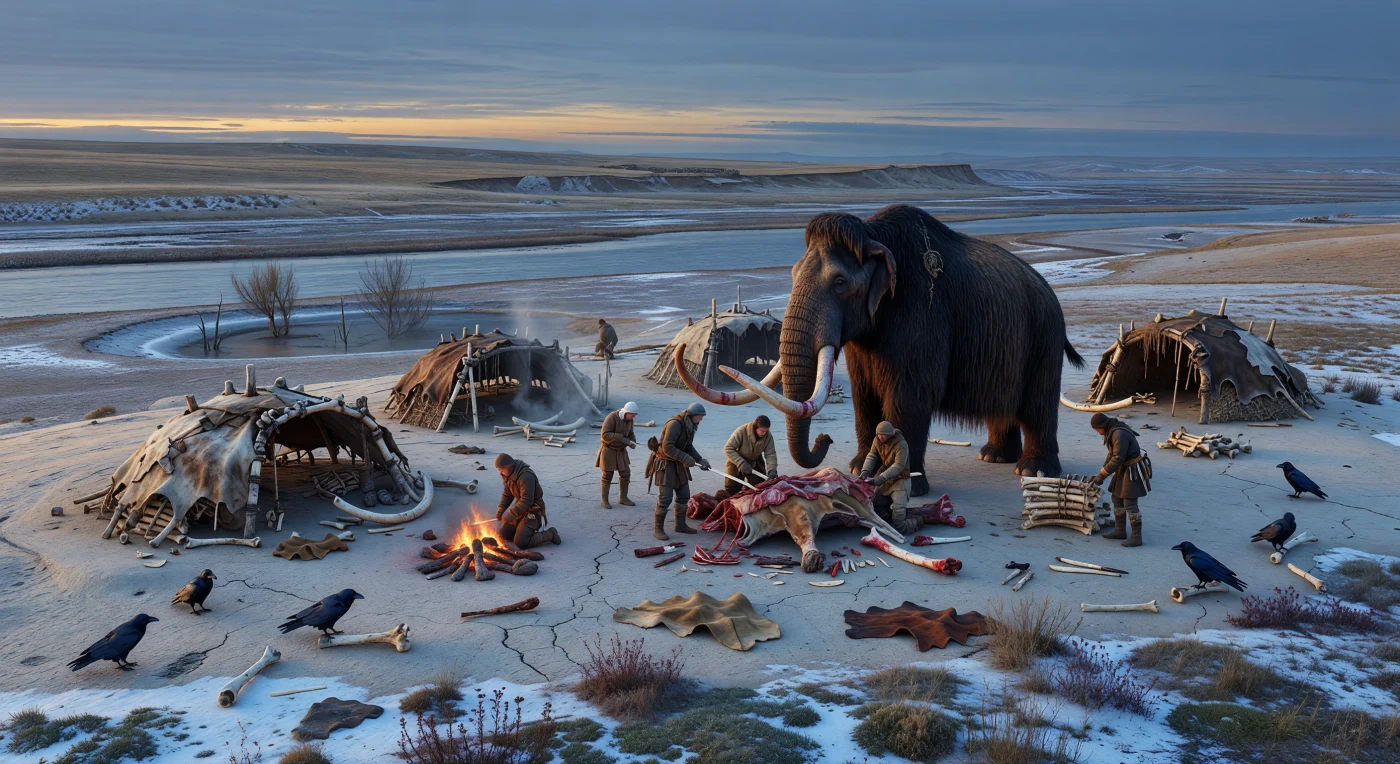
On the East European mammoth steppe during the Late Pleistocene, about 20,000–15,000 years ago, anatomically modern humans gather around hide-covered shelters built from mammoth bones and tusks on a wind-scoured loess terrace. In the bitter dusk, people dressed in tailored fur and hide clothing butcher a woolly mammoth, Mammuthus primigenius, beside glowing hearths, while ravens, Corvus corax, wait for scraps in the freezing air. The scene captures the harsh but resource-rich periglacial world of Ice Age Eurasia, where human communities depended on megafauna, fire, stone tools, and carefully constructed camps to survive.

On the shallow Beringian shelf during the Late Pleistocene, several walruses, Odobenus rosmarus, forage head-down in cold, silty water, stirring muddy sand with their tusks and sensitive whiskered muzzles as they excavate buried clams. Unearthed shells of Mya truncata and Serripes groenlandicus lie amid clouds of sediment, while pink northern shrimp (Pandalus borealis) and brittle stars scatter across the seafloor. This scene captures a familiar Ice Age feeding behavior in a glaciomarine habitat along the exposed margins of Beringia, roughly tens of thousands of years ago.
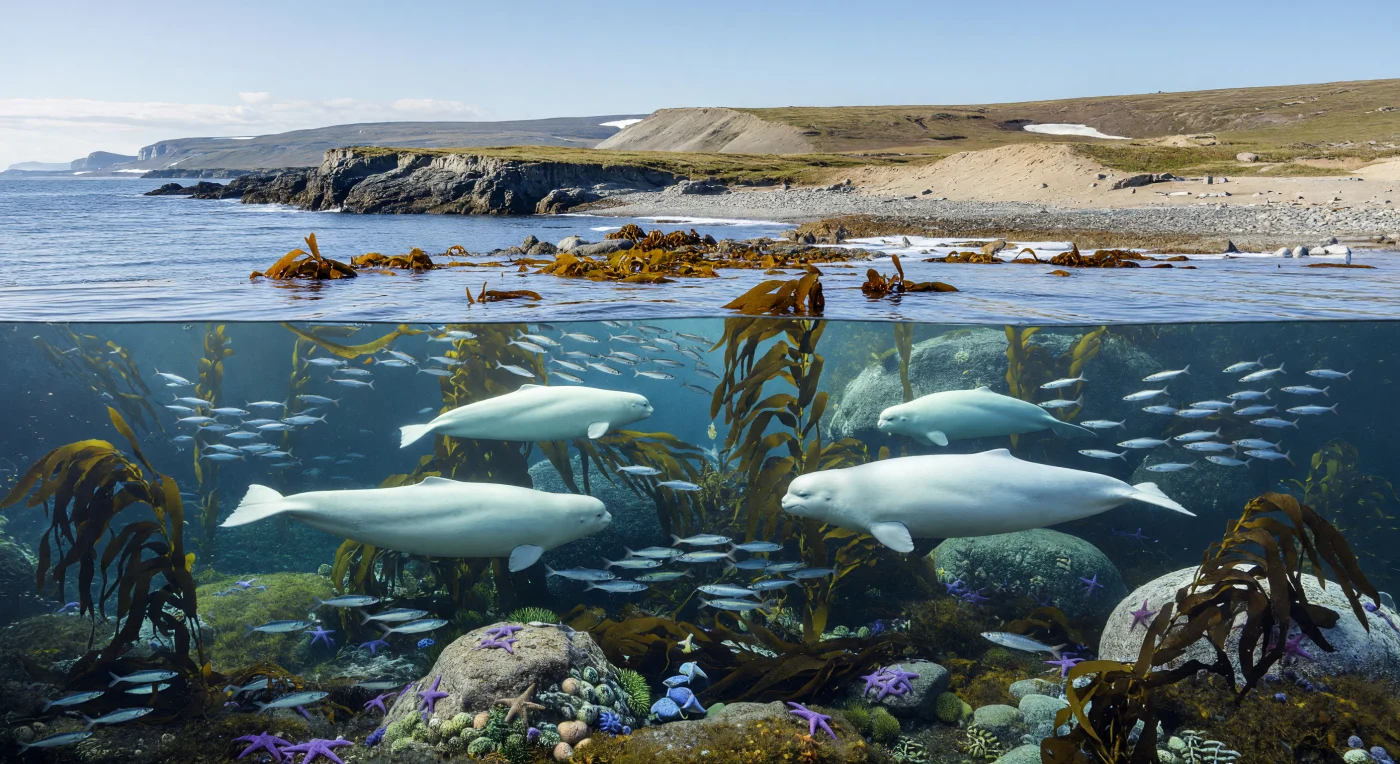
Along a cold North Pacific shore near glacial-age Beringia, white belugas (Delphinapterus leucas) glide through a shallow kelp forest of Laminaria and Alaria, weaving among schooling herring above sea stars and green sea urchins on wave-worn rocks. This scene evokes the Late Pleistocene, roughly 126,000 to 11,700 years ago, when treeless, wind-scoured mammoth-steppe landscapes reached the coast in parts of Alaska and the Beringian region. Although best known for giant land mammals, these icy margins also supported rich marine ecosystems much like subarctic kelp habitats today.

Late Pleistocene Arctic shelf waters, roughly 20,000–50,000 years ago, supported bowhead whales (Balaena mysticetus) much as they do today, skimming dense blooms of zooplankton along the edge of shorefast sea ice. In this scene, several immense bowheads—14 to 18 metres long, black-backed and blow-clouded in the frigid air—surface beside drifting ice while swarms of Calanus copepods and Thysanoessa krill concentrate beneath them in the cold, productive water. The low, treeless periglacial coast beyond places these marine giants at the icy margin of the mammoth steppe world.
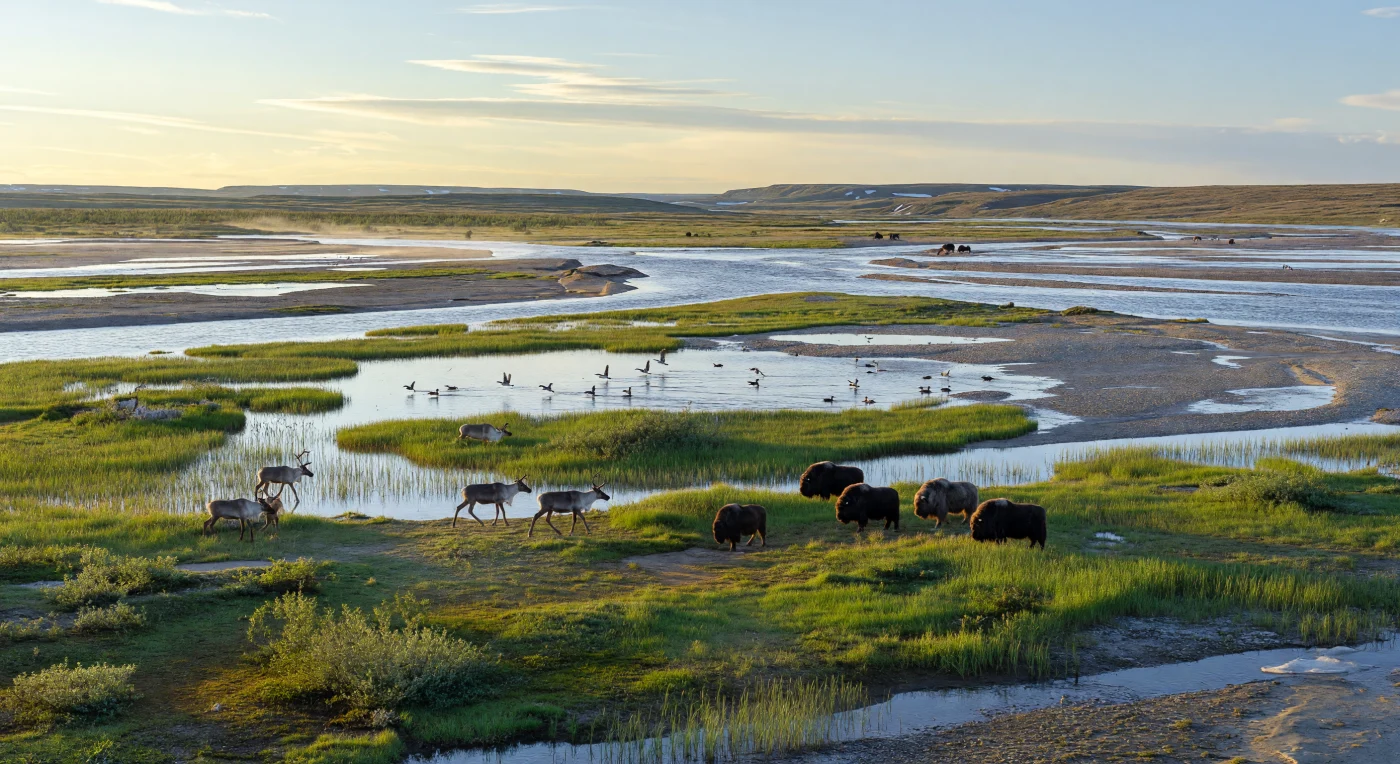
In a brief Arctic summer on the Beringian lowlands, reindeer (Rangifer tarandus) and musk oxen (Ovibos moschatus) graze among sedge-rich wetlands bordering a braided, silty meltwater river, while waterfowl rise from thaw ponds beneath the near-midnight sun. This scene represents Late Pleistocene Beringia, roughly 20,000–12,000 years ago, when Alaska, Yukon, and northeastern Siberia formed part of a vast steppe-tundra ecosystem shaped by permafrost, loess, and seasonal meltwater. Treeless but surprisingly productive in summer, these high-latitude landscapes supported cold-adapted herbivores and migratory birds across one of the Ice Age world’s great refugia.