In this reconstruction of an Early to Middle Jōmon settlement in the Japanese archipelago, families gather in an autumn clearing to process chestnuts, walnuts, and acorns beside open hearths, using stone hammerstones, grinding slabs, woven baskets, and cord-marked pottery. Around them stand semi-subterranean pit houses with thatched roofs, while dogs rest near deer-antler tools and everyday wooden implements. The scene reflects the Jōmon peoples’ sophisticated sedentary forager lifeways, in which woodland resources, pottery technology, and communal seasonal labor were central to survival long before the spread of wet-rice agriculture in Japan.
In a damp woodland clearing of Neolithic Europe, hunters armed with self bows, flint-tipped arrows, spears, and polished stone axes confront a wary aurochs bull, the powerful wild ancestor of domestic cattle. The scene captures a period when farming communities had begun to reshape parts of the landscape, yet vast forests still dominated much of the continent and dangerous game remained part of everyday experience. Details such as hide and plant-fiber clothing, stone tools, and the mixed deciduous forest setting reflect the material world of central and western Europe before metal weapons became common.
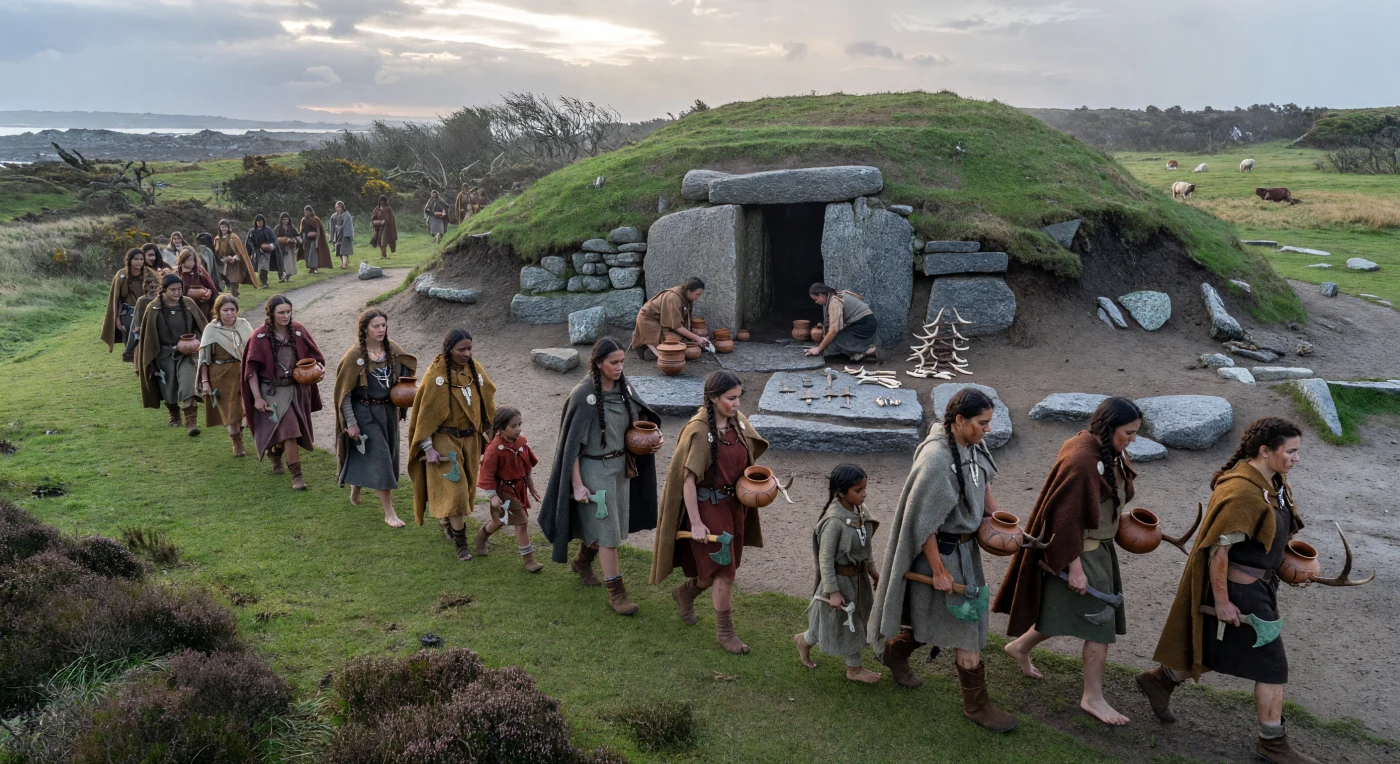
A line of villagers approaches a turf-covered passage tomb beneath a grey Atlantic sky, carrying pottery, polished stone axeheads, and antler offerings toward the narrow entrance framed by massive granite slabs. Such monuments, built in western Europe during the 4th millennium BC, were not isolated graves but enduring ceremonial places tied to ancestor veneration, communal memory, and long-distance exchange. The clothing, tools, and architecture here reflect a late Neolithic world of farming communities whose ritual life centered on earth, stone, and carefully curated offerings rather than metal or writing.
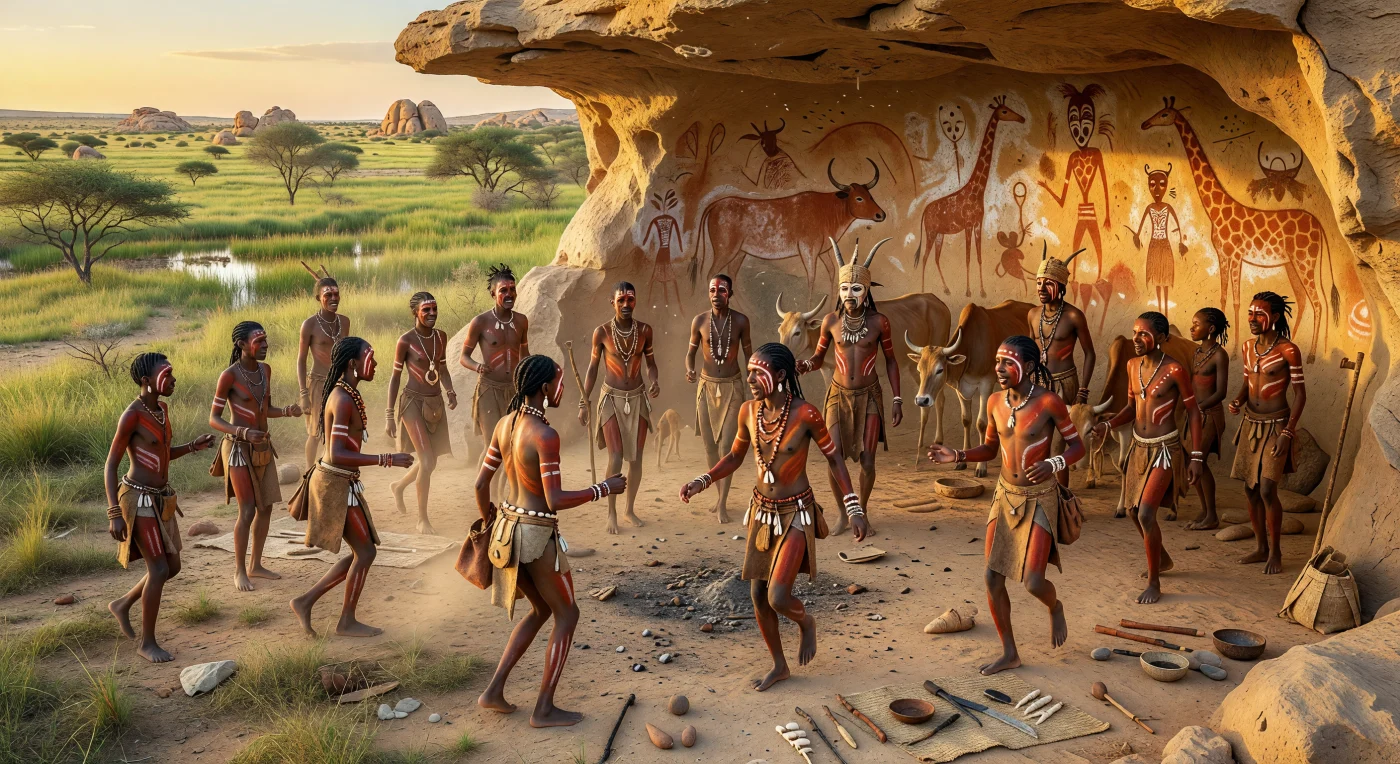
At dusk in the greener Sahara of the 5th millennium BC, herders and foragers gather before a sandstone shelter in the Tassili n’Ajjer to perform a communal dance, their bodies marked with red and white mineral pigments and adorned with ostrich-eggshell beads. Behind them, painted cattle, giraffes, and elongated ritual figures evoke the celebrated rock art of the region, created during the African Humid Period when grasslands, seasonal wetlands, and early pastoral lifeways spread across what is now desert. The scene reflects a world in which ritual, herding, and artistic expression were closely intertwined in Neolithic North Africa.
In the dry Oaxaca highlands during the Middle to Late Formative period, a small household hamlet tends garden plots of maize, squash, and gourds beside humble pole-and-thatch dwellings. Men and women work with digging sticks, metates, baskets, and obsidian blades, reflecting the intimate scale of early village life before the rise of Oaxaca’s later urban and monumental centers. The scene evokes a community rooted in household farming, local craft, and regional exchange in shell and obsidian.
On the central coast of Peru in the late 4th millennium BC, families from a preceramic maritime community gather mussels and limpets from wave-washed rocks while children carry woven baskets past reed fish traps. Sea lions, pelicans, and cormorants crowd this cold, fog-bright shoreline shaped by the Humboldt Current, where shell middens, gourds, nets, and fiber gear speak to a lifeway deeply rooted in marine harvesting. Long before the rise of Andean states and monumental architecture, coastal peoples like these sustained complex communities through fishing, shellfish collection, and early cotton-based technologies.
On a rocky promontory of the southern Levant, Neolithic villagers gather at dusk beside a freshwater spring that seeps into the sea, laying shells, fish bones, stone beads, and red ochre before a simple ring of upright stones. Such modest coastal shrines are plausible for the Pre-Pottery and early Pottery Neolithic, when communities along the eastern Mediterranean combined farming with fishing, shell collecting, and small-scale maritime exchange. The scene evokes the ritual importance of liminal places—where land, fresh water, and salt water met in daily life and belief.
A newly built passage tomb crowns a wind-beaten Atlantic headland in late Neolithic Brittany or western Ireland, where members of a small farming community approach with pottery, baskets, and other offerings as cattle graze nearby above the crashing sea. Such megalithic monuments, raised between the 4th and early 3rd millennia BC, linked ancestral ritual, emerging agricultural life, and the maritime landscapes of Europe’s western seaways. The scene reflects a world of stone architecture, plant-fiber textiles, domestic stock, and coastal exchange long before the arrival of metal tools or later Celtic culture.
Families at a Jōmon estuary sort oysters and clams on the muddy shore, working among baskets, cord-marked pottery, and towering shell middens accumulated over generations. Their bark-fiber and hide clothing, shell ornaments, pit houses, and simple wooden and stone tools reflect the lifeways of Middle-to-Late Jōmon communities in prehistoric Japan, where coastal foraging, fishing, and estuarine gathering sustained settled villages long before the spread of wet-rice agriculture.