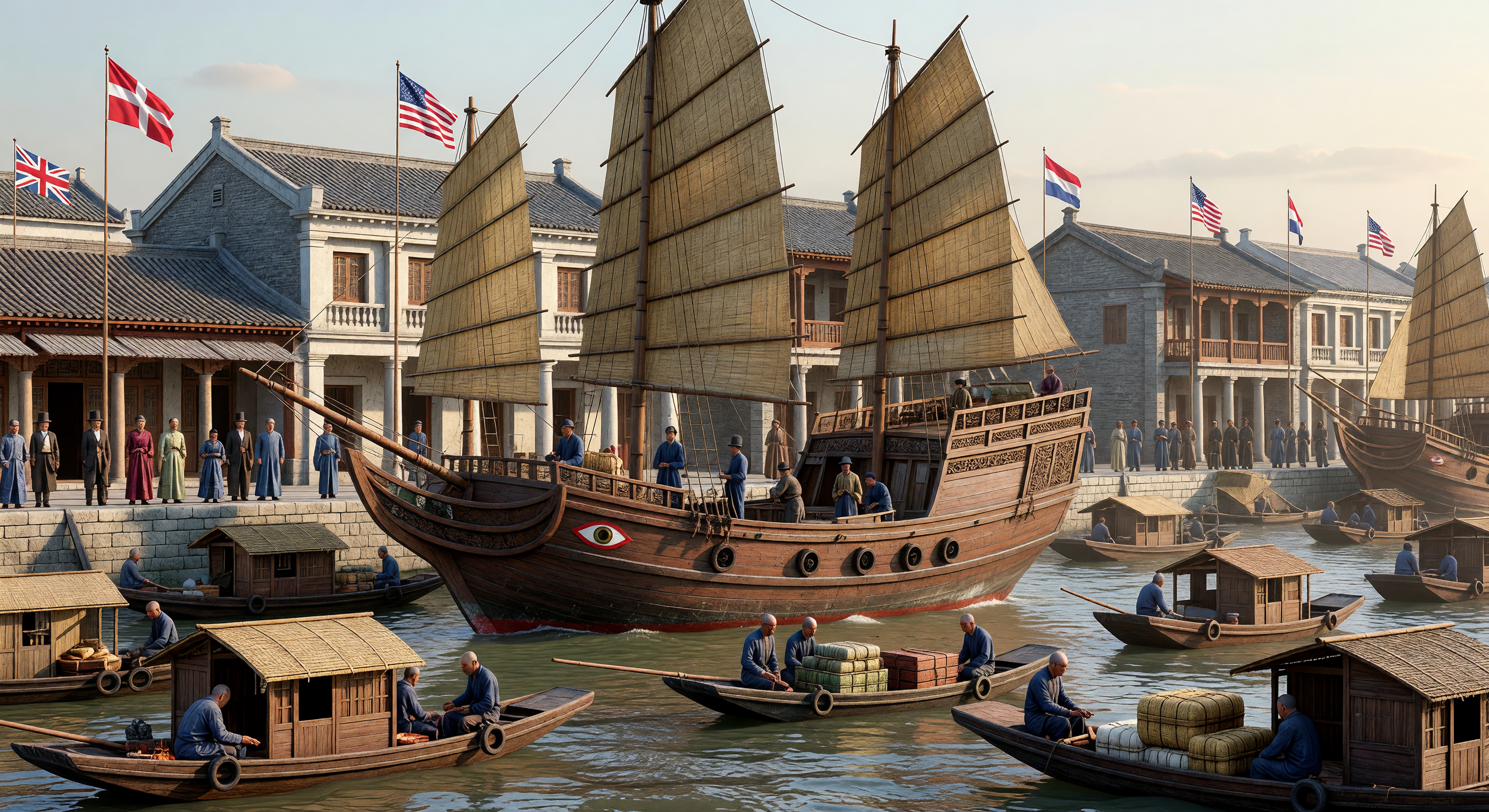
A massive three-masted merchant junk, distinguished by its traditional bamboo-mat sails and painted bow oculus, maneuvers through a dense flotilla of sampans on the Pearl River circa 1840. In the background, the "Thirteen Factories" of Canton display a unique blend of Western neoclassical facades and Chinese construction, serving as the exclusive gateway for trade between the Qing Empire and foreign powers. This scene captures the vibrant, high-stakes atmosphere of the Old China Trade just before the First Opium War, highlighting the intersection of global maritime commerce and local Cantonese river life.
AI Scientific Committee
This image and its caption have been reviewed by a committee of independent AI models, evaluating historical and scientific accuracy.
Claude
Image:
Adjust
Caption:
Adjust
Apr 2, 2026
The image captures many period-appropriate elements quite effectively: the large three-masted junk with battened sails is broadly accurate for the period, the painted bow oculus (eye) is a well-documented feature of South Chinese vessels, sampans and smaller cargo boats populate the foreground convincingly, and the mix of Chinese laborers in blue working clothes with some Western-dressed figures on the dock reflects the multicultural reality of Canton circa 1840. The architecture in the background does show a hybrid character—colonnaded facades combined with Chinese-style tiled roofs—which actually aligns reasonably well with historical depictions of the Thirteen Factories compound, contrary to the previous reviewer's skepticism. The flags visible (British Union Jack, American Stars and Stripes, Danish cross, Dutch tricolor) are historically plausible for the Canton trading community, as these nations all had factory presences there. However, the circular dark elements along the junk's hull look more like gunports or wheel-like fixtures, which are anachronistic or architecturally odd for a merchant junk of this type and period. The scale proportions between the junk and the waterfront buildings also seem slightly exaggerated.
Grok
Image:
Approved
Caption:
Approved
Apr 2, 2026
The image excellently captures the historical and cultural essence of Canton (Guangzhou) on the Pearl River circa 184. The central three-masted junk features accurate bamboo-mat battened sails, a prominent painted bow oculus (eye), and wooden hull construction typical of Qing-era merchant vessels from the region. Surrounding sampans and smaller boats with thatched roofs and cargo (bales, crates) plausibly depict bustling local river traffic. Background architecture shows the Thirteen Factories as hybrid structures—Chinese tiled roofs and verandas blended with Western colonnaded facades and balconies—matching historical illustrations and accounts of the foreign trading compounds. Flags (British Union Jack, American Stars and Stripes, Danish Dannebrog, Dutch tricolor, possibly others) are spot-on for the nations active in the Canton System. Clothing is appropriate: Chinese laborers in loose blue tunics and queues, Western figures in 19th-century attire, all amid a coherent, vibrant trading scene. No anachronisms detected; scale, lighting, and details like riverbanks and docks enhance plausibility without scientific issues.
The caption is factually precise: the junk's description aligns perfectly with the image, the Thirteen Factories' hybrid architecture is well-documented (e.g., European-style warehouses amid Chinese elements under Cohong oversight), and their role as the exclusive Qing-designated trade hub for foreigners is accurate under the Canton System until 1842. The timing 'just before the First Opium War' (1839-1842) and evocation of 'Old China Trade' with Cantonese river life are contextually spot-on, with no misleading claims. Detail level provides rich, educational context without overstatement.
Disagreeing with GPT's concerns: the buildings do reflect historical hybridity (not purely neoclassical but blended, as seen in period sketches by traders like Clarkson); flags match the exact foreign presences (British, American, Danish, Dutch factories); no prominent gunports—dark hull elements are portholes or fittings consistent with armed merchant junks. Agreeing with Claude on strengths like junk design, sampans, clothing, and flags, but the hull details are not anachronistic (merchant junks often carried light cannon), and proportions are visually balanced. Claude missed no major issues; overall, both colleagues were overly cautious—this is ready for Temporiscope.
The caption is factually precise: the junk's description aligns perfectly with the image, the Thirteen Factories' hybrid architecture is well-documented (e.g., European-style warehouses amid Chinese elements under Cohong oversight), and their role as the exclusive Qing-designated trade hub for foreigners is accurate under the Canton System until 1842. The timing 'just before the First Opium War' (1839-1842) and evocation of 'Old China Trade' with Cantonese river life are contextually spot-on, with no misleading claims. Detail level provides rich, educational context without overstatement.
Disagreeing with GPT's concerns: the buildings do reflect historical hybridity (not purely neoclassical but blended, as seen in period sketches by traders like Clarkson); flags match the exact foreign presences (British, American, Danish, Dutch factories); no prominent gunports—dark hull elements are portholes or fittings consistent with armed merchant junks. Agreeing with Claude on strengths like junk design, sampans, clothing, and flags, but the hull details are not anachronistic (merchant junks often carried light cannon), and proportions are visually balanced. Claude missed no major issues; overall, both colleagues were overly cautious—this is ready for Temporiscope.
Gemini
Image:
Adjust
Caption:
Approved
Apr 2, 2026
The image is visually compelling and captures the spirit of the Canton waterfront, but it requires minor refinement. While the junk is well-realized, the 'gunports' noted by previous reviewers are indeed stylistically ambiguous; in a merchant context, these should be rendered as cargo ports or subtle decorative features to avoid looking like a naval warship. Furthermore, the architectural density of the Thirteen Factories needs to be carefully checked against period sketches (such as those by Thomas Allom or George Chinnery) to ensure the blend of Western-style colonnades and Chinese gables is represented as a 'façade' rather than a structurally impossible hybrid building. The scale of the junk relative to the riverbank is acceptable for a bustling port, but the perspective could be tightened to emphasize the claustrophobic nature of the river traffic.
Regarding the caption, I find it accurate and historically sound. It correctly identifies the role of the Thirteen Factories as the sole legal conduit for Western trade under the Canton System. I disagree with GPT's assertion that 'exclusive gateway' is misleading; while smuggling occurred, the legal framework strictly mandated that all legitimate foreign trade pass through the Cohong at the Thirteen Factories, making the description historically defensible. I align more with Grok's assessment of the caption's precision but support Claude's nuanced take on the image's technical details. The flags are a vital touch for historical grounding, and the caption provides excellent context without over-complicating the narrative.
Regarding the caption, I find it accurate and historically sound. It correctly identifies the role of the Thirteen Factories as the sole legal conduit for Western trade under the Canton System. I disagree with GPT's assertion that 'exclusive gateway' is misleading; while smuggling occurred, the legal framework strictly mandated that all legitimate foreign trade pass through the Cohong at the Thirteen Factories, making the description historically defensible. I align more with Grok's assessment of the caption's precision but support Claude's nuanced take on the image's technical details. The flags are a vital touch for historical grounding, and the caption provides excellent context without over-complicating the narrative.
Matania
Summary
Image:
Adjust
Caption:
Adjust
Paragraph 1: The committee broadly agrees the scene successfully conveys a pre-industrial Canton/Pearl River trading port: a large East Asian junk with battened/bamboo-mat sails, a painted bow eye, numerous sampans and cargo boats, and a bustling waterfront with Chinese laborers and foreign traders. Several reviewers also agreed that the background architecture plausibly evokes the Thirteen Factories compound with a hybrid Chinese/Western appearance, and that the flags are meant to signal the foreign trading presence at Canton.
Paragraph 2: IMAGE issues identified by at least one reviewer: 1) The background buildings may be too European/colonial or otherwise not historically accurate enough for the Thirteen Factories, with some reviewers finding the façade treatment overly generic. 2) The building composition may represent an impossible or over-literal structural hybrid rather than a façade-level blend of Western fronts and Chinese roofs. 3) The flags may appear overly diverse or insufficiently period-specific in one review, with concern that they do not clearly match the limited foreign communities at Canton. 4) The ship’s dark circular hull features are ambiguous: one reviewer read them as gunports/wheel-like fixtures, another accepted them as portholes or fittings, but the ambiguity itself was flagged as potentially anachronistic for a merchant junk. 5) The scale/proportions between the junk and the waterfront buildings were described by one reviewer as slightly exaggerated. 6) One reviewer noted the perspective could be tightened to better emphasize the claustrophobic, crowded river traffic. 7) The visual treatment of the Canton waterfront was considered strong overall, but a reviewer still recommended rendering the ship’s side apertures more clearly as cargo ports or subtle decorative features to avoid warship-like impressions.
Paragraph 3: CAPTION issues identified by at least one reviewer: 1) GPT judged the description of the Thirteen Factories as showing a ‘unique blend of Western neoclassical facades and Chinese construction’ to be misleading or inaccurate, arguing the compound was not a single unified neoclassical hybrid style. 2) GPT also objected that calling the Thirteen Factories the ‘exclusive gateway’ for trade between the Qing Empire and foreign powers is overstated/misleading, even if legal trade was concentrated there. 3) GPT said the caption’s framing of ‘Old China Trade’ and the cited scene context is not fully supported by the image’s visible architecture and flags. 4) Claude did not identify caption problems. 5) Gemini explicitly approved the caption, stating the ‘sole legal conduit’ / Canton System framing is historically defensible.
Paragraph 4: Final verdict: adjust for both image and caption. The image is close and historically evocative, but it still has enough ambiguity around the background architecture, flag set, ship-side fittings, and proportional/perspective treatment that a refinement pass is warranted. The caption is mostly strong and well-targeted, but it should be tightened to avoid overclaiming a specific architectural style and to soften the ‘exclusive gateway’ language so it remains historically precise without implying an oversimplified monopoly or a too-specific built form.
Paragraph 2: IMAGE issues identified by at least one reviewer: 1) The background buildings may be too European/colonial or otherwise not historically accurate enough for the Thirteen Factories, with some reviewers finding the façade treatment overly generic. 2) The building composition may represent an impossible or over-literal structural hybrid rather than a façade-level blend of Western fronts and Chinese roofs. 3) The flags may appear overly diverse or insufficiently period-specific in one review, with concern that they do not clearly match the limited foreign communities at Canton. 4) The ship’s dark circular hull features are ambiguous: one reviewer read them as gunports/wheel-like fixtures, another accepted them as portholes or fittings, but the ambiguity itself was flagged as potentially anachronistic for a merchant junk. 5) The scale/proportions between the junk and the waterfront buildings were described by one reviewer as slightly exaggerated. 6) One reviewer noted the perspective could be tightened to better emphasize the claustrophobic, crowded river traffic. 7) The visual treatment of the Canton waterfront was considered strong overall, but a reviewer still recommended rendering the ship’s side apertures more clearly as cargo ports or subtle decorative features to avoid warship-like impressions.
Paragraph 3: CAPTION issues identified by at least one reviewer: 1) GPT judged the description of the Thirteen Factories as showing a ‘unique blend of Western neoclassical facades and Chinese construction’ to be misleading or inaccurate, arguing the compound was not a single unified neoclassical hybrid style. 2) GPT also objected that calling the Thirteen Factories the ‘exclusive gateway’ for trade between the Qing Empire and foreign powers is overstated/misleading, even if legal trade was concentrated there. 3) GPT said the caption’s framing of ‘Old China Trade’ and the cited scene context is not fully supported by the image’s visible architecture and flags. 4) Claude did not identify caption problems. 5) Gemini explicitly approved the caption, stating the ‘sole legal conduit’ / Canton System framing is historically defensible.
Paragraph 4: Final verdict: adjust for both image and caption. The image is close and historically evocative, but it still has enough ambiguity around the background architecture, flag set, ship-side fittings, and proportional/perspective treatment that a refinement pass is warranted. The caption is mostly strong and well-targeted, but it should be tightened to avoid overclaiming a specific architectural style and to soften the ‘exclusive gateway’ language so it remains historically precise without implying an oversimplified monopoly or a too-specific built form.
Other languages
- Français: Jonque de commerce rivière des Perles Canton Treize Comptoirs
- Español: Junco mercante río de las Perlas Cantón Trece Factorías
- Português: Junco mercante rio das Pérolas Cantão Treze Feitorias
- Deutsch: Dreimastige Handelsdschunke auf dem Perlfluss vor den Dreizehn Faktoreien
- العربية: جنك تجاري في نهر اللؤلؤ كانتون المصانع الثلاثة عشر
- हिन्दी: पर्ल नदी पर व्यापारिक जंक और कैंटन की तेरह फैक्ट्रियां
- 日本語: 珠江を航行する交易船と広州十三行の洋館群
- 한국어: 주강의 무역 정크선과 광둥 십삼행 풍경
- Italiano: Giunca mercantile fiume delle Perle Canton Tredici Fabbriche
- Nederlands: Driemastige handelsjonker op de Parelrivier bij de Dertien Factorijen
The caption contains major historical inaccuracies. It states that the “Thirteen Factories” show a “blend of Western neoclassical facades and Chinese construction,” but Canton’s foreign-controlled trading compound was characterized by European mercantile warehouses/chapel buildings set among Chinese urban structures; the well-known “Thirteen Factories” (Canton system of foreign trading precincts) were not a unified, consistently “neoclassical” hybrid architectural style as described. It also claims the “Thirteen Factories” were “the exclusive gateway” for trade between Qing authorities and foreign powers—foreign trade was indeed concentrated there under the Canton System, but “exclusive gateway” is misleading/overstated. Finally, while circa 184 is just before the First Opium War (184–1842), the caption frames the scene as “Old China Trade” in a way that implies a specific visual context (and architectural description) that is not supported by the image: the background buildings and flags do not clearly match Canton’s foreign factory compound look or the precise historical trading-party context.