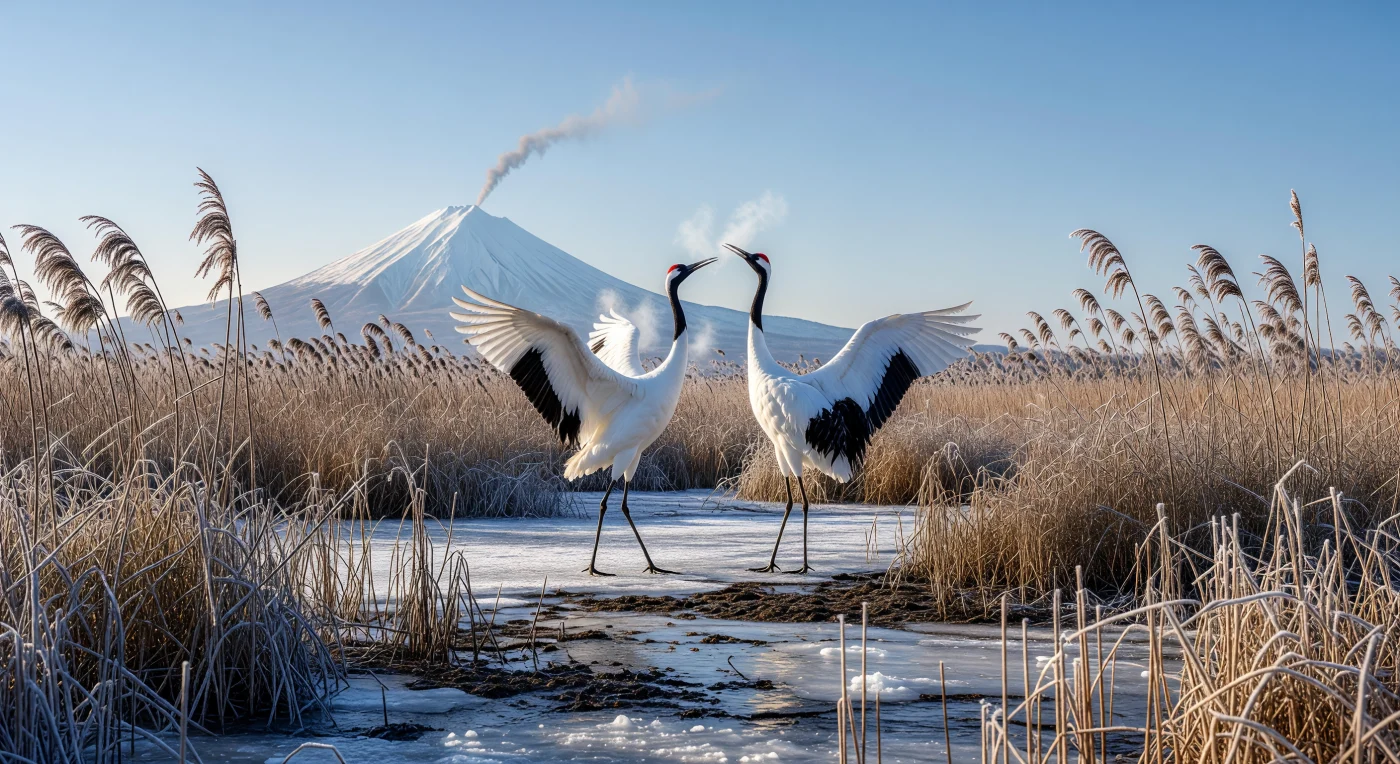
A pair of red-crowned cranes performs a ritual mating dance across the frozen Kushiro marshes of Hokkaido, then known as Ezo, during the mid-19th century. To the indigenous Ainu people, these birds were revered as *Sarurun Kamuy*, or the "God of the Marsh," inhabiting a landscape defined by volcanic activity and extreme sub-arctic winters. This scene captures the pristine wilderness of Japan’s northern frontier in 1850, just years before the Meiji Restoration would bring rapid industrialization and settlement to the region.

This scene captures the vibrant social atmosphere of a mid-19th-century teahouse in Canton (Guangzhou) during the late Qing Dynasty. Han Chinese patrons, identifiable by their mandated queues and indigo-dyed cotton changshans, engage in conversation amidst the distinct Lingnan-style architecture and the aroma of fermented puerh tea. These teahouses were the heart of Cantonese public life, serving as essential spaces for community, commerce, and the enduring traditions of dim sum and songbird appreciation.

A massive three-masted merchant junk, distinguished by its traditional bamboo-mat sails and painted bow oculus, maneuvers through a dense flotilla of sampans on the Pearl River circa 1840. In the background, the "Thirteen Factories" of Canton display a unique blend of Western neoclassical facades and Chinese construction, serving as the exclusive gateway for trade between the Qing Empire and foreign powers. This scene captures the vibrant, high-stakes atmosphere of the Old China Trade just before the First Opium War, highlighting the intersection of global maritime commerce and local Cantonese river life.

Two samurai, distinguished by their traditional chonmage hairstyles and the daisho—a matched pair of swords signifying their social rank—patrol the Nihonbashi district of Edo during the mid-19th century. They navigate a street lined with dark-timbered machiya townhouses and shops adorned with indigo-dyed noren curtains, illustrating the sophisticated urban architecture of the Bakumatsu period. This scene captures the final years of the Tokugawa Shogunate, a transitional era where centuries of feudal tradition began to meet the encroaching pressures of internal unrest and foreign influence.

In the fertile Red River Delta, Kinh peasants are depicted during the seasonal rice harvest, dressed in traditional brown hemp tunics and conical "nón lá" hats. This scene illustrates the agricultural foundations of the 19th-century Nguyen Dynasty, where the rhythmic cycle of wet-rice cultivation relied on manual labor and the essential assistance of water buffalo. The use of hand-forged iron sickles and natural dyes like *củ nâu* highlights the self-sufficient, pre-industrial technologies that characterized Vietnamese rural life during this era.

This scene depicts members of the Korean yangban elite performing a solemn ancestral ritual (Jesa) within the granite courtyard of a private Seoul residence during the mid-19th century. Dressed in translucent white ramie overcoats and traditional horsehair hats (gat), the officials observe the strict Neo-Confucian protocols that governed the social and spiritual hierarchy of the Joseon Kingdom. The meticulous arrangement of brass offering bowls and the vibrant dancheong patterns on the family shrine highlight the era's profound emphasis on filial piety and ancestral veneration.

A traditional Qing Dynasty war junk, distinguished by its painted oculus and battened lug sails, engages a British iron-hulled paddle steamer amidst the sulfurous smoke of the Humen Strait. This scene captures the stark technological disparity of the First Opium War (1839–1842), where the British East India Company’s steam-powered vessels, such as the HMS Nemesis, successfully bypassed the traditional coastal defenses of the Pearl River Delta. While the Chinese crew operates within a centuries-old maritime framework, the presence of coal smoke and iron hulls signals the forceful arrival of the Industrial Revolution and the shifting global balance of power in 19th-century East Asia.

In a sun-drenched workshop in Suzhou, Han Chinese weavers operate massive wooden drawlooms, known as *hualou*, to produce the intricate floral damasks that defined the mid-Qing Dynasty’s luxury trade. During the 1840s, Suzhou remained the epicenter of global silk production, where traditional Jiangnan architecture provided the humid, stable environment necessary to prevent delicate silk threads from snapping. The scene captures the disciplined labor of female artisans who, dressed in practical indigo-dyed tunics, blended centuries-old techniques with the sophisticated artistic demands of both the Imperial court and burgeoning international markets.