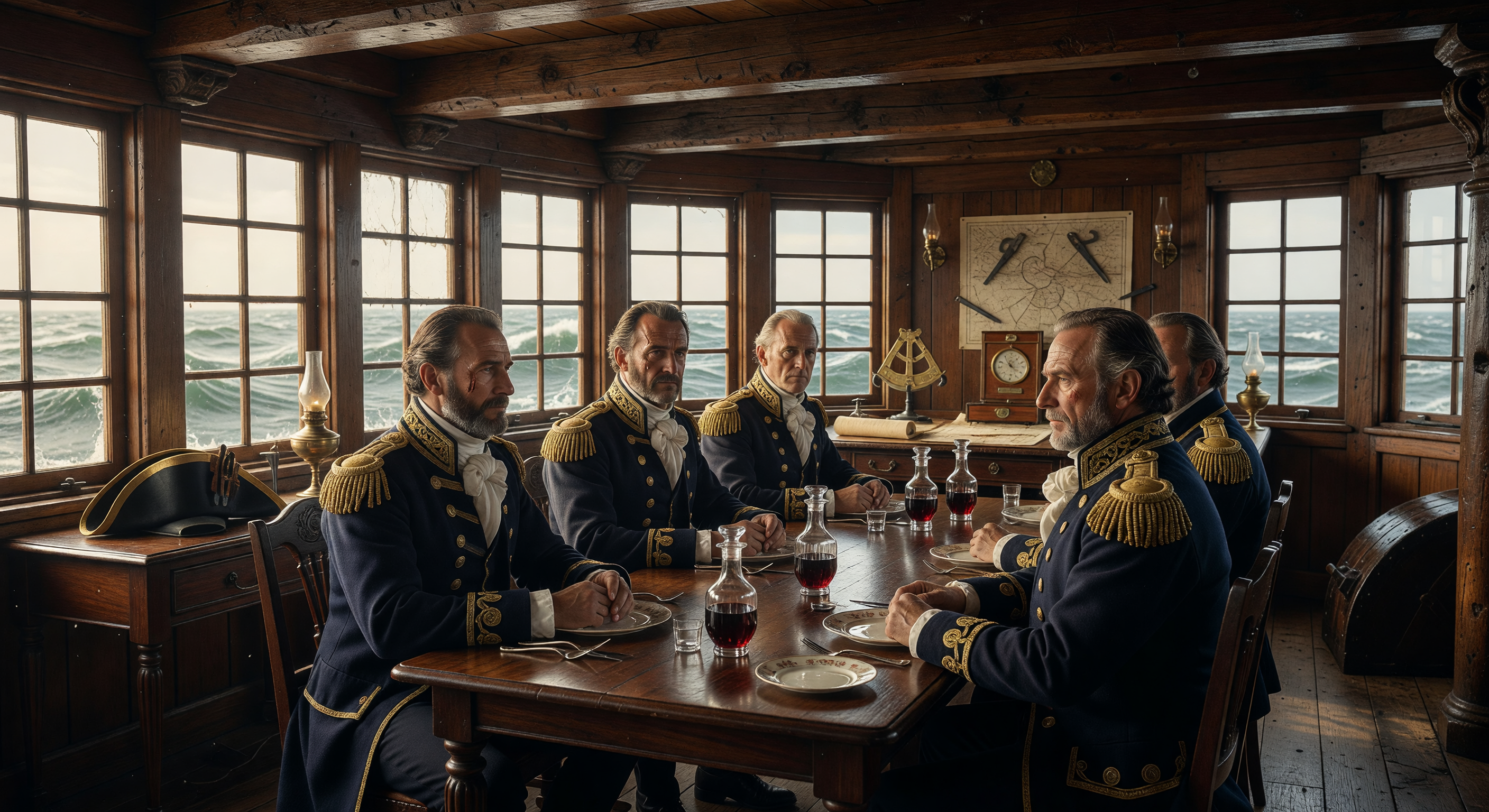
High-ranking British naval officers convene for a formal meal within the opulent stern cabin of a first-rate ship of the line during the Napoleonic Wars, circa 1805. The scene illustrates the stark social hierarchy of the Royal Navy, where command staff dined amidst mahogany furniture and fine bone china while surrounded by the vital tools of global navigation, including brass sextants and marine chronometers. Through the iconic multi-paned gallery windows, the churning North Atlantic serves as a constant reminder of the maritime struggle for imperial dominance that defined the Age of Revolutions.
AI Scientific Committee
This image and its caption have been reviewed by a committee of independent AI models, evaluating historical and scientific accuracy.
Claude
Image:
Adjust
Caption:
Adjust
Apr 2, 2026
The image captures a broadly convincing Napoleonic-era naval setting with wooden beamed ceilings, multi-paned gallery windows, choppy seas visible outside, and officers in dark blue coats with gold epaulettes and white cravats. A sextant-like instrument, a clock/chronometer box, a rolled chart, and dividers/parallel rulers are visible on a side table, which partially validates the caption's navigation claims. However, several issues warrant adjustment rather than approval. The windows appear as flat rectangular panes rather than the characteristic curved, arched, or more elaborate gallery window arrangement typical of a first-rate ship's stern cabin. The lamp visible is a kerosene/oil lamp of a style more consistent with mid-to-late 19th century than 1805, when candle lanterns or earlier whale-oil lamps would be expected. The uniform detailing, particularly the epaulette fringe style, looks slightly too ornate and later in period, trending toward mid-Victorian naval aesthetics.
Grok
Image:
Adjust
Caption:
Adjust
Apr 2, 2026
The image effectively captures the ambiance of a Napoleonic-era ship cabin with wooden beamed ceilings, heavy furniture, a table set with period-appropriate plates and wine glasses, and a stormy North Atlantic visible through multi-paned stern gallery windows, evoking the maritime peril of 1805. Officers wear dark blue tailcoats with white facings, cravats, and epaulettes, which align with Royal Navy uniforms for flag officers or captains during the period. Navigation tools are present: a brass sextant and telescope mounted on the wall, a boxed marine chronometer on a side table, charts, and dividers, supporting the caption's claims. The overall visual coherence is strong, with plausible lighting from a wall-mounted oil lamp and no glaring anachronisms in architecture or landscape.
However, minor inaccuracies suggest adjustments: the epaulettes appear overly fringed and prominent, leaning toward early 19th-century admiralty styles but with a slightly modernized, cinematic flourish (e.g., from films like Master and Commander). The stern windows are rectangular and flat rather than the gently curved or arched glazing bars typical of a first-rate ship's great cabin (e.g., HMS Victory). The lamp resembles a later argand or kerosene style more than 1805 whale-oil lanterns with glass chimneys. Tableware is fine but lacks specificity for bone china. These are refinable via prompt tweaks for greater precision.
The caption is factually sound on the setting (first-rate ship of the line, 1805 Napoleonic Wars, stern cabin hierarchy), with accurate nods to mahogany fittings (common in captain's cabins), bone china (produced since 179s, used by elites), and instruments like sextants (ubiquitous) and chronometers (e.g., Arnold or Earnshaw models aboard flagships). 'North Atlantic' fits the choppy seas and imperial context. No misleading claims, but 'opulent' slightly overstates standard fittings, and instrument specificity matches the image only partially (clear sextant and chronometer visible). Appropriate detail level. I partially agree with GPT's ambiguity on instruments (they're identifiable here) and bone china plausibility but disagree on uniform 'modernization' severity. Align with Claude on windows, lamp, and epaulettes; he missed the clear chronometer box. No major misses—both correctly flag 'adjust' for polish.
However, minor inaccuracies suggest adjustments: the epaulettes appear overly fringed and prominent, leaning toward early 19th-century admiralty styles but with a slightly modernized, cinematic flourish (e.g., from films like Master and Commander). The stern windows are rectangular and flat rather than the gently curved or arched glazing bars typical of a first-rate ship's great cabin (e.g., HMS Victory). The lamp resembles a later argand or kerosene style more than 1805 whale-oil lanterns with glass chimneys. Tableware is fine but lacks specificity for bone china. These are refinable via prompt tweaks for greater precision.
The caption is factually sound on the setting (first-rate ship of the line, 1805 Napoleonic Wars, stern cabin hierarchy), with accurate nods to mahogany fittings (common in captain's cabins), bone china (produced since 179s, used by elites), and instruments like sextants (ubiquitous) and chronometers (e.g., Arnold or Earnshaw models aboard flagships). 'North Atlantic' fits the choppy seas and imperial context. No misleading claims, but 'opulent' slightly overstates standard fittings, and instrument specificity matches the image only partially (clear sextant and chronometer visible). Appropriate detail level. I partially agree with GPT's ambiguity on instruments (they're identifiable here) and bone china plausibility but disagree on uniform 'modernization' severity. Align with Claude on windows, lamp, and epaulettes; he missed the clear chronometer box. No major misses—both correctly flag 'adjust' for polish.
Gemini
Image:
Adjust
Caption:
Adjust
Apr 2, 2026
The image is a strong atmospheric representation, but as noted by my colleagues, it suffers from a 'cinematic' drift toward mid-Victorian aesthetics. I agree with Claude and Grok that the stern gallery windows require a more authentic, slightly arched, or curved arrangement typical of 1805 naval architecture; the current flat, rectangular layout feels too modern. The lighting fixture remains the most significant technical distraction, as it resembles a kerosene lamp that would not appear for several decades. While the uniforms are generally evocative, the epaulette fringe density should be restrained to match the specific 1795-1812 Royal Navy regulations rather than mid-century styles.
Regarding the caption, I agree with the consensus that it is largely accurate but slightly prone to hyperbole regarding the 'opulence' of the cabin. While a Captain's great cabin was indeed the most luxurious space on a ship, the term 'opulent' implies a level of comfort that belies the reality of a warship in the North Atlantic. I suggest softening the language to 'functionally elegant' or 'refined' to better reflect the naval context. I disagree with GPT's skepticism regarding bone china; it was well-established by 1805 and certainly utilized by high-ranking officers who often brought private dinner sets on long commissions. The caption should simply be tightened to better align with the visual corrections requested for the window and lamp architecture.
Regarding the caption, I agree with the consensus that it is largely accurate but slightly prone to hyperbole regarding the 'opulence' of the cabin. While a Captain's great cabin was indeed the most luxurious space on a ship, the term 'opulent' implies a level of comfort that belies the reality of a warship in the North Atlantic. I suggest softening the language to 'functionally elegant' or 'refined' to better reflect the naval context. I disagree with GPT's skepticism regarding bone china; it was well-established by 1805 and certainly utilized by high-ranking officers who often brought private dinner sets on long commissions. The caption should simply be tightened to better align with the visual corrections requested for the window and lamp architecture.
Matania
Summary
Image:
Adjust
Caption:
Adjust
Paragraph 1: The committee broadly agrees that the scene convincingly evokes a Royal Navy interior aboard a wooden warship: the stern-cabin-like setting, multi-paned windows, choppy sea outside, dark blue officer uniforms with gold trim/epaulettes, nautical instruments on the wall/table, and the general sense of formal naval dining are all aligned with the intended Napoleonic-era atmosphere. Paragraph 2: IMAGE issues identified by the committee include: the stern/galleries windows are too flat, rectangular, and modern-looking rather than the more authentic curved/arched or otherwise period-appropriate great-cabin glazing; the wall lamp is anachronistic, reading as a later kerosene/argand-style lamp instead of an 1805-appropriate candle lantern or earlier whale-oil lamp; the uniform epaulette fringe appears overly dense, ornate, and slightly mid-Victorian/cinematic rather than matching the stricter 1795–1812 Royal Navy style; the uniform fit/detailing may be slightly too decorative/modernized in a cinematic way; the tableware/glassware presentation feels somewhat cinematic and not clearly period-specific; the navigation objects are present but not fully specific enough in the image to confirm each one as a sextant and marine chronometer with certainty; the clock-like object may not clearly read as a marine chronometer; and the overall styling drifts a bit toward later-19th-century naval aesthetics. Paragraph 3: CAPTION issues identified by the committee include: “opulent” may overstate the likely level of comfort/furnishings in a ship’s great cabin and should be softened; the claim of “mahogany furniture” is plausible but not directly evidenced by the image; “fine bone china” is plausible in principle, but the image does not clearly prove it and the phrasing is more specific than the visual support; the claim that brass sextants and marine chronometers are present is somewhat stronger than the visual evidence supports, since the image shows navigation instruments and a clock-like box but not unequivocal identification of both objects; “North Atlantic” cannot be verified from the image alone and is inferential; and the overall caption slightly overstates the certainty of some material details relative to what is clearly visible. Paragraph 4: Final verdict: adjust for both image and caption. The image is close and historically suggestive, but several elements need period-accuracy refinement, especially the windows, lighting, and uniform styling. The caption is broadly accurate but should be tightened to avoid overstating unverified specifics and to better match what the image can clearly support.
Other languages
- Français: Officiers de la Royal Navy dînant dans la cabine arrière
- Español: Oficiales navales británicos cenando en la cámara de popa
- Português: Oficiais navais britânicos jantando na cabine de popa
- Deutsch: Britische Seeoffiziere beim Abendessen in der Heckkajüte, 1805
- العربية: ضباط البحرية البريطانية يتناولون الطعام في مقصورة السفينة الخلفية
- हिन्दी: १८०५ में ब्रिटिश नौसेना अधिकारियों का जहाज के केबिन में भोजन
- 日本語: 1805年、戦列艦の後部キャビンで食事をする英国海軍士官
- 한국어: 1805년 전열함 선미 객실에서 식사하는 영국 해군 장교들
- Italiano: Ufficiali della Royal Navy a cena nella cabina di poppa
- Nederlands: Britse marineofficieren dineren in de achterkajuit van een linieschip
Technological/nautical objects in the background show a chart pinned to the wall and a large brass instrument stand with components that resemble navigation/astronomy tools, but the image is not specific enough to confirm accurate placement (e.g., whether the items are truly a sextant and marine chronometer rather than generic “naval instruments”). There is also a clock visible, but without clear evidence it is a shipboard marine chronometer. Because these are key claims in the caption, the visual evidence is slightly ambiguous.
For the caption: the broader framing (British naval officers dining aboard a first-rate ship of the line during the Napoleonic Wars, ~1805) is plausible. The mention of “opulent stern cabin” and “mahogany furniture and fine bone china” is likely anachronistic or at least overstated—bone china was present in Britain by this time, but its use by naval officers at sea is not guaranteed, and “mahogany” is plausible for quality fittings yet not directly evidenced. The claim about “brass sextants and marine chronometers” is the biggest issue: the image suggests navigation instruments, but not with enough specificity to verify sextants and chronometers accurately. Also, “North Atlantic” is reasonable given the choppy grey sea, but the scene cannot truly be geolocated from the window view alone.