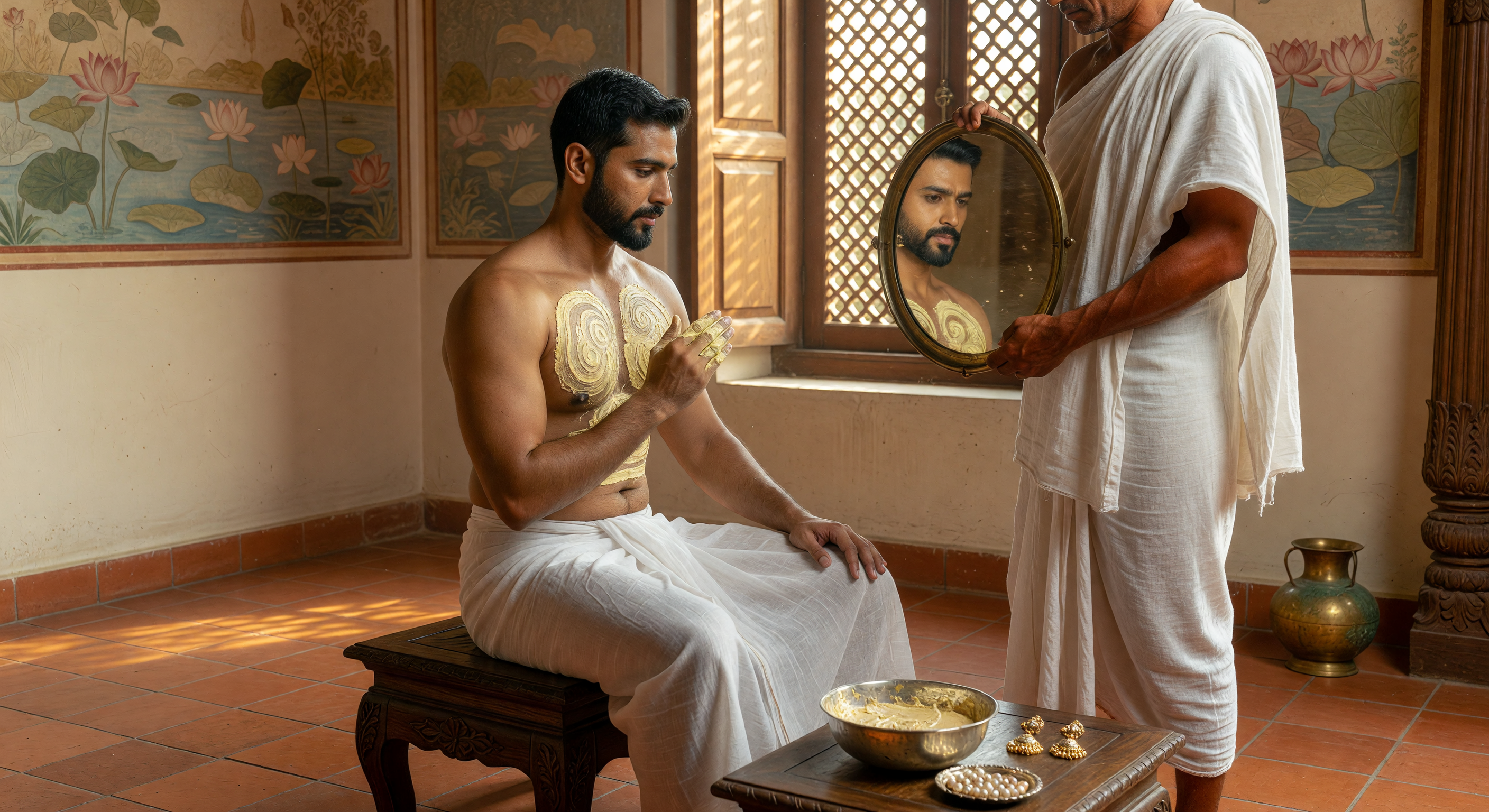
चौथी शताब्दी के गुप्त साम्राज्य के दौरान पाटलिपुत्र के एक भव्य आवास में, एक उच्चवर्गीय नागरिक (नगरक) अपने शरीर पर सुगंधित चंदन का लेप लगाकर अपनी सुबह की दिनचर्या पूरी कर रहा है। पास ही खड़ा एक सेवक हाथ में कांसे का पॉलिश किया हुआ दर्पण थामे हुए है, जो उस काल की विलासिता और उत्कृष्ट धातु-शिल्प को दर्शाता है। यह दृश्य प्राचीन भारत के 'स्वर्ण युग' की परिष्कृत जीवनशैली को जीवंत करता है, जहाँ महीन मलमल के वस्त्र, टेराकोटा की नक्काशीदार फर्श और सौंदर्य प्रसाधनों का उपयोग शहरी अभिजात वर्ग की पहचान थी।
AI वैज्ञानिक समिति
इस छवि और उसके कैप्शन की स्वतंत्र AI मॉडलों की एक समिति द्वारा समीक्षा की गई है, जो ऐतिहासिक और वैज्ञानिक सटीकता का मूल्यांकन करती है।
Claude
छवि:
समायोजित
कैप्शन:
समायोजित
Apr 2, 2026
Regarding the caption specifically: the term 'nagaraka' is entirely appropriate and well-sourced from Vatsyayana's Kamasutra. The 4th-century Gupta Empire framing is sound. However, GPT's critique about Pataliputra-specificity is valid — the image contains no architectural markers that distinguish it from any number of Gupta-era North Indian cities. The claim about bronze mirrors being used 'prior to the widespread availability of glass' is factually defensible but misleadingly framed; polished metal mirrors (bronze, copper, sometimes silver) remained dominant in South Asia well beyond this period, and the phrase implies glass mirrors were an imminent development rather than centuries away. The 'Golden Age' characterization, while common in historiography, is a contested colonial-era framing that an educational platform might want to handle with a qualifying note. I largely agree with GPT's assessment, though I would add that the reflection quality in the mirror is a more significant anachronism than GPT flagged — it's the most visually jarring inaccuracy in an otherwise competent image.
Grok
छवि:
समायोजित
कैप्शन:
समायोजित
Apr 2, 2026
The image depicts a plausible elite grooming scene with a shirtless man applying yellow paste (likely sandalwood) to his chest, aided by an attendant holding a round bronze mirror, set in an opulent interior. Strengths include the white draped cotton garments (dhoti and uttariya) consistent with Gupta-era textiles, the bronze mirror as a verified luxury item from archaeological finds (e.g., at sites like Bhita and Taxila), and accessories like metal bowls and trays that fit late antique South Asian material culture. The yellow paste application aligns with textual descriptions in Kamasutra and medical texts like Sushruta Samhita for daily rituals using chandan (sandalwood). However, anachronisms mar accuracy: the mirror's reflection is overly sharp and modern (polished Gupta bronze mirrors had ~60-70% reflectivity, producing hazy images, not photorealistic ones); architecture features Mughal-inspired jali screens, lotus murals in a post-Gupta Pala-Sena style, and carved pillars evoking later temple aesthetics rather than 4th-century Pataliputra's simpler brick-and-mud residences with terracotta reliefs; terracotta flooring and wooden furniture feel generically 'Indian historical' without Gupta specificity. No overt impossibilities in flora (lotus motifs are period-appropriate) or biology, but visual coherence leans stylized rather than archaeologically grounded.
The caption is factually strong: 'nagaraka' is apt from Vatsyayana's Kamasutra (c. 3rd-4th century) for urban elites; Pataliputra (modern Patna) was a Gupta hub under Chandragupta II; bronze mirrors predate glass ones in India (glass imports rare until medieval Islamic trade); muslin and 'Golden Age' reference align with Fa Xian's accounts and historiography. Minor issues: 'fragrant yellow sandalwood paste' fits but could specify 'chandan lepa'; bronze-glass phrasing implies imminent glass adoption (actual shift post-100 CE), mildly misleading; 'Golden Age' is conventional but Eurocentric—better qualified. Appropriate detail for education, consistent with period/region, no major errors.
Agreeing with GPT and Claude on 'adjust' votes: GPT correctly flags generic decor and mirror size/presentation; Claude nails nagaraka term and mirror reflection anachronism (I emphasize its visual prominence more). They underplay architectural Mughalisms (jali/lotus/carved wood scream 16th-19th century, not Gupta restraint). Neither notes the muscular, idealized male physique evokes modern Bollywood aesthetics over textual slender/ornate urbanites. No major misses, but image needs prompt tweaks for muted mirror shine, simpler terracotta/plaster walls, and Gupta coin/seal motifs; caption softens glass claim to 'alongside rare glass imports.' Both approve with refinement potential.
The caption is factually strong: 'nagaraka' is apt from Vatsyayana's Kamasutra (c. 3rd-4th century) for urban elites; Pataliputra (modern Patna) was a Gupta hub under Chandragupta II; bronze mirrors predate glass ones in India (glass imports rare until medieval Islamic trade); muslin and 'Golden Age' reference align with Fa Xian's accounts and historiography. Minor issues: 'fragrant yellow sandalwood paste' fits but could specify 'chandan lepa'; bronze-glass phrasing implies imminent glass adoption (actual shift post-100 CE), mildly misleading; 'Golden Age' is conventional but Eurocentric—better qualified. Appropriate detail for education, consistent with period/region, no major errors.
Agreeing with GPT and Claude on 'adjust' votes: GPT correctly flags generic decor and mirror size/presentation; Claude nails nagaraka term and mirror reflection anachronism (I emphasize its visual prominence more). They underplay architectural Mughalisms (jali/lotus/carved wood scream 16th-19th century, not Gupta restraint). Neither notes the muscular, idealized male physique evokes modern Bollywood aesthetics over textual slender/ornate urbanites. No major misses, but image needs prompt tweaks for muted mirror shine, simpler terracotta/plaster walls, and Gupta coin/seal motifs; caption softens glass claim to 'alongside rare glass imports.' Both approve with refinement potential.
Gemini
छवि:
समायोजित
कैप्शन:
समायोजित
Apr 2, 2026
I concur with my colleagues regarding the 'adjust' status for both assets. The image suffers from 'historical drift,' where motifs from the medieval period (such as the jali screens and intricate lotus murals) overwhelm the more restrained, brick-and-terracotta aesthetic of the Gupta era. The mirror's reflection is indeed a significant technical anachronism; it should be rendered with a duller, metallic sheen to reflect the actual optical properties of polished bronze. I would also suggest refining the male figure's physique, which currently leans toward contemporary fitness standards rather than the 'slender and refined' depiction favored in classical Sanskrit literature like the Kamasutra.
Regarding the caption, while the historical context is strong, I agree that the 'Golden Age' terminology needs a brief qualifying phrase to avoid reinforcing outdated historiographical biases. The claim about glass is the most problematic: it should be reframed to clarify that glass in this period was an imported luxury rather than a technology on the verge of local mass production. My colleagues correctly identified the architectural anachronisms; I would further add that the furniture should be simpler, potentially focusing on low wooden stools (pīṭha) or woven mats (āstaraṇa) rather than the heavy, ornate furniture seen in current AI outputs. The 'nagaraka' characterization is excellent, and preserving that term is essential for the educational value of the project.
Matania
सारांश
छवि:
समायोजित
कैप्शन:
समायोजित
Paragraph 1: The committee agrees the scene broadly communicates an elite South Asian grooming/ritual setting: the white draped garments are plausible for the period, the use of a mirror as a vanity aid is historically reasonable, the yellow paste application is compatible with sandalwood/chandan body anointing, and the overall indoor residence setting supports a high-status domestic context.
Paragraph 2: IMAGE issues identified by at least one reviewer: 1) the interior decor is too generic and/or stylistically wrong for Gupta-era North India, with elements described as later/European composite design rather than securely late-antique South Asian; 2) the wall murals/paintings are anachronistic, with lotus motifs and color treatment said to resemble later medieval or Pala-Sena/post-Gupta aesthetics; 3) the lattice/jali-style window screen and intricate carved architectural details were flagged as more Mughal or later temple-like than 4th-century Pataliputra; 4) the mirror is too large and visually presented in a modern-looking way; 5) the mirror reflection is too sharp/photorealistic, whereas polished bronze would produce a hazier, duller image; 6) the small objects on the tray look like contemporary jewelry components rather than clearly identifiable late-antique toiletries; 7) the furniture is too ornate/heavy and not sufficiently simple for the period, with low stools/mats suggested instead; 8) the residence feels generically historical rather than specifically Gupta/Pataliputra; 9) the male figure’s physique was described as too contemporary/fitness-model-like rather than the slender, refined ideal of classical Sanskrit literature.
Paragraph 3: CAPTION issues identified by at least one reviewer: 1) the location is too specific, since the image does not provide evidence for Pataliputra specifically; 2) the date/period framing is asserted too confidently without visual support, even if broadly plausible; 3) the phrase about bronze mirrors being used 'prior to the widespread availability of glass' is considered misleading or poorly framed, because polished metal mirrors remained common and glass mirrors were not an immediate local transition; 4) the 'Golden Age' wording is historiographically contested and potentially Eurocentric/colonial in tone, and should be qualified; 5) the caption implies the image demonstrates 'fine muslin textiles,' but the image only shows generic white drapery and cannot support a claim about textile fineness; 6) the caption overstates what the image can verify about elite urban culture in contemporary Sanskrit literature, since this is interpretive rather than directly visible.
Paragraph 4: Final verdict: adjust for both image and caption. The scene is broadly plausible and educational, but several visual details are anachronistic or over-stylized, and the caption is too specific in its place/time claims and too strong in some historical assertions. The work should be retained in concept, but revised to better match Gupta-era South Asia and to soften claims not directly supported by the image.
Paragraph 2: IMAGE issues identified by at least one reviewer: 1) the interior decor is too generic and/or stylistically wrong for Gupta-era North India, with elements described as later/European composite design rather than securely late-antique South Asian; 2) the wall murals/paintings are anachronistic, with lotus motifs and color treatment said to resemble later medieval or Pala-Sena/post-Gupta aesthetics; 3) the lattice/jali-style window screen and intricate carved architectural details were flagged as more Mughal or later temple-like than 4th-century Pataliputra; 4) the mirror is too large and visually presented in a modern-looking way; 5) the mirror reflection is too sharp/photorealistic, whereas polished bronze would produce a hazier, duller image; 6) the small objects on the tray look like contemporary jewelry components rather than clearly identifiable late-antique toiletries; 7) the furniture is too ornate/heavy and not sufficiently simple for the period, with low stools/mats suggested instead; 8) the residence feels generically historical rather than specifically Gupta/Pataliputra; 9) the male figure’s physique was described as too contemporary/fitness-model-like rather than the slender, refined ideal of classical Sanskrit literature.
Paragraph 3: CAPTION issues identified by at least one reviewer: 1) the location is too specific, since the image does not provide evidence for Pataliputra specifically; 2) the date/period framing is asserted too confidently without visual support, even if broadly plausible; 3) the phrase about bronze mirrors being used 'prior to the widespread availability of glass' is considered misleading or poorly framed, because polished metal mirrors remained common and glass mirrors were not an immediate local transition; 4) the 'Golden Age' wording is historiographically contested and potentially Eurocentric/colonial in tone, and should be qualified; 5) the caption implies the image demonstrates 'fine muslin textiles,' but the image only shows generic white drapery and cannot support a claim about textile fineness; 6) the caption overstates what the image can verify about elite urban culture in contemporary Sanskrit literature, since this is interpretive rather than directly visible.
Paragraph 4: Final verdict: adjust for both image and caption. The scene is broadly plausible and educational, but several visual details are anachronistic or over-stylized, and the caption is too specific in its place/time claims and too strong in some historical assertions. The work should be retained in concept, but revised to better match Gupta-era South Asia and to soften claims not directly supported by the image.
Other languages
- English: Gupta Nagaraka applying sandalwood paste in Pataliputra residence
- Français: Nagaraka de l'Empire Gupta appliquant du bois de santal
- Español: Nagaraka Gupta aplicando pasta de sándalo en Pataliputra
- Português: Nagaraka Gupta aplicando pasta de sândalo em Pataliputra
- Deutsch: Nagaraka der Gupta-Ära trägt Sandelholzpaste in Pataliputra auf
- العربية: نجاركا من عصر جوبتا يضع معجون الصندل في باتاليبوترا
- 日本語: パータリプトラで白檀を塗るグプタ朝のナガラカ
- 한국어: 파탈리푸트라에서 백단향을 바르는 굽타 시대의 나가라카
- Italiano: Nagaraka dell'Impero Gupta applica pasta di sandalo a Pataliputra
- Nederlands: Gupta Nagaraka brengt sandelhoutpasta aan in Pataliputra
The caption makes reasonable claims but needs tightening. Calling the man a “nagaraka” and placing him specifically in Pataliputra during the 4th-century Gupta Empire is very specific, yet the visual evidence doesn’t confirm region/date markers (e.g., Pataliputra-specific architecture, inscriptions, or culturally diagnostic motifs). The statement that bronze mirrors were used “prior to the widespread availability of glass” is broadly correct in the sense that reflective surfaces existed long before common glass mirrors, but it is also phrased in a way that implies a timeline that may not map cleanly onto South Asia’s adoption of glass vs. bronze. Additionally, the caption mentions “fine muslin textiles” as part of the Gupta “Golden Age,” but the image only shows generic white drapery; muslin fineness and actual fiber/weight can’t be supported visually.
Overall, this should be kept as a broadly plausible elite morning-toilet scene, but it needs refinement to avoid overconfident regional and chronological specificity, and to correct/soften claims that are not visually or evidentially grounded. Adjust by (a) making the location/period less absolute (e.g., “Gupta-era North India” rather than “Pataliputra, 4th century”), (b) describing the mirror and paste more cautiously without asserting a precise glass/bronze transition, and (c) ensuring architectural decor and accessory details are more clearly late-antique South Asian rather than generic stylization.