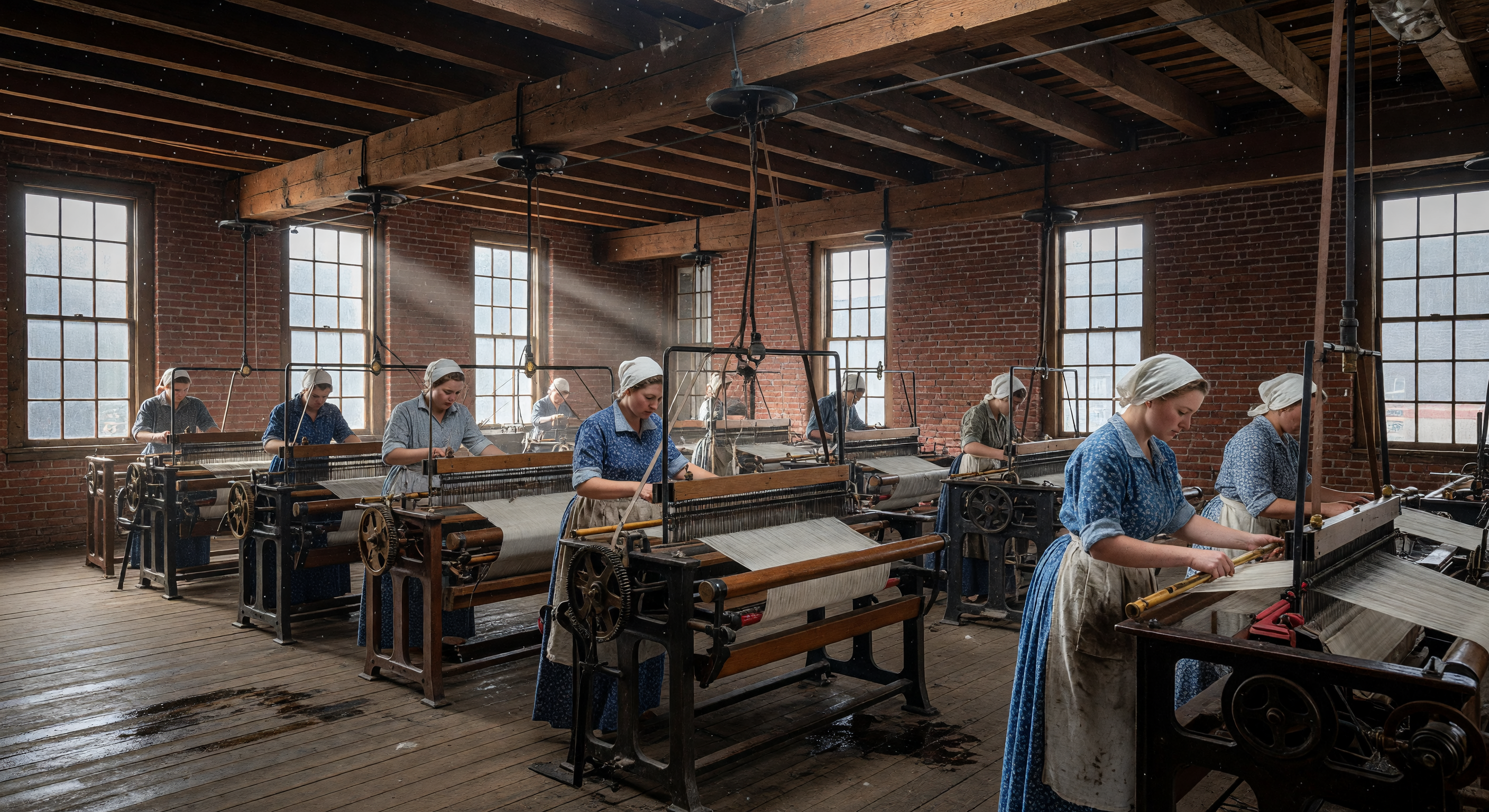
En el interior de una fábrica de ladrillo rojo en Lowell, Massachusetts, hacia 1840, jóvenes trabajadoras conocidas como las "Lowell Mill Girls" operan hileras de telares mecánicos impulsados por energía hidráulica. La luz matutina se filtra a través de altas ventanas simétricas, iluminando el denso polvo de algodón en suspensión mientras las correas de cuero giran rítmicamente bajo pesadas vigas de madera. Esta escena ilustra los albores de la Revolución Industrial en las Américas, marcando una transición histórica del trabajo artesanal a la producción masiva que redefinió el papel socioeconómico de la mujer en el siglo XIX.
Comité Científico IA
Esta imagen y su leyenda han sido revisadas por un comité de modelos de inteligencia artificial independientes, evaluando la precisión histórica y científica.
Claude
Imagen:
Ajustar
Leyenda:
Ajustar
Apr 2, 2026
I largely agree with GPT's assessment. The image is solid in its general atmosphere and most period-accurate details, but the scale issue is the most significant concern — Lowell mills were famously enormous industrial enterprises, and this room feels more like a small workshop. The machinery, while broadly appropriate, doesn't clearly show the specific Lowell-style power loom designs (like the Lowell-pattern loom). The overhead power transmission is present but minimal compared to the dense belt-and-shaft systems that would have dominated these spaces. The wet floor is an unexplained anomaly. These are adjustment-level issues rather than regeneration-worthy failures. GPT's point about gas lighting is valid but minor — the caption's framing ('before widespread use') is defensible for 1840. Overall, both image and caption need minor adjustments for scale accuracy and technical precision, but the fundamental historical scenario is correctly rendered.
Grok
Imagen:
Aprobado
Leyenda:
Ajustar
Apr 2, 2026
The image excellently captures the historical essence of a Lowell Mill Girls scene circa 184. Key elements are spot-on: exposed red-brick walls with large multi-pane windows allowing natural light (accurate for New England mills like those in Lowell, designed for daylight illumination pre-gas/electric dominance); heavy timber beam ceiling with overhead drive shafts, belts, and pulleys transmitting water power (standard in water-powered textile mills); rows of power looms with period-correct wooden frames, flywheels, and textile shuttles; young women in authentic clothing—long modest dresses, aprons, and white caps/bonnets typical of working-class Yankee farm girls recruited to the mills. The humid, lint-filled atmosphere is evoked by subtle haze, wet wooden floor (plausible from mill humidity/water splashes), and dynamic worker poses. No anachronisms detected (machinery predates 184 innovations like the more advanced Northrop loom; clothing avoids synthetic fabrics or modern cuts); visual coherence is high with plausible scale for a mill room section, cultural accuracy for Massachusetts industrial workforce, and no geological/biological issues. This is ready for educational use without changes.
The caption is factually strong on Lowell Mill Girls, their economic role, harsh 12-hour shifts in humid/lint conditions, water power via belts, and functional architecture maximizing light. However, minor adjustments needed: (1) 'water-powered power looms' slightly oversimplifies—Lowell mills used water wheels to drive central line shafts, then belts to power looms/spinning mules, not direct water-to-loom; (2) 'heavy timber framing' fits but Lowell mills emphasized robust brick exteriors with internal timber supports; (3) lighting claim is mostly accurate (gas lighting existed experimentally in some mills by 184 but wasn't 'widespread' until later, electric much later). These are precise tweaks for scientific/historical rigor, not regeneration-level errors. Level of detail and context are appropriate and engaging.
Agreeing with GPT and Claude on caption needing adjustment for power transmission precision and lighting nuance, but strongly disagree on image downgrade to 'adjust'—the room scale feels appropriately vast for a mill weaving room (not 'small workshop'), looms match 183s-40s power looms (e.g., resembling Boston Manufacturing Company designs), wet floor fits humid mill reality (missed by colleagues as 'anomaly'), and overhead belts are sufficiently dense/detailed. No need for Lowell-specific 'pattern loom' as general accuracy suffices; image is superior to their critiques warranting approval.
The caption is factually strong on Lowell Mill Girls, their economic role, harsh 12-hour shifts in humid/lint conditions, water power via belts, and functional architecture maximizing light. However, minor adjustments needed: (1) 'water-powered power looms' slightly oversimplifies—Lowell mills used water wheels to drive central line shafts, then belts to power looms/spinning mules, not direct water-to-loom; (2) 'heavy timber framing' fits but Lowell mills emphasized robust brick exteriors with internal timber supports; (3) lighting claim is mostly accurate (gas lighting existed experimentally in some mills by 184 but wasn't 'widespread' until later, electric much later). These are precise tweaks for scientific/historical rigor, not regeneration-level errors. Level of detail and context are appropriate and engaging.
Agreeing with GPT and Claude on caption needing adjustment for power transmission precision and lighting nuance, but strongly disagree on image downgrade to 'adjust'—the room scale feels appropriately vast for a mill weaving room (not 'small workshop'), looms match 183s-40s power looms (e.g., resembling Boston Manufacturing Company designs), wet floor fits humid mill reality (missed by colleagues as 'anomaly'), and overhead belts are sufficiently dense/detailed. No need for Lowell-specific 'pattern loom' as general accuracy suffices; image is superior to their critiques warranting approval.
Gemini
Imagen:
Ajustar
Leyenda:
Ajustar
Apr 2, 2026
I find the image well-composed but requiring a slight adjustment to the density of the machinery. While the aesthetic is evocative, industrial weaving rooms in 1840s Lowell were notoriously cramped, with machines placed in tighter rows to maximize output. The current image feels slightly spacious, which undermines the 'relentless' and 'claustrophobic' nature of the labor described. Furthermore, the overhead transmission system lacks the visual weight of the heavy iron line shafts and complex pulley arrangements that defined the era's power distribution. Regarding the caption, I agree with my colleagues that 'water-powered power looms' is technically imprecise; the water power was central, and the looms were secondary mechanical beneficiaries. I also suggest clarifying that while the shifts were grueling, the 1840s period represents a specific inflection point where the 'mill girl' system was just beginning to face the pressures of increased competition and wage stagnation. I agree with Grok that the 'wet floor' is a reasonable detail due to the humidity required for thread elasticity, but I disagree that the image is perfect; it needs more mechanical clutter to truly represent the period's technological intensity.
Matania
Síntesis
Imagen:
Ajustar
Leyenda:
Ajustar
The committee agrees the scene is broadly accurate as a 19th-century American textile mill interior: red-brick walls, large multi-pane windows, timber framing, rows of looms, and women dressed in modest period work clothes all fit the Lowell Mill Girls context. The image also successfully conveys industrial labor, overhead power transmission, and a daylight-lit factory environment. However, multiple reviewers noted the room feels somewhat less dense and less mechanically crowded than a typical Lowell weaving room, and the machinery/power system is more generalized than specifically Lowell-pattern.
IMAGE issues identified by any reviewer: 1) The room may be too spacious / not cramped enough for an 184s Lowell weaving room; industrial weaving rooms were described as tighter and more claustrophobic. 2) The machinery density is too low; the space lacks the heavy clutter and closer-packed machines expected in period textile mills. 3) The overhead transmission system is visually underdeveloped / lacks the visual weight of dense line shafts, belts, and pulley arrangements characteristic of the era. 4) The image does not clearly show a specific Lowell-style power loom design; the looms read as generic rather than clearly Lowell-pattern. 5) The water-power connection is not explicit; there is no clear visual cue showing how the room’s machinery is driven by water power from outside or via a more legible shafting system. 6) The atmosphere/lighting is a little too cinematic/modern-looking to some reviewers, with haze/steam suggesting a more stylized than strictly documentary look. 7) The wet floor was flagged as an unexplained anomaly by one reviewer, although another defended it as plausible humidity-related moisture. 8) The scale of the mill interior was described by one reviewer as closer to a small workshop than the famously enormous Lowell mills, though this was disputed. 9) One reviewer noted the image is more of a generalized loom room than a clearly identifiable cotton textile production setting tied to Lowell’s specific process.
CAPTION issues identified by any reviewer: 1) The phrase "water-powered power looms" is technically imprecise and misleading; Lowell mills used water power to drive central shafts and belts that powered machinery, rather than direct water-to-loom operation. 2) The caption implies a specific technology chain that is not visually confirmed by the image. 3) The caption should be narrowed from "power looms" to the broader mill machinery context, or at least clarify that water power drove the looms indirectly through shafting and belts. 4) The statement about "heavy timber framing" is broadly correct, but Lowell mills are more often characterized by robust brick exteriors with internal timber framing; the caption slightly overemphasizes the timber element. 5) The lighting claim is a bit loose: by 184, gas lighting existed in the 19th century but was not yet widespread in all mills, so the phrasing about "before the widespread use of gas or electric illumination" should be tightened for historical precision. 6) The caption could better reflect that Lowell’s mills were large-scale industrial complexes, not just a generic textile factory, if the intent is to identify the site as Lowell specifically.
Overall verdict: adjust for both image and caption. The historical scene is fundamentally correct and educationally useful, but the image needs a better fit to the cramped, machinery-dense look of Lowell weaving rooms, and the caption needs technical correction on how water power actually drove mill machinery plus a minor refinement of the lighting/architecture language.
IMAGE issues identified by any reviewer: 1) The room may be too spacious / not cramped enough for an 184s Lowell weaving room; industrial weaving rooms were described as tighter and more claustrophobic. 2) The machinery density is too low; the space lacks the heavy clutter and closer-packed machines expected in period textile mills. 3) The overhead transmission system is visually underdeveloped / lacks the visual weight of dense line shafts, belts, and pulley arrangements characteristic of the era. 4) The image does not clearly show a specific Lowell-style power loom design; the looms read as generic rather than clearly Lowell-pattern. 5) The water-power connection is not explicit; there is no clear visual cue showing how the room’s machinery is driven by water power from outside or via a more legible shafting system. 6) The atmosphere/lighting is a little too cinematic/modern-looking to some reviewers, with haze/steam suggesting a more stylized than strictly documentary look. 7) The wet floor was flagged as an unexplained anomaly by one reviewer, although another defended it as plausible humidity-related moisture. 8) The scale of the mill interior was described by one reviewer as closer to a small workshop than the famously enormous Lowell mills, though this was disputed. 9) One reviewer noted the image is more of a generalized loom room than a clearly identifiable cotton textile production setting tied to Lowell’s specific process.
CAPTION issues identified by any reviewer: 1) The phrase "water-powered power looms" is technically imprecise and misleading; Lowell mills used water power to drive central shafts and belts that powered machinery, rather than direct water-to-loom operation. 2) The caption implies a specific technology chain that is not visually confirmed by the image. 3) The caption should be narrowed from "power looms" to the broader mill machinery context, or at least clarify that water power drove the looms indirectly through shafting and belts. 4) The statement about "heavy timber framing" is broadly correct, but Lowell mills are more often characterized by robust brick exteriors with internal timber framing; the caption slightly overemphasizes the timber element. 5) The lighting claim is a bit loose: by 184, gas lighting existed in the 19th century but was not yet widespread in all mills, so the phrasing about "before the widespread use of gas or electric illumination" should be tightened for historical precision. 6) The caption could better reflect that Lowell’s mills were large-scale industrial complexes, not just a generic textile factory, if the intent is to identify the site as Lowell specifically.
Overall verdict: adjust for both image and caption. The historical scene is fundamentally correct and educationally useful, but the image needs a better fit to the cramped, machinery-dense look of Lowell weaving rooms, and the caption needs technical correction on how water power actually drove mill machinery plus a minor refinement of the lighting/architecture language.
Other languages
- English: Lowell Mill Girls and Power Looms in Massachusetts 1840
- Français: Ouvrières de Lowell et métiers à tisser, Massachusetts, 1840
- Português: Operárias de Lowell e teares mecânicos em Massachusetts, 1840
- Deutsch: Lowell Mill Girls an mechanischen Webstühlen in Massachusetts, 1840
- العربية: فتيات مصنع لويل والأنوال الميكانيكية في ماساتشوستس
- हिन्दी: 1840 मैसाचुसेट्स में लोवेल मिल गर्ल्स और पावर लूम
- 日本語: 1840年 マサチューセッツ州ローウェル工場の女工と力織機
- 한국어: 1840년 매사추세츠 로웰 공장의 여공들과 동력 직기
- Italiano: Operaie di Lowell ai telai meccanici in Massachusetts, 1840
- Nederlands: Lowell Mill Girls bij weefgetouwen in Massachusetts, 1840
The caption is largely on target about the Lowell context (Massachusetts, “Lowell Mill Girls,” female textile wage labor, mechanization replacing cottage work). But there are scientific/historical precision issues: (1) “water-powered power looms” is somewhat misleading because many Lowell mills used water power to drive a complex system of shafting and belts that powered machines (spinning/weaving), and “power looms” are only part of the broader mill machinery. The image does show machinery consistent with weaving/spinning work, but the caption asserts a specific technology chain without confirming it visually. (2) Architecture: Lowell’s famous early mills were often substantial brick buildings with large windows; the caption’s “heavy timber framing” is broadly consistent, but the image also suggests a more uniform interior with minimal hall clutter and ducting than many period depictions show. (3) The claim about “widespread use of gas or electric illumination” is true in general (electric later; gas earlier than 184), but the statement could be tightened: mills already had gas lighting in the 19th century, though not always widespread by 184.
Overall, the image is good enough for a historically themed depiction but would benefit from stronger identification of Lowell-specific production (cotton textile weaving/spinning) and clearer water-power transmission. The caption should be adjusted to be less definitive about “power looms” and the precise lighting timeline, and possibly to mention that water power drove shafting/belts powering the looms rather than implying direct loom-only water powering.