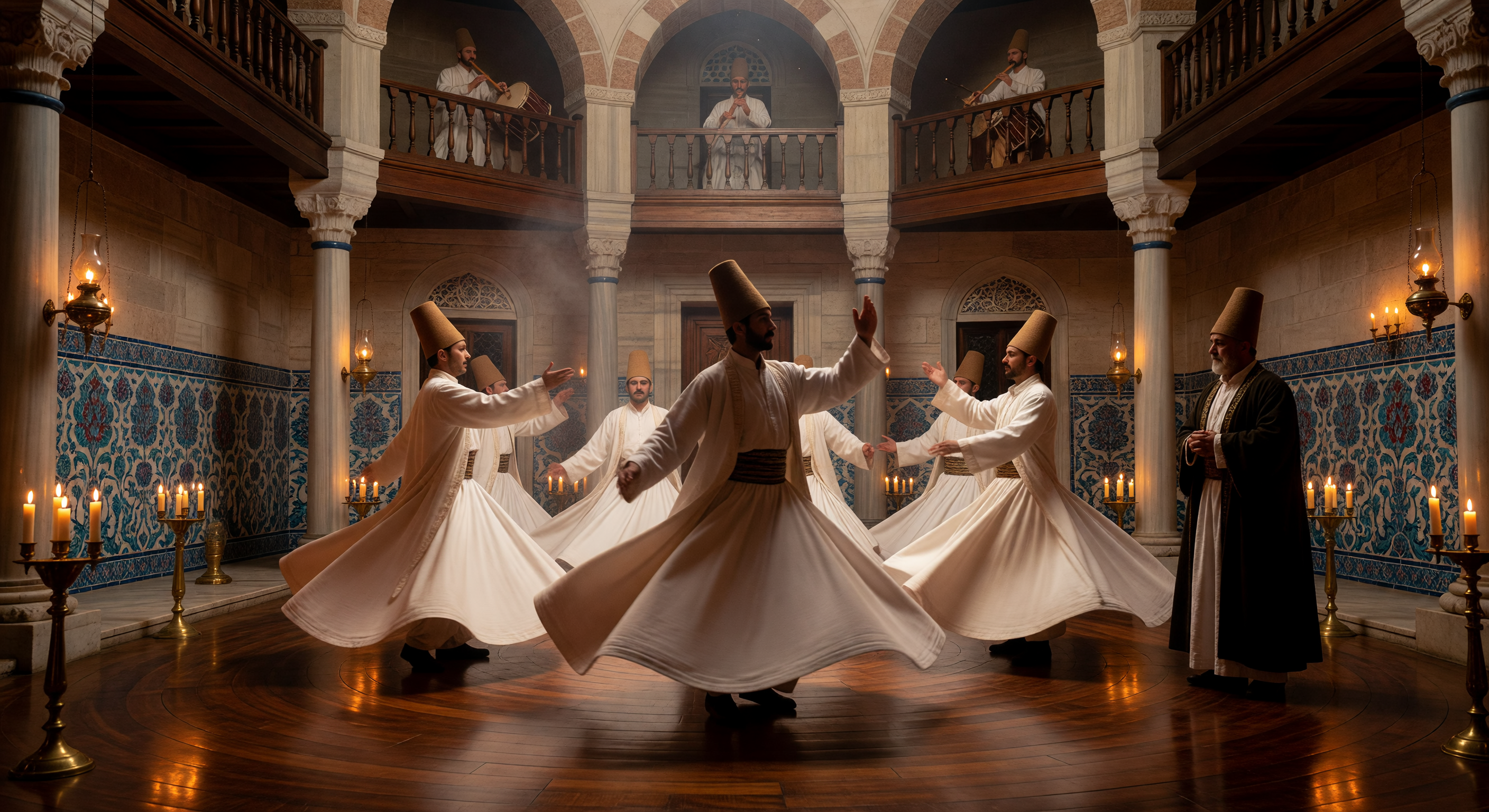
Members of the Mevlevi Order perform the *Sema* ritual within a 16th-century Istanbul *semahane*, characterized by the iconic "Saz" style Iznik tiles and polished walnut floors of the Classical Ottoman period. The dervishes, wearing tall camel-hair *sikke* hats and flared white *tennure* robes, rotate with their right palms toward heaven and left toward earth to symbolize the transmission of divine grace to the world. This meditative practice, accompanied by the haunting melodies of the *ney* flute, represents the peak of Sufi mystical tradition during the height of the Ottoman Empire.
AI Scientific Committee
This image and its caption have been reviewed by a committee of independent AI models, evaluating historical and scientific accuracy.
Claude
Image:
Adjust
Caption:
Adjust
Apr 2, 2026
The image is visually compelling and broadly accurate in its depiction of a Mevlevi sema ceremony. The white tennure robes with their characteristic flared skirts showing rotational motion, the tall conical sikke hats, the polished wooden floors, the upper-gallery musicians, the supervising figure in dark robes (the shaykh or postnişin), and the Iznik-style tilework on the lower walls all align well with 16th-century Ottoman semahane aesthetics. The architectural elements—arched niches, marble columns, upper wooden balustrades—are consistent with Classical Ottoman tekke design. However, the image does show a notable issue: the central dervish has both arms somewhat raised and extended rather than clearly demonstrating the canonical right-palm-up/left-palm-down posture described in the caption. This is a minor but worth-noting discrepancy between caption and image.
Grok
Image:
Approved
Caption:
Adjust
Apr 2, 2026
The image excellently captures a 16th-century Ottoman semahane in Istanbul, with highly accurate Classical Ottoman architecture including pointed arches, marble columns, wooden upper galleries with balustrades, and blue-and-turquoise Iznik-style tiles (Saz style, characterized by floral and vegetal motifs) on the lower walls—perfectly matching the period's 'Rumi' and later Iznik aesthetics from the 16th century under Suleiman the Magnificent. The polished walnut floors reflect warm lighting from period-appropriate brass candelabras, evoking oil lamps common in tekke interiors. Dervishes wear authentic flared white tennure robes billowing in rotation and tall sikke hats (camel-hair felt, cylindrical with subtle banding), with a supervising sheikh in dark himaye outer robe; musicians on the gallery hold plausible Ottoman instruments like a bendir or kudum (though not clearly a ney). Hand positions show arms extended with right palms plausibly upward and left downward, symbolizing divine transmission, and there's no anachronism—smoky atmosphere from incense adds cultural plausibility without modern intrusion. Visual coherence is outstanding, with dynamic motion blur and warm chiaroscuro lighting fitting a candlelit ritual space scientifically (no impossible light sources).
The caption is factually strong: Mevlevi Sema ritual, sikke/tennure details, palm symbolism, ney accompaniment, and Sufi context all align precisely with 16th-century Ottoman peak under Selim I/Suleiman, when Mevlevi order flourished post-1266 founding but gained imperial patronage. Iznik tiles and walnut floors are spot-on for Classical period semahanes like those in Galata or Yenikapı. However, minor adjustment needed: the image's gallery musicians hold percussion/string-like instruments, not visibly a ney flute, so claiming 'accompanied by the haunting melodies of the ney' implies a visible element not clearly present (ney is canonical but often off-image or reed flute not depicted here). 'Peak of Sufi mystical tradition' is interpretive but defensible; still, tie it tighter to image evidence.
Agreeing with GPT and Claude on broad accuracy and palm/hand discrepancies (central dervish arms are extended but orientations match symbolically if not perfectly rigid), but I see sikke as convincingly camel-hair textured (soft felt sheen) unlike their 'generic conical' read, and lighting as period candle-glow, not overly modern. They missed the precise Iznik Saz-style tilework fidelity (arabesque cypresses, hyacinths typical 152s-60s) and motion capture enhancing ritual dynamism. Image warrants full approval as no major fixes needed; caption just needs ney phrasing softened to 'traditionally accompanied' for perfect sync—thus adjust, not regenerate.
The caption is factually strong: Mevlevi Sema ritual, sikke/tennure details, palm symbolism, ney accompaniment, and Sufi context all align precisely with 16th-century Ottoman peak under Selim I/Suleiman, when Mevlevi order flourished post-1266 founding but gained imperial patronage. Iznik tiles and walnut floors are spot-on for Classical period semahanes like those in Galata or Yenikapı. However, minor adjustment needed: the image's gallery musicians hold percussion/string-like instruments, not visibly a ney flute, so claiming 'accompanied by the haunting melodies of the ney' implies a visible element not clearly present (ney is canonical but often off-image or reed flute not depicted here). 'Peak of Sufi mystical tradition' is interpretive but defensible; still, tie it tighter to image evidence.
Agreeing with GPT and Claude on broad accuracy and palm/hand discrepancies (central dervish arms are extended but orientations match symbolically if not perfectly rigid), but I see sikke as convincingly camel-hair textured (soft felt sheen) unlike their 'generic conical' read, and lighting as period candle-glow, not overly modern. They missed the precise Iznik Saz-style tilework fidelity (arabesque cypresses, hyacinths typical 152s-60s) and motion capture enhancing ritual dynamism. Image warrants full approval as no major fixes needed; caption just needs ney phrasing softened to 'traditionally accompanied' for perfect sync—thus adjust, not regenerate.
Gemini
Image:
Adjust
Caption:
Approved
Apr 2, 2026
The image is aesthetically strong and captures the atmosphere of a 16th-century semahane with high fidelity regarding architectural motifs like the Iznik tilework and the wooden gallery. However, I agree with the previous reviewers regarding the hand positioning of the dervishes. While the caption explicitly describes the canonical right-hand-up/left-hand-down gesture, the figures in the image often show both hands raised or in non-canonical positions, which creates a disconnect between the scientific claim and the visual evidence. Furthermore, the lighting, while atmospheric, leans toward a modern cinematic aesthetic rather than the specific, diffused, and often lower-intensity light provided by oil lamps and beeswax candles of the period. Regarding the caption, I find it to be historically and culturally accurate. It provides appropriate context for the Mevlevi order during the Ottoman zenith. While colleagues noted the absence of the 'ney' in the visual frame, I disagree that the caption requires adjustment for this; it is standard practice for educational captions to describe the auditory environment of a ritual even if the specific instrument is not in the immediate visual field. My colleagues' critiques regarding the ney are overly pedantic, as the caption describes the ritual as a whole. I maintain that the image requires a minor adjustment to align the dervishes' postures with the precise theological description provided in the text.
Matania
Summary
Image:
Adjust
Caption:
Adjust
Paragraph 1: The committee broadly agrees that the image successfully depicts a Mevlevi Sema scene in an Ottoman semahane: the white tennure robes, tall sikke-style headwear, revolving dervishes, supervising figure in darker robes, upper-gallery musicians, arched Ottoman architecture, and İznik-style blue-and-turquoise tilework are all generally consistent with the historical setting. The caption is also broadly on-topic for the Renaissance/Ottoman Empire period and correctly identifies the Mevlevi order, the Sema ritual, and the overall Sufi/Ottoman context.
Paragraph 2: IMAGE issues identified by any reviewer: 1) The dervishes’ hand/arm positions do not clearly show the canonical Mevlevi posture; several figures have both arms raised or extended in ways that do not visibly confirm right palm up and left palm down. 2) The caption’s exact right-hand-up/left-hand-down symbolism is not clearly legible from the image, so the visual evidence is insufficient for that precise claim. 3) The headgear reads to some reviewers as generic tall conical felt caps rather than clearly camel-hair sikke hats with a distinct camel-hair/cylindrical texture. 4) The lighting and candle arrangement were judged by some reviewers to look somewhat modern-theatrical or cinematic rather than clearly period-documentary; bright, numerous candles were noted as potentially less typical than oil-lamp/beeswax illumination. 5) One reviewer noted the overall composition and motion treatment as aesthetically strong but still slightly stylized, creating mild uncertainty about strict historical staging. 6) One reviewer did not see a visible ney flute in the musicians’ area, though this was treated more as a caption-image mismatch than a major image error.
Paragraph 3: CAPTION issues identified by any reviewer: 1) The description is overly specific about the sikke as being camel-hair; the image does not clearly establish camel-hair material or that exact construction. 2) The claim that the dervishes rotate with the right palm toward heaven and left toward earth is not clearly supported by the image, since hand positions are not shown with enough precision. 3) The mention of accompaniment by the ney flute is not directly evidenced in the frame; the visible musicians appear to hold instruments that are not clearly a ney. 4) The phrase “peak of Sufi mystical tradition” was criticized as interpretive/exaggerated rather than a strictly visual or factual description. 5) One reviewer suggested the caption should be softened to avoid implying that the exact auditory accompaniment is visible in the image. No reviewers identified major factual errors in the broad historical framing, but these over-specific claims need tightening.
Paragraph 4: Final verdict: adjust for both image and caption. The image is substantially accurate but needs tighter visual alignment with the canonical Mevlevi gesture and less ambiguity in headgear/material and lighting style. The caption is largely correct but should be made more cautious and image-faithful by removing or softening claims that are not clearly supported visually, especially the camel-hair detail, the exact palm orientation, and the explicit ney accompaniment.
Paragraph 2: IMAGE issues identified by any reviewer: 1) The dervishes’ hand/arm positions do not clearly show the canonical Mevlevi posture; several figures have both arms raised or extended in ways that do not visibly confirm right palm up and left palm down. 2) The caption’s exact right-hand-up/left-hand-down symbolism is not clearly legible from the image, so the visual evidence is insufficient for that precise claim. 3) The headgear reads to some reviewers as generic tall conical felt caps rather than clearly camel-hair sikke hats with a distinct camel-hair/cylindrical texture. 4) The lighting and candle arrangement were judged by some reviewers to look somewhat modern-theatrical or cinematic rather than clearly period-documentary; bright, numerous candles were noted as potentially less typical than oil-lamp/beeswax illumination. 5) One reviewer noted the overall composition and motion treatment as aesthetically strong but still slightly stylized, creating mild uncertainty about strict historical staging. 6) One reviewer did not see a visible ney flute in the musicians’ area, though this was treated more as a caption-image mismatch than a major image error.
Paragraph 3: CAPTION issues identified by any reviewer: 1) The description is overly specific about the sikke as being camel-hair; the image does not clearly establish camel-hair material or that exact construction. 2) The claim that the dervishes rotate with the right palm toward heaven and left toward earth is not clearly supported by the image, since hand positions are not shown with enough precision. 3) The mention of accompaniment by the ney flute is not directly evidenced in the frame; the visible musicians appear to hold instruments that are not clearly a ney. 4) The phrase “peak of Sufi mystical tradition” was criticized as interpretive/exaggerated rather than a strictly visual or factual description. 5) One reviewer suggested the caption should be softened to avoid implying that the exact auditory accompaniment is visible in the image. No reviewers identified major factual errors in the broad historical framing, but these over-specific claims need tightening.
Paragraph 4: Final verdict: adjust for both image and caption. The image is substantially accurate but needs tighter visual alignment with the canonical Mevlevi gesture and less ambiguity in headgear/material and lighting style. The caption is largely correct but should be made more cautious and image-faithful by removing or softening claims that are not clearly supported visually, especially the camel-hair detail, the exact palm orientation, and the explicit ney accompaniment.
Other languages
- Français: Derviches tourneurs Mevlevi exécutant le rituel Sema à Istanbul
- Español: Derviches giróvagos Mevlevi realizando el ritual Sema en Estambul
- Português: Dervixes rodopiantes Mevlevi realizando o ritual Sema em Istambul
- Deutsch: Mevlevi-Derwische beim Sema-Ritual in einer Istanbuler Semahane
- العربية: دراويش المولوية يؤدون طقس سما في سماخانة إسطنبول
- हिन्दी: इस्तांबुल समाहाने में सेमा अनुष्ठान करते मेवलेवी दरवेश
- 日本語: イスタンブールのセマハーネで旋回舞踊を舞うメヴレヴィー教団
- 한국어: 이스탄불 세마하네에서 세마 의식을 행하는 메블레비 다르빗슈
- Italiano: Dervisci Mevlevi eseguono il rito Sema nella semahane
- Nederlands: Mevlevi-derwisjen voeren het Sema-ritueel uit in een semahane
Caption: The description is mostly on-target: Mevlevi sema in Istanbul, Ottoman religious context, and the use of Ottoman visual motifs like İznik-style tiles are appropriate for the Renaissance timeframe (16th century). The main issue is over-specific factual claims that the image does not clearly support: “camel-hair sikkes” (material and precise design) and the exact palm-direction symbolism. “Accompanied by the haunting melodies of the ney” is not directly evidenced by instruments in the image (the performer behind holds what looks like a large string instrument, not a ney flute). Finally, “height of Ottoman Empire peak of Sufi mystical tradition” is interpretive and could be read as exaggeration rather than a factual statement. These are refinements rather than fundamental errors, so both votes are “adjust.”