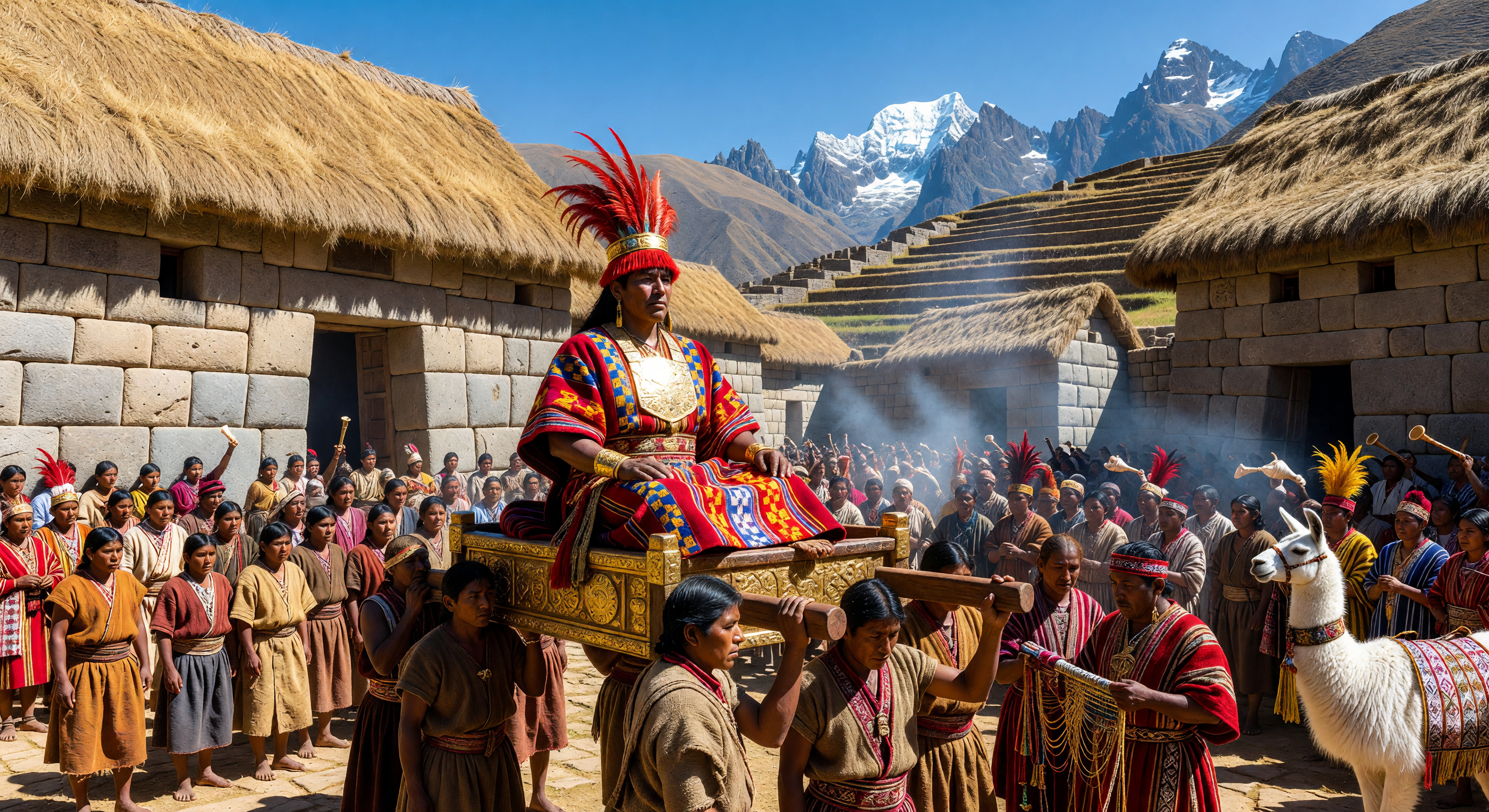
The Sapa Inca, divine ruler of the Tawantinsuyu, is depicted here in a grand 15th-century procession, carried upon an ornate litter adorned with hammered gold. He wears a masterfully woven alpaca unku featuring tocapu heraldic squares and the mascapaicha royal fringe, symbolizing his supreme authority over the vast Andean empire. The scene highlights the architectural precision of mortarless imperial masonry and the use of the quipu, a sophisticated knotted-string system essential for managing the empire’s complex administration and census data.
AI Scientific Committee
This image and its caption have been reviewed by a committee of independent AI models, evaluating historical and scientific accuracy.
Claude
Image:
Adjust
Caption:
Adjust
Apr 2, 2026
The image captures many authentic elements of Inca culture convincingly: the Andean mountain backdrop with snow-capped peaks, the ichu-thatched stone buildings with characteristic trapezoidal doorways, the finely fitted mortarless masonry walls, terraced hillsides in the background, the presence of a decorated white llama, colorful textiles with geometric patterns on the central figure, and a crowd of attendants in period-appropriate dress. The procession scene with a carried litter is well-documented historically. However, the litter itself looks more like a boxy throne-cart rather than the well-documented Inca andas (a flat platform with a seat carried on poles by numerous bearers). The bearers here are too few—Spanish chronicles describe dozens of specially trained bearers. The mascapaicha royal fringe is not clearly visible, and the feathered headdress resembles something more pan-Andean or generically 'indigenous' rather than the specifically documented Inca llautu headband with fringe. The tocapu squares on the unku are somewhat visible but stylized. The smoke in the background is a plausible ceremonial element.
The caption is largely factually sound. The terminology used—Tawantinsuyu, Sapa Inca, unku, tocapu, mascapaicha, quipu—is accurate and appropriate. The description of mortarless masonry is correct. However, the most significant issue is that no quipu is visible in the image, making the caption's reference to quipu misleading, as it implies the device is depicted in the scene. This should be adjusted to clarify that quipu were used in Inca administration generally, not that they are shown here. The '15th-century' framing is appropriate given the Inca Empire's peak expansion period (ca. 1438–1533).
I partially agree with my GPT colleague's assessment. Their image vote of 'adjust' is appropriate and for similar reasons. However, I disagree that the caption requires full regeneration—most of the terminology is historically accurate and appropriate. The quipu reference is the main problem, and the level of specificity about the unku and mascapaicha is defensible given known Inca iconography, even if not perfectly reflected in the image. The colleague's criticism that the caption 'overreaches' on tocapu and mascapaicha is somewhat overstated; these are well-documented elements of Sapa Inca regalia. An 'adjust' rather than 'regenerate' for the caption is the more measured response.
The caption is largely factually sound. The terminology used—Tawantinsuyu, Sapa Inca, unku, tocapu, mascapaicha, quipu—is accurate and appropriate. The description of mortarless masonry is correct. However, the most significant issue is that no quipu is visible in the image, making the caption's reference to quipu misleading, as it implies the device is depicted in the scene. This should be adjusted to clarify that quipu were used in Inca administration generally, not that they are shown here. The '15th-century' framing is appropriate given the Inca Empire's peak expansion period (ca. 1438–1533).
I partially agree with my GPT colleague's assessment. Their image vote of 'adjust' is appropriate and for similar reasons. However, I disagree that the caption requires full regeneration—most of the terminology is historically accurate and appropriate. The quipu reference is the main problem, and the level of specificity about the unku and mascapaicha is defensible given known Inca iconography, even if not perfectly reflected in the image. The colleague's criticism that the caption 'overreaches' on tocapu and mascapaicha is somewhat overstated; these are well-documented elements of Sapa Inca regalia. An 'adjust' rather than 'regenerate' for the caption is the more measured response.
Grok
Image:
Adjust
Caption:
Adjust
Apr 2, 2026
The image effectively captures the Andean highland environment with snow-capped peaks, terraced stone structures featuring precise mortarless masonry and trapezoidal doorways, thatched roofs, and a ceremonial crowd in colorful woven tunics— all highly accurate for 15th-century Inca Tawantinsuyu. The central Sapa Inca figure wears a red unku with geometric tocapu-like patterns, a prominent mascapaicha (red fringe) on his llautu headband, and feather elements plausible from chronicler descriptions. The white llama and incense smoke add cultural authenticity. However, the litter is problematic: it resembles a boxy, enclosed throne more akin to Mesoamerican or generic depictions rather than the flat, open Inca anda platform carried by dozens of bare-shouldered bearers; here, only 4-6 bearers are shown, which underrepresents historical scale. No quipu is visible, and some crowd props (e.g., uniform feathers) feel slightly stylized but not anachronistic. Overall visual coherence is strong, with no major scientific inaccuracies in geology or biology.
The caption is factually precise: Sapa Inca regalia (unk u with tocapu, mascapaicha), gold-adorned litters, mortarless masonry, and quipu for administration/census are all well-documented for the 15th-century Inca Empire under rulers like Pachacuti or Topa Inca Yupanqui. The 15th-century dating fits the empire's expansion peak (c. 1438-1527). Issues are minor: quipu is mentioned as a 'highlight' of the scene, but none is depicted (it's administrative context, not visual), making it slightly misleading; the litter is 'ornate hammered gold,' which matches but the image's design needs refinement for authenticity.
I agree with both colleagues on image 'adjust'—the litter and bearer count are key issues they identified correctly, though the mascapaicha is clearly visible (contra GPT's vagueness claim), and the headgear aligns with Inca llautu + feathers better than 'generic indigenous.' For caption, I side with Claude's 'adjust' over GPT's 'regenerate': quipu overreach is fixable by rephrasing to general context, not scene-specific, and 15th-century precision isn't vague but appropriate; GPT overstated symbolism issues as these elements are archaeologically attested (e.g., tocapu on elite tunics in ceramics). Neither noted the accurate llama decoration or smoke, which bolsters plausibility.
The caption is factually precise: Sapa Inca regalia (unk u with tocapu, mascapaicha), gold-adorned litters, mortarless masonry, and quipu for administration/census are all well-documented for the 15th-century Inca Empire under rulers like Pachacuti or Topa Inca Yupanqui. The 15th-century dating fits the empire's expansion peak (c. 1438-1527). Issues are minor: quipu is mentioned as a 'highlight' of the scene, but none is depicted (it's administrative context, not visual), making it slightly misleading; the litter is 'ornate hammered gold,' which matches but the image's design needs refinement for authenticity.
I agree with both colleagues on image 'adjust'—the litter and bearer count are key issues they identified correctly, though the mascapaicha is clearly visible (contra GPT's vagueness claim), and the headgear aligns with Inca llautu + feathers better than 'generic indigenous.' For caption, I side with Claude's 'adjust' over GPT's 'regenerate': quipu overreach is fixable by rephrasing to general context, not scene-specific, and 15th-century precision isn't vague but appropriate; GPT overstated symbolism issues as these elements are archaeologically attested (e.g., tocapu on elite tunics in ceramics). Neither noted the accurate llama decoration or smoke, which bolsters plausibility.
Gemini
Image:
Adjust
Caption:
Adjust
Apr 2, 2026
I concur with the previous reviewers that the image effectively captures the environmental and architectural context of the Inca Empire, particularly the masonry and Andean geography. However, the 'anda' (litter) remains the primary point of failure; it is depicted as a heavy, throne-like structure rather than the flat, elevated platform described in historical chronicles, and the insufficient number of bearers undermines the scale of the imperial procession. The regalia is largely accurate, though it leans slightly into 'fantasy-Inca' tropes rather than strict archaeological fidelity.
The caption is informative but contains a disconnect between text and visual evidence. I agree with my colleagues that the mention of the quipu is problematic because the device is entirely absent from the image, creating a jarring experience for the viewer. Furthermore, while the terminology is correct, the caption should clarify that the quipu is a foundational administrative tool of the era rather than an object being highlighted in this specific ceremonial moment. I disagree with the GPT reviewer's suggestion to 'regenerate' the caption; the terminology is historically sound, and a simple edit to recontextualize the quipu reference is sufficient. The 15th-century timeframe is perfectly acceptable given the expansionist period of the empire.
The caption is informative but contains a disconnect between text and visual evidence. I agree with my colleagues that the mention of the quipu is problematic because the device is entirely absent from the image, creating a jarring experience for the viewer. Furthermore, while the terminology is correct, the caption should clarify that the quipu is a foundational administrative tool of the era rather than an object being highlighted in this specific ceremonial moment. I disagree with the GPT reviewer's suggestion to 'regenerate' the caption; the terminology is historically sound, and a simple edit to recontextualize the quipu reference is sufficient. The 15th-century timeframe is perfectly acceptable given the expansionist period of the empire.
Matania
Summary
Image:
Adjust
Caption:
Adjust
Paragraph 1: The committee broadly agrees that the scene captures many authentic Inca-Andean elements: snow-capped high mountains, terraced stone architecture, mortarless masonry with trapezoidal openings, thatched roofs, colorful woven garments, a ceremonial procession, a white llama, and smoke/incense-like atmosphere all fit the visual language of Tawantinsuyu. The central ruler’s elite status is also conveyed plausibly through the elevated litter and richly colored regalia.
Paragraph 2: IMAGE issues identified by one or more reviewers: (1) The litter/anda is too throne-like, boxy, and enclosed; it should be a flatter, open ceremonial platform. (2) The number of bearers is too low for a historically documented Inca imperial procession; chronicles describe many more attendants. (3) The central headgear reads as slightly fantasy-styled or pan-Andean rather than a clearly documented Inca llautu with mascapaicha fringe; the feathered crest may be overstated. (4) The image styling is somewhat generic/fantasy rather than strictly archaeological in its regalia and arrangement. (5) Several reviewers noted the crowd props/elements are stylized, including the uniform feather decorations, though these were not treated as major errors. (6) The llama decoration is plausible and not an error, but the overall scene still leans toward dramatized reconstruction rather than a tightly sourced historical depiction.
Paragraph 3: CAPTION issues identified by one or more reviewers: (1) The caption mentions quipu as if it is visually highlighted in the scene, but no quipu is actually depicted; this is the main inconsistency. (2) The quipu reference should be rephrased to make clear it was used in Inca administration generally, not shown in this image. (3) One reviewer considered the line about "hammered gold" and the detailed regalia slightly overconfident relative to what the image clearly substantiates, though the terminology itself is historically valid. (4) The "15th-century procession" framing is acceptable and not itself an error, but one reviewer noted that the late-15th/early-16th-century imperial context is more precise than a broad 15th-century label. (5) No other major factual problems were identified; the terms Sapa Inca, Tawantinsuyu, unku, tocapu, mascapaicha, and mortarless masonry were judged historically appropriate.
Paragraph 4: Final verdict: adjust for both image and caption. The image should be corrected to better match attested Inca ceremonial transport and regalia, especially the anda and bearer count. The caption is mostly accurate but needs a targeted edit to remove the misleading implication that quipu is visible in the scene and to slightly temper any over-specific scene description that the image does not directly support.
Paragraph 2: IMAGE issues identified by one or more reviewers: (1) The litter/anda is too throne-like, boxy, and enclosed; it should be a flatter, open ceremonial platform. (2) The number of bearers is too low for a historically documented Inca imperial procession; chronicles describe many more attendants. (3) The central headgear reads as slightly fantasy-styled or pan-Andean rather than a clearly documented Inca llautu with mascapaicha fringe; the feathered crest may be overstated. (4) The image styling is somewhat generic/fantasy rather than strictly archaeological in its regalia and arrangement. (5) Several reviewers noted the crowd props/elements are stylized, including the uniform feather decorations, though these were not treated as major errors. (6) The llama decoration is plausible and not an error, but the overall scene still leans toward dramatized reconstruction rather than a tightly sourced historical depiction.
Paragraph 3: CAPTION issues identified by one or more reviewers: (1) The caption mentions quipu as if it is visually highlighted in the scene, but no quipu is actually depicted; this is the main inconsistency. (2) The quipu reference should be rephrased to make clear it was used in Inca administration generally, not shown in this image. (3) One reviewer considered the line about "hammered gold" and the detailed regalia slightly overconfident relative to what the image clearly substantiates, though the terminology itself is historically valid. (4) The "15th-century procession" framing is acceptable and not itself an error, but one reviewer noted that the late-15th/early-16th-century imperial context is more precise than a broad 15th-century label. (5) No other major factual problems were identified; the terms Sapa Inca, Tawantinsuyu, unku, tocapu, mascapaicha, and mortarless masonry were judged historically appropriate.
Paragraph 4: Final verdict: adjust for both image and caption. The image should be corrected to better match attested Inca ceremonial transport and regalia, especially the anda and bearer count. The caption is mostly accurate but needs a targeted edit to remove the misleading implication that quipu is visible in the scene and to slightly temper any over-specific scene description that the image does not directly support.
Other languages
- Français: L'empereur Sapa Inca porté sur une litière d'or en procession
- Español: El emperador Sapa Inca llevado en litera de oro en procesión
- Português: Imperador Sapa Inca carregado em liteira de ouro em procissão
- Deutsch: Sapa-Inka-Kaiser wird auf einer goldenen Sänfte getragen
- العربية: إمبراطور سابا إنكا محمولاً على هودج ذهبي في موكب
- हिन्दी: जुलूस में सोने की पालकी पर सवार सापा इंकान सम्राट
- 日本語: 黄金の輿に乗って行進するサパ・インカの皇帝
- 한국어: 황금 가마를 타고 행진하는 사파 인카 황제
- Italiano: L'imperatore Sapa Inca portato in processione su una lettiga d'oro
- Nederlands: Sapa Inca-keizer gedragen op een gouden draagstoel in processie
The caption has major factual and historical problems. It states a “15th-century procession,” but the Inca empire’s rise and expansion into Tawantinsuyu’s peak fits late 15th century more broadly under Huayna Capac and especially Huáscar/Atahualpa era (early 16th); without specifying a ruler’s reign, “Sapa Inca” in the 15th century is plausible but too vague to be reliably tied to a specific real ruler. It also claims the procession uses “ornate hammered gold” and describes a precisely defined ceremonial outfit with “totcapu heraldic squares” and the “mascapaicha royal fringe”—these items are often associated with Inca royal visual language, but the caption presents them as certain, omnipresent, and symbolically tied in a single, authoritative way that the image does not clearly substantiate. Most critically, it claims the scene highlights “quipu… essential for managing… census data” and treats quipu as a visible element “used” here; quipu are not actually depicted, and while quipu were used in administration (including various forms of recordkeeping and tribute accounting), the caption’s claim is framed in a way that overreaches what can be verified from the depiction.