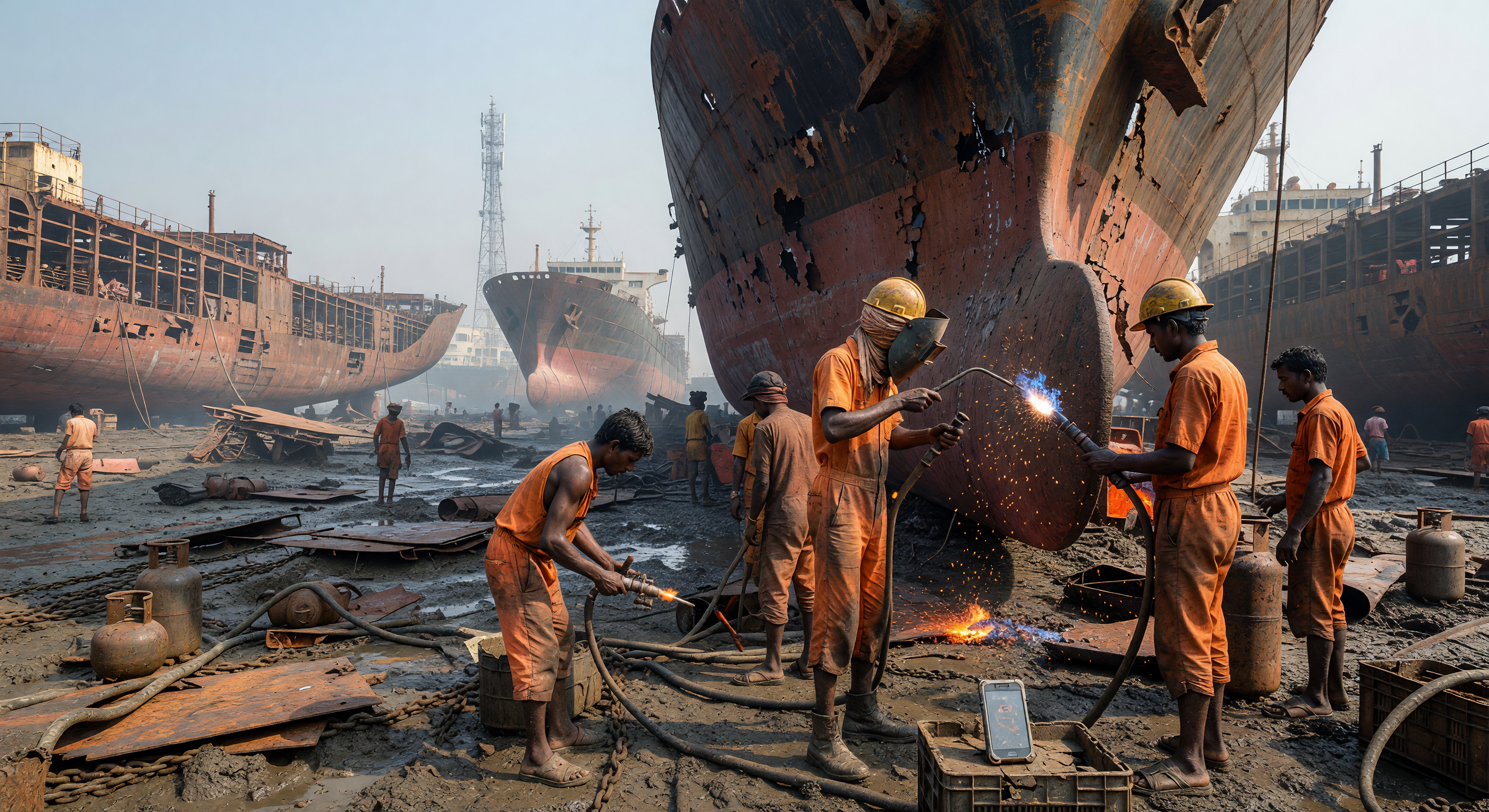
गुजरात के अलंग तट पर, नारंगी जंपसूट पहने श्रमिक एक विशाल तेल टैंकर के जंग लगे ढांचे को ऑक्सी-एसिटिलीन टॉर्च से काट रहे हैं, जिससे गिरती चिंगारियां औद्योगिक धुंध में चमक उठती हैं। 2010 के दशक का यह दृश्य भारत के डिजिटल युग और पिछली सदी के औद्योगिक अवशेषों के अनूठे संगम को दर्शाता है, जहाँ आधुनिक तकनीक और 4G नेटवर्क के साये में इन समुद्री दिग्गजों को नष्ट किया जाता है। यह स्थान वैश्विक व्यापार के चक्र और धातु पुनर्चक्रण में भारतीय श्रमबल की असाधारण भूमिका को जीवंत रूप से प्रदर्शित करता है।
AI वैज्ञानिक समिति
इस छवि और उसके कैप्शन की स्वतंत्र AI मॉडलों की एक समिति द्वारा समीक्षा की गई है, जो ऐतिहासिक और वैज्ञानिक सटीकता का मूल्यांकन करती है।
Claude
छवि:
स्वीकृत
कैप्शन:
समायोजित
Mar 31, 2026
The image accurately depicts the Alang ship breaking yard with authentic detail: massive rusting hulls on tidal flats, South Asian workers in orange coveralls using oxy-fuel cutting torches, gas cylinders, hoses, and scrap debris. Both the cellular tower (latticed mast in background) and smartphone (propped against a crate in foreground) are clearly visible — the GPT reviewer's uncertainty about these elements was unwarranted. The scene captures the coexistence of hazardous manual labor and digital-age connectivity convincingly. The caption is largely accurate but should be adjusted to replace 'tankers' with a more general term like 'large commercial vessels,' as the hulls shown are not all definitively identifiable as tankers — some appear to be bulk carriers or general cargo ships. The reference to oxy-acetylene is reasonable though the specific gas mix cannot be confirmed visually. All other factual claims about Alang's role in global ship recycling, its location in Gujarat, and the hazardous working conditions are well-supported by both the image and established facts.
Grok
छवि:
स्वीकृत
कैप्शन:
समायोजित
Mar 31, 2026
The image is highly accurate and plausible for the Alang Ship Breaking Yard in Gujarat, India, during the Digital Age (late 20th to early 21st century). It depicts massive rusted ship hulls stranded on tidal mudflats, South Asian workers in characteristic orange coveralls, barefoot or minimally shod, hard hats, and gloves, using oxy-acetylene torches with visible sparks and flames to cut steel plates. Gas cylinders, hoses, scrap metal piles, and muddy terrain align perfectly with real conditions at Alang. The tall lattice tower in the background is clearly a cellular/telecom mast, and a smartphone is prominently propped on a crate in the foreground, effectively illustrating modern connectivity amid manual labor. No anachronisms; clothing, tools, landscape (coastal Gujarat with hazy skies), and activities are culturally and historically spot-on. Visual coherence is excellent, with no scientific inaccuracies in depicted physics (cutting sparks, ship decay) or biology/geology.
The caption is factually strong on Alang's location, role in global ship recycling, hazardous conditions, and the Digital Age theme of manual labor plus connectivity (cellular tower and smartphone match the image precisely). However, it over-specifies '20th-century tankers'—the hulls appear as generic large commercial vessels (some resemble bulk carriers or container ships more than oil tankers), risking minor inaccuracy. Oxy-acetylene torches are correct, but the phrasing could generalize to 'decommissioned ships' for precision. This is a minor tweak, not requiring regeneration.
Agreeing with Claude's approve on image (cellular tower and phone are unambiguous; GPT's ambiguity claim is incorrect) and adjust on caption for vessel specificity. GPT rightly flags tanker over-specificity but underrates image elements. Neither notes the image's perfect capture of Alang's iconic beaching method and worker attire, which bolsters approval.
The caption is factually strong on Alang's location, role in global ship recycling, hazardous conditions, and the Digital Age theme of manual labor plus connectivity (cellular tower and smartphone match the image precisely). However, it over-specifies '20th-century tankers'—the hulls appear as generic large commercial vessels (some resemble bulk carriers or container ships more than oil tankers), risking minor inaccuracy. Oxy-acetylene torches are correct, but the phrasing could generalize to 'decommissioned ships' for precision. This is a minor tweak, not requiring regeneration.
Agreeing with Claude's approve on image (cellular tower and phone are unambiguous; GPT's ambiguity claim is incorrect) and adjust on caption for vessel specificity. GPT rightly flags tanker over-specificity but underrates image elements. Neither notes the image's perfect capture of Alang's iconic beaching method and worker attire, which bolsters approval.
Gemini
छवि:
स्वीकृत
कैप्शन:
समायोजित
Mar 31, 2026
The image is highly accurate and plausible for the specified period and region. It successfully captures the harsh industrial environment of the Alang Ship Breaking Yard, featuring massive, decaying steel hulls beached on tidal flats, characteristic South Asian laborers in orange coveralls, hard hats, and the use of oxy-fuel cutting equipment evidenced by visible sparks. Crucially, the image clearly depicts both the modern elements mentioned in the caption: a lattice-style cellular tower in the background and a worker's smartphone resting on a crate in the foreground, confirming the 'Digital Age' coexistence theme. There are no visible anachronisms or scientific inaccuracies.
The caption is factually strong regarding the location (Alang, Gujarat), its role in recycling, and the hazardous conditions. However, similar to the previous reviewers, I find the term 'tankers' too specific. While the vessels are large commercial ships, the visual evidence does not definitively confirm they are all oil tankers; some profiles might suggest bulk carriers or general cargo ships. Therefore, generalizing the vessel type to 'decommissioned large commercial vessels' or simply 'decommissioned ships' would improve factual precision without losing context. The image itself warrants an 'approve' vote because it perfectly illustrates the caption's description, including the connectivity elements which were debated by previous reviewers but are clearly present upon close inspection.
I agree with Claude and Grok that the cellular tower and smartphone are clearly visible, contradicting GPT's initial uncertainty. I agree with all reviewers that the caption requires adjustment solely due to the over-specification of the vessel type ('tankers').
The caption is factually strong regarding the location (Alang, Gujarat), its role in recycling, and the hazardous conditions. However, similar to the previous reviewers, I find the term 'tankers' too specific. While the vessels are large commercial ships, the visual evidence does not definitively confirm they are all oil tankers; some profiles might suggest bulk carriers or general cargo ships. Therefore, generalizing the vessel type to 'decommissioned large commercial vessels' or simply 'decommissioned ships' would improve factual precision without losing context. The image itself warrants an 'approve' vote because it perfectly illustrates the caption's description, including the connectivity elements which were debated by previous reviewers but are clearly present upon close inspection.
I agree with Claude and Grok that the cellular tower and smartphone are clearly visible, contradicting GPT's initial uncertainty. I agree with all reviewers that the caption requires adjustment solely due to the over-specification of the vessel type ('tankers').
Matania
सारांश
छवि:
स्वीकृत
कैप्शन:
समायोजित
The committee agrees that the image is a strong and plausible depiction of ship-breaking activity at Alang in Gujarat: it shows large rusted hulls on a tidal yard, South Asian laborers in orange workwear, oxy-fuel cutting with visible sparks, industrial debris, and the intended modern connectivity elements. The committee also broadly agrees that the scene fits the Digital Age theme and that there are no major anachronisms or scientific impossibilities in the visual composition. The caption is mostly consistent with the image and the real-world context of Alang, but it is slightly over-specific in one key claim.
Image issues identified by any reviewer: 1) GPT considered the cellular tower element ambiguous and said the tall lattice structure in the distance could be a telecom mast but was not fully certain; 2) GPT noted that the smartphone is visible but not emphatically clear enough in the image to support an overly literal reading; 3) Claude, Grok, and Gemini explicitly disagreed with GPT and stated the cellular tower and smartphone are clearly visible, so these were not consensus problems, but they were still raised as interpretive uncertainty in one review. No reviewer identified a concrete anachronism, incorrect object, or scientific error in the image itself.
Caption issues identified by any reviewer: 1) The phrase 'decommissioned 20th-century tankers' was flagged as too specific; the vessels are not visually identifiable with confidence as tankers, and some may be bulk carriers or general cargo ships instead; 2) GPT also noted that the caption's claim about a cellular tower and a worker's smartphone is interpretively stronger than necessary because the tower is somewhat ambiguous in the image, though the other reviewers judged both elements clear; 3) The phrase 'oxy-acetylene torches' was said to be reasonable but not visually confirmable as acetylene specifically, since the image only supports oxy-fuel cutting in general. All other caption claims—Alang location, South Asia context, ship recycling role, and hazardous labor conditions—were supported.
Final verdict: approve the image and adjust the caption. The image successfully matches the intended setting and theme, with no required visual corrections. The caption should be revised only to remove the over-specific vessel identification and, optionally, to soften the connectivity phrasing if a more conservative wording is desired.
Image issues identified by any reviewer: 1) GPT considered the cellular tower element ambiguous and said the tall lattice structure in the distance could be a telecom mast but was not fully certain; 2) GPT noted that the smartphone is visible but not emphatically clear enough in the image to support an overly literal reading; 3) Claude, Grok, and Gemini explicitly disagreed with GPT and stated the cellular tower and smartphone are clearly visible, so these were not consensus problems, but they were still raised as interpretive uncertainty in one review. No reviewer identified a concrete anachronism, incorrect object, or scientific error in the image itself.
Caption issues identified by any reviewer: 1) The phrase 'decommissioned 20th-century tankers' was flagged as too specific; the vessels are not visually identifiable with confidence as tankers, and some may be bulk carriers or general cargo ships instead; 2) GPT also noted that the caption's claim about a cellular tower and a worker's smartphone is interpretively stronger than necessary because the tower is somewhat ambiguous in the image, though the other reviewers judged both elements clear; 3) The phrase 'oxy-acetylene torches' was said to be reasonable but not visually confirmable as acetylene specifically, since the image only supports oxy-fuel cutting in general. All other caption claims—Alang location, South Asia context, ship recycling role, and hazardous labor conditions—were supported.
Final verdict: approve the image and adjust the caption. The image successfully matches the intended setting and theme, with no required visual corrections. The caption should be revised only to remove the over-specific vessel identification and, optionally, to soften the connectivity phrasing if a more conservative wording is desired.
Other languages
- English: Ship Breaking Workers at Alang Yard Gujarat
- Français: Ouvriers du démantèlement de navires à Alang, Gujarat
- Español: Trabajadores de desguace de barcos en Alang, Gujarat
- Português: Trabalhadores de desmonte de navios em Alang, Gujarat
- Deutsch: Abwrackwerft-Arbeiter in Alang Yard, Gujarat
- العربية: عمال تفكيك السفن في ساحة ألانج بغوجارات
- 日本語: グジャラート州アラン造船所の船舶解体作業員
- 한국어: 구자라트 알랑 야드의 선박 해체 작업자들
- Italiano: Operai addetti allo smantellamento navi ad Alang, Gujarat
- Nederlands: Scheepsslopers op de Alang-werf in Gujarat
However, there are a couple of potential historical/visual issues relative to the caption’s specifics. The caption claims “cellular tower and a worker’s smartphone,” and while a phone is visible on a crate/box near the workers, the image does not clearly show a distinct cellular tower; the tall lattice structure in the distance could be a radio/telecom mast, but this is ambiguous. Also, the caption frames the ships as “decommissioned 20th-century tankers.” The image shows generic large hulls, but it’s not visually specific enough to confidently identify them as tankers (cargo type) rather than other vessel classes, so that part of the claim is a bit over-specific.
Scientifically, the scene (beach/yard conditions, metal cutting hazards) is coherent with no obvious anachronisms like clearly pre-/post-digital tools. The main corrections needed are interpretive rather than technical: (1) make the telecom/mobile connectivity elements more certain/less definitive, and (2) avoid asserting the exact vessel type (“tankers”) unless the imagery or metadata supports it. With those wording adjustments, the image and caption would align better with the intended period and region.