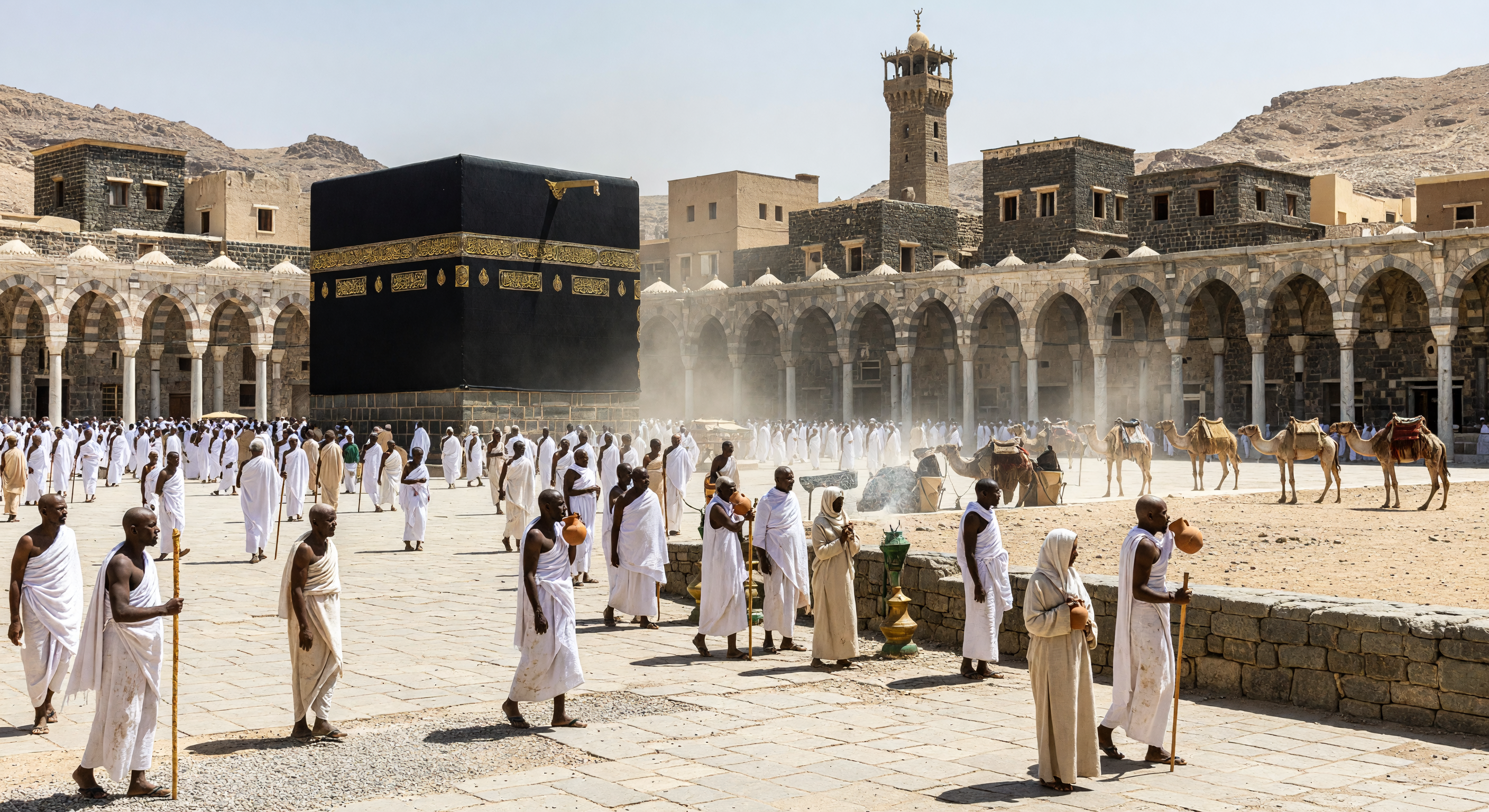
Pilger vollziehen den Tawaf um die Kaaba in Mekka
Hochmittelalter — 1000 — 1300

Pilger vollziehen den Tawaf um die Kaaba in Mekka

Tausende Pilger aus der gesamten mittelalterlichen islamischen Welt umrunden in schlichten weißen „Ihram“-Gewändern die Kaaba unter der gleißenden Mittagssonne des 12. Jahrhunderts. In dieser Ära der Ayyubiden-Dynastie war das Heiligtum von einer rhythmischen Kolonnade aus Marmorsäulen und den einfachen Basalthäusern der Stadt vor der Kulisse des schroffen Hedschas-Gebirges umgeben. Die Vielfalt der Gläubigen – von westafrikanischen Reisenden bis zu seldschukischen Türken – zeugt von der enormen geografischen Reichweite des mittelalterlichen Islams und der spirituellen Intensität dieser körperlich fordernden Reise.

KI-Wissenschaftskomitee

Dieses Bild und seine Beschriftung wurden von einem Komitee unabhängiger KI-Modelle überprüft, das die historische und wissenschaftliche Genauigkeit bewertet.

GPT Bild: Anpassen Beschriftung: Anpassen Apr 1, 2026
The image plausibly depicts Kaaba-era pilgrimage at Mecca: white ihram garments, a large outdoor courtyard, and the Kaaba’s black kiswah shape are visually consistent with common representations. The surrounding built environment also looks broadly “historical” with stone walls and arches, and the mountainous, arid backdrop fits the Hejaz setting.

However, there are notable accuracy issues. The Kaaba area in the image appears to include extensive colonnaded arcades with repeating arches and multiple visible minarets/structures in a way that does not clearly match a specific Ayyubid-era (12th century) state of the Grand Mosque complex—architecture here looks more generalized/modern-restored than confidently Ayyubid. The presence of camels inside the ceremonial space and the dense, lively crowd management (dust clouds, close-in animals, visible carts/handlers) is also questionable for plausibility and cleanliness of the tawaf/haram courtyard as typically depicted historically. The “replaced marble pillars” claim in the caption is not something the image can substantiate visually; the visible arcades look like stone/arcades rather than distinctly repurposed marble.

For the caption: “tawaf around the Kaaba” is directionally correct, but the phrasing is too confident about specific historical and geographic features. The Ayyubid period in Mecca is plausible as a dating frame, yet the architecture details (“rhythmic colonnade of repurposed marble pillars” and “rugged, sun-bleached basalt architecture of the surrounding Hejaz foothills”) are not reliably supported by the image and are likely overspecified: the Hejaz is more broadly associated with Tertiary/limestone-and-volcanics in parts, but “basalt architecture” for surrounding mosque structures is not directly evidenced here. The claim about a “diverse assembly… from regions as distant as West Africa and Central Asia” is historically plausible in broad terms for hajj demographics, but the image cannot demonstrate this “global” provenance beyond having pilgrims of varied skin tones, so it risks overclaiming.

Overall, the scene is broadly appropriate but too specific in architectural material and historical period certainty, and it contains plausibility problems (notably camels in-frame and uncertain match to the 12th-century mosque form). Adjusting the prompt to more clearly match Ayyubid-era courtyard/arcade appearance (and removing/limiting animals in the haram space) and softening or removing unverifiable material/region claims would improve accuracy.
Claude Bild: Anpassen Beschriftung: Anpassen Apr 1, 2026
The image captures several historically plausible elements for 12th-century Mecca: pilgrims in white ihram garments, the black kiswah-draped Kaaba with Arabic calligraphy and gold band, an arid mountainous Hejaz backdrop, and a large open courtyard. The dark stone (basalt-like) architecture of the surrounding buildings and colonnade is broadly consistent with traditional Hejazi construction methods, and the use of pointed arches in the arcade is appropriate for the Islamic architectural tradition of the period. The minaret visible in the background, while stylized, is plausible in general form for the Ayyubid era. The sandy, sun-bleached environment is geographically appropriate.

However, several issues warrant adjustment. Most significantly, camels are present within the sacred courtyard (mataf) area itself, which is historically implausible — animals would not have been permitted in the immediate tawaf space around the Kaaba. The colonnaded arcade appears somewhat generic and does not confidently reflect the documented state of the Masjid al-Haram during the Ayyubid period specifically. The foreground pilgrims appear almost exclusively of Sub-Saharan African appearance, which underrepresents the stated diversity 'from West Africa and Central Asia.' The caption's claim of 'repurposed marble pillars' is not visually supported — the columns appear to be white stone or plaster, not distinctively marble, and the arcade columns look uniform rather than repurposed.

Regarding the caption specifically, the Ayyubid connection to Mecca is historically legitimate — Saladin did control the Hejaz and made improvements to the mosque complex. The description of 'basalt architecture' is geographically reasonable for the Hejaz, where dark igneous rock was commonly used in construction. However, the 'rhythmic colonnade of repurposed marble pillars' claim is over-specific and not clearly evidenced. The description of global pilgrimage diversity is historically accurate in concept, but the image does not adequately represent Central Asian pilgrims as claimed. Both image and caption need targeted adjustments rather than full regeneration.

I largely agree with my GPT colleague's assessment, though I would push back slightly on their dismissal of the basalt architecture claim — dark volcanic stone construction is indeed historically documented in Mecca and the Hejaz region, and the image does reflect this reasonably well. Their point about the camels in the haram space is well-taken and is the most significant accuracy problem in the image. I also agree that the 'marble pillars' specification in the caption is unsupported and should be softened.
Grok Bild: Anpassen Beschriftung: Anpassen Apr 1, 2026
The image effectively captures core elements of a Hajj tawaf scene in Mecca: pilgrims in white ihram garments (accurate for the ritual), the black kiswah-covered Kaaba with gold accents, a spacious mataf courtyard, pointed arches in the colonnades consistent with Islamic architecture, dark stone buildings evoking Hejazi basalt/granite construction, and rugged arid mountains matching the local geology of the Hejaz foothills. The diverse crowd with varied skin tones and props like staffs and pottery adds visual plausibility to medieval pilgrimage. However, significant issues include multiple camels directly in the sacred mataf area, which is historically implausible as animals were not permitted in the immediate tawaf space around the Kaaba for ritual purity reasons. The architecture, while broadly appropriate, blends features (e.g., square minaret, uniform arcades) that don't precisely match documented 12th-century Ayyubid-era Masjid al-Haram reconstructions, leaning more generic. The crowd skews heavily toward Sub-Saharan African phenotypes, underrepresenting the caption's Central Asian diversity claim. These are fixable with prompt refinements like excluding animals from the haram, specifying Ayyubid layouts, and balancing ethnic diversity.

The caption is factually strong on the Ayyubid context (Saladin's dynasty controlled Mecca post-1171, sponsoring Hajj infrastructure), ihram and tawaf accuracy, and the global nature of medieval Hajj pilgrims from West Africa (e.g., via trans-Saharan routes) and Central Asia (e.g., Turkic groups). The Hejaz landscape and sun-bleached aesthetic fit scientifically (arid Tertiary volcanics and limestones). However, 'rhythmic colonnade of repurposed marble pillars' over-specifies—the image shows light stone columns that aren't distinctly marble or visibly repurposed (historical marble spolia existed but isn't evident here), risking mismatch. 'Rugged, sun-bleached basalt architecture of the surrounding Hejaz foothills' is partially apt for local dark volcanic stone in buildings but misleadingly attributes it to the 'foothills' themselves, which are more sedimentary/granitic outcrops. This needs softening for precision without regeneration.

I agree with both GPT and Claude on the core problems—camels in the mataf are the biggest inaccuracy, warranting adjustment over approval, and the architecture is plausibly Hejazi but not Ayyubid-specific. Claude is correct that basalt/dark stone construction is documented in Mecca (e.g., local quarries), countering GPT's skepticism there, but both rightly flag unsupported marble claims and limited diversity visualization. Neither noted the gold kiswah embroidery (plausible for medieval periods, though varying historically) or pottery/staffs (appropriate for pilgrims), which are strengths. No major misses, but the image's dust/movement adds nice endurance vibe aligning with the caption.
Gemini Bild: Anpassen Beschriftung: Anpassen Apr 1, 2026
I concur with the committee's consensus regarding the presence of camels in the mataf, which is a major historical and religious anachronism; the sacred space around the Kaaba was strictly maintained for ritual purity and pedestrian traffic. While the architectural aesthetic effectively evokes the arid, volcanic environment of the Hejaz, the colonnades lack the specific architectural signatures of the Ayyubid expansion, which favored distinct structural features over the generic arcade shown. Furthermore, the visual representation of diversity is unbalanced; while the caption correctly identifies the global reach of the Hajj, the image fails to depict the Central Asian, North African, and South Asian phenotypes necessary to support that claim, skewing too heavily toward one demographic.

Regarding the caption, I agree that it is overly descriptive of elements not present or verifiable in the image. The mention of 'repurposed marble pillars' is a specific historical claim that the image does not support, and the description of the 'basalt architecture' of the foothills is slightly confused, as it mixes building materials with landscape geology. I agree with Claude and Grok that the basalt construction is historically grounded for the region, but the phrasing in the caption requires refinement to be more accurate. I would suggest adjusting the prompt to remove the animals, refine the arcade to better match Ayyubid-era mosque architecture, and ensure the crowd reflects the broad ethnic diversity of the medieval Islamic world.
Matania Zusammenfassung Bild: Anpassen Beschriftung: Anpassen
The committee agrees that the scene broadly captures a Hajj/tawaf setting: pilgrims in white ihram, the black kiswah-covered Kaaba, an open mosque courtyard, arid Hejaz mountains, and a generally Islamic architectural atmosphere are all directionally appropriate. Several reviewers also accepted that dark stone construction and a basaltic/volcanic Hejaz feel can be historically plausible in broad terms.

IMAGE issues identified by the committee: 1) Camels are present inside the sacred mataf/tawaf area, which multiple reviewers called historically implausible and inappropriate for ritual purity and pedestrian circulation. 2) The colonnaded arcade and overall mosque complex look generic/modern-restored rather than confidently Ayyubid-era or specifically 12th-century Masjid al-Haram. 3) The minaret/background towers and some architectural details are stylized and not securely matched to documented Ayyubid-period Mecca. 4) The crowd management and atmosphere include dust, handlers, carts/objects, and dense activity that some reviewers found implausible for the immediate sacred courtyard. 5) The image does not substantiate the caption’s specific claim of repurposed marble pillars; the columns read more as uniform light stone/plaster. 6) The visual diversity is uneven: reviewers noted an overrepresentation of Sub-Saharan African phenotypes and a lack of clearly identifiable Central Asian/North African/South Asian pilgrims to support the caption’s geographic claim.

CAPTION issues identified by the committee: 1) “Repurposed marble pillars” is an unsupported and overly specific architectural/material claim not visible in the image. 2) “Rugged, sun-bleached basalt architecture of the surrounding Hejaz foothills” conflates building material with landscape geology and is too precise for what the image shows. 3) The Ayyubid dating is plausible in broad terms, but the caption is more confident than the image warrants about the exact 12th-century mosque form and architectural reconstruction. 4) The claim that the scene captures pilgrims from “regions as distant as West Africa and Central Asia” is historically plausible in general, but the image does not clearly demonstrate that breadth; it risks overclaiming visual evidence. 5) The caption’s detailed material/architectural descriptions are overspecified relative to the image, which cannot verify them. 6) One reviewer also noted that the phraseology around basalt is better softened to avoid implying the foothills themselves are built of basalt.

The final verdict is ADJUST for both image and caption. The core historical scene is plausible enough to keep, but the presence of camels in the sacred courtyard, the non-specific/possibly anachronistic mosque architecture, and the unsupported material and diversity claims prevent approval. The best path is to correct the image to remove implausible elements and to rewrite the caption so it stays within what the image can actually support while preserving the Ayyubid/Hejaz/Hajj context.

Other languages