A vast equatorial ice sheet stretches to the horizon in this reconstruction of Cryogenian Snowball Earth, about 720–635 million years ago. Wind-sculpted sastrugi, deep blue crevasses, and scattered debris frozen into the ice convey the harsh, hyper-arid conditions of a near-globally frozen planet. Dark granite and gneiss nunataks rise above the plain, their bare surfaces marked by glacial abrasion and hosting only sparse microbial films—among the few visible signs of life on land during the Sturtian and Marinoan glaciations.

A basaltic eruption tears through the Cryogenian ice sheet, creating a steep-walled melt crater filled with churning gray water, steam, and freshly quenched pillow lava. Around the vent lie rubble-like hyaloclastite, ash-darkened snow, and sulfur-stained ice—hallmarks of explosive interaction between magma and meltwater beneath a globally frozen world. This scene represents Snowball Earth during the Cryogenian, about 720–635 million years ago, when vast glaciers covered much of the planet and volcanic heat provided rare local breaks in the ice.
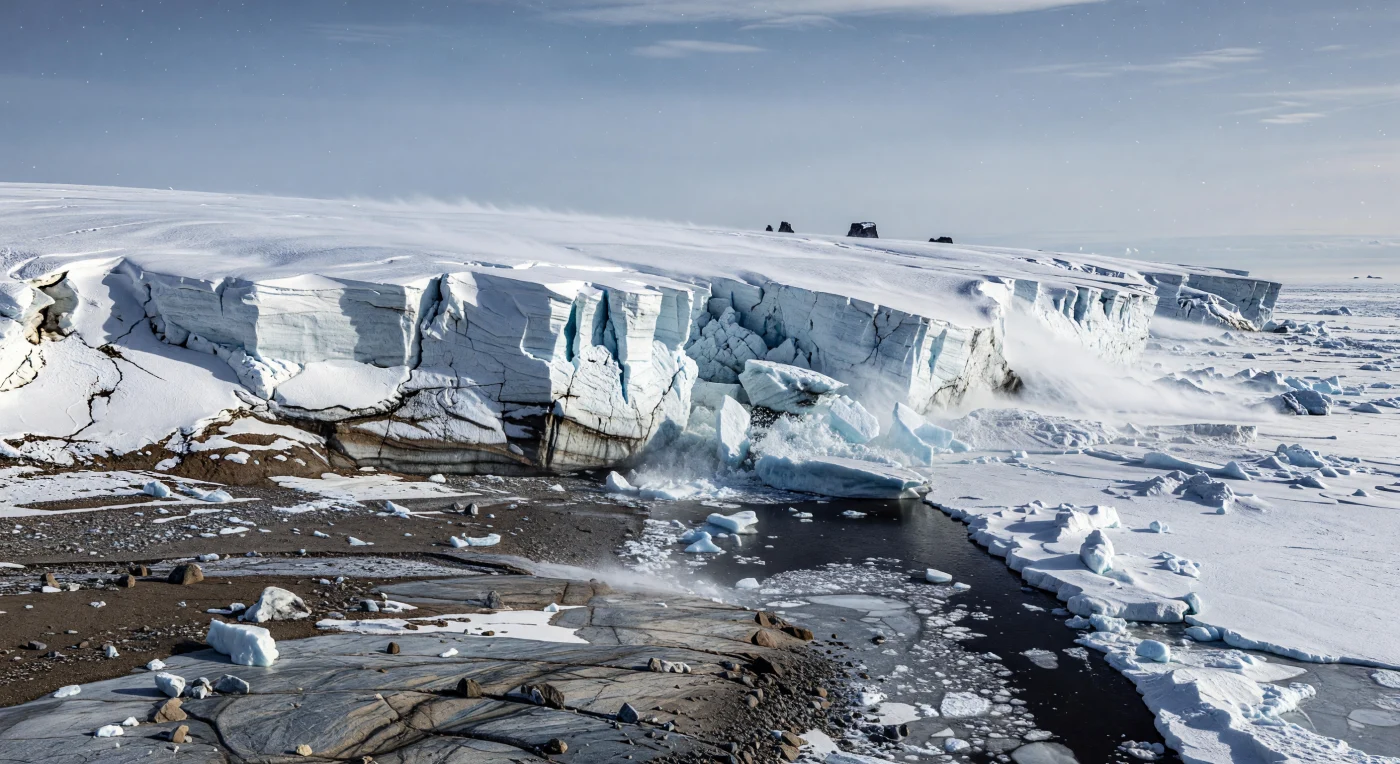
A Cryogenian shoreline during Snowball Earth, about 720–635 million years ago, would have been dominated by grounded continental ice flowing into a floating ice shelf, with fractured blue-white cliffs calving into narrow leads of dark seawater. This scene shows a harsh, nearly ice-covered world of pressure-ridged sea ice, debris-rich glacier ice, and glacially scoured bedrock, with no plants or animals visible on the surface. Such environments left behind the diamictites, striated pavements, and other glacial deposits that provide key evidence for the Sturtian and Marinoan global glaciations.

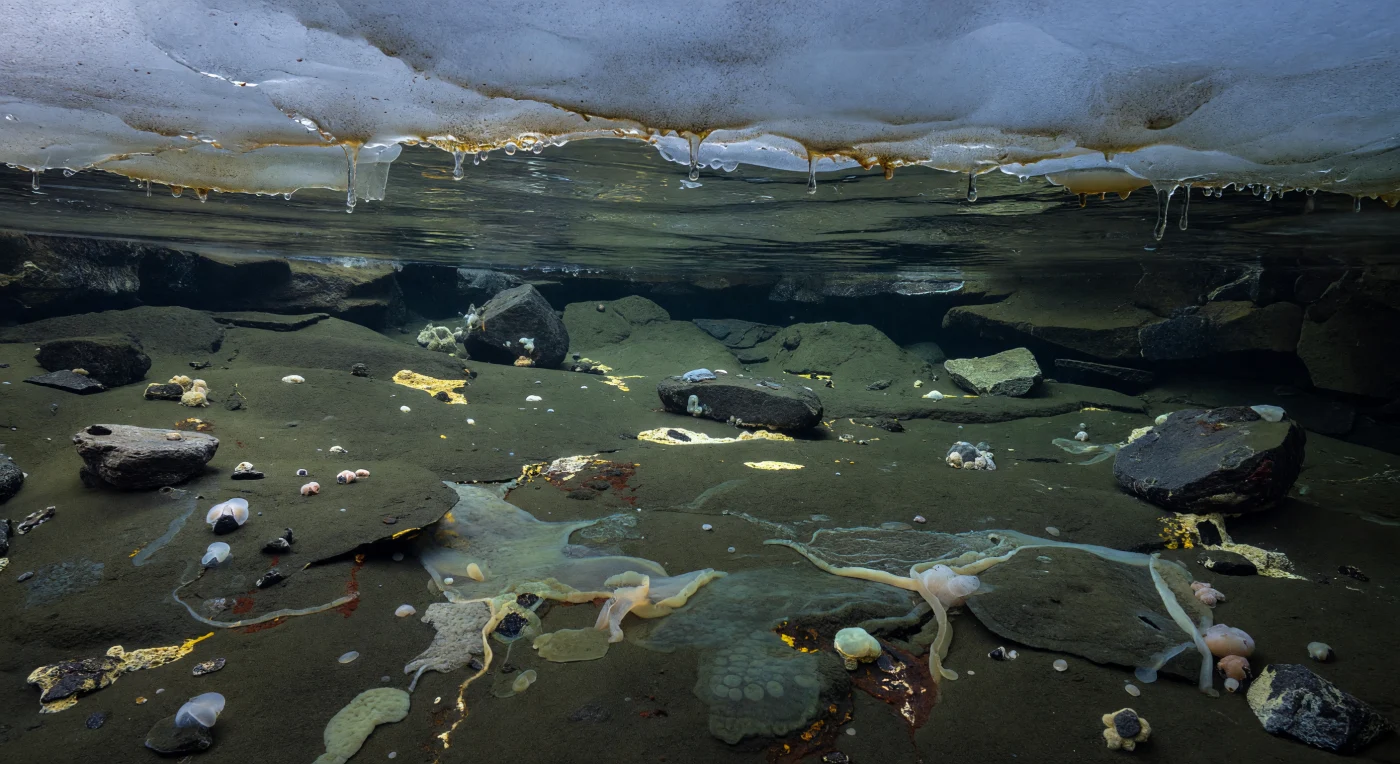
Beneath fractured sea ice on Cryogenian “Snowball Earth,” dim blue-green light falls across a shallow seafloor of basalt cobbles, glacial silt, and wrinkled microbial mats. Attached to the rocks are small vase-shaped early sponges—plausibly stem-group demosponges—living in one of the few habitable sub-ice refuges between about 720 and 635 million years ago. This scene highlights how simple microbial ecosystems and some of the earliest animals may have persisted in cold, low-light marine environments during one of the most severe glaciations in Earth’s history.

In this close-up view of Cryogenian sea ice, about 720–635 million years ago, a maze of saline brine channels winds through dense blue ice, their walls coated with dark cyanobacterial filaments and thin green algal biofilms. Such microscopic refuges may have helped photosynthetic microbes survive during Snowball Earth, when near-global glaciation sealed much of the ocean beneath thick ice. The scene highlights one of the few habitable niches in an otherwise intensely frozen world, where concentrated salts and filtered light created tiny ecosystems within the ice itself.
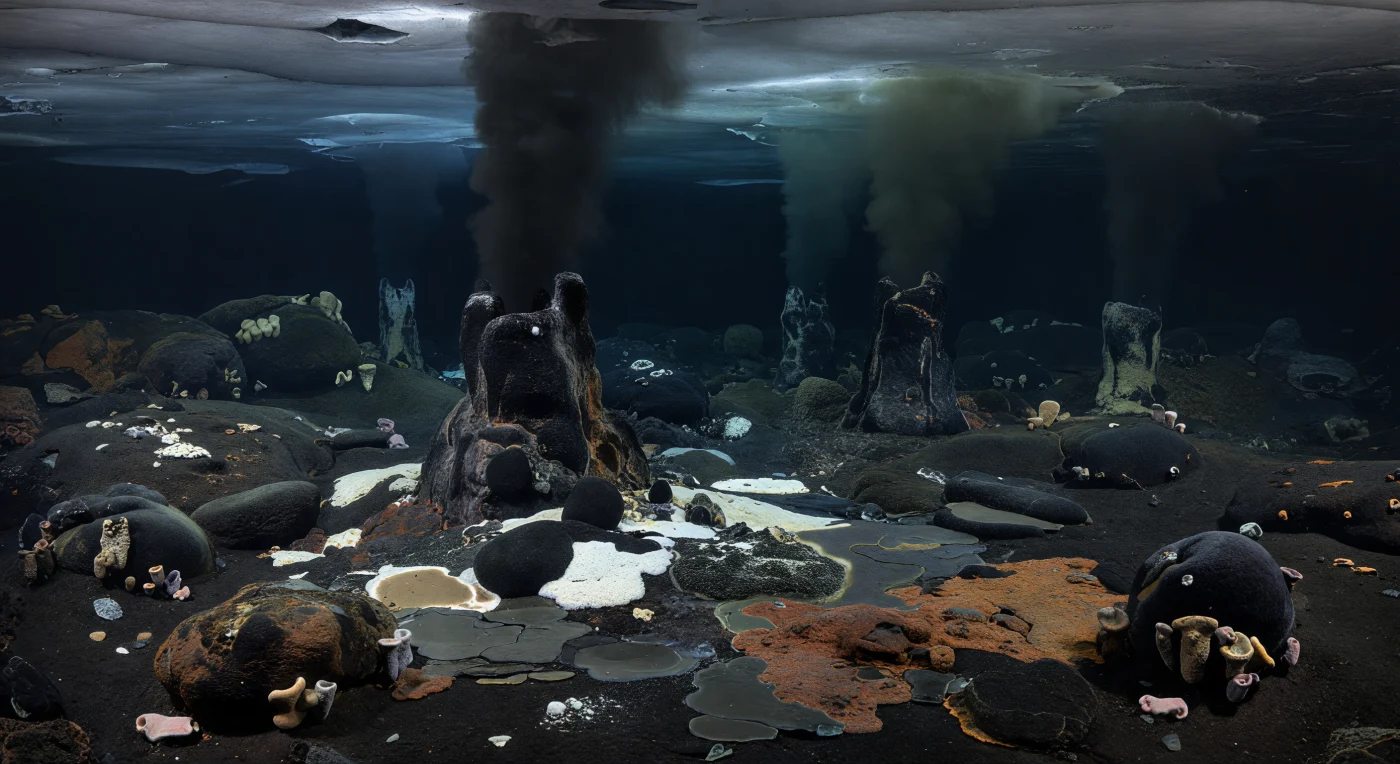
Beneath the global ice cover of Snowball Earth, roughly 720–635 million years ago during the Cryogenian Period, hydrothermal vents may have formed sparse refuges for life on the deep seafloor. This scene shows black smoker chimneys rising from basaltic crust, surrounded by white, orange, and brown microbial mats nourished by chemical energy rather than sunlight. At the cooler margins, a few simple sponge-grade early animals cling to the rocks, hinting at the modest metazoan life that may have persisted in these dark, near-freezing oceans.

A dim, near-freezing seafloor lies beneath a continuous roof of Cryogenian sea ice during Snowball Earth, about 720–635 million years ago. Dark microbial mats and small thrombolitic mounds spread across fine mud and scattered dropstones, while tiny soft-bodied worm-like bilaterians leave faint feeding traces over the sediment. This scene reflects one proposed sub-ice refuge for Precambrian life, where microbial ecosystems may have persisted despite the planet’s near-global glaciation.

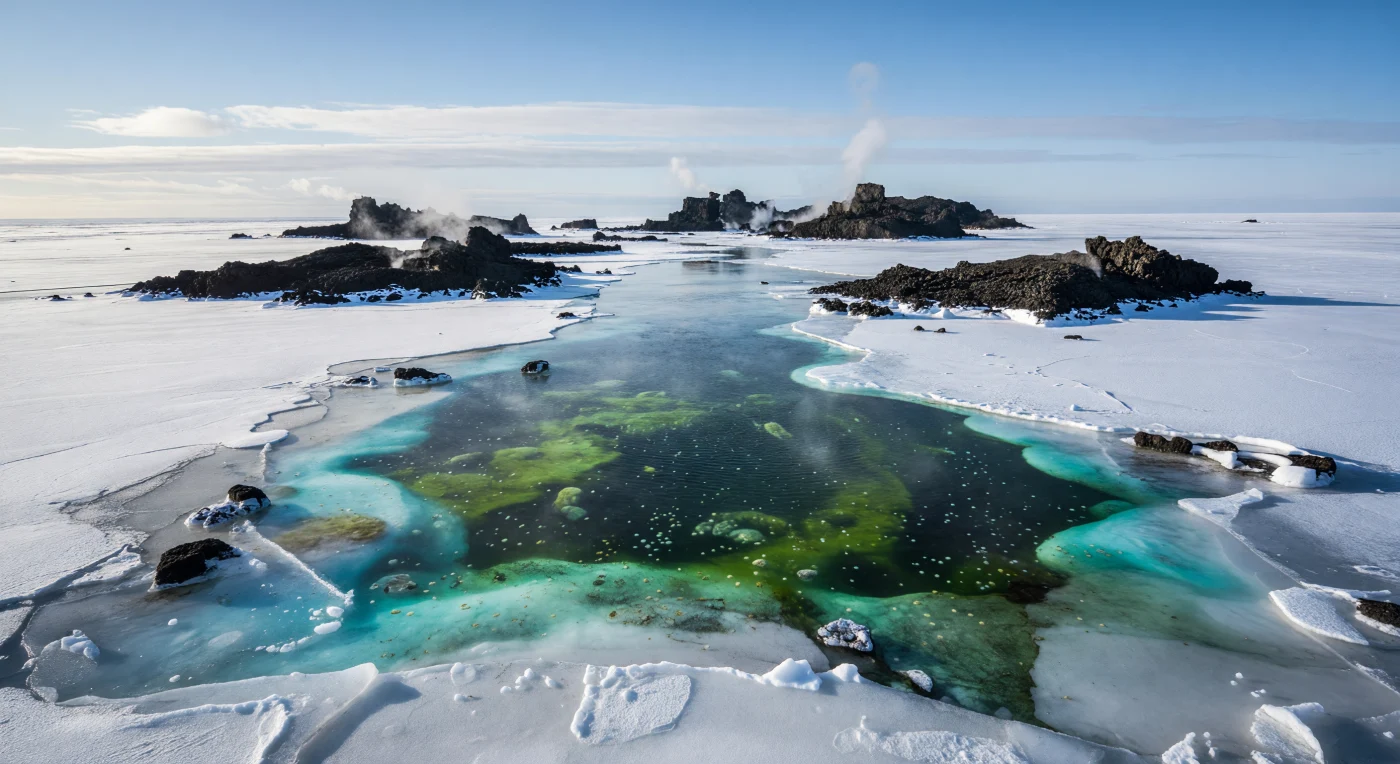
A geothermally maintained volcanic polynya interrupts the nearly continuous sea ice of Cryogenian “Snowball Earth,” about 720–635 million years ago, creating a rare patch of dark open water edged with frazil ice and ash-streaked snow. Beneath the surface, a diffuse green bloom of cyanobacteria and early eukaryotic algae hints at one of the few sunlit refuges for photosynthetic life in this globally frozen world. Basaltic volcanic debris and drifting steam mark the local heat source, while pressure ridges, cracked ice polygons, and distant glacial ice emphasize the immense scale and severity of the Sturtian or Marinoan ice age.