On a quiet outer-shelf slope of the Burgess Shale sea, about 508 million years ago in the middle Cambrian, the muddy seafloor is sparsely inhabited by simple but distinctive animals. Beige Vauxia sponges rise from the soft sediment, flat Choia sponge discs rest on the bottom, tiny Marrella splendens arthropods pick their way across the mud, and pinkish Ottoia prolifica priapulid worms probe from shallow burrows as fine organic particles drift down through the dim water. This scene reflects a low-light marine environment below storm wave base, where soft-bodied communities flourished and were sometimes preserved in extraordinary detail.

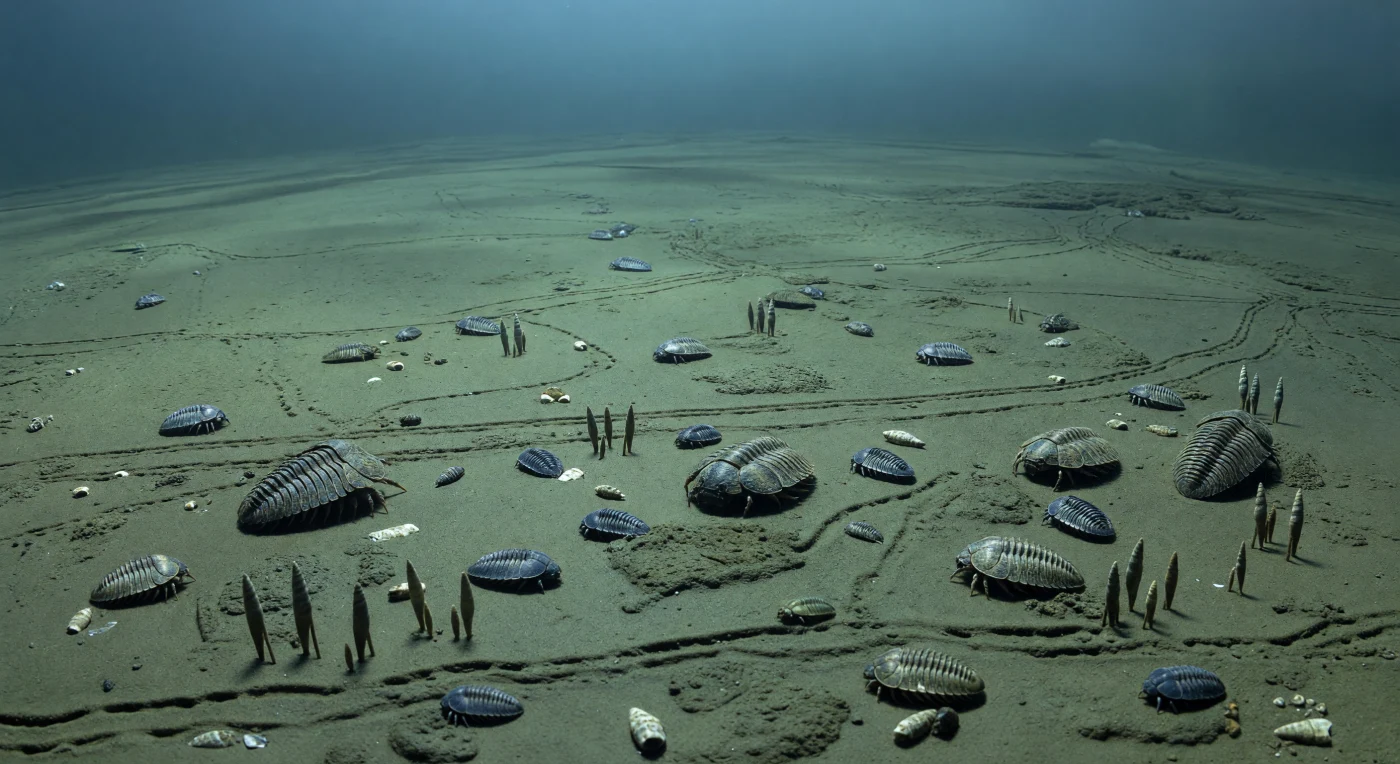
In this Late Cambrian deep-basin setting, around 497–485 million years ago, a sparse community of olenid trilobites such as Olenus and tiny Obolus brachiopods occupies a quiet, oxygen-poor seafloor of black, finely laminated mud. The nearly unburrowed sediment, flecked with pyrite and veiled by a faint haze of suspended particles, reflects dysoxic conditions below storm wave base where only a few specially adapted animals could persist. This stark scene captures one of the darker marine environments of the Cambrian world, long before fishes, reefs, or marine reptiles came to dominate later oceans.

A catastrophic turbidity current sweeps down a middle Cambrian continental slope, smothering a dim seafloor community much like those preserved in the Burgess Shale about 508 million years ago. Branching Vauxia sponges stand amid the mud as Burgessochaeta worms, Canadaspis perfecta arthropods, and spiny Hallucigenia sparsa are engulfed by clouds of fine silt and clay. Such rapid burial in oxygen-poor sediment helped preserve delicate soft-bodied animals that reveal the extraordinary diversity of early marine life.

On a steep outer-slope escarpment in the Middle Cambrian, about 510 million years ago, dim blue twilight reveals a sparse deep-marine community clinging to hard patches above a dark basin. Pale Hazelia and disk-like Choia sponges dominate the rock face, while small stalked eocrinoids rise from firmer sediment and Lingulella brachiopods sit partly anchored in muddy pockets. This scene captures a quiet Cambrian slope habitat below storm wave base, where sponges, early echinoderms, and brachiopods flourished long before fishes, reefs, or marine reptiles came to dominate the seas.

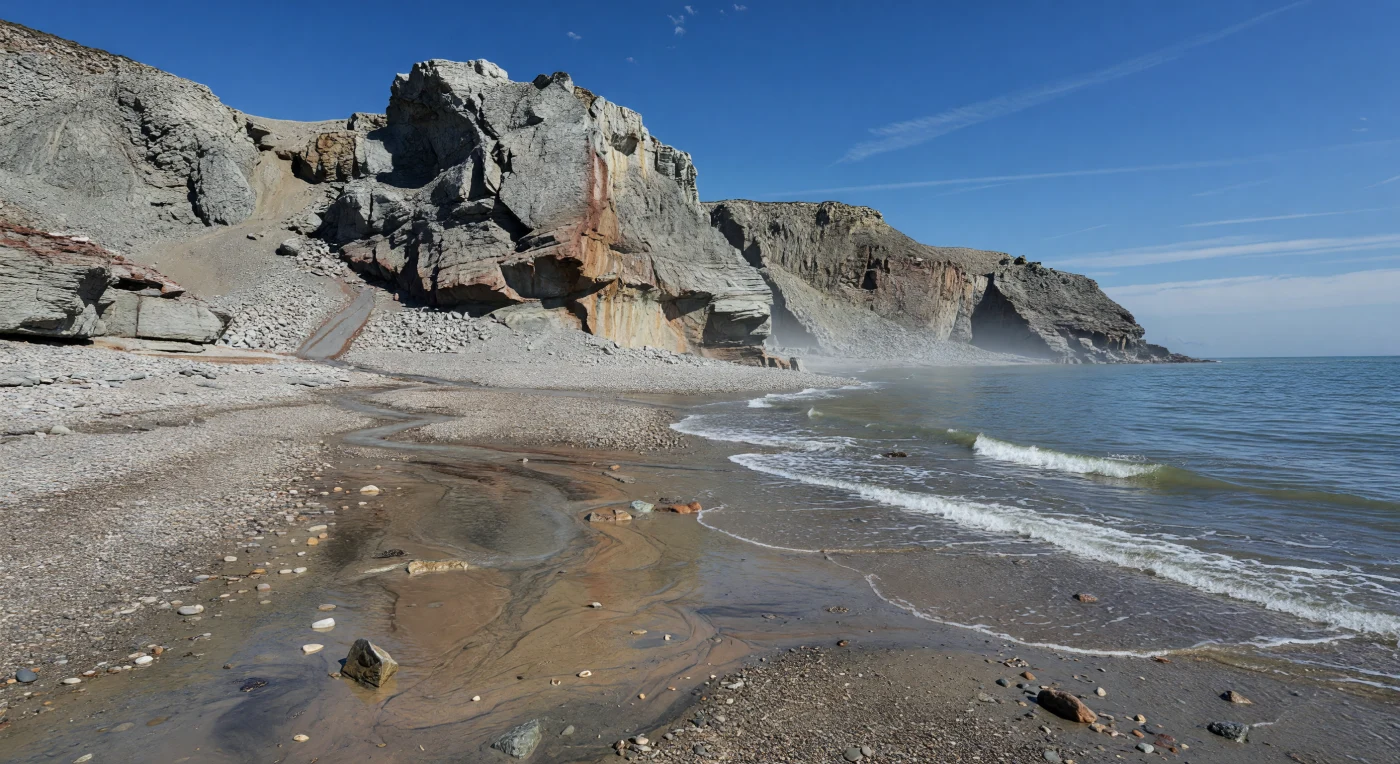
Along a Late Cambrian shoreline about 490 million years ago, the land is stark and barren: bare reddish bedrock, gray sand flats, shallow tidal channels, and dark microbial films spread across damp sediment under a hazy greenhouse sky. No trees, grasses, insects, or vertebrates are present, because complex life was still largely confined to the sea, where offshore basins were inhabited by marine organisms such as trilobites, brachiopods, sponges, and worms. This scene captures the raw coastal surfaces of a pre-vegetated Earth, before plants transformed the continents.

Volcanic shorelines like this could occur along Cambrian coasts roughly 500 million years ago, when Earth’s land remained almost entirely barren of visible plants and animals. Fresh basalt flows, ash-covered gravel flats, steaming fissures, and thin microbial crusts would have bordered warm shallow inlets at the edge of the sea, creating a stark and chemically harsh landscape. Although Cambrian life flourished offshore in oceans inhabited by trilobites, brachiopods, sponges, and other early marine animals, the land itself was still an austere volcanic frontier.