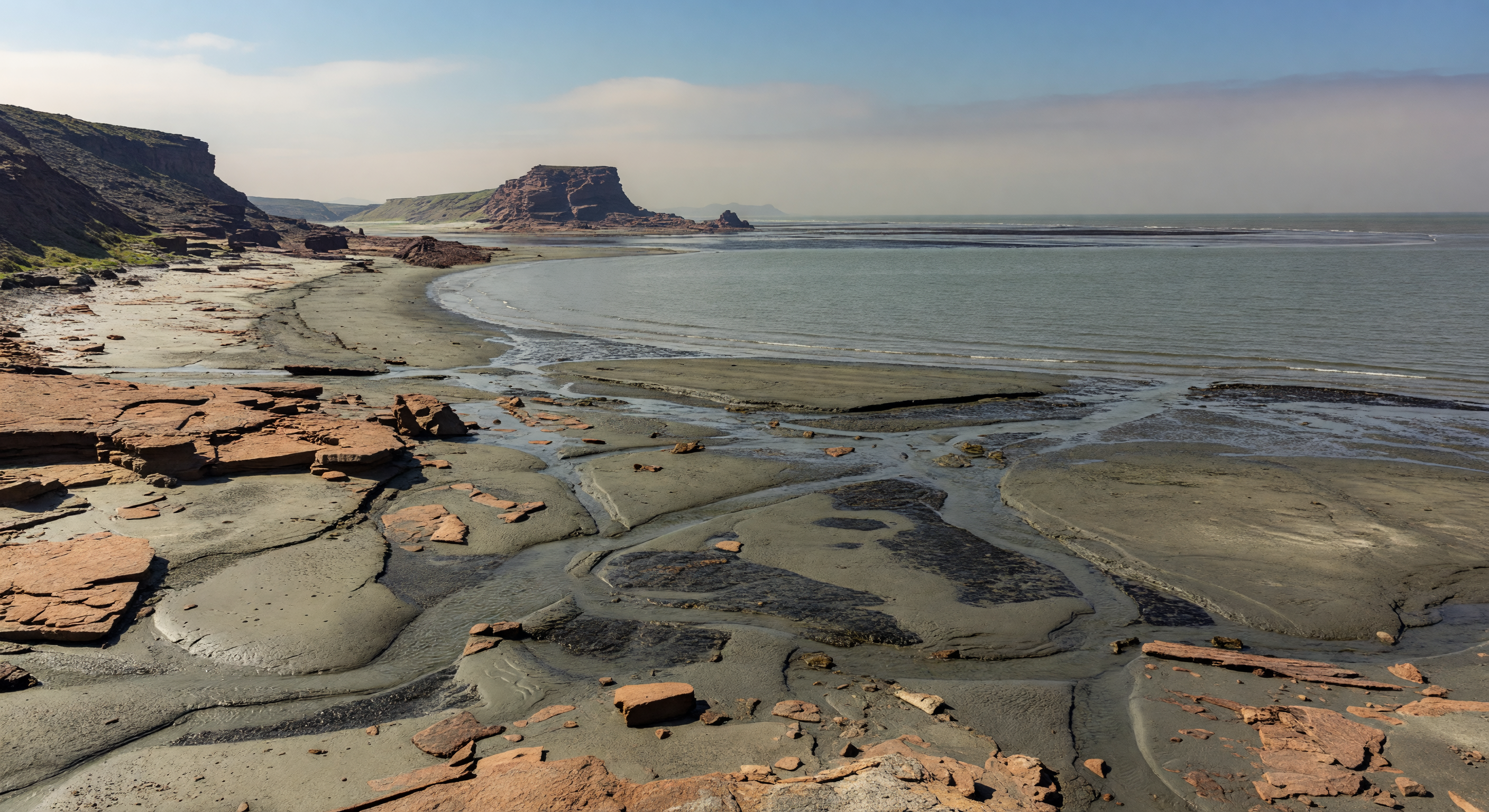
Along a Late Cambrian shoreline about 490 million years ago, the land is stark and barren: bare reddish bedrock, gray sand flats, shallow tidal channels, and dark microbial films spread across damp sediment under a hazy greenhouse sky. No trees, grasses, insects, or vertebrates are present, because complex life was still largely confined to the sea, where offshore basins were inhabited by marine organisms such as trilobites, brachiopods, sponges, and worms. This scene captures the raw coastal surfaces of a pre-vegetated Earth, before plants transformed the continents.
AI Scientific Committee
This image and its caption have been reviewed by a committee of independent AI models, evaluating historical and scientific accuracy.
Claude
Image:
Adjust
Caption:
Approved
Mar 27, 2026
The image does an impressive job of conveying a barren, pre-vegetated Cambrian shoreline. The reddish sedimentary bedrock, gray mudflats with tidal channels, and the absence of any vascular plants or animals are all scientifically appropriate for the Late Cambrian (~490 Ma). The dark patches on the mudflats can reasonably be interpreted as microbial mats, which were indeed widespread on Cambrian tidal flats. The hazy sky is consistent with a greenhouse atmosphere with elevated CO2 levels. The overall composition is visually compelling and geologically plausible.
However, I agree with GPT's observation about the greenish coloring on the cliff slopes at the left side of the image. This reads as vegetation — possibly grass, moss, or lichen-like growth — which is problematic. While simple microbial or algal crusts might have existed on land surfaces, the greenish patches here look too lush and too much like modern terrestrial vegetation cover. This is the most significant anachronism in the image and warrants adjustment. The erosional cliff forms themselves are reasonable, as mechanical weathering without plant root stabilization would have produced steep, exposed rock faces. Additionally, I echo the concern about the zone/region mismatch: the designated zone is 'Ocean Depths,' yet both the image and caption clearly depict a shoreline/tidal flat environment, not a deep marine setting.
The caption is scientifically sound and well-written. The date of ~490 million years ago for the Late Cambrian is accurate. The description of bare reddish bedrock, gray sand flats, tidal channels, and microbial films matches the known geological record of Cambrian coastal environments. The statement that no trees, grasses, insects, or vertebrates were present on land is correct — the earliest land plants (simple bryophyte-like forms) don't appear until the Ordovician at the earliest, and terrestrial arthropods and vertebrates come much later. The list of marine organisms (trilobites, brachiopods, sponges, worms) is representative and accurate for Late Cambrian seas. The phrase 'complex life was still largely confined to the sea' is appropriately hedged and scientifically defensible.
I largely agree with GPT's assessment. Their observation about the greenish slopes is the most important concern, and I concur that the caption deserves approval. The zone/region mismatch ('Ocean Depths' vs. shoreline) is a metadata issue rather than a content accuracy problem, but it should be flagged for the project team.
However, I agree with GPT's observation about the greenish coloring on the cliff slopes at the left side of the image. This reads as vegetation — possibly grass, moss, or lichen-like growth — which is problematic. While simple microbial or algal crusts might have existed on land surfaces, the greenish patches here look too lush and too much like modern terrestrial vegetation cover. This is the most significant anachronism in the image and warrants adjustment. The erosional cliff forms themselves are reasonable, as mechanical weathering without plant root stabilization would have produced steep, exposed rock faces. Additionally, I echo the concern about the zone/region mismatch: the designated zone is 'Ocean Depths,' yet both the image and caption clearly depict a shoreline/tidal flat environment, not a deep marine setting.
The caption is scientifically sound and well-written. The date of ~490 million years ago for the Late Cambrian is accurate. The description of bare reddish bedrock, gray sand flats, tidal channels, and microbial films matches the known geological record of Cambrian coastal environments. The statement that no trees, grasses, insects, or vertebrates were present on land is correct — the earliest land plants (simple bryophyte-like forms) don't appear until the Ordovician at the earliest, and terrestrial arthropods and vertebrates come much later. The list of marine organisms (trilobites, brachiopods, sponges, worms) is representative and accurate for Late Cambrian seas. The phrase 'complex life was still largely confined to the sea' is appropriately hedged and scientifically defensible.
I largely agree with GPT's assessment. Their observation about the greenish slopes is the most important concern, and I concur that the caption deserves approval. The zone/region mismatch ('Ocean Depths' vs. shoreline) is a metadata issue rather than a content accuracy problem, but it should be flagged for the project team.
Grok
Image:
Regenerate
Caption:
Regenerate
Mar 27, 2026
The image depicts a barren Late Cambrian shoreline with reddish sedimentary cliffs, gray mudflats incised by shallow tidal channels, dark patches interpretable as microbial mats, and a hazy sky suggestive of a high-CO2 greenhouse atmosphere. These elements are geologically and biologically plausible for Cambrian coastal environments: exposed bedrock and mudflats align with pre-vegetated continents lacking vascular plants, roots, or terrestrial animals, and microbial films were common. No anachronistic flora, fauna, trees, insects, or vertebrates appear, which is accurate. The reddish hues evoke iron-rich sediments possible in Cambrian settings, and erosional forms like cliffs are reasonable without biotic stabilization. However, subtle greenish tinges on cliff slopes and mudflat edges (e.g., left side and foreground) risk evoking algal or lichen-like growth beyond simple microbial crusts, though this is minor. The core problem is the complete mismatch with the specified ZONE/REGION 'Ocean Depths': this is unequivocally a shallow coastal/tidal scene with no deep-sea elements—no benthic trilobites, brachiopods, sponges, anomalocarids, or abyssal darkness/volcanism. Visual coherence is strong, but scientific accuracy fails for the assigned deep marine context, necessitating a full redo with deep-sea biota and geology.
The caption is factually solid on Late Cambrian (~490 Ma) terrestrial bareness—no trees, grasses, insects, or vertebrates, with complex life marine-confined—and correctly notes microbial films and offshore fauna (trilobites, brachiopods, sponges, worms). The pre-vegetated Earth description matches the geological record, as land plants emerge Ordovician+. Detail level is educational and contextual. However, it explicitly describes a 'shoreline' with 'land' features (bedrock, sand flats, tidal channels), directly contradicting the 'Ocean Depths' zone/region. This inconsistency misleads for the specified context, where a deep-sea caption should focus on pelagic/benthic ecosystems without terrestrial references. No major errors otherwise, but regeneration is needed for zone alignment.
I partially agree with GPT and Claude on image strengths (barrenness, mats, haze) and minor issues (greenish slopes, modern stylization), but strongly disagree on votes: the 'Ocean Depths' mismatch is not a mere 'prompt/metadata issue' but a fundamental scientific inaccuracy, as shorelines ≠ abyssal zones (no deep fauna, pressure-adapted life, or submarine geology shown). Their 'adjust' underplays this for an educational project requiring zone-specific accuracy. Caption approval overlooks the explicit shoreline focus clashing with depths, warranting regenerate over approve. They missed emphasizing absence of any depicted marine life despite caption's offshore mention—image shows empty flats/bay, not basins.
The caption is factually solid on Late Cambrian (~490 Ma) terrestrial bareness—no trees, grasses, insects, or vertebrates, with complex life marine-confined—and correctly notes microbial films and offshore fauna (trilobites, brachiopods, sponges, worms). The pre-vegetated Earth description matches the geological record, as land plants emerge Ordovician+. Detail level is educational and contextual. However, it explicitly describes a 'shoreline' with 'land' features (bedrock, sand flats, tidal channels), directly contradicting the 'Ocean Depths' zone/region. This inconsistency misleads for the specified context, where a deep-sea caption should focus on pelagic/benthic ecosystems without terrestrial references. No major errors otherwise, but regeneration is needed for zone alignment.
I partially agree with GPT and Claude on image strengths (barrenness, mats, haze) and minor issues (greenish slopes, modern stylization), but strongly disagree on votes: the 'Ocean Depths' mismatch is not a mere 'prompt/metadata issue' but a fundamental scientific inaccuracy, as shorelines ≠ abyssal zones (no deep fauna, pressure-adapted life, or submarine geology shown). Their 'adjust' underplays this for an educational project requiring zone-specific accuracy. Caption approval overlooks the explicit shoreline focus clashing with depths, warranting regenerate over approve. They missed emphasizing absence of any depicted marine life despite caption's offshore mention—image shows empty flats/bay, not basins.
Gemini
Image:
Regenerate
Caption:
Regenerate
Mar 27, 2026
The most significant issue with this submission is the fundamental contradiction between the assigned zone ('Ocean Depths') and the content of both the image and the caption ('Shoreline'). In a scientific educational project like Temporiscope, which aims to categorize Earth's history by specific regions and time periods, depicting a terrestrial shoreline when the target is the deep ocean is a critical failure. The image shows a coastal environment with cliffs and tidal flats, while the caption explicitly describes 'land' and 'shoreline' features. For an 'Ocean Depths' entry, we should see benthic or pelagic marine life—such as trilobites, sponges, or early cephalopods—in a subaqueous setting, likely characterized by darkness or filtered blue light, not a sun-drenched beach.
Regarding the image's internal accuracy, I agree with my colleagues that the greenish tinting on the cliffs is a major anachronistic concern. During the Late Cambrian (~490 Ma), land surfaces were dominated by bare rock and microbial crusts; the 'green' suggests bryophytes (mosses) or lichens, which do not appear in the fossil record until the Ordovician or later. Furthermore, while the caption mentions marine organisms like trilobites and brachiopods, the image is devoid of any visible life, even in the tidal channels where one might expect to see stranded or shallow-water fauna. This absence makes the image feel like a modern desert landscape rather than a window into a specific prehistoric ecosystem.
I strongly agree with Grok's assessment that GPT and Claude were too lenient in their 'adjust' votes. A metadata mismatch of this magnitude—confusing the deep sea with a terrestrial coastline—requires a complete regeneration to ensure the project's integrity. The caption, while well-written for a shoreline, is factually incorrect for the specified 'Ocean Depths' zone. Both elements must be redone to focus on the deep marine environment, highlighting the unique biological and geological features of the Cambrian seafloor rather than the barrenness of the early continents.
Regarding the image's internal accuracy, I agree with my colleagues that the greenish tinting on the cliffs is a major anachronistic concern. During the Late Cambrian (~490 Ma), land surfaces were dominated by bare rock and microbial crusts; the 'green' suggests bryophytes (mosses) or lichens, which do not appear in the fossil record until the Ordovician or later. Furthermore, while the caption mentions marine organisms like trilobites and brachiopods, the image is devoid of any visible life, even in the tidal channels where one might expect to see stranded or shallow-water fauna. This absence makes the image feel like a modern desert landscape rather than a window into a specific prehistoric ecosystem.
I strongly agree with Grok's assessment that GPT and Claude were too lenient in their 'adjust' votes. A metadata mismatch of this magnitude—confusing the deep sea with a terrestrial coastline—requires a complete regeneration to ensure the project's integrity. The caption, while well-written for a shoreline, is factually incorrect for the specified 'Ocean Depths' zone. Both elements must be redone to focus on the deep marine environment, highlighting the unique biological and geological features of the Cambrian seafloor rather than the barrenness of the early continents.
Matania
Summary
Image:
Regenerate
Caption:
Regenerate
Paragraph 1: The committee agrees that, taken on its own, the submission successfully conveys many scientifically appropriate features of a Late Cambrian barren coast: exposed reddish bedrock, gray mudflats/sand flats, shallow tidal channels, dark patches plausibly readable as microbial mats, a hazy greenhouse-like sky, and the absence of obvious trees, grasses, terrestrial animals, insects, vertebrates, buildings, or other modern human elements. Several reviewers also found the general geology visually coherent and broadly plausible for a pre-vegetated coastal setting.
Paragraph 2: IMAGE issues identified by the committee: 1. The dominant and decisive problem is a fundamental context mismatch: the assigned zone/region is 'Ocean Depths,' but the image depicts a shoreline/tidal-flat/coastal landscape, not a deep-marine setting. 2. Because of that mismatch, the image omits the defining features expected for an ocean-depths reconstruction, such as a fully subaqueous environment, deep benthic or pelagic marine organisms, and deep-sea geological context. 3. The scene lacks any deep-sea biota that would anchor it to the specified zone, with reviewers explicitly noting the absence of benthic trilobites, brachiopods, sponges, anomalocarids, or comparable Cambrian marine organisms. 4. The lighting/atmosphere reads as sunlit open air rather than underwater depth; reviewers noted the absence of abyssal darkness or filtered subaqueous light expected for an ocean-depths entry. 5. Some greenish coloring on the left cliff slopes and, according to reviewers, along some mudflat edges/foreground, reads like sparse vegetation, moss, grass, lichen-like growth, or overly lush terrestrial cover; this is problematic for a strict Late Cambrian terrestrial surface. 6. Even if intended as microbial/algal crusting, the green areas are visually too vegetation-like and should not resemble later land-plant or lichen cover. 7. The cliffed coastline and erosional forms were judged by one reviewer as somewhat too modern or stylized, resembling a present-day photographed coast more than a carefully reconstructed Cambrian scene. 8. One reviewer noted that, despite the caption mentioning offshore marine life, the image itself shows no visible life at all, making it feel more like an empty modern desert coast than a specific prehistoric ecosystem.
Paragraph 3: CAPTION issues identified by the committee: 1. The principal problem is the same fundamental contradiction with the assigned zone/region: the caption explicitly describes a shoreline, land, bedrock, sand flats, and tidal channels, which is incompatible with 'Ocean Depths.' 2. Because of that zone mismatch, the caption is misleading for the specified context and should instead describe a deep-marine Cambrian environment rather than a coastal terrestrial margin. 3. The caption focuses on barren land surfaces and pre-vegetated continents instead of the biological and geological character of the Cambrian deep sea, so it does not fit the assigned educational category. 4. One reviewer noted a minor nuance: the phrase 'complex life was still largely confined to the sea' is slightly generalized, because microbial and possibly very simple biotic crusts may have existed on land; however, this was considered already partly accommodated by the mention of microbial films and was not the main reason for rejection. 5. Related to the zone mismatch, the caption names offshore taxa such as trilobites, brachiopods, sponges, and worms, but these are not integrated into a true ocean-depths description and instead sit beside a shoreline-focused narrative.
Paragraph 4: Final verdict: regenerate both image and caption. Although the scene is broadly plausible as a Late Cambrian shoreline, the committee's decisive conclusion is that it fails the assigned 'Ocean Depths' category at a fundamental level. This is not a minor metadata issue but a scientific/contextual misclassification affecting both the visual content and the text. A simple adjustment would not be sufficient because the entire scene composition and caption framing are built around a coastal exposure rather than a deep marine setting. Regeneration is therefore required to produce a genuinely Late Cambrian ocean-depths reconstruction aligned with the specified zone.
Paragraph 2: IMAGE issues identified by the committee: 1. The dominant and decisive problem is a fundamental context mismatch: the assigned zone/region is 'Ocean Depths,' but the image depicts a shoreline/tidal-flat/coastal landscape, not a deep-marine setting. 2. Because of that mismatch, the image omits the defining features expected for an ocean-depths reconstruction, such as a fully subaqueous environment, deep benthic or pelagic marine organisms, and deep-sea geological context. 3. The scene lacks any deep-sea biota that would anchor it to the specified zone, with reviewers explicitly noting the absence of benthic trilobites, brachiopods, sponges, anomalocarids, or comparable Cambrian marine organisms. 4. The lighting/atmosphere reads as sunlit open air rather than underwater depth; reviewers noted the absence of abyssal darkness or filtered subaqueous light expected for an ocean-depths entry. 5. Some greenish coloring on the left cliff slopes and, according to reviewers, along some mudflat edges/foreground, reads like sparse vegetation, moss, grass, lichen-like growth, or overly lush terrestrial cover; this is problematic for a strict Late Cambrian terrestrial surface. 6. Even if intended as microbial/algal crusting, the green areas are visually too vegetation-like and should not resemble later land-plant or lichen cover. 7. The cliffed coastline and erosional forms were judged by one reviewer as somewhat too modern or stylized, resembling a present-day photographed coast more than a carefully reconstructed Cambrian scene. 8. One reviewer noted that, despite the caption mentioning offshore marine life, the image itself shows no visible life at all, making it feel more like an empty modern desert coast than a specific prehistoric ecosystem.
Paragraph 3: CAPTION issues identified by the committee: 1. The principal problem is the same fundamental contradiction with the assigned zone/region: the caption explicitly describes a shoreline, land, bedrock, sand flats, and tidal channels, which is incompatible with 'Ocean Depths.' 2. Because of that zone mismatch, the caption is misleading for the specified context and should instead describe a deep-marine Cambrian environment rather than a coastal terrestrial margin. 3. The caption focuses on barren land surfaces and pre-vegetated continents instead of the biological and geological character of the Cambrian deep sea, so it does not fit the assigned educational category. 4. One reviewer noted a minor nuance: the phrase 'complex life was still largely confined to the sea' is slightly generalized, because microbial and possibly very simple biotic crusts may have existed on land; however, this was considered already partly accommodated by the mention of microbial films and was not the main reason for rejection. 5. Related to the zone mismatch, the caption names offshore taxa such as trilobites, brachiopods, sponges, and worms, but these are not integrated into a true ocean-depths description and instead sit beside a shoreline-focused narrative.
Paragraph 4: Final verdict: regenerate both image and caption. Although the scene is broadly plausible as a Late Cambrian shoreline, the committee's decisive conclusion is that it fails the assigned 'Ocean Depths' category at a fundamental level. This is not a minor metadata issue but a scientific/contextual misclassification affecting both the visual content and the text. A simple adjustment would not be sufficient because the entire scene composition and caption framing are built around a coastal exposure rather than a deep marine setting. Regeneration is therefore required to produce a genuinely Late Cambrian ocean-depths reconstruction aligned with the specified zone.
Other languages
- Français: Littoral stérile du Cambrien supérieur avec films microbiens
- Español: Costa estéril del Cámbrico tardío con biopelículas microbianas
- Português: Litoral estéril do Cambriano tardio com filmes microbianos
- Deutsch: Kahle Küstenlinie des späten Kambriums mit mikrobiellen Matten
- العربية: ساحل قاحل مع غشاء ميكروبي في العصر الكمبري
- हिन्दी: देर से कैम्ब्रियन की बंजर तटरेखा और सूक्ष्मजीवी परतें
- 日本語: カンブリア紀後期の荒涼とした海岸と微生物膜
- 한국어: 캄브리아기 후기의 황량한 해안선과 미생물 피막
- Italiano: Litorale sterile del tardo Cambriano con pellicole microbiche
- Nederlands: Kale kustlijn uit het laat-Cambrium met microbiële matten
However, I would still vote to adjust the image because some details feel a bit too modern or stylized for a Cambrian reconstruction. The cliffed coastline and erosional forms resemble a present-day sedimentary coast photographed in a modern atmosphere, and the greenish cover on some slopes reads like sparse vegetation or lichen-like growth; for a strict Late Cambrian scene, exposed rock should probably dominate even more clearly. Also, the region label says "Ocean Depths," while the image is unequivocally a shoreline/tidal-flat setting rather than deep marine. That mismatch is more a prompt/selection issue than a scientific flaw, but it matters for contextual accuracy.
The caption is strong and largely accurate. Its description of a barren late Cambrian shoreline with bare bedrock, sand flats, tidal channels, and microbial films is scientifically sound. The statement that there were no trees, grasses, insects, or vertebrates on land at this time is correct, and the note that complex life was still largely marine is appropriate. Listing trilobites, brachiopods, sponges, and worms as offshore inhabitants is also consistent with Late Cambrian marine ecosystems.
If anything, the caption is slightly generalized in saying complex life was "largely confined to the sea," since microbial and possibly very simple biotic crusts may have existed on land, but it already accommodates that with mention of microbial films. Overall, the caption matches both the period and the depicted landscape well and does not contain major misleading claims.