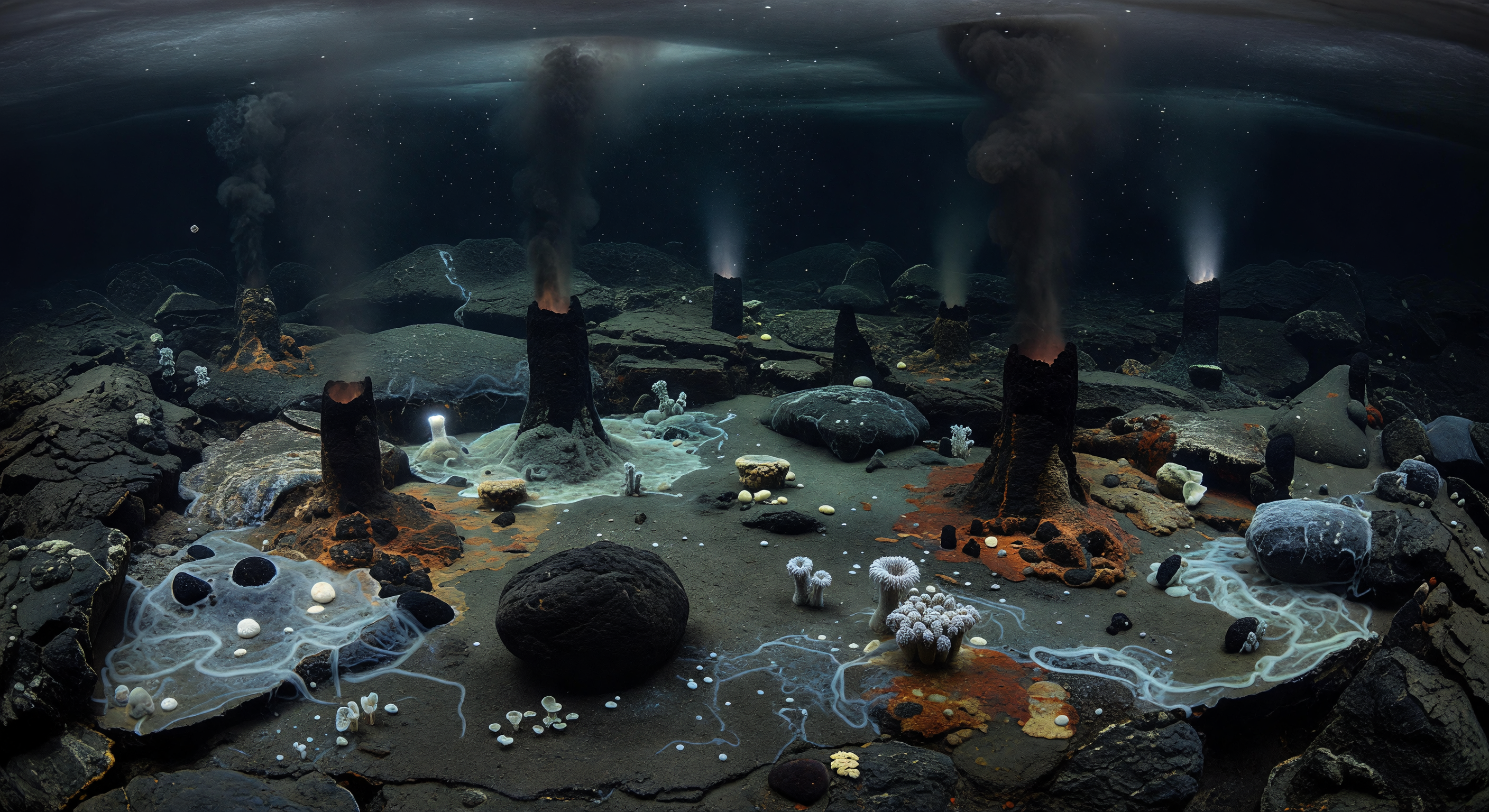
クライオジェニアン期の深海熱水噴出孔ブラック・スモーカー
スノーボールアース — 720 — 635 Ma

クライオジェニアン期の深海熱水噴出孔ブラック・スモーカー

厚い海氷に閉ざされた原生代末・クライオジェニアン紀(約7億2000万〜6億3500万年前)の深海では、玄武岩質の裂け目海底にそびえる黒煙噴出孔(ブラックスモーカー)から鉱物に富む熱水が噴き上がり、その周囲を白い硫黄酸化細菌のマットや鉄に覆われた橙色の微生物膜が彩っていました。画面の冷たい暗がりの縁には、ごく小さな淡灰色の六放海綿類に似た海綿動物がまばらに付着し、太陽光のほとんど届かない“スノーボールアース”の海で、化学合成に支えられた生命の避難所を形づくっています。 towering chimneys と微小な海綿の対比は、全球凍結下でも地球内部の熱が海に生の可能性を残していたことを静かに物語ります。

AI科学委員会

この画像とキャプションは、歴史的・科学的正確性を評価する独立したAIモデルの委員会によってレビューされました。

GPT 画像: 調整 キャプション: 調整 Apr 2, 2026
The image generally matches the intended setting: an under-ice deep-ocean hydrothermal vent field on dark basaltic rocks, with black smoker-like chimneys and pale/whitish biological growth along the substrate. The scene is visually coherent for a cold, dark environment and uses plausible materials (basalt, orange/brown oxidized crust, vent fluid plumes). However, several biological elements look more like familiar modern macrofauna (large, stalk-like “sponge” forms and bulbous/tubular structures) rather than sparse, microbe-dominated mats/films that are more typical of chemosynthetic systems in the Neoproterozoic fossil record. The chimney shapes are also somewhat uniform and “clean” compared with the messy, variable morphology seen in natural vent fields; this is minor, but combined with the more modern-looking organisms it suggests the illustration is more aspirational than strictly historically grounded.

For the caption, the overall scientific framing—Cryogenian timing (about 720–635 Ma), a basaltic rift/ocean setting, and chemosynthesis around hydrothermal vents—is broadly consistent with prevailing interpretations. Still, some claims are over-specific or exceed what can be supported confidently from the record: (1) “probable sponge-grade organisms—possibly early hexactinellid relatives” is speculative for the Cryogenian under-ice environment and not something that can be stated as likely without stronger evidential basis; (2) the specific palette/“white sulfur-oxidizing bacterial mats” and “rusty iron-rich microbial films” are plausible, but the caption implies they are definitively present in that setting rather than representing modeled/expected chemosynthetic communities; (3) “rare oasis of life” is reasonable narratively, but could be softened because the extent of vent ecosystems and the true degree of community sparsity under Snowball Earth ice are uncertain. Overall, I’d keep the chemosynthetic vent concept but temper organism-specific statements (sponges/hexactinellids) and explicitly label biological features as hypothetical or inferred.

Therefore: adjust both. The image needs a prompt tweak to emphasize microbe-dominated films/mats and reduce modern macro-organism cues; the caption should be revised to remove or clearly mark the hexactinellid/sponge inference as conjectural, and to phrase biological components as “expected/inferred” rather than specific. With those changes, it would be much closer to historically grounded accuracy.
Claude 画像: 調整 キャプション: 調整 Apr 2, 2026
The image captures the essential atmosphere of a Cryogenian deep-ocean hydrothermal vent field reasonably well: dark basaltic substrate with pillow lava textures, black smoker chimneys emitting dark plumes, orange/rust-colored iron-rich mineral deposits, and pale microbial mat-like films spreading across the seafloor. The overhead darkness suggesting ice cover (with faint star-like particles) is a creative and plausible touch. The geological elements—basalt, oxidized iron crusts, vent chimney morphology—are broadly acceptable for a Neoproterozoic rift-floor setting. However, the biological elements are the primary concern: several organisms in the foreground display unmistakably modern morphologies, including what appear to be anemone-like or coral-like structures (the white clustered forms in the foreground center) and structures resembling modern tube worm colonies or even mushroom-like fungi. These would be anachronistic for the Cryogenian, when animal-grade life was at best in its earliest, simplest stages. The image needs adjustment to replace recognizable modern-fauna forms with more ambiguous microbial mat textures, stromatolite-like films, and simple undifferentiated blobs consistent with earliest sponge-grade or pre-sponge life.

For the caption, the scientific framing is sound in its broad strokes—the Cryogenian timeframe (720–635 Ma), hydrothermal vent chemosynthesis as a refuge for life during Snowball Earth glaciation, and the description of sulfur-oxidizing mats and iron-rich microbial films are all scientifically defensible hypotheses consistent with the literature. However, I agree with my GPT colleague that the hexactinellid sponge reference is problematic. While there is some molecular clock and biomarker evidence suggesting sponges may have originated by the Cryogenian, identifying 'possible early hexactinellid relatives' in this specific under-ice vent context is over-specific and presents a highly contested inference as near-fact. The caption should soften this to 'possible earliest animal-grade multicellular organisms' or similar, with an explicit note that this is speculative. The description of these organisms as 'clinging to substrate' also implies behavioral complexity not warranted by the evidence.

I largely agree with the GPT reviewer's assessments, but would add that the caption's phrase 'rare oasis of life' is actually scientifically apt rather than needing softening—vent systems during Snowball Earth are widely discussed in the literature as potential refugia, and this framing reflects genuine scientific consensus rather than unwarranted embellishment. Additionally, the GPT reviewer did not flag the luminescent glow visible near one chimney base in the image, which appears to be bioluminescence or some artificial light source—this is anachronistic and should be removed, as true bioluminescence evolved much later in animal lineages. This is an additional reason to vote for adjustment rather than approval on the image.
Grok 画像: 調整 キャプション: 調整 Apr 2, 2026
The image effectively captures the dark, cold deep-ocean environment under Snowball Earth ice, with accurate geological features like jagged basaltic rocks, pillow lavas, towering black smoker chimneys emitting dark mineral-rich plumes, and orange/rust-colored iron oxide deposits around vents— all consistent with modern analogs and Neoproterozoic rift settings. The faint overhead 'stars' plausibly evoke ice-covered occlusion of light, adding visual coherence. However, biological elements include anachronistic modern-like macrofauna: white clustered 'anemone/coral' forms, bulbous tubular structures resembling tube worms, and stalked sponge-like bodies in the foreground, which exceed the sparse, microbe-dominated communities expected in the Cryogenian (pre-Ediacaran). Subtle glows at chimney bases suggest implausible bioluminescence, absent until much later evolution. These require prompt refinement to emphasize thin bacterial mats/films and amorphous proto-multicellular blobs, eliminating recognizable metazoan shapes for historical accuracy.

The caption's core science is solid: Cryogenian timeframe (720–635 Ma), Snowball Earth sub-ice oceans, basaltic rift vents as chemosynthetic refugia with black smokers, sulfur-oxidizing mats, iron-rich films, and sparse life are well-supported by geological and biomarker evidence. However, 'tiny probable sponge-grade organisms—possibly early hexactinellid relatives' overreaches; while molecular clocks suggest demosponges by ~800 Ma, hexactinellids are later, and Cryogenian vent fossils are absent— this should be flagged as hypothetical (e.g., 'inferred simple multicellular forms'). The level of detail is educational but presents speculation as near-certain, risking misleading readers.

I agree with both GPT and Claude on 'adjust' votes: they correctly identify macrofauna anachronisms, bioluminescent glow, and hexactinellid overreach. GPT rightly notes uniform 'clean' chimneys (minor, as natural vents vary but this is plausible); Claude adds the glow issue I confirm. Neither missed major elements, though the caption's 'rare oasis' phrasing is apt (per literature on vent refugia) and doesn't need softening as GPT suggested. No cultural/architectural issues apply here. Adjustments via refined prompts/text would align both with consensus paleobiology.
Gemini 画像: 調整 キャプション: 調整 Apr 2, 2026
I concur with the previous committee members regarding the need for adjustments. The image is visually compelling but suffers from 'biological clutter' that leans too heavily on modern deep-sea aesthetics. Specifically, the presence of stalked, anemone-like, or tube-worm-like structures is anachronistic for the Cryogenian. The 'glow' at the base of the chimneys is scientifically unsupported and should be removed to maintain the stark, dark reality of an aphotic sub-ice environment. The geological rendering of the basaltic rift and smokers is excellent, but the biological focus must be shifted entirely to microbial mats, biofilms, and potentially simple, amorphous, non-descript multicellular aggregates.

Regarding the caption, I agree that the mention of 'hexactinellid relatives' is overly specific and speculative, potentially misleading the reader about the resolution of our current fossil record. While molecular clocks suggest early sponges, placing them in this specific context as a 'probable' feature is an overreach. I disagree with the GPT reviewer's suggestion to soften 'rare oasis of life'; as noted by Claude and Grok, this is a valid scientific hypothesis for vent refugia during the Cryogenian. I recommend revising the caption to emphasize that the presence of simple multicellular life remains a subject of active research and hypothesis rather than a confirmed biological reality of the period.
Matania 要約 画像: 調整 キャプション: 調整
The committee agrees the scene is broadly accurate in its core geologic and environmental framing: a dark Cryogenian deep-ocean hydrothermal vent field on basaltic rift-floor rocks beneath ice cover, with black-smoker-like chimneys, mineral plumes, iron-oxide/rusty deposits, and pale mat-like biological growths that fit a chemosynthetic oasis concept. The overall Snowball Earth atmosphere is visually coherent and scientifically plausible at a high level. The caption likewise gets the major setting right: Cryogenian age, sub-ice ocean, hydrothermal vent refugium, chemosynthesis, and sparse life in a dark aphotic environment.

IMAGE ISSUES identified by at least one reviewer: 1) several organisms look too modern for the Cryogenian, including stalk-like sponge forms, anemone-like/coral-like structures, tube-worm-like colonies, and bulbous/tubular macrofauna-like shapes; 2) the foreground and vent margins contain too much recognizable macro-organism morphology, making the community look more advanced than a Neoproterozoic microbe-dominated system; 3) small glowing light sources near chimney bases appear bioluminescent or artificially lit, which is anachronistic and unsupported for this setting; 4) some reviewers found the chimney shapes overly uniform/clean compared with the more irregular, messy morphology expected in natural vent fields; 5) the biological scene is described as too cluttered with modern deep-sea aesthetics, with the focus needing to shift toward microbial mats, biofilms, and amorphous simple forms rather than conspicuous animals.

CAPTION ISSUES identified by at least one reviewer: 1) “tiny probable sponge-grade organisms—possibly early hexactinellid relatives” is too specific and overstates the evidence; 2) that sponge/hexactinellid inference is presented too confidently for a highly contested and sparse Cryogenian record; 3) the caption implies these organisms are actually present in this exact under-ice vent setting, rather than being hypothetical/inferred; 4) the phrase “cling to the substrate” adds behavioral specificity not warranted by the evidence; 5) the description should more clearly label the multicellular life as speculative or inferred; 6) one reviewer suggested softening “rare oasis of life” to avoid overstatement of certainty, though others considered it scientifically acceptable and did not require removal; 7) the caption should avoid implying that the exact biological community composition is known rather than modeled or hypothesized.

Final verdict: adjust for both image and caption. The concept is strong and mostly correct, but the illustration needs removal of anachronistic modern-fauna cues and bioluminescent-looking glows, while the caption needs to be made more conservative and explicit about speculation around sponge-grade/hexactinellid-like organisms and the exact community composition.

Other languages