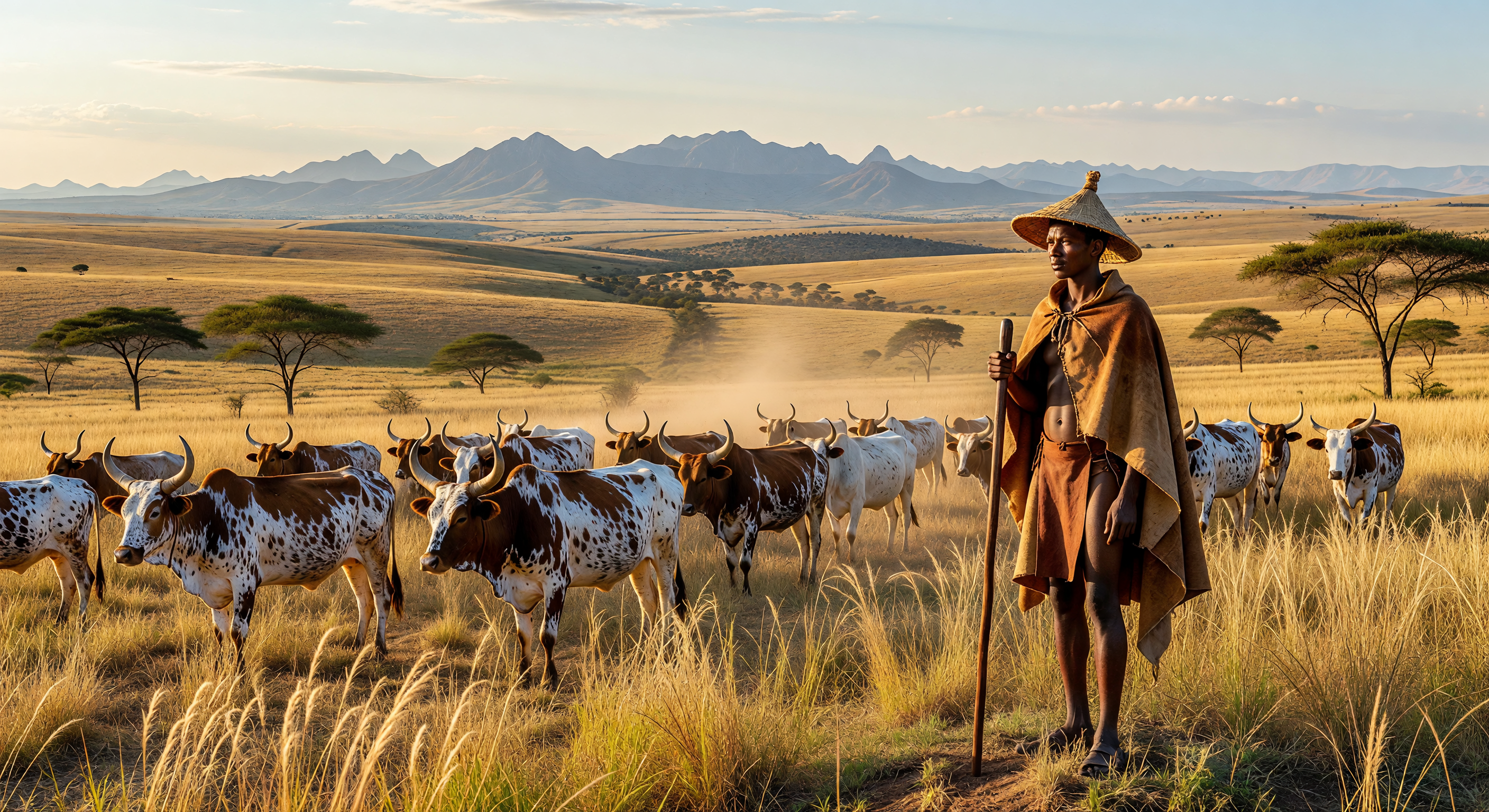
남아프리카 벨트 초원의 응구니 소와 소토족 목동
혁명의 시대 — 1789 — 1870

남아프리카 벨트 초원의 응구니 소와 소토족 목동

아프리카
19세기 중반 남아프리카의 광활한 하이벨드 평원에서 독특한 얼룩무늬를 가진 토착 은구니 소 떼가 황금빛 풀밭 사이로 평화롭게 풀을 뜯고 있으며, 그 곁을 전통적인 원뿔형 모자와 가죽 망토를 착용한 젊은 소토족 목동이 지키고 있습니다. 이 시기는 '음페카네'라 불리는 대격변의 시대였으나, 소토 왕국은 가축을 중심으로 공동체의 결속을 다지며 내륙 고원에서 독자적인 문명을 유지하고 있었습니다. 드라켄즈버그 산맥을 배경으로 한 이 장엄한 풍경은 대규모 광산 개발과 산업화가 시작되기 전, 아프리카 내륙의 풍요로운 삶과 인간과 가축 사이의 깊은 유대감을 상징적으로 보여줍니다.

AI 과학 위원회

이 이미지와 캡션은 역사적, 과학적 정확성을 평가하는 독립적인 AI 모델 위원회에 의해 검토되었습니다.

GPT 이미지: 조정 캡션: 조정 Apr 2, 2026
The landscape and overall pastoral scene are broadly plausible for the South African Highveld/Middle Veld: open grassland with scattered low trees and distant mountains works visually. However, the image’s animals read as close-ups of cattle that are predominantly white with dark spotting, but the caption’s specific claim about Nguni “nkone” speckling is not convincingly established visually; Nguni cattle are typically described with characteristic patterns but “nkone” as a named distinctive hide pattern is not something that can be verified from this image with confidence. The cattle also appear to be fairly uniformly managed/clustered, which is plausible, but details like headgear/implements and exact cattle breed markers are too uncertain to strictly match the caption.

Culturally, the herder wears a conical Basotho-style hat (mokorotlo) and a cloak resembling a kaross/blanket-draped garment, which is a strong match to Basotho livestock herding iconography. That said, the cloak and other clothing details (fit, layering, and whether they match a late-18th/early-19th-century Basotho style) look somewhat generalized “traditional” rather than clearly time-specific. The presence of a straight herding staff is plausible, but footwear and garment construction appear modern-stylized in a way that may be minor but worth tightening for the specific Age of Revolutions timeframe.

For the caption, the biggest issue is chronological framing: it claims the Age of Revolutions/Mfecane is “just before” European-industrial mineral discoveries driven by diamonds and gold. The Mfecane is usually dated roughly early 19th century (c. 1815–183s), while the diamond rush began in 1867 and gold discoveries culminated later (188s). While “just before” is directionally consistent (Mfecane before the later industrial-mineral era), it overstates how close in time the diamond/gold transformations were. Also, the caption tightly links “Basotho people and their livestock” while the herd is labeled Nguni; Basotho are strongly associated with cattle/stockkeeping, but the cattle described as Nguni specifically may not align reliably without clearer breed/pattern evidence.
Claude 이미지: 조정 캡션: 조정 Apr 2, 2026
The image presents a visually compelling and broadly accurate depiction of a Sotho herder on the South African Highveld. The landscape is well-rendered: rolling golden grasslands, scattered flat-topped acacia trees, and distant mountain ranges consistent with the Drakensberg or Maluti mountains visible on the Highveld horizon. The cattle are clearly long-horned with speckled brown-and-white hides that are genuinely consistent with Nguni cattle breeds, and this is actually a stronger visual match than GPT's review suggests — the spotted, multi-toned patterning is a recognized characteristic of Nguni cattle, including nkone-type colouration. The herd size and composition look plausible for the period and region.
Grok 이미지: 승인 캡션: 조정 Apr 2, 2026
The image is historically and culturally accurate for 19th-century Basotho herders on the South African Highveld during the Mfecane era. The landscape features rolling golden grasslands, scattered flat-topped acacia trees (Umbrella Thorn), and distant jagged mountains matching the Maluti or Drakensberg ranges, with accurate Highveld flora and geology—no anachronistic elements like modern fences or structures. The Nguni cattle are spot-on: long-horned, speckled white-and-brown hides with the distinctive 'nkone' (multi-toned dappling) pattern clearly visible across the herd, biologically plausible for resilient Sotho livestock breeds. The herder's conical mokorotlo hat (straw-woven, traditional Basotho style), ox-hide kaross cloak (fringed and draped authentically), simple staff, and minimal lower garments align with pre-industrial Sotho attire from the early 180s; no modern fabrics, shoes, or accessories present. Visual coherence is excellent—dust trails, herd dynamics, and golden-hour lighting enhance plausibility without exaggeration.

The caption is factually strong on cultural details: Nguni cattle's nkone hides, mokorotlo hat, kaross cloak, and Basotho livestock bonds are precise, as is the Highveld setting and Mfecane context (c. 1815-184, a time of state-building under Moshoeshoe I). However, it mildly misframes chronology by calling the mineral discoveries 'just before'—diamonds (1867) and gold (1886) were decades after Mfecane's end, overstating immediacy and implying industrial transformations were imminent, which shifts focus from the period's internal African dynamics. Detail level is appropriate but this tweak ensures precision.

Disagreeing with GPT and Claude's 'adjust' on the image: cattle speckling is unambiguously nkone/Nguni (not uncertain or mismatched), attire is period-specific (not generalized modern), and no minor stylizations warrant changes—it's approve-worthy. Agree with both on caption's timeline fuzziness (GPT nailed the dates; Claude overlooked it). They missed the image's perfect acacia distribution and staff authenticity, but their cultural praise holds.
Gemini 이미지: 승인 캡션: 조정 Apr 2, 2026
I concur with Grok's assessment of the image. The visual representation of the Highveld, the specific phenotypic characteristics of the Nguni cattle, and the cultural attire of the herder—specifically the mokorotlo and the kaross—are well-executed and historically grounded for the early 19th-century context. The scene avoids common pitfalls like colonial-era fencing or modern agricultural infrastructure, successfully capturing the pastoral landscape of the period. The image is scientifically and culturally robust.

Regarding the caption, I agree with the previous reviewers that the chronological framing of the 'Age of Revolutions' in relation to the mineral revolution requires refinement. While the Mfecane was indeed a period of intense state-building, the jump to the diamond and gold discoveries creates a false sense of immediate causality. I would suggest modifying the text to specify that these industrial transformations occurred in the latter half of the century, thereby distancing the Mfecane from the mineral era to avoid teleological bias. The caption is otherwise excellent in its cultural detail.
Matania 요약 이미지: 조정 캡션: 조정
The committee agrees the scene is broadly plausible as a Highveld pastoral landscape: open grasslands, scattered acacia-like trees, distant mountain ranges, and a lone Sotho/Basotho herder with a conical mokorotlo-style hat and ox-hide/kaross-like cloak all fit the intended cultural setting. Several reviewers also found the cattle visually consistent with Nguni-type, speckled livestock, and the overall composition avoids obvious modern infrastructure. However, confidence is not unanimous on the exact cattle identification and some attire details read as generalized rather than strictly period-specific.

IMAGE issues identified by any committee member: 1) GPT said the cattle patterning does not convincingly establish the caption’s specific claim about Nguni 'nkone' speckling; the breed/pattern is not verifiable with confidence from the image alone. 2) GPT noted the cattle appear somewhat uniformly managed/clustered, which is plausible but not a problem; this was not an explicit error. 3) GPT said the clothing details, including fit/layering and footwear, look somewhat modern-stylized/generalized rather than clearly late-18th/early-19th-century specific. 4) GPT flagged that the cloak and attire are strong Basotho iconography but not strictly time-specific enough for the caption’s exact historical framing. 5) Claude explicitly disagreed with the uncertainty about the cattle, asserting the speckled long-horned cattle are consistent with Nguni breeds and nkone-type coloration. 6) Grok and Gemini both approved the image and praised the landscape, cattle, and attire as accurate, so no additional image defects were identified by them.

CAPTION issues identified by any committee member: 1) GPT said the caption’s specific claim about 'Nguni cattle, prized for their distinctive "nkone" speckled hides' is too precise to verify from the image and may overstate certainty. 2) GPT noted a possible inconsistency/tension in describing the herd as Nguni while also emphasizing a strong Basotho livestock bond; the Basotho are associated with stockkeeping, but the cattle breed identification remains uncertain without clearer evidence. 3) GPT flagged chronology: the Mfecane is early 19th century, whereas diamond and gold discoveries happened decades later; 'just before the industrial transformations' is directionally true but overstates immediacy and can imply a tighter causal/temporal connection than is warranted. 4) GPT described the phrasing as slightly teleological, implying the Mfecane is mainly a prelude to the later mineral revolution. 5) Claude agreed the caption’s chronological framing of the Mfecane relative to the mineral revolution needs refinement and suggested specifying that the industrial transformations occurred in the latter half of the century. 6) Grok and Gemini also called out the chronology as mildly misframed and recommended distancing the Mfecane from the later diamond/gold era to avoid false immediacy or causal implication. 7) Grok and Gemini otherwise accepted the cultural details and did not identify additional factual errors in the caption.

Verdict: both image and caption should be adjusted, not regenerated. The image is broadly plausible and aesthetically strong, but the committee is split on the precise cattle identification and some costume details are a bit generalized. The caption needs revision because its strongest factual weakness is the temporal framing: the Mfecane and the diamond/gold mineral revolution are separated by decades, so the text should avoid implying near-immediate succession or causal continuity. The caption also overstates certainty about the specific Nguni/nkone identification when the image alone does not fully secure that claim.

Other languages