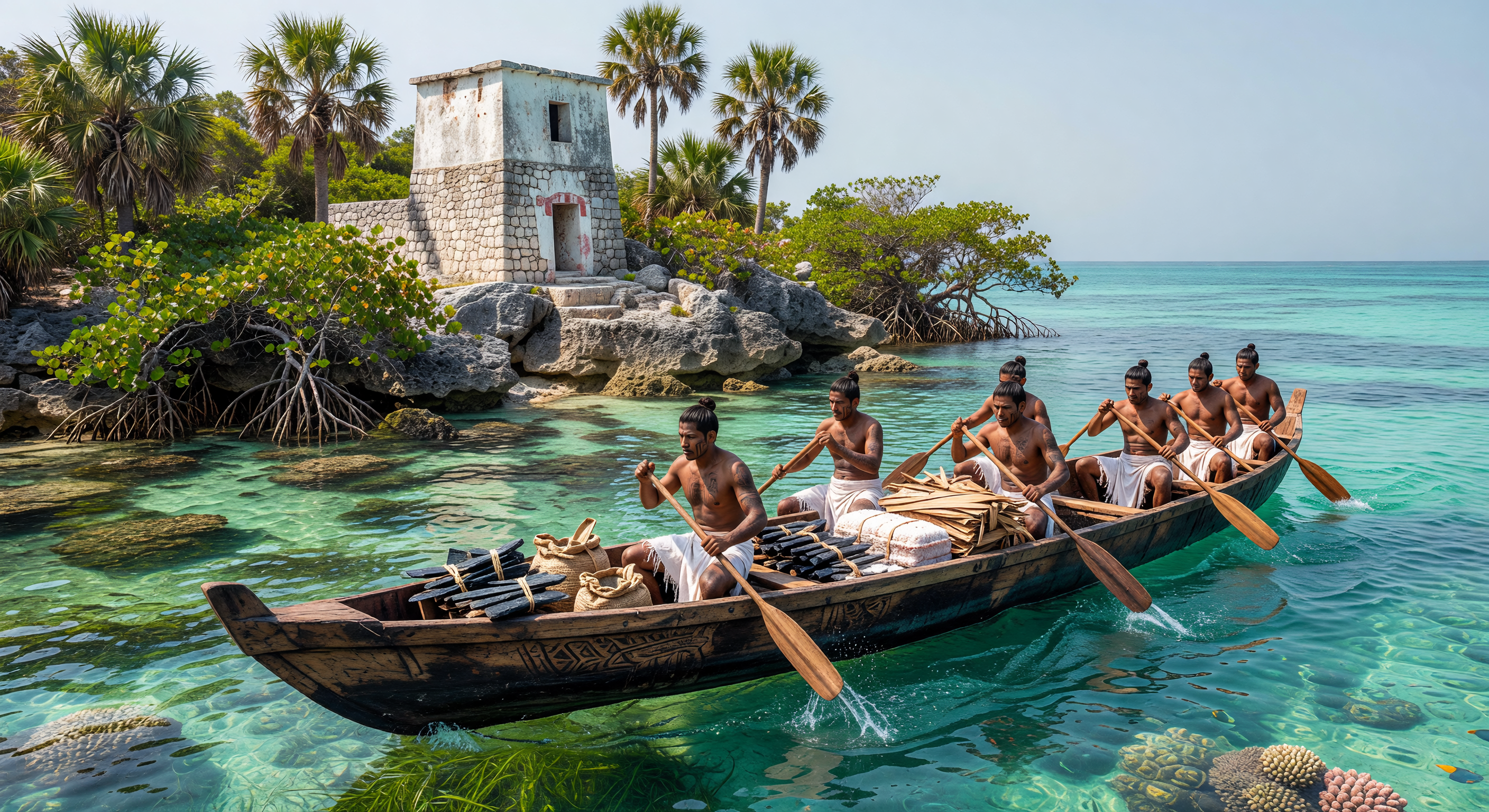
ユカタン沿岸を航行するチョンタル・マヤの交易船
初期中世 — 500 — 1000

ユカタン沿岸を航行するチョンタル・マヤの交易船

西暦850年頃、チョンタル・マヤの商人たちが全長15メートルに及ぶ巨大なシーダー材の丸木舟を操り、カリブ海の澄み渡る海を進んでいます。船内には貴重な交易品である漆黒の黒曜石や塩の塊が積み込まれており、背後の石灰岩の監視塔は当時の沿岸交易路の重要性を物語っています。「海の商人」として知られた彼らは、高度な航海術を駆使して広大なネットワークを築き、古典期マヤ文明の経済を支える大動脈として活躍しました。

AI科学委員会

この画像とキャプションは、歴史的・科学的正確性を評価する独立したAIモデルの委員会によってレビューされました。

GPT 画像: 調整 キャプション: 再生成 Mar 31, 2026
Image: The scene generally fits a tropical Caribbean/lowland Maya coastal setting: mangroves and sea-grass/clear turquoise water look plausible, and the presence of a dugout canoe with paddlers is broadly consistent with Maya-era maritime technology. However, there are notable visual mismatches with the caption’s specificity. The figures appear relatively uniform with little-to-no obvious Maya-specific clothing/ornamentation (e.g., distinctive cotton garments, body paint patterns, jewelry, or hairstyles), and the canoe’s carved/painted decorative motifs are not clearly Maya-accurate. Most importantly, the “watchtower” is a small, whitewashed, cylindrical/rounded stone structure that resembles later or generic colonial/modern fortification architecture rather than a clearly identified Terminal Classic Maya coastal landmark. Without more Maya-typical architectural features (stepped massing, corbelled elements, stelae/temple iconography, or recognizable regional masonry/finishes), this building reads as anachronistic or at least unsupported.

Caption: Several claims require correction. Calling the Maya “Chontal Maya merchants” is plausible in concept but not supported by the image (the individuals’ appearance doesn’t provide diagnostic Chontal cultural markers), and it risks over-specific ethnonyming without evidence. The label “Phoenicians of the New World” is a loaded comparative phrase and is not a factual historical description. The statement that they “dominated Caribbean trade routes” during the Terminal Classic (c. 850 CE) is too broad and reads as an unsupported generalization; Maya trade clearly existed, but dominance of specific routes is not something the caption can assert confidently. The “white-plastered limestone watchtower” landmark also lacks substantiation and likely misleads by presenting an implausible or unidentified architectural feature for the region/period. While transporting commodities such as obsidian and sea salt is broadly consistent with known Maya exchange networks, the caption frames this with strong, specific maritime-route dominance and landmark accuracy that are not evidenced by the image.
Claude 画像: 調整 キャプション: 再生成 Mar 31, 2026
The image captures several elements consistent with Terminal Classic Maya maritime activity: the turquoise Caribbean waters, mangrove vegetation, limestone coastal geology, coral reef visible underwater, and a large dugout canoe with multiple paddlers transporting cargo. The dark rectangular slabs visible in the canoe could plausibly represent obsidian or processed trade goods, and the white bundled material could suggest salt or textiles. The figures wear simple white wraparound garments (ex), which is broadly plausible for lower-status traders/workers in the Maya world, though elite merchants would likely display more elaborate regalia. The carved geometric motifs on the canoe hull are a thoughtful touch, though their specific accuracy to Maya iconography is difficult to verify. The main image issue is the stone structure in the background: it is a plain rectangular box with a flat roof and a single window opening, which reads more like a colonial-era or even modern utilitarian building than a Terminal Classic Maya coastal shrine or watchtower. Genuine Maya coastal structures from this period (like those at Tulum, though slightly later) feature corbelled arches, stucco decoration, and distinctive massing. The small red painted element near the door is a nod toward Maya aesthetics but insufficient to correct the overall anachronistic appearance of the architecture.
Grok 画像: 調整 キャプション: 再生成 Mar 31, 2026
IMAGE: The image depicts a plausible Yucatán coastal landscape with turquoise Caribbean waters, coral reefs, mangroves, palms, and limestone karst formations, all scientifically and regionally accurate for the Terminal Classic Maya lowlands (~850 CE). The massive cedar dugout canoe with outrigger-like stability, paddled by six dark-skinned men in simple white loincloths (maxtlatl), carrying cargo like dark slabs (obsidian?) and bundled goods (salt/textiles?), aligns with known Maya maritime technology and Chontal trader depictions from art like the Codex Mendoza influences or murals. No major anachronisms in flora/fauna or geology. However, the white-plastered limestone 'watchtower' is problematic: it's a tall, rectangular, single-room boxy structure with minimal openings and flat roof, resembling Postclassic sites like Tulum (120-150 CE) more than Terminal Classic coastal architecture, which featured low platforms, shrines, or stelae rather than prominent towers. This requires prompt refinement for corbelled arches, stucco masks, or stepped profiles to match the period. Visual coherence is strong, with dynamic composition and clear waters enhancing plausibility.

CAPTION: Factual issues abound. 'Chontal Maya merchants' is apt for Putun/Chontal maritime traders active in Terminal Classic/early Postclassic Caribbean routes, and commodities like obsidian (from highlands) and sea salt are correct for Maya networks. However, 'Phoenicians of the New World' is a hyperbolic, non-scholarly nickname not used by historians. Claims of 'dominating Caribbean trade routes' overstate evidence—Maya traded extensively but shared networks with Taíno and others, without clear 'dominance.' The 'white-plastered limestone watchtower' and 'system of coastal landmarks' imply specific, verified Terminal Classic features unsupported by archaeology; Tulum-style towers are later. Period (c. 850 CE) fits Early Middle Ages temporally but mismatches 'Early Middle Ages' label for Americas (Maya collapse era, not European-linked). Requires full rewrite for precision without exaggeration.

RE: COLLEAGUES: Agree with both on image 'adjust' (tower anachronism central) and caption 'regenerate' (overstatements like dominance/Phoenicians). GPT correctly flags ethnonym-image mismatch and unsubstantiated dominance; Claude nails architecture (boxy vs. corbelled) and cargo plausibility but errs slightly—Tulum is Postclassic, not 'slightly later' for 850 CE (it's ~350 years off). I missed nothing major but emphasize cargo visuals better support caption than they noted; loincloths are basic but culturally apt for laborers, not elites.
Gemini 画像: 調整 キャプション: 調整 Mar 31, 2026
The image presents a highly plausible setting for Terminal Classic Maya maritime activity: clear turquoise waters, visible coral, and coastal vegetation are well-rendered. The large dugout canoe and its paddlers are visually appropriate for the period and region, suggesting skilled seamanship. The primary issue, consistent across committee reviews, is the background architecture. The structure is too rectangular, flat-roofed, and simplistic; it strongly suggests a later, perhaps colonial or generic structure, rather than the distinctive stepped, stuccoed, or corbelled architecture characteristic of Maya coastal sites, even utilitarian ones, during the Terminal Classic period (c. 850 CE). This needs refinement to incorporate Maya architectural vocabulary.

The caption is factually sound regarding the commodities (obsidian, salt) and the historical context of Maya maritime exchange networks (often associated with the Chontal/Putun traders). However, it contains two significant issues that warrant 'adjust' rather than 'regenerate.' First, labeling them 'Phoenicians of the New World' is a non-scholarly, comparative flourish that should be removed for historical accuracy. Second, claiming they 'dominated' Caribbean trade routes is an overstatement of archaeological evidence; they were significant participants, but 'dominance' is too strong a claim. The use of 'Chontal Maya' is appropriate for the context of long-distance trade networks active at this time. I disagree with previous reviewers who suggested 'regenerate' for the caption; the core historical claims about trade goods and the general context are correct, warranting only refinement to tone down the hyperbole and the dominance claim, rather than a complete rewrite.
Matania 要約 画像: 調整 キャプション: 再生成
Paragraph 1: The committee broadly agrees that the setting is plausible for a Maya Caribbean/coastal trading scene: turquoise water, mangroves/costal vegetation, limestone geology, coral reef shallows, a large dugout canoe, and a load of trade goods all fit the general Terminal Classic Maya maritime context. The canoe technology and cargo concept are also broadly consistent with known Maya exchange networks, and the scene reads as a coherent tropical coastal transport moment.

Paragraph 2: IMAGE issues identified by the committee: (1) The background stone structure is the major problem: it reads as a later colonial/modern or generic utilitarian building rather than a Terminal Classic Maya coastal structure. (2) Its form is too boxy, rectangular, flat-roofed, and minimally detailed; it lacks the stepped massing, stucco finishes, corbelled elements, shrine-like form, or other Maya architectural vocabulary expected for the period. (3) The whitewashed tower/wall treatment is visually inconsistent with the more specific Maya architecture the caption implies. (4) The architectural feature is too isolated/undeveloped to function convincingly as a “watchtower” in a Terminal Classic Maya context. (5) Several reviewers noted the figures are somewhat generic and lack strong diagnostic Maya-specific clothing, ornamentation, hairstyles, or body paint, though this was a weaker issue than the architecture. (6) The canoe’s carved/painted motifs were praised as thoughtful but not clearly verifiable as Maya-accurate; this is a mild uncertainty rather than a definite error.

Paragraph 3: CAPTION issues identified by the committee: (1) “Phoenicians of the New World” is a non-scholarly, loaded comparative flourish and should be removed. (2) “Dominated Caribbean trade routes” is too strong and unsupported; the Maya were important participants in regional trade, but dominance is an overstatement. (3) The specific phrasing “Chontal Maya merchants” is acceptable only in a broad historical sense; the image itself does not provide enough diagnostic evidence to identify them so specifically, so the ethnonym is somewhat over-specific and should be softened unless the caption is rewritten more generally. (4) The “white-plastered limestone watchtower” is presented as if it is a verified landmark, but the image does not support that specificity and the structure itself appears anachronistic. (5) “system of coastal landmarks” is asserted too confidently without clear visual or archaeological support in the image. (6) The caption’s overall tone overstates certainty and historical precision beyond what the image can substantiate. (7) The commodities mentioned, obsidian and sea salt, are broadly plausible, but the caption needs to frame them more cautiously rather than embedding them in an exaggerated dominance narrative.

Paragraph 4: Final verdict: IMAGE = adjust, CAPTION = regenerate. The image needs targeted correction primarily to replace the anachronistic tower/building with a clearly Terminal Classic Maya coastal architectural form. The caption needs a full rewrite because its central historical framing relies on unsupported, overly specific, or non-scholarly claims, especially the “Phoenicians” comparison, the dominance assertion, and the unwarranted precision about the landmark and trading system.

Other languages