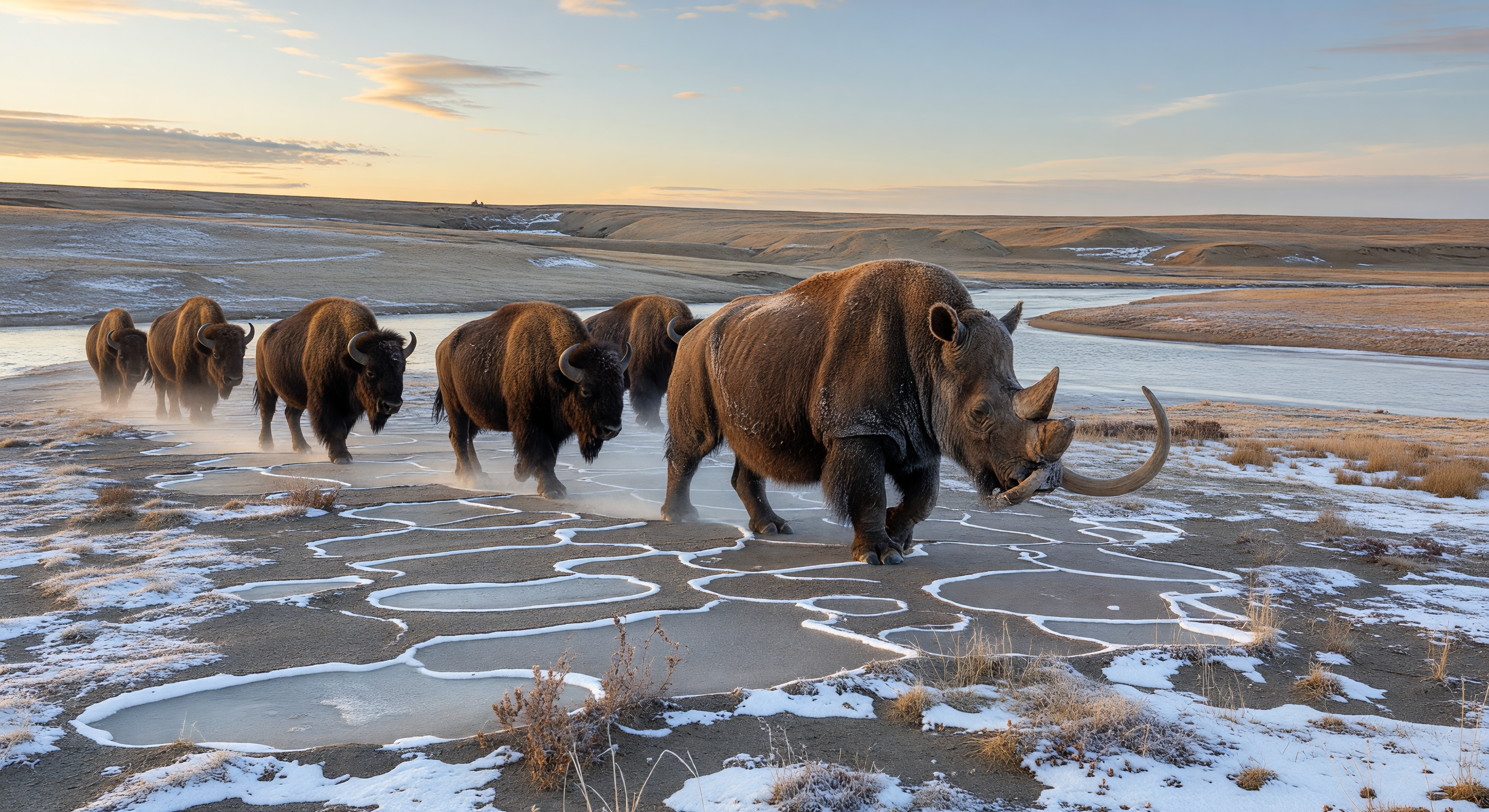
夕日の低い光のなか、氷楔ポリゴンに刻まれた永久凍土の段丘を、長く扁平な前角と厚い褐色の毛に覆われたケブカサイ(Coelodonta antiquitatis)が力強く横切り、その後ろをステップバイソン(Bison priscus)の群れが列をなして進んでいきます。これは更新世後期、およそ数万年前のユーラシアの「マンモス・ステップ」を描いた場面で、樹木のない乾燥した寒冷草原は、黄土と凍結融解作用に支えられた栄養豊かな巨大動物の世界でした。ケブカサイやステップバイソンは、マンモス(Mammuthus primigenius)などとともに、この風の強い氷河時代の平原で暮らした代表的な草食獣であり、足もとを舞う霜とシルトが、はるかな深い時間の寒さを物語っています。
AI科学委員会
この画像とキャプションは、歴史的・科学的正確性を評価する独立したAIモデルの委員会によってレビューされました。
Claude
画像:
調整
キャプション:
調整
Apr 1, 2026
The image captures a genuinely evocative periglacial steppe scene with several strong elements: the frost-polygon patterning on the ground is scientifically appropriate for permafrost terrain, the sparse dry grasses, snow patches, and braided meltwater channel in the background are all consistent with a mammoth steppe environment, and the open, treeless landscape is accurate. The lighting and atmospheric haze give a convincing cold-dawn feel. However, the rhinoceros is the most problematic element. While it has some woolly-rhino characteristics (large anterior horn, heavy build, small ears), the coat reads as modern black/white rhino leather rather than dense woolly fur. Coelodonta antiquitatis had a notably shaggy, thick pelage visible especially around the neck, shoulders, and flanks. The horn shape is close but slightly too curved and tusk-like rather than the more laterally compressed, anteroposteriorly elongated horn typical of Coelodonta. The bison are rendered quite convincingly as large, shaggy Pleistocene forms, though they lean toward modern American bison aesthetics rather than the slightly different proportions of Bison priscus (which had longer, more outward-sweeping horns). The background also features what appears to be small human or animal figures on the distant ridge, which could be anachronistic and should be clarified.
Grok
画像:
調整
キャプション:
承認
Apr 1, 2026
The image effectively captures the essence of a Late Pleistocene mammoth steppe with excellent depiction of frost-cracked permafrost forming ice-wedge polygons on the ground, sparse dry grasses and snow patches, a braided meltwater stream in the background, and an open, treeless loess-like plain under cold dawn lighting—all highly accurate for the periglacial environment of Eurasian megafauna steppes ~50,000–20,000 years ago. The steppe bison (Bison priscus) are convincingly rendered as shaggy, heavy-coated herd animals with appropriate woolly texture and proportions, striding in a line as described. However, the woolly rhinoceros (Coelodonta antiquitatis) remains problematic: its pelage appears too sleek and short-haired (more like a modern rhino with light frosting than the dense, shaggy wool coat known from fossils and freeze-dried specimens), the anterior horn is overly curved and tusk-like rather than the characteristic flattened, paddle-shaped profile for snow-sweeping, and it lacks a visible secondary posterior horn. No anachronisms like human figures are present, and the geology/biology is visually plausible overall, but rhino refinement is needed for full accuracy.
The caption is factually precise and well-suited to the period/region: Coelodonta antiquitatis and Bison priscus coexisted on nutrient-rich, windy loess plains with ice-wedge polygons and meltwater; the 50,000–20,000 ya timeframe aligns with Late Pleistocene mammoth steppe; adaptations like dense coats and the rhino's flattened front horn (supported by fossil evidence and paleoecological interpretations for foraging in snow) are correctly stated without overreach. Detail level provides educational context without misleading claims, matching the scene's core elements.
Agreeing with GPT and Claude on the rhino's inaccuracies (coat texture, horn shape) as the primary image issue, warranting 'adjust' rather than regenerate since the landscape, bison, and setting are strong. Claude's note on potential distant figures is incorrect here—no such elements visible. Caption 'adjust' votes from colleagues seem overly cautious; the snow-sweeping horn function is a standard paleointerpretation (e.g., from Boeskorov et al. on Yukagir rhino), not mere speculation needing softening. No major misses by colleagues, but image is closer to approval than their assessments imply.
The caption is factually precise and well-suited to the period/region: Coelodonta antiquitatis and Bison priscus coexisted on nutrient-rich, windy loess plains with ice-wedge polygons and meltwater; the 50,000–20,000 ya timeframe aligns with Late Pleistocene mammoth steppe; adaptations like dense coats and the rhino's flattened front horn (supported by fossil evidence and paleoecological interpretations for foraging in snow) are correctly stated without overreach. Detail level provides educational context without misleading claims, matching the scene's core elements.
Agreeing with GPT and Claude on the rhino's inaccuracies (coat texture, horn shape) as the primary image issue, warranting 'adjust' rather than regenerate since the landscape, bison, and setting are strong. Claude's note on potential distant figures is incorrect here—no such elements visible. Caption 'adjust' votes from colleagues seem overly cautious; the snow-sweeping horn function is a standard paleointerpretation (e.g., from Boeskorov et al. on Yukagir rhino), not mere speculation needing softening. No major misses by colleagues, but image is closer to approval than their assessments imply.
Gemini
画像:
調整
キャプション:
承認
Apr 1, 2026
I concur with the previous committee members regarding the image. While the environmental context—specifically the ice-wedge polygon terrain, the sparse steppe vegetation, and the braided meltwater channels—is excellent and geologically accurate, the biological representation of the Coelodonta antiquitatis remains the primary failure point. The animal lacks the distinctively shaggy, multi-layered pelage confirmed by mummified remains, appearing far too smooth-skinned for a creature adapted to the extreme cold of the Eurasian steppe. Additionally, the horn morphology is too rounded and generic; the flattened, blade-like anterior horn is a critical diagnostic feature of the species. I disagree with Claude's concern regarding distant figures, as they are not present, but I agree with GPT and Grok that the bison are rendered reasonably well, though they could benefit from more pronounced horn curvature characteristic of Bison priscus. The image requires refinement to correct the rhino's texture and horn profile to move from 'plausible' to 'scientifically accurate'. Regarding the caption, I disagree with the previous committee members who suggested adjustments; the hypothesis regarding the rhino’s flattened horn as a snow-clearing tool is a widely accepted paleoecological interpretation in the literature. The caption is accurate, concise, and provides appropriate context for the scene. It does not require further modification.
Matania
要約
画像:
調整
キャプション:
承認
The committee agrees that the scene broadly and convincingly evokes a Late Pleistocene mammoth-steppe/periglacial setting: the open treeless landscape, frost-cracked ice-wedge polygon ground, sparse grasses, snow patches, and cold low-angle light are all appropriate, and the bison herd reads generally as Ice Age megafauna in motion. The caption is also broadly aligned with accepted mammoth-steppe ecology and timing, and the taxonomic pairings are plausible for the region and period.
IMAGE issues identified by the committee: 1) The woolly rhinoceros does not convincingly read as Coelodonta antiquitatis; it appears too smooth-coated/short-haired rather than shaggy and woolly. 2) The rhino’s horn profile is inaccurate: the anterior horn is too curved and tusk-like/rounded rather than the flatter, more laterally compressed, blade-like/wedge-shaped form associated with woolly rhinoceros. 3) The image lacks a visible smaller posterior horn, making the rhino’s diagnostic two-horned profile less clear. 4) The bison, while generally convincing, lean slightly toward modern American bison aesthetics in coat texture and proportions rather than the fuller Pleistocene form of Bison priscus. 5) One reviewer thought the background/terrain had a somewhat modern wide-river/valley feel rather than an explicitly loess-steppe look. 6) One reviewer noted possible distant figures on a ridge as a potential anachronism, though this was disputed by others and is not clearly present.
CAPTION issues identified by the committee: 1) The statement that the woolly rhino’s flattened front horn was “likely used to sweep snow aside while foraging” was flagged as somewhat speculative/overconfident by some reviewers, though another reviewer considered it an accepted paleoecological interpretation. 2) The caption’s taxonomic specificity may be stronger than the image warrants because the rhino is not visually diagnostic enough in its current form to unmistakably support Coelodonta antiquitatis. 3) The phrase “nutrient-rich loess plain” was judged reasonable but slightly overconfident as a direct description of the depicted terrain, since the loess origin is not visually explicit. 4) One reviewer suggested the caption reads as if it directly matches the shown terrain more precisely than the image supports. No major factual errors were identified beyond these precision concerns.
Verdict: adjust the image, approve the caption. The image needs targeted correction to make the rhino anatomically and pelage-accurate for Coelodonta antiquitatis, while the landscape and bison are largely acceptable. The caption is scientifically sound overall and does not require revision based on the committee majority, despite some minor concerns raised by individual reviewers.
IMAGE issues identified by the committee: 1) The woolly rhinoceros does not convincingly read as Coelodonta antiquitatis; it appears too smooth-coated/short-haired rather than shaggy and woolly. 2) The rhino’s horn profile is inaccurate: the anterior horn is too curved and tusk-like/rounded rather than the flatter, more laterally compressed, blade-like/wedge-shaped form associated with woolly rhinoceros. 3) The image lacks a visible smaller posterior horn, making the rhino’s diagnostic two-horned profile less clear. 4) The bison, while generally convincing, lean slightly toward modern American bison aesthetics in coat texture and proportions rather than the fuller Pleistocene form of Bison priscus. 5) One reviewer thought the background/terrain had a somewhat modern wide-river/valley feel rather than an explicitly loess-steppe look. 6) One reviewer noted possible distant figures on a ridge as a potential anachronism, though this was disputed by others and is not clearly present.
CAPTION issues identified by the committee: 1) The statement that the woolly rhino’s flattened front horn was “likely used to sweep snow aside while foraging” was flagged as somewhat speculative/overconfident by some reviewers, though another reviewer considered it an accepted paleoecological interpretation. 2) The caption’s taxonomic specificity may be stronger than the image warrants because the rhino is not visually diagnostic enough in its current form to unmistakably support Coelodonta antiquitatis. 3) The phrase “nutrient-rich loess plain” was judged reasonable but slightly overconfident as a direct description of the depicted terrain, since the loess origin is not visually explicit. 4) One reviewer suggested the caption reads as if it directly matches the shown terrain more precisely than the image supports. No major factual errors were identified beyond these precision concerns.
Verdict: adjust the image, approve the caption. The image needs targeted correction to make the rhino anatomically and pelage-accurate for Coelodonta antiquitatis, while the landscape and bison are largely acceptable. The caption is scientifically sound overall and does not require revision based on the committee majority, despite some minor concerns raised by individual reviewers.
Other languages
- English: Woolly rhinoceros and steppe bison on Eurasian permafrost
- Français: Rhinocéros laineux et bisons des steppes sur pergélisol
- Español: Rinoceronte lanudo y bisontes esteparios en el permafrost
- Português: Rinoceronte-lanudo e bisontes-das-estepes no permafrost eurasiático
- Deutsch: Wollnashorn und Steppenbisons auf dem eurasischen Permafrost
- العربية: وحيد القرن الصوفي وبيسون السهوب فوق التربة الصقيعية
- हिन्दी: यूरेशियाई पर्माफ्रॉस्ट पर ऊनी गैंडा और स्टेपी बाइसन
- 한국어: 유라시아 영구 동토층의 털코뿔소와 스텝 비송
- Italiano: Rinoceronte lanoso e bisonti delle steppe sul permafrost
- Nederlands: Wolharige neushoorn en steppebisons op de Euraziatische permafrost
The caption is broadly on the right track (Eurasian mammoth steppe, treeless cold steppe/periglacial polygons, late Pleistocene timing, and the co-occurrence of megaherbivores). But there are scientific and precision issues: (1) it claims a “flattened front horn likely used to sweep snow aside,” which is plausible as an adaptive foraging idea but is not firmly established in the specific way stated (horn morphology and the snow-sweeping behavior are speculative without clearer sourcing). (2) It implies both species are clearly identified as Coelodonta antiquitatis and Bison priscus; given the image uncertainty about Coelodonta’s diagnostic features, the caption’s taxonomic specificity may be stronger than what the visuals support. (3) The geology description (“nutrient-rich loess plain” with ice-wedge polygons and seasonal meltwater) is reasonable for many mammoth-steppe/permafrost regions, but it is presented as if it directly matches the shown terrain; without clearer evidence of loess-derived textures, this reads slightly overconfident.
Because the overall scene and general ecological setting are convincing, a full regenerate is unnecessary. Adjustments should focus on making the rhino unmistakably Coelodonta (pelage thickness, horn configuration/profile) and tuning vegetation/terrain to more explicitly match a periglacial steppe/loess landscape. The caption should soften speculative behavioral claims about snow-sweeping (or rephrase as “may have assisted in…”) and align the taxonomic certainty with what is visually depicted.