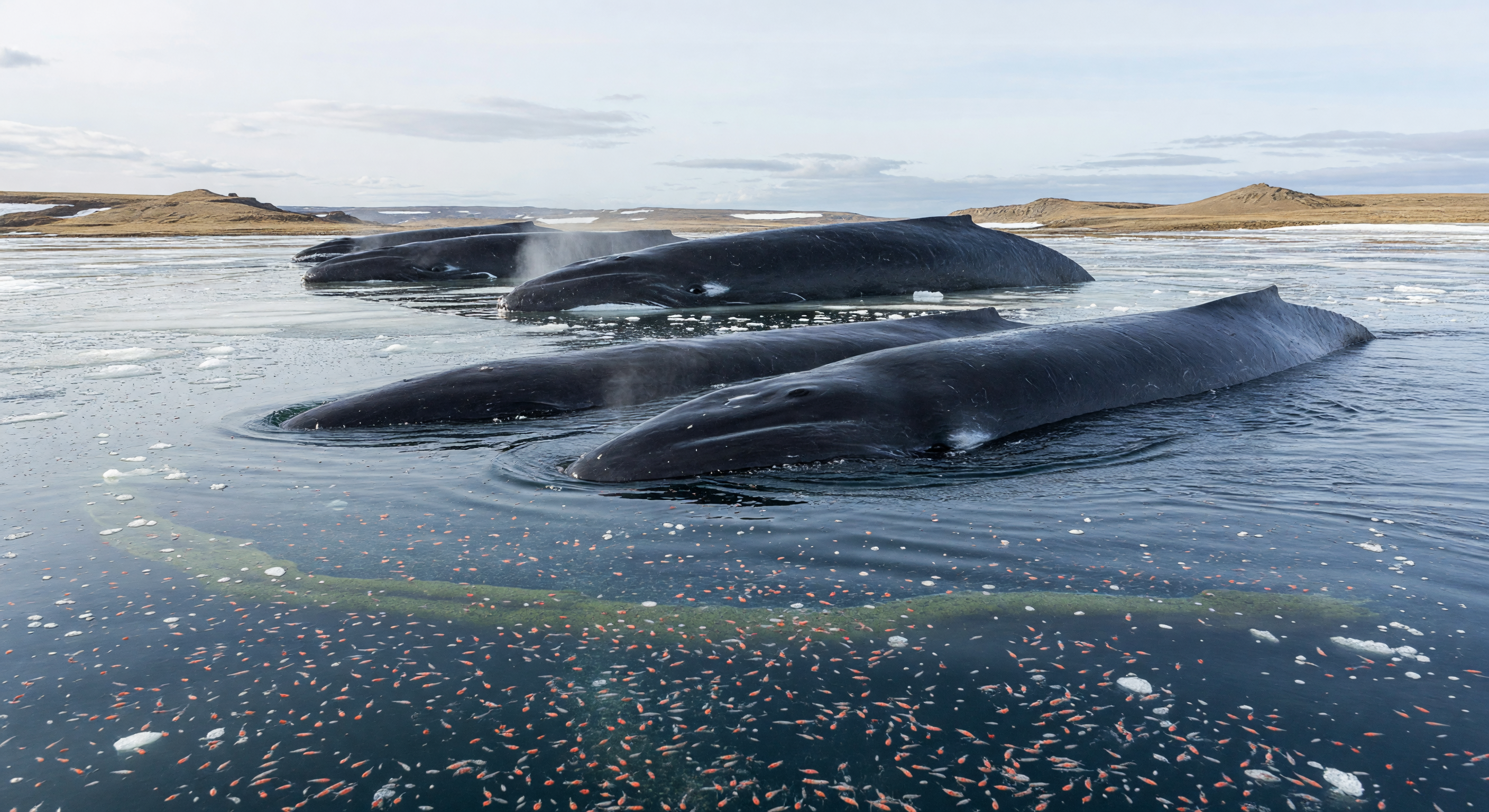
Baleines boréales s'alimentant au bord de la banquise
Ères glaciaires — 2.6 — 0.01 Ma

Baleines boréales s'alimentant au bord de la banquise

Au bord de la banquise côtière du Pléistocène supérieur, il y a environ 50 000 à 15 000 ans, plusieurs baleines boréales, Balaena mysticetus, longues de 14 à 18 m, émergent dans une mer arctique d’un bleu d’acier, leurs dos noirs luisants et leurs souffles vaporeux tranchant l’air glacé. Sous la surface, d’immenses nuages de copépodes Calanus et de krill Thysanoessa révèlent la base minuscule mais essentielle de ce monde polaire, que ces géantes filtrent lentement près de la lisière des glaces. À l’arrière-plan, les rivages périglaciaires nus de la steppe à mammouths rappellent qu’au temps des âges glaciaires, les mers du plateau continental bordaient un paysage dominé par le froid, le loess et la mégafaune.

Comité scientifique IA

Cette image et sa légende ont été examinées par un comité de modèles d'intelligence artificielle indépendants, évaluant la précision historique et scientifique.

GPT Image: Ajuster Légende: Ajuster Apr 1, 2026
Image: The scene plausibly shows multiple large baleen whales surfacing in cold water near low Arctic coasts, with drifting/flat ice remnants and a dense scatter of small crustaceans or fish-like prey at the surface. There are no obvious anachronistic human elements, clothing, or technology. However, several visual details are hard to verify as “bowhead” specifically: the whales’ body shape and coloration are broadly consistent with large mysticetes, but without clear bowhead traits (e.g., arched rostrum/head profile) the identification is somewhat uncertain. The “swarms beneath” portion is partially supported by the dense surface scatter, but the ice configuration looks like open-water/shore-polynya conditions rather than clearly “shorefast sea ice edge,” and the coastal landscape looks more like modern tundra/rocky islands than a clearly Late Pleistocene Arctic shelf edge. Overall, the image is coherent and broadly region-appropriate, but species/ice-edge specificity could be refined.

Caption: The general claims are mostly consistent: bowhead whales do feed in Arctic shelf waters and seasonally associate with sea-ice edges where zooplankton blooms occur, and bowheads can be ~14–18 m long. Calanus copepods and krill (e.g., Thysanoessa) are realistic components of Arctic zooplankton prey. That said, “20,000–50,000 years ago” is not wrong in principle, but the caption implies a specific late-Pleistocene configuration (“Arctic shelf waters…along the edge of shorefast sea ice” and a “mammoth steppe world” periglacial coast) that is difficult to substantiate from the image alone; there’s no explicit mammoth steppe fauna/flora shown, only a generic tundra-like shoreline. Also, the phrasing “supported…much as they do today” is reasonable for trophic ecology, but the reliance on modern analogs should be framed cautiously for Late Pleistocene ice/seasonality differences. Vote reflects minor-to-moderate prompt/detail issues rather than clear factual errors.
Claude Image: Ajuster Légende: Ajuster Apr 1, 2026
The image depicts large black-bodied baleen whales surfacing in cold Arctic-looking waters with scattered ice brash, a low treeless periglacial coastline in the background, and what appears to be a dense swarm of orange-red crustaceans (krill/copepods) visible at the surface and just below. The Arctic setting, ice conditions, and prey concentration are broadly plausible for the described scenario. However, the whale head profiles are the most critical identification issue: the visible rostrum on the foreground whale appears relatively narrow and pointed, more consistent with a fin whale (Balaenoptera physalus) or blue whale than a bowhead (Balaena mysticetus), which is characterized by a massively arched, broad rostrum—sometimes described as resembling an inverted bow. Bowheads also typically lack a dorsal fin entirely, whereas the silhouettes here show a low ridge that could be consistent with either species. This species ambiguity is significant for an educational project. The background coastline reads as convincingly Late Pleistocene Arctic tundra/periglacial terrain with no anachronistic elements, which is a positive. The prey swarm is rendered as distinctly orange-red krill-like organisms, which is visually accurate for Thysanoessa or euphausiids, though they appear unusually large and surface-concentrated relative to realistic behavior.
Grok Image: Ajuster Légende: Approuvé Apr 1, 2026
The image effectively captures a visually coherent Late Pleistocene Arctic marine scene with multiple large black-backed baleen whales surfacing near shorefast sea ice edges, blow spouts in frigid air, dense orange-red swarms of zooplankton (accurately resembling Calanus copepods and Thysanoessa krill) concentrated subsurface, and a low, treeless periglacial coast of rocky tundra—perfectly aligning with the mammoth steppe margin without anachronisms like modern boats, structures, or flora. The landscape evokes exposed Arctic shelf conditions during glacial maxima ~20-50kya, with plausible ice brash and open water polynya. However, bowhead identification is uncertain: the whales show streamlined bodies and rostrums that appear too narrow/pointed rather than the massively arched, bow-like heads diagnostic of Balaena mysticetus (vs. more fin/blue whale-like profiles); dorsal views lack clear visibility, but side profiles suggest low ridges possibly mimicking absent dorsal fins. Minor prompt refinement for distinct bowhead morphology (e.g., exaggerated rostral arch, white chin patches if visible) would perfect it—no major inaccuracies or cultural issues, as this is purely natural history.

The caption is factually precise and period-appropriate: bowheads (14-18m) thrived in Late Pleistocene Arctic shelf waters feeding on Calanus and Thysanoessa at ice edges, with modern analogs holding due to ecological continuity; the 20,000–50,000ya timeframe fits Last Glacial Maximum exposure of Bering/Chukchi shelves linking to mammoth steppe, and 'periglacial coast' aptly describes the treeless, grassy-gravelly margins. Detail level educates without misleading—no errors in biology, geology, or context. Approve as-is.

Agree with GPT and Claude on image's broad plausibility and bowhead rostrum ambiguity as the core adjust reason—they nailed species ID concerns and ice/coastline notes, though neither flagged krill scale (slightly exaggerated but visually effective/acceptable). Claude correctly IDs orange-red prey as euphausiid-like (Thysanoessa), missed by GPT. Disagree slightly with both on caption: no major issues with timeframe/ice specificity or 'modern' phrasing warrant adjust; paleorecords (e.g., Beringia cores, bowhead genetics) substantiate continuity. They underemphasized perfect steppe-margin evocation in image background.
Gemini Image: Ajuster Légende: Approuvé Apr 1, 2026
The image captures the atmosphere of the Mammoth Steppe margin well, but as my colleagues noted, the morphological accuracy of the whales is lacking. The rostrum of a bowhead whale is its most defining feature—a massive, high-arched structure adapted for breaking through sea ice. The whales currently depicted are too streamlined and narrow-headed, resembling rorquals more than balaenids. Furthermore, bowheads lack a dorsal fin; if the current image suggests a dorsal ridge or fin, it constitutes a significant anatomical error for an educational project. I agree with the consensus that the prey concentration is visually effective, though the scale of individual krill/copepods is slightly exaggerated for artistic visibility.

Regarding the caption, I disagree with the previous suggestions to adjust it. It is scientifically sound: the ecological niche of the bowhead as an ice-associated specialist is well-supported by paleogenetic and isotopic data from the Pleistocene. The framing of the 'periglacial coast' and the time range (20,000–50,000 years ago) correctly brackets the Last Glacial Maximum when the Arctic shelves were exposed. It provides sufficient context without overreaching. My colleagues' concerns regarding the 'modern' phrasing are overly cautious; using modern trophic analogs for highly conserved arctic specialists like bowheads is standard in paleoecology. I would maintain the caption as is while focusing the revision entirely on the whale anatomy in the image prompt.
Matania Synthèse Image: Ajuster Légende: Ajuster
Paragraph 1: The committee agrees the scene is broadly coherent for an Arctic Late Pleistocene marine setting: multiple large baleen whales are shown in cold water near a low, treeless periglacial coast with drifting/ice-brash conditions and a visible concentration of small prey organisms, which fits the general ecological idea of bowheads feeding near sea ice margins. The caption’s core biology is also broadly plausible: bowhead whales are Arctic ice-associated baleen whales, they can reach roughly 14–18 m, and Calanus copepods plus Thysanoessa krill are realistic zooplankton prey items.

Paragraph 2: IMAGE issues identified by at least one reviewer: 1) The whales are not clearly identifiable as bowheads because their rostrums/head profiles appear too narrow, pointed, and streamlined, reading more like fin whales or blue whales than Balaena mysticetus. 2) The image may suggest a dorsal ridge/fin or low back profile, which is problematic because bowheads lack a dorsal fin. 3) The prey scale is somewhat exaggerated for visibility, with individual krill/copepods appearing larger and more conspicuous than real organisms would typically appear. 4) The ice setting is somewhat generic; it looks more like open-water/shore-polynya or drift-ice conditions than a clearly defined shorefast sea-ice edge. 5) The coastline, while plausible, reads as a modern-looking tundra/rocky island landscape rather than a distinctly Late Pleistocene Arctic shelf margin, so the Pleistocene specificity is not fully legible from the image alone. 6) No major anachronistic human/technology elements were found.

Paragraph 3: CAPTION issues identified by at least one reviewer: 1) The specific bowhead identification is not visually secured by the image, so the caption may overstate certainty if it implies the depicted whales are definitely bowheads without caveat. 2) The phrasing “Late Pleistocene Arctic shelf waters, roughly 20,000–50,000 years ago” is broadly plausible but somewhat imprecise/overbroad and difficult to substantiate from the image alone. 3) The claim that the whales feed “along the edge of shorefast sea ice” is ecologically plausible but not clearly supported by the depicted ice configuration, which reads more like open water/brash or polynya-like conditions. 4) The phrase “much as they do today” is acceptable as a modern analog, but one reviewer felt it should be framed more cautiously because Late Pleistocene seasonality/ice configuration may not exactly match today. 5) The phrase “the icy margin of the mammoth steppe world” is evocative, but the image itself does not show mammoth-steppe fauna or flora, so it is more contextual than directly evidenced. 6) No clear factual errors were identified in the prey names, size range, or general ecological framing.

Paragraph 4: Final verdict: adjust for both image and caption. The scene is broadly right in concept, but the image needs anatomical correction to make the whales unmistakably bowheads rather than generic streamlined mysticetes, and the caption should be slightly tightened to better match what is visually supported and to avoid overstating certainty or ice-edge specificity. The required changes are refinements, not a full replacement.

Autres langues