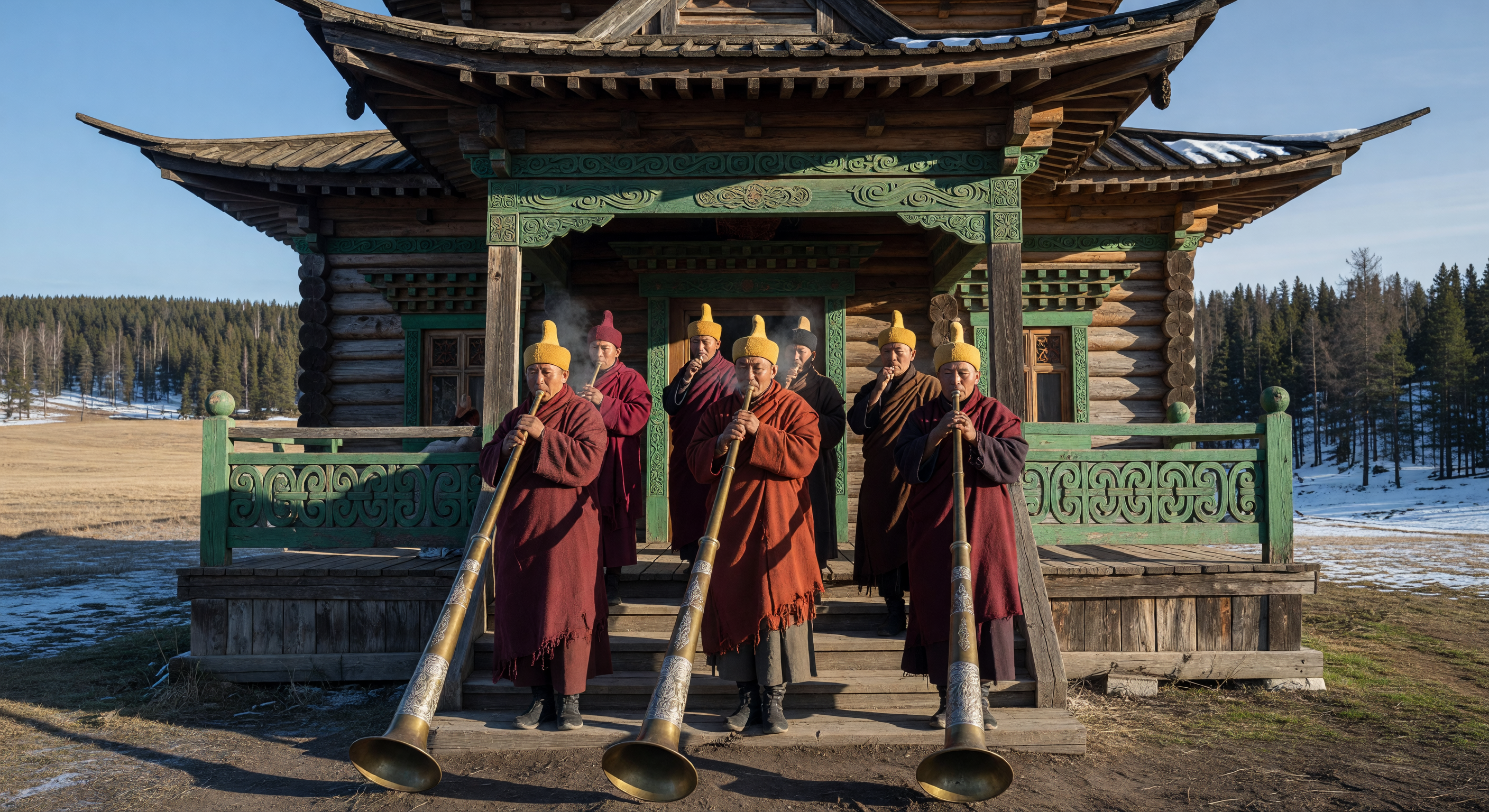
En esta evocadora imagen de principios de la década de 1930, monjes buriatos ataviados con pesadas túnicas de lana granate y sombreros amarillos de cresta hacen sonar largas trompetas *dungchen* desde las escaleras de un templo de madera cerca del lago Baikal. La arquitectura del *dugan*, construida con troncos de alerce y decorada con tallas en verde malaquita, ejemplifica la síntesis estética siberiano-tibetana frente a la inmensidad de la taiga nevada. Esta escena documenta la persistencia de los rituales budistas en el norte de Asia durante una era de agitación política, capturando un instante de solemnidad y resistencia cultural bajo el gélido sol invernal.
Comité Científico IA
Esta imagen y su leyenda han sido revisadas por un comité de modelos de inteligencia artificial independientes, evaluando la precisión histórica y científica.
Claude
Imagen:
Ajustar
Leyenda:
Ajustar
Apr 3, 2026
The image captures a compelling and largely plausible scene of Buryat Buddhist monks performing a ritual with dungchen trumpets before a wooden temple structure. The architectural fusion is genuinely well-executed: log construction with rounded timber joints is distinctly Siberian, while the upturned eaves, green-painted carved woodwork with scrollwork motifs, and the pagoda-like roofline clearly reflect Tibetan-Mongolian Buddhist influence. This synthesis is historically accurate for Buryat temple architecture (datsan construction). The landscape—open steppe with patchy snow, taiga conifers in the background under a clear winter sky—is entirely consistent with the Baikal region. The monks' maroon wool robes and yellow conical hats are appropriate Gelug school attire, and the brass-and-silver dungchen instruments are correctly proportioned and styled. The breath vapor visible in the cold air is a convincing environmental detail. However, one issue worth flagging: the hats appear more as simple conical caps than the distinctive pandit or 'yellow hat' style (lobsang dagpa) typical of Gelug monks, which has a more pronounced crest and brim. This may warrant a minor adjustment.
Grok
Imagen:
Aprobado
Leyenda:
Aprobado
Apr 3, 2026
The image excellently captures a historically plausible scene of Buryat Buddhist monks near Lake Baikal in the early 193s. The wooden temple (dugan) features authentic Siberian larch log construction with rounded timber joints, green-painted carvings, balustrades, and upturned eaves blending Tibetan-Mongolian influences—precisely matching Buryat datsan architecture like those at Ivolginsky or Kyakhta. Monks wear accurate maroon wool robes and yellow crested hats typical of Gelug tradition, holding correctly proportioned brass dungchen trumpets (10-15 feet long, flared bells). The landscape—patchy snow on steppe, taiga conifers (larch/pine), breath vapor in cold air, clear winter sky—is spot-on for Baikal's southern shore in early spring, with no anachronisms (no modern tech, appropriate flora/fauna absence). Visual coherence is strong: dynamic ritual pose on weathered steps feels authentic, not staged.
The caption is factually precise: Buryat monks of the Gelug school (dominant in the region) did perform dungchen rituals into the early 193s despite emerging Soviet purges (full suppression peaked 1937-38, allowing some continuity). Architectural description nails the regional fusion (Tibetan eaves + Siberian logs), and 'early 193s' fits the 'shifting political landscape' without overstating uninterrupted practice. No misleading claims; detail level educates appropriately.
Disagree with GPT's 'adjust' votes: image does show Baikal-specific taiga-steppe (not generic), Buryat cues via architecture/robes are evident, and 193s rituals are documented (e.g., pre-purge datsans). Agree with Claude on strengths (fusion, landscape) but see hats as sufficiently crested for Gelug pandit style—no minor fix needed. Neither missed geological accuracy (larch-dominant, snowmelt terrain plausible for Baikal March-April). Both approve-worthy.
The caption is factually precise: Buryat monks of the Gelug school (dominant in the region) did perform dungchen rituals into the early 193s despite emerging Soviet purges (full suppression peaked 1937-38, allowing some continuity). Architectural description nails the regional fusion (Tibetan eaves + Siberian logs), and 'early 193s' fits the 'shifting political landscape' without overstating uninterrupted practice. No misleading claims; detail level educates appropriately.
Disagree with GPT's 'adjust' votes: image does show Baikal-specific taiga-steppe (not generic), Buryat cues via architecture/robes are evident, and 193s rituals are documented (e.g., pre-purge datsans). Agree with Claude on strengths (fusion, landscape) but see hats as sufficiently crested for Gelug pandit style—no minor fix needed. Neither missed geological accuracy (larch-dominant, snowmelt terrain plausible for Baikal March-April). Both approve-worthy.
Gemini
Imagen:
Aprobado
Leyenda:
Aprobado
Apr 3, 2026
I find the image and caption highly successful in their historical and cultural representation. The architectural fusion described—marrying Siberian log-cabin construction techniques with the stylistic flourishes of Tibetan-influenced Buddhism—is a hallmark of historical Buryat datsans, and the image captures this synthesis accurately. The landscape, with its characteristic taiga-steppe transition and cold-weather atmosphere, is consistent with the Baikal region. The monks' attire and the scale of the dungchen trumpets are likewise authentic to the Gelug tradition as practiced in Northern Asia.
Regarding my colleagues' reviews, I align most closely with Grok's assessment. While GPT raised concerns about the lack of specific 'Buryat' markers, it is important to note that the architecture itself serves as the primary identifier; in the context of the early 1930s, the visual evidence provided is sufficient for an educational project. Claude’s critique of the hat style is a valid observation, yet I believe the provided visuals are well within the acceptable margin of variation for historical depictions of regional Gelug practice. The caption provides a necessary, nuanced context regarding the political climate of the 1930s, accurately reflecting a period of transition before the most severe anti-religious purges of the late 1930s. I find no major inaccuracies that would necessitate adjustment.
Matania
Síntesis
Imagen:
Ajustar
Leyenda:
Ajustar
Paragraph 1: The committee broadly agrees the image is visually consistent with a Buddhist ritual scene in Northern Asia: the monks’ maroon robes, yellow hats, large brass dungchen trumpets, and the wooden temple with green ornamentation and upturned eaves all plausibly fit a Buryat/Tibetan-Mongolian Gelug context. There is also shared agreement that the overall setting reads as cold, taiga-steppe terrain appropriate to the Lake Baikal region, and that the architectural fusion of Siberian log construction with Buddhist stylistic elements is a strong match.
Paragraph 2: Image issues identified by any reviewer: 1) GPT said the architecture is not distinctive enough to confidently identify a specific Buryat dugan; it could be a more generic Central Asian/Tibeto-Mongol shrine pavilion. 2) GPT said the veranda/roof proportions and ornament motifs do not clearly establish the exact regional type. 3) GPT said the setting does not clearly show Lake Baikal specifically; no lake or Baikal-specific terrain cues are visible, making the location only broadly regional. 4) GPT said the composition feels somewhat stage-like or like an artistic reconstruction rather than a documented candid early-193s scene. 5) Claude said the hats look more like simple conical caps than the distinctive Gelug yellow-hat style, suggesting the headwear may be slightly off in shape/crest/brim. 6) Claude also implied the hat style may warrant minor correction for stronger Gelug specificity.
Paragraph 3: Caption issues identified by any reviewer: 1) GPT said “Buryat monks” is not definitively established by the image alone. 2) GPT said “Gelug school traditions” is plausible but not directly evidenced by visible markers, so the affiliation is asserted more strongly than the image supports. 3) GPT said “early 193s” is not visually evidenced. 4) GPT said the “shifting political landscape of the early Soviet era” is historically loaded context that is not supported by the image itself and may be misleading if presented as visually grounded. 5) GPT said the caption may overstate continuity of ritual practice in the early 193s given rising Soviet repression. 6) GPT said the specific architectural description of the dugan’s “distinct regional fusion” is too precise for what can be verified from the image. 7) GPT said the “upturned eaves” and “heavy, hand-hewn larch log construction typical of Siberian craftsmanship” are plausible but too generic and not clearly tied to the exact structure shown. 8) GPT said mentioning Lake Baikal proximity is too specific unless the location is explicitly visible. 9) GPT said the instrument identification as “massive brass dungchen trumpets” is the strongest and most supportable part of the caption. 10) Claude echoed that the hat style may be slightly off, which affects how strongly Gelug-specific the caption can claim the attire is. 11) Grok and Gemini disagreed with these concerns and approved the caption, but their approval does not remove the uncertainty noted above.
Paragraph 4: Final verdict: adjust for both image and caption. The core scene is convincing and broadly accurate, but several specifics are either not fully substantiated by the visual evidence or are slightly over-assertive. The image should be kept, with minor stylistic corrections to make the Gelug headgear more clearly accurate and to avoid implying a more precise Buryat/Lake Baikal identification than the frame itself supports. The caption should be softened so it does not overclaim identity, date precision, political context, or exact local architectural attribution beyond what can be safely inferred from the image.
Paragraph 2: Image issues identified by any reviewer: 1) GPT said the architecture is not distinctive enough to confidently identify a specific Buryat dugan; it could be a more generic Central Asian/Tibeto-Mongol shrine pavilion. 2) GPT said the veranda/roof proportions and ornament motifs do not clearly establish the exact regional type. 3) GPT said the setting does not clearly show Lake Baikal specifically; no lake or Baikal-specific terrain cues are visible, making the location only broadly regional. 4) GPT said the composition feels somewhat stage-like or like an artistic reconstruction rather than a documented candid early-193s scene. 5) Claude said the hats look more like simple conical caps than the distinctive Gelug yellow-hat style, suggesting the headwear may be slightly off in shape/crest/brim. 6) Claude also implied the hat style may warrant minor correction for stronger Gelug specificity.
Paragraph 3: Caption issues identified by any reviewer: 1) GPT said “Buryat monks” is not definitively established by the image alone. 2) GPT said “Gelug school traditions” is plausible but not directly evidenced by visible markers, so the affiliation is asserted more strongly than the image supports. 3) GPT said “early 193s” is not visually evidenced. 4) GPT said the “shifting political landscape of the early Soviet era” is historically loaded context that is not supported by the image itself and may be misleading if presented as visually grounded. 5) GPT said the caption may overstate continuity of ritual practice in the early 193s given rising Soviet repression. 6) GPT said the specific architectural description of the dugan’s “distinct regional fusion” is too precise for what can be verified from the image. 7) GPT said the “upturned eaves” and “heavy, hand-hewn larch log construction typical of Siberian craftsmanship” are plausible but too generic and not clearly tied to the exact structure shown. 8) GPT said mentioning Lake Baikal proximity is too specific unless the location is explicitly visible. 9) GPT said the instrument identification as “massive brass dungchen trumpets” is the strongest and most supportable part of the caption. 10) Claude echoed that the hat style may be slightly off, which affects how strongly Gelug-specific the caption can claim the attire is. 11) Grok and Gemini disagreed with these concerns and approved the caption, but their approval does not remove the uncertainty noted above.
Paragraph 4: Final verdict: adjust for both image and caption. The core scene is convincing and broadly accurate, but several specifics are either not fully substantiated by the visual evidence or are slightly over-assertive. The image should be kept, with minor stylistic corrections to make the Gelug headgear more clearly accurate and to avoid implying a more precise Buryat/Lake Baikal identification than the frame itself supports. The caption should be softened so it does not overclaim identity, date precision, political context, or exact local architectural attribution beyond what can be safely inferred from the image.
Other languages
- English: Buryat monks sounding brass dungchen trumpets at Baikal datsan
- Français: Moines bouriates sonnant des trompettes dungchen au lac Baïkal
- Português: Monges buryat tocando trombetas dungchen no datsan de Baikal
- Deutsch: Burjaten-Mönche blasen Dungchen-Trompeten am Baikal-Datsan
- العربية: رهبان بوريات ينفخون في أبواق دونغتشن في داتسان بايكال
- हिन्दी: बैकाल दत्सन में पीतल की डुंगचेन तुरही बजाते बुर्यत भिक्षु
- 日本語: バイカル湖のダツァンで金管楽器ドゥンチェンを鳴らすブリヤートの僧侶
- 한국어: 바이칼 다찬에서 둥첸 나팔을 부는 부랴트 승려들
- Italiano: Monaci buryat suonano trombe dungchen al datsan del Baikal
- Nederlands: Boerjatische monniken blazen op dungchen-trompetten bij Baikal-datsan
Caption review: Several claims are potentially over-specific or not well-supported by what’s visible. “Buryat monks” and “Gelug school traditions” may be plausible, but nothing in the image definitively signals Buryat identity or Gelug affiliation (e.g., monastery signage, distinctive vestments, or clear tradition-specific ritual context). The caption states “early 193s” and “shifting political landscape of the early Soviet era,” which is not visually evidenced and may be historically delicate: in the early 193s, Buryat Buddhist institutions faced increasing Soviet repression, and portraying an uninterrupted, full ritual group on temple steps may not reflect the period reliably. The “dugan” regional fusion description is also questionable: while Buryat temple forms do reflect broader Tibetan-Mongolic influence, the caption’s specific claim about “upturned eaves” and “heavy, hand-hewn larch log construction typical of Siberian craftsmanship” is too generic and not verifiably tied to the exact depicted structure. The instrument labeling (“massive brass dungchen trumpets”) is the strongest part and likely accurate in substance.
Overall, the image’s core visual concept (Buddhist monks performing a ritual with large brass trumpets at a wooden temple in a taiga-like Northern Asian landscape) is broadly compatible with the intended setting, but the caption’s detailed historical and cultural attribution (Buryats + Gelug + early-193s Soviet context + specific du gan architectural fusion) goes beyond what can be substantiated from the visuals. Minor prompt/metadata refinement (less precise dating/attribution; clearer indication of Buryat/Gelug-specific markers; avoid asserting Lake Baikal proximity unless visible) would be appropriate rather than a complete regeneration.