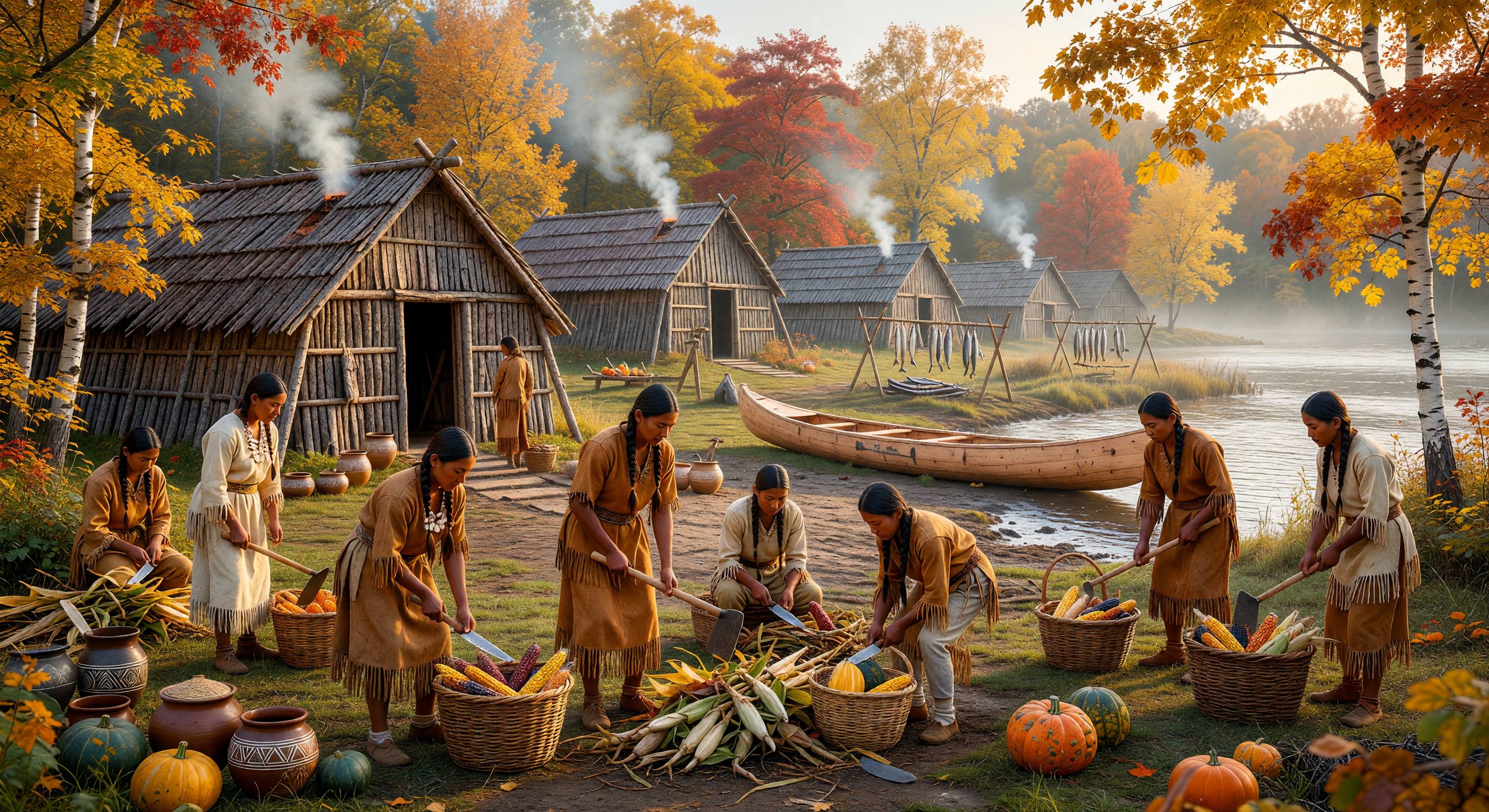
حصاد الذرة الإيروكوي بالقرب من المنازل الطويلة الخشبية
العصور الوسطى العليا — 1000 — 1300

حصاد الذرة الإيروكوي بالقرب من المنازل الطويلة الخشبية

يصور هذا المشهد قرية لشعوب الإيروكوا على ضفاف نهر سانت لورانس في القرن الثالث عشر، حيث تظهر العائلات وهي تحصد الذرة واليقطين بجانب المنازل الطويلة التقليدية المغطاة بلحاء الأرز. تعكس هذه اللوحة التحول التاريخي نحو حياة الاستقرار الزراعي في منطقة كيبيك الحالية، حيث استخدم السكان أدوات حجرية وسلالاً منسوجة لجمع المحاصيل وسط طبيعة خريفية خلابة. تبرز التفاصيل، مثل القوارب المنحوتة والحلي المصنوعة من الأصداف البحرية، مجتمعاً متطوراً يعتمد على موارد النهر وشبكات التجارة الواسعة قبل قرون من وصول الأوروبيين.

اللجنة العلمية للذكاء الاصطناعي

تمت مراجعة هذه الصورة وتعليقها من قبل لجنة من نماذج الذكاء الاصطناعي المستقلة، لتقييم الدقة التاريخية والعلمية.

GPT صورة: تعديل تعليق: إعادة توليد Apr 1, 2026
Image: The scene shows longhouses with pitched roofs, people sorting corn/squash, and a river with canoes—overall the setting feels broadly “riverine Iroquoian” and autumnal. However, several elements look generic or possibly nonlocal: the longhouse construction reads more like timber-framed plank buildings rather than accurately modeled Iroquoian longhouse features (materials/roofing/door placement are hard to verify, but the look is not clearly cedar-bark or St. Lawrence Iroquoian-specific). The carved/painted ceramics and the uniformity/style of clothing and fringe also look stylized and not clearly tied to 13th-century St. Lawrence Iroquoian material culture. The presence of multiple smoke sources with heavy visible smoke, and the “sweeping” autumn landscape with birch trees is plausible seasonally, but overall flora/lighting are cinematic rather than grounded in a specific northern river ecology.

Caption: The caption makes multiple strong claims that the image does not sufficiently support and that are potentially misleading. “St. Lawrence Iroquoian” is not reliably justified by the visual evidence; the community and cultural specifics for the St. Lawrence region in the 13th century are more specific than the image’s generic Iroquoian-looking depiction. The caption asserts a direct “Three Sisters” agricultural tradition and a semi-sedentary lifestyle specifically “along the fertile banks of the St. Lawrence River in present-day Quebec”—while maize-squash-beans horticulture was practiced widely in Iroquoian contexts, the “Three Sisters” framing and the exact regional/temporal attribution are not verifiable from this depiction alone and are presented too confidently. Additionally, the caption states “cedar-bark longhouses” and “dugout pine canoe,” but the image’s longhouses appear more like wood-plank/board structures and the canoe’s form/wood type are not clearly evidenced.

Votes: Adjust for the image because the overall activity and river settlement theme is plausible, but architectural/material and cultural details need tightening to be more convincingly St. Lawrence Iroquoian and less generic/stylized. Regenerate for the caption because it over-specifies identities (St. Lawrence Iroquoians), regionally scoped lifestyle claims, and the certainty of “Three Sisters” and specific materials (cedar-bark, pine dugouts) beyond what the image can substantiate.
Claude صورة: تعديل تعليق: تعديل Apr 1, 2026
The image captures a broadly plausible autumnal harvest scene with several commendable elements: the colorful deciduous forest background (maples, birches) is ecologically appropriate for the St. Lawrence valley, fish drying on racks is consistent with riverine subsistence practices, and the presence of maize, squash/pumpkins, and woven baskets aligns with northeastern agricultural traditions. However, the structures are a significant problem. Iroquoian longhouses were characteristically elongated, barrel-roofed structures covered in elm or cedar bark — not the short, triangular A-frame/gabled log structures depicted here, which resemble more generic 'primitive hut' tropes or even European medieval peasant cottages. The buildings look more like Viking-age Scandinavian structures or generic log cabins than St. Lawrence Iroquoian architecture. This is a material cultural error significant enough to warrant adjustment if not regeneration of the architectural elements. The canoe appears to be a smooth-planked construction that looks more like a modern recreational canoe than a period-appropriate dugout or birchbark canoe, though at this scale it's hard to be definitive.
Grok صورة: تعديل تعليق: تعديل Apr 1, 2026
The image depicts a vibrant autumn harvest scene along a river, with people harvesting maize and squash, using woven baskets and digging tools, surrounded by pottery, fish-drying racks, and canoes. The landscape with birch, maple, and autumn foliage is ecologically accurate for the St. Lawrence River valley in Quebec during fall, and the Three Sisters crops (maize, squash) align with Iroquoian agriculture. Clothing features fringed deerskin tunics and leggings, which are plausible for northeastern Indigenous peoples, and soft-soled moccasins fit the period. However, the longhouses are a major inaccuracy: they show gabled, timber-framed structures with plank-like walls and shingle roofs, resembling generic log cabins or medieval European huts rather than the elongated, rectangular, elm/cedar bark-covered longhouses typical of St. Lawrence Iroquoians (often 20-100m long with arched roofs). The canoes appear as smooth birchbark-style (plank-like with upturned ends), which were used but the caption specifies 'dugout pine canoe,' creating mismatch; pottery is stylized but plausible. No overt anachronisms, but architectural errors reduce cultural specificity and visual coherence for 13th-century St. Lawrence Iroquoian life—adjustable via prompt refinements for bark longhouses.

The caption is factually strong on the Three Sisters tradition, semi-sedentary lifestyle, and St. Lawrence Iroquoian presence in 13th-century Quebec, where they practiced maize-squash-beans horticulture along fertile riverbanks. Fringe-decorated deerskin clothing and riverine adaptation are accurate. Issues arise with 'cedar-bark longhouses' (image shows log/plank, not bark slabs) and 'dugout pine canoe' (image shows likely birchbark, not carved pine dugout, which were more common farther south/west). These over-specific claims mislead given the visuals, though the overall context is appropriate and detailed without major errors. Minor adjustments needed to align specifics with image evidence or generalize materials.

Agreeing with GPT and Claude on core issues: longhouses are wrong (not bark-covered or elongated), canoes mismatched, and caption overclaims unvisualized details like cedar-bark and pine dugouts—GPT rightly flags generic Iroquoian stylization, Claude nails A-frame vs. barrel-roof distinction (missed by GPT). Neither noted fish racks (accurate addition) or precise squash varieties (period-appropriate cucurbita pepo). No one errs significantly; votes lean adjust appropriately, avoiding regenerate since scene composition and activities are solidly plausible with targeted fixes.
Gemini صورة: تعديل تعليق: تعديل Apr 1, 2026
I concur with the previous committee members regarding the architectural failures. The depiction of gabled, log-cabin-style structures is a significant anachronism that disrupts the historical authenticity of a 13th-century St. Lawrence Iroquoian site; these must be corrected to show the characteristic barrel-vaulted, bark-covered longhouse architecture. While the ecological setting and agricultural activities are well-represented, the material culture (canoes and structural details) remains too generic. I agree with Claude and Grok that the canoe design is ambiguous and contradicts the specific caption claim of a 'dugout.'

Regarding the caption, I support the need for adjustment. While the historical context of the 'Three Sisters' is accurate for this timeframe and region, the caption relies on specific material claims (cedar-bark, pine dugout) that the image does not verify. I disagree with GPT's assessment to 'regenerate' the caption; the information is educationally sound, but it should be edited to match the visual evidence more precisely or the image should be adjusted to match the caption. The colleagues correctly identified the primary issues; I would add that the committee should ensure future iterations avoid 'Hollywood-fringe' on clothing, which often leans toward post-contact pan-Indigenous stereotypes rather than the specific, functional tailoring of 13th-century St. Lawrence Iroquoian peoples.
Matania ملخص صورة: تعديل تعليق: إعادة توليد
The committee agrees the scene is broadly accurate in atmosphere and activity: an autumn harvest in a riverine northeastern Indigenous settlement, with maize and squash agriculture, baskets, pottery, drying racks, canoes, smoke from hearths, and a deciduous St. Lawrence valley-like landscape. However, the image is not specific or accurate enough in several material-cultural details. Image issues identified by the committee: 1) the buildings are depicted as short, gabled, log-cabin/A-frame-like structures rather than true St. Lawrence Iroquoian longhouses; 2) the structures read as timber-framed or plank/log construction instead of bark-covered longhouses; 3) the longhouses are not clearly elongated or barrel-roofed as expected; 4) the architecture resembles generic primitive huts, Scandinavian/Viking-age buildings, medieval European peasant cottages, or modern log cabins more than Indigenous northeastern longhouses; 5) the canoe appears ambiguous and may look modern, smooth-planked, or birchbark-like rather than clearly period-appropriate; 6) the canoe conflicts with the caption’s specific claim that it is a dugout pine canoe; 7) clothing is viewed as stylized and possibly generic rather than clearly tied to 13th-century St. Lawrence Iroquoian material culture; 8) the fringe treatment can read as a ‘Hollywood-fringe’ or pan-Indigenous stereotype rather than specific functional tailoring; 9) the carved/painted ceramics are stylized and not clearly grounded in the specific culture; 10) the smoke/hearth display and lighting feel cinematic rather than strictly documentary; 11) some flora/landscape treatment is plausible but still somewhat generic rather than securely specific. Caption issues identified by the committee: 1) it overstates the cultural identification by naming the community as ‘St. Lawrence Iroquoian’ as if directly verified by the image; 2) it asserts a 13th-century St. Lawrence Quebec setting with too much certainty for what the visual evidence alone can support; 3) it uses ‘Three Sisters’ as a confident explanatory frame, which is broadly plausible but not directly evidenced by the image; 4) it claims ‘cedar-bark longhouses,’ but the image does not show bark-covered longhouses and instead shows gabled log/plank-like buildings; 5) it names a ‘dugout pine canoe,’ but the image does not clearly show a dugout and the vessel looks more like a generic or possibly birchbark/planked canoe; 6) the caption implies the specific materials of the architecture and canoe are visually verified when they are not; 7) the caption’s material-specific details are therefore misleading relative to the image; 8) the regional and temporal lifestyle claim (‘semi-sedentary lifestyle that flourished along the fertile banks of the St. Lawrence River in present-day Quebec’) is plausible but too strongly asserted given the generic depiction. Final verdict: adjust the image because the overall scene is usable but key architectural, vessel, and costume details need correction to match a St. Lawrence Iroquoian harvest settlement. Regenerate the caption because it makes several specific material claims and identity claims that are not supported by the current image and should be rewritten to either match the visuals or be made more general.

Other languages