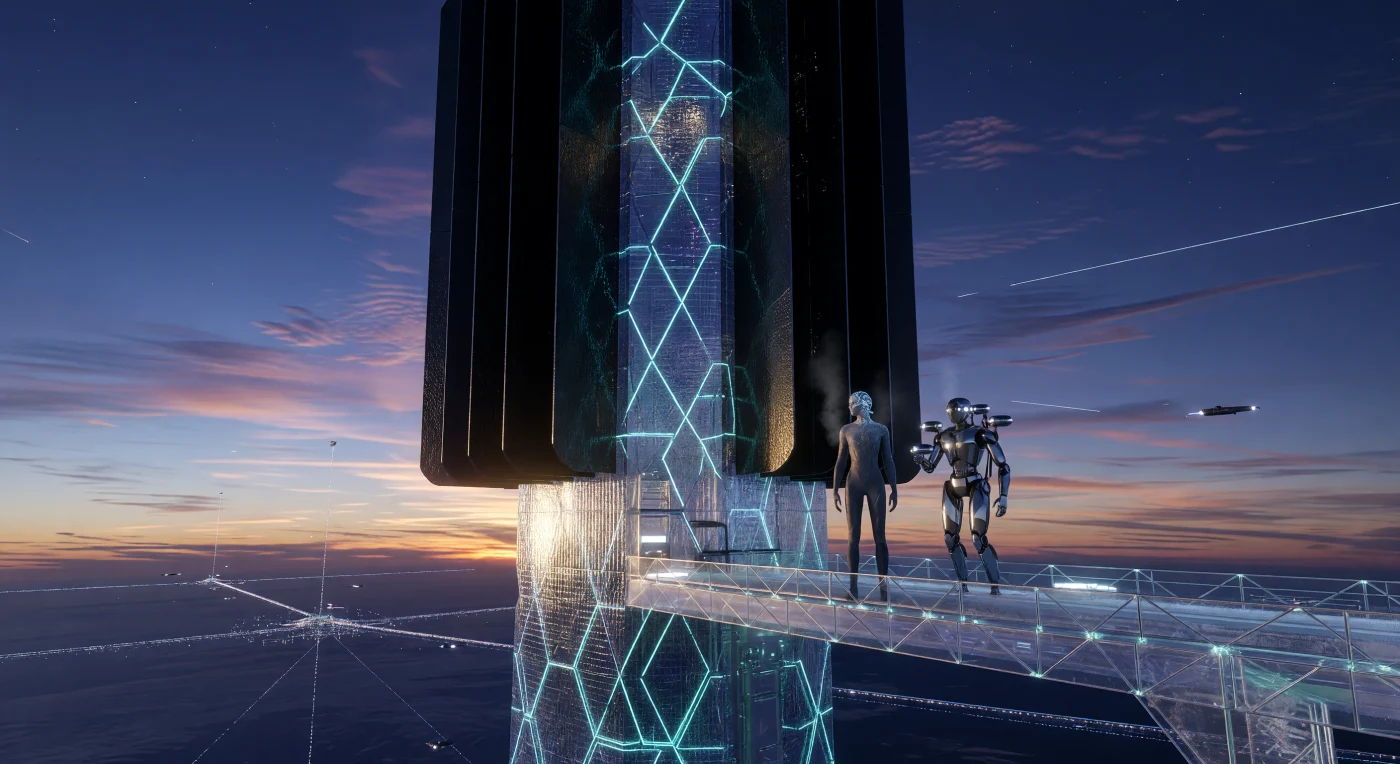
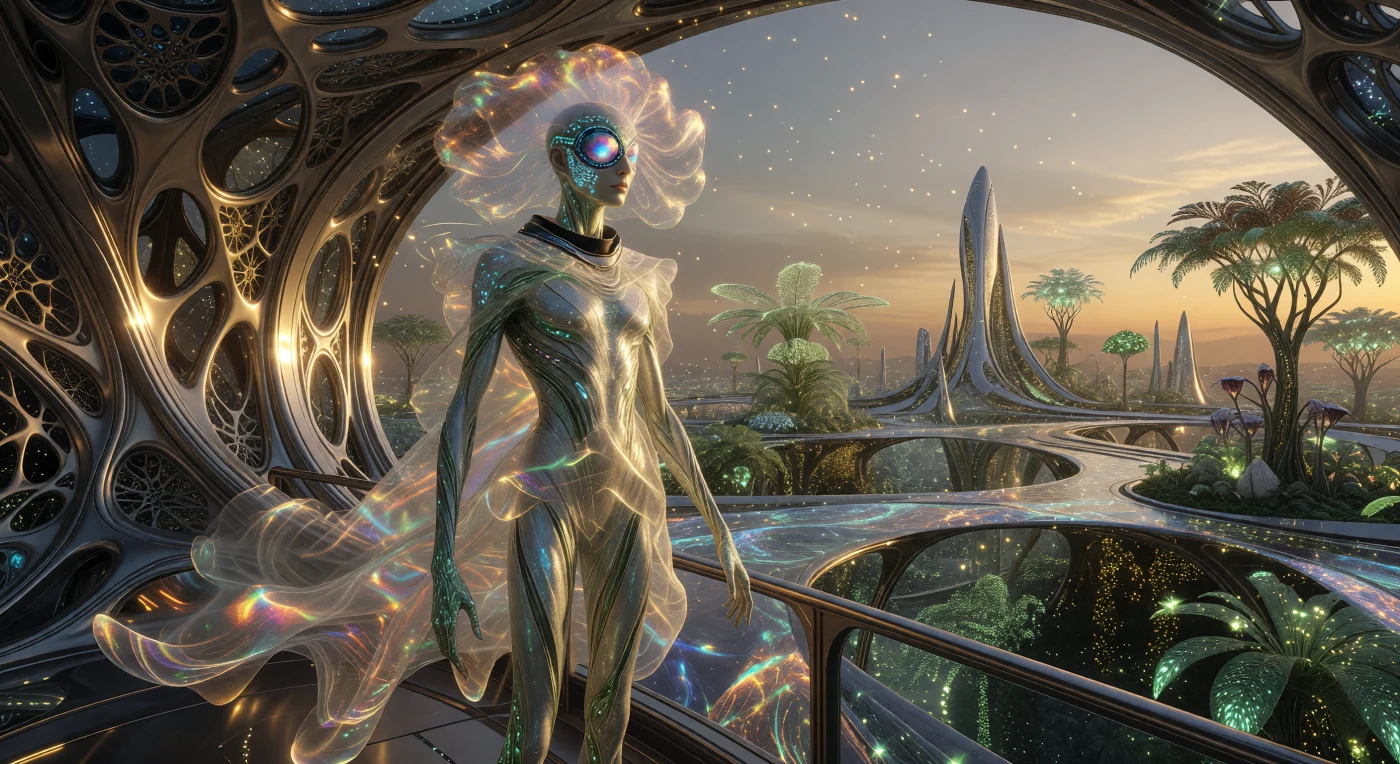
During the era of The Convergence (2100–2200 CE), massive infrastructure like the Basalt Atmospheric Shunt Ring became essential for urban survival against planet-wide climatic instability. This 50-kilometer arc utilizes liquid-state superconductors, visible as pulsing cyan veins, to generate localized magnetic fields that divert toxic "Super-Cell" hurricanes away from populated hubs. In the foreground, a Maintenance Custodian—a post-human biological entity specifically engineered with iridescent skin and reinforced ossification for high-radiation environments—stands near a cluster of pearlescent Myco-Hives, which are self-repairing fungal habitats cultivated from biolith and mycelium-composites.

During the Convergence (2100–2200), urban environments evolved into responsive, semi-sentient landscapes where the distinction between biology and architecture dissolved. This Flux-Plaza demonstrates the era's use of liquid-metal gallium alloys that, triggered by electromagnetic frequencies, rearrange into rigid fractal tiers to accommodate gatherings of post-biological citizens and synthetic intelligences. In the background, a 1.5-kilometer-tall Synaptic Spire pulses with violet light during a collective neural data transfer, while the distant "Great Re-Wilding Spine" megastructure signifies the century's commitment to planetary ecological restoration.

Set against the violet-hued stratosphere of the 22nd century, this scene depicts the height of "The Convergence" (2100–2200 AD), an era defined by the total integration of biological life and digital architecture. Towering 1.5-kilometer Synaptic Spires, composed of self-healing copper-gold biolith, facilitate massive data transfers through pulsing neural arrays while organic Myco-Hive residential clusters cling to their surfaces like glowing coral. In the foreground, gracile post-human beings—standing 2.5 meters tall with translucent skin and integrated neural filaments—gather on a shifting liquid-gallium plaza to interface with the collective network. This period marks a radical shift in Earth's history, where molecular assembly and bio-mechanical engineering replaced traditional construction to create a living, breathing urban ecosystem.

During the 22nd-century era known as The Convergence, urban centers like this Myco-Hive colony represent a seamless fusion of synthetic biology and advanced engineering. The bulbous habitats are composed of Biolith—a self-healing "living stone" secreted by engineered bacteria—and draped in iridescent photo-glass membranes that harvest solar energy while filtering the atmosphere. In the foreground, gene-edited humans with UV-deflecting skin traverse a modular Flux-Plaza made of liquid-gallium alloy, surrounded by bio-engineered Sequoias that serve as vertical research stations. This scene illustrates a future where architecture is cultivated rather than built, functioning as a living, breathing extension of the Earth's restored ecosystem.

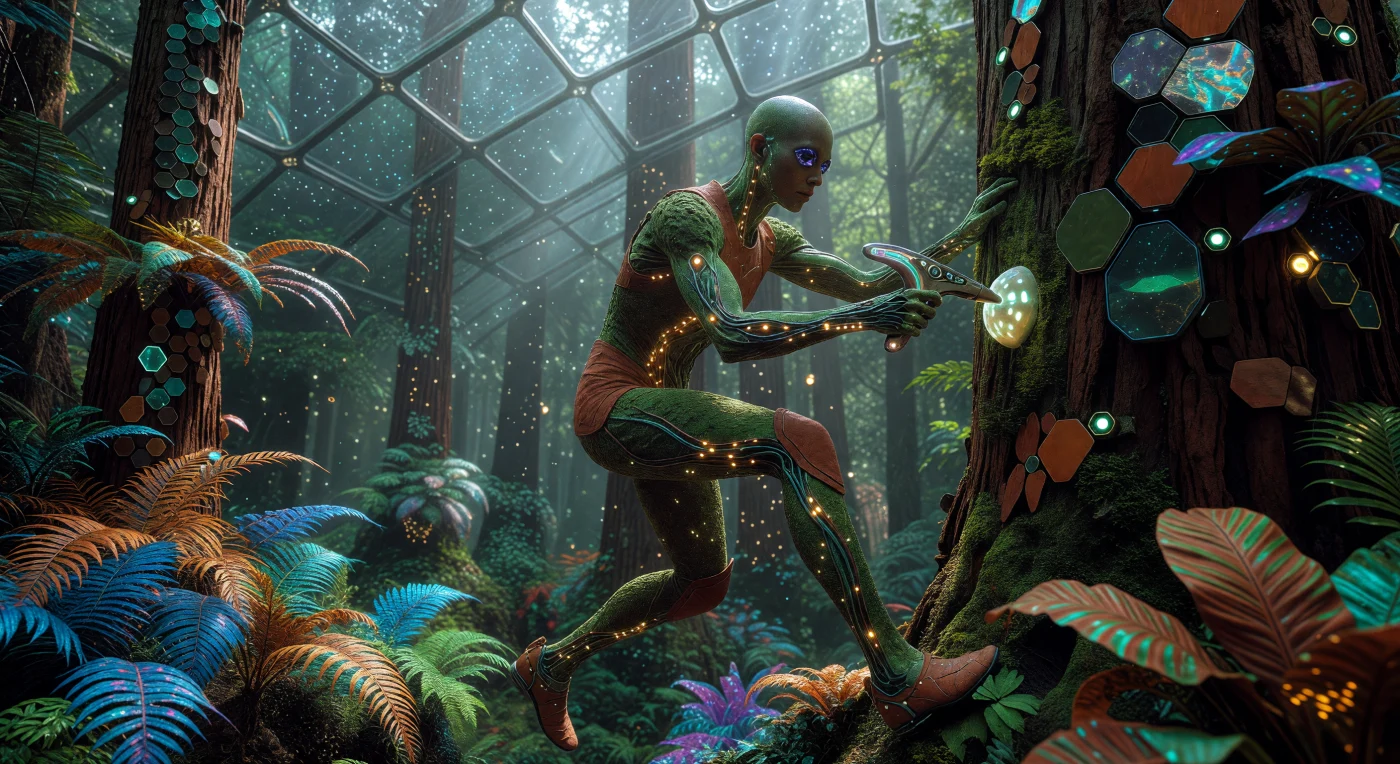
Set during the Convergence era (circa 2145), this scene illustrates the seamless integration of biotechnology and urbanism within a "Vertical Forest 2.0" research station. The interior of this genetically modified Sequoia is reinforced with a self-healing, translucent Biolith lattice and illuminated by oxygen-producing bioluminescent algae tanks. In the foreground, a post-Convergence human exhibiting iridescent "Fractal-Skin" dermal patterns interacts with a liquid-metal interface, while carbon-thread sky-bridges connect the massive trees 300 meters above a re-wilded forest floor.
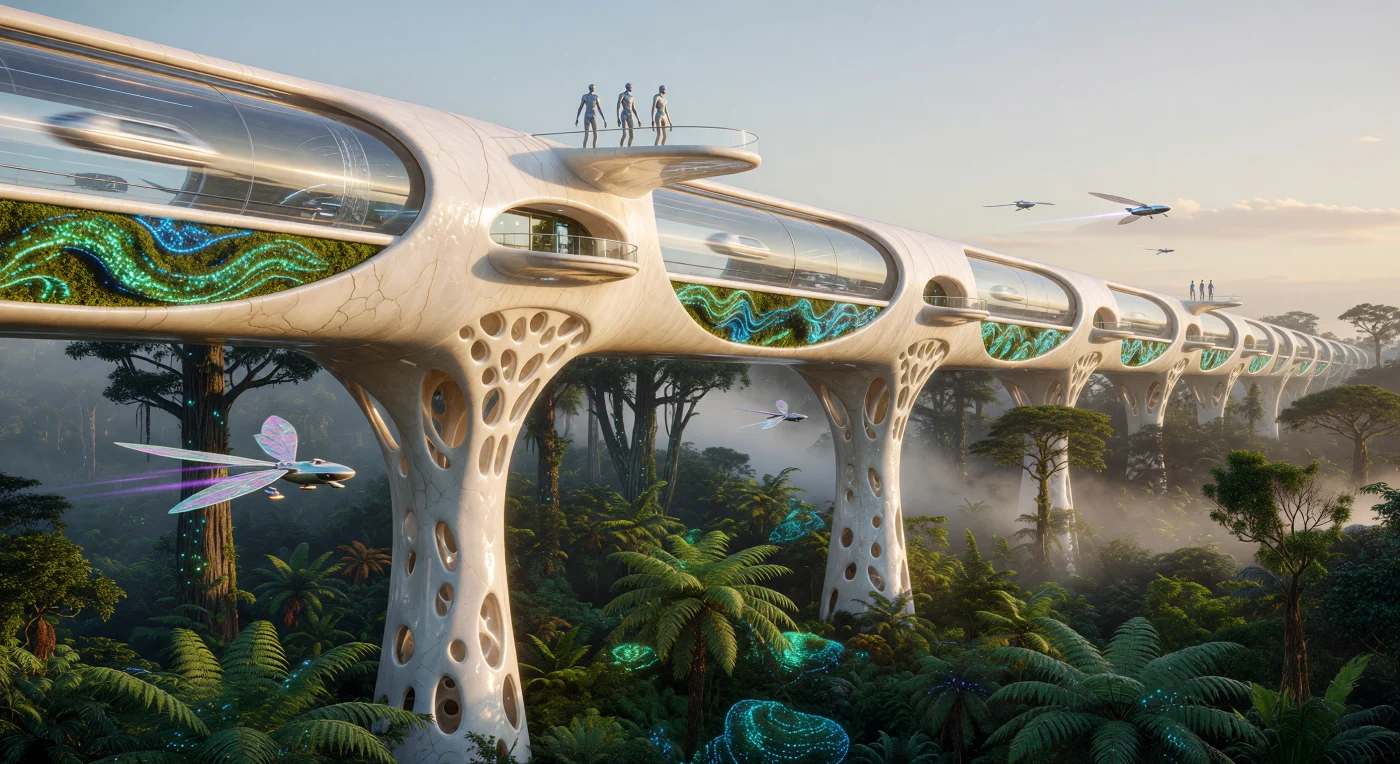
This panoramic view captures the Pan-Continental Re-Wilding Spine, a 22nd-century megastructure of self-healing Biolith soaring above a reconstructed primordial ecosystem. During the era known as The Convergence (2100–2200 AD), such architectural arteries integrated high-speed transit with ecological restoration, utilizing bioluminescent moss to monitor the health of bio-engineered Sequoias and giant ferns below. The scene illustrates a high-oxygen atmosphere reminiscent of the Carboniferous period, where transhumanity oversees a planet-wide effort to merge advanced urbanism with the chaotic vitality of a reclaimed wilderness.

Dominating the Kenyan skyline during the 22nd-century era known as The Convergence, this five-kilometer-wide anchor base is constructed from "Biolith," a self-healing living stone reinforced by an internal lattice of diamond-nanothreads. The monolithic pyramid serves as the terrestrial foundation for carbon-nanotube cables that ascend into the stratosphere to support a space elevator, while pulsing cyan veins manage the intense kinetic energy of the transit system. On the surrounding Flux-Plaza, post-human citizens with bioluminescent neural networks and low-gravity-adapted limbs traverse a modular landscape of liquid-metal flooring and organic, lichen-like "Myco-Hive" habitats.
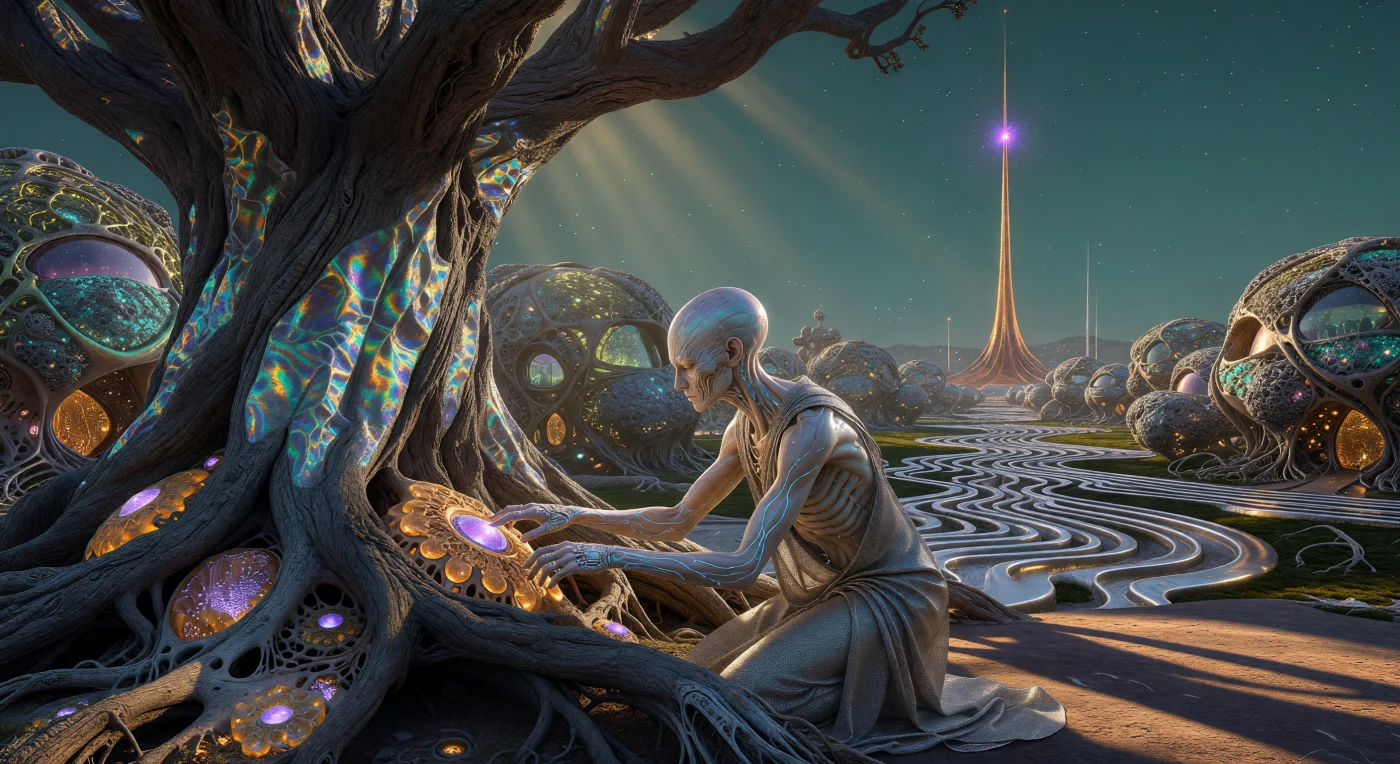
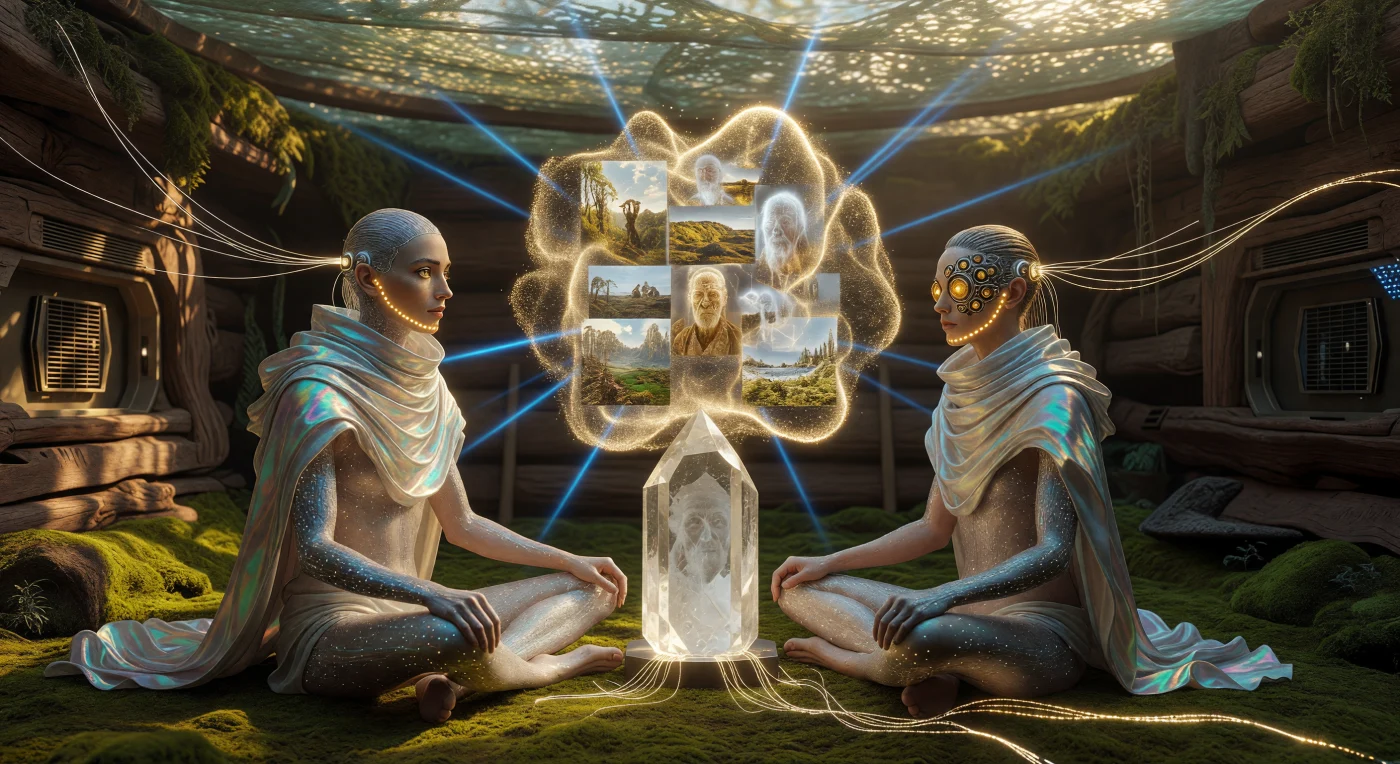
Set during the Convergence (2100–2200 AD), this scene illustrates the total synthesis of biology and digital technology within a Fractal Urbanism park. A post-human individual interacts with the bioluminescent neural nodes of an "Ancestor Tree," a bio-engineered organism whose biolith roots and mycelium-silicon core serve as a living archive for digital consciousness. In the background, the horizon is dominated by coral-like Myco-Hive residences and a towering Synaptic Spire, structures cultivated from living stone and carbon-thread to facilitate global neural connectivity.