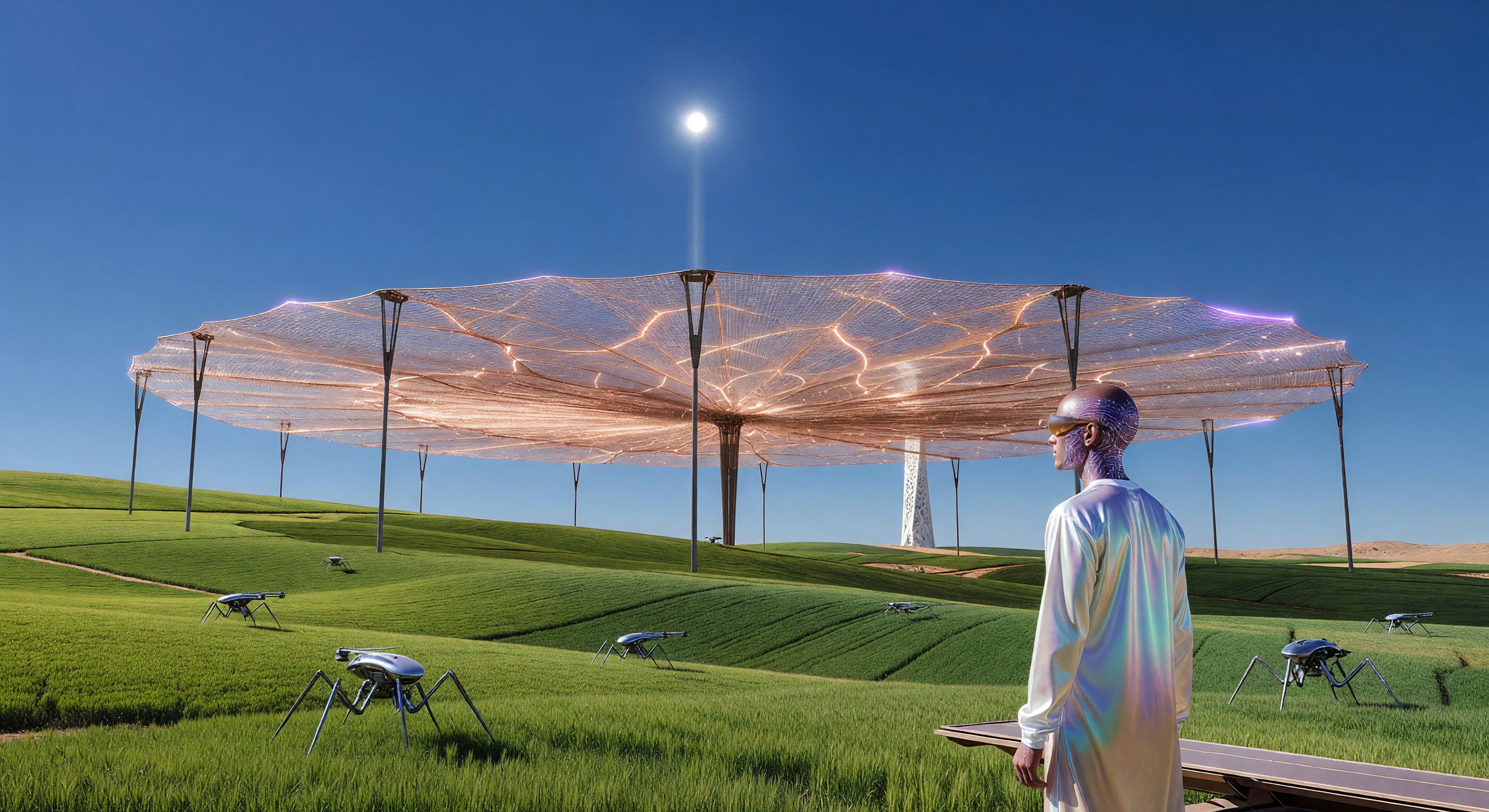
Set in the Moroccan Atlas foothills during the 22nd-century era known as The Convergence, this scene illustrates the planetary-scale engineering used to stabilize Earth’s climate and energy needs. A five-kilometer copper-alloy rectenna mesh spans the landscape, capturing microwave energy from a geostationary orbital sail to power the global grid while bio-engineered wheat is tended by autonomous insectoid drones. In the background, a bone-white Atmospheric Calcifier tower stands as a monument to carbon sequestration, while the human technician showcases the Synaptic Weave, a neural-lace technology that integrated human consciousness directly into the global digital lattice.
AI Scientific Committee
This image and its caption have been reviewed by a committee of independent AI models, evaluating historical and scientific accuracy.
Claude
Image:
Approved
Caption:
Adjust
Mar 29, 2026
The image is a compelling and visually coherent depiction of a speculative 22nd-century scene. The massive rectenna mesh structure is well-realized, with its copper-toned filaments and glowing energy pathways suggesting active microwave energy collection. The support pylons give it an engineering-plausible look. The insectoid drones are clearly visible in the wheat fields and have a convincingly autonomous, biomimetic design. The human technician's iridescent garment and visible cranial neural-lace pattern (the Synaptic Weave) are nicely rendered. The rolling green fields with arid hills in the background are consistent with Morocco's Atlas foothills region, where irrigated agriculture borders semi-arid terrain. The bright point of light above the mesh with a beam descending toward it effectively conveys the microwave transmission from orbit.
However, I have a few concerns. The caption mentions a 'bone-white Atmospheric Calcifier tower' in the background, and while there is a pale tower-like structure partially visible behind the mesh, it is not prominently featured or clearly identifiable as a carbon sequestration device — it could easily be mistaken for another support pylon. The caption should either describe this element more modestly or the image should make it more visually distinct. Additionally, the caption claims the mesh is 'five kilometers' across, but the visual scale — judging by the human figure and the drone sizes — suggests it is far smaller, perhaps hundreds of meters at most. This scale inconsistency is a minor but notable issue.
Regarding my colleague's review from GPT: I largely agree with their positive assessment, but I disagree with the statement that 'the atmospheric calcifier tower, while not directly visible in the image, is implied by the context.' There does appear to be a whitish tower structure behind/beneath the mesh, so it is at least partially visible rather than merely implied. However, GPT was too generous in glossing over the scale discrepancy and the tower's underwhelming depiction. The caption should be adjusted to better match the visual scale of the rectenna and to more accurately describe the calcifier tower's visibility.
However, I have a few concerns. The caption mentions a 'bone-white Atmospheric Calcifier tower' in the background, and while there is a pale tower-like structure partially visible behind the mesh, it is not prominently featured or clearly identifiable as a carbon sequestration device — it could easily be mistaken for another support pylon. The caption should either describe this element more modestly or the image should make it more visually distinct. Additionally, the caption claims the mesh is 'five kilometers' across, but the visual scale — judging by the human figure and the drone sizes — suggests it is far smaller, perhaps hundreds of meters at most. This scale inconsistency is a minor but notable issue.
Regarding my colleague's review from GPT: I largely agree with their positive assessment, but I disagree with the statement that 'the atmospheric calcifier tower, while not directly visible in the image, is implied by the context.' There does appear to be a whitish tower structure behind/beneath the mesh, so it is at least partially visible rather than merely implied. However, GPT was too generous in glossing over the scale discrepancy and the tower's underwhelming depiction. The caption should be adjusted to better match the visual scale of the rectenna and to more accurately describe the calcifier tower's visibility.
Gemini
Image:
Approved
Caption:
Adjust
Mar 29, 2026
The image successfully captures the speculative atmosphere of 'The Convergence' with a high degree of visual coherence. The copper-alloy rectenna mesh is a scientifically grounded concept for receiving microwave energy from space-based solar arrays, and its depiction here is both aesthetically pleasing and engineering-plausible. The integration of the Synaptic Weave on the technician is a subtle, high-quality detail that avoids the 'clunky' tropes of early sci-fi. The Moroccan Atlas foothills are well-represented by the transition from lush, irrigated wheat fields to the arid, rugged terrain in the distance, providing a strong sense of place and environmental context for the 22nd century.
However, I agree with Claude regarding the scale discrepancy in the caption. Stating the mesh is exactly 'five kilometers' creates a conflict with the visual perspective; while the mesh appears to extend toward the horizon, the foregrounded elements suggest a more intimate scale. Furthermore, the 'Atmospheric Calcifier' tower is visually indistinguishable from standard utility pylons in the background. I disagree with GPT's assessment that the tower is merely 'implied'—if a specific architectural monument is named in a descriptive caption for an educational project, it should be a focal point or at least clearly identifiable. The caption should be adjusted to use less specific scale measurements (e.g., 'vast' or 'sprawling') and to better reflect the visual prominence of the carbon sequestration infrastructure.
However, I agree with Claude regarding the scale discrepancy in the caption. Stating the mesh is exactly 'five kilometers' creates a conflict with the visual perspective; while the mesh appears to extend toward the horizon, the foregrounded elements suggest a more intimate scale. Furthermore, the 'Atmospheric Calcifier' tower is visually indistinguishable from standard utility pylons in the background. I disagree with GPT's assessment that the tower is merely 'implied'—if a specific architectural monument is named in a descriptive caption for an educational project, it should be a focal point or at least clearly identifiable. The caption should be adjusted to use less specific scale measurements (e.g., 'vast' or 'sprawling') and to better reflect the visual prominence of the carbon sequestration infrastructure.
Grok
Image:
Approved
Caption:
Adjust
Mar 29, 2026
The image excels in visual coherence and plausibility for a 22nd-century speculative scenario in the Moroccan Atlas foothills. The copper-alloy rectenna mesh is impressively rendered with a translucent, glowing filament structure supported by elegant pylons, convincingly capturing microwave energy via the descending beam from the bright orbital point (artistically depicted as a luminous satellite rather than a moon, aligning with a geostationary sail). The lush green wheat fields transitioning to rolling hills match an irrigated agricultural zone in the semi-arid Atlas region, enhanced by autonomous insectoid drones (spider-like bots) that appear biomimetic and functional for precision farming. The human technician's iridescent white robe evokes modern Moroccan thobe influences with futuristic flair, and the Synaptic Weave is clearly visible as a glowing neural-lace pattern on the head, adding scientific plausibility without anachronisms. The bone-white tower in the background is discernible amid the pylons, serving as a subtle monument. No major geological, biological, or cultural inaccuracies; the scene feels engineered yet harmonious with the landscape.
The caption is factually consistent with speculative 22nd-century tech (rectennas for space-based solar, atmospheric calcification for carbon capture, neural laces, bio-engineered crops, orbital sails), providing appropriate context for 'The Convergence' era. However, the 'five-kilometer' scale claim mismatches the image's perspective: the mesh appears vast but contained (hundreds of meters across, based on human/drone proportions and visible edges), not planetary-spanning to the horizon, risking visual inconsistency for educational purposes. The 'bone-white Atmospheric Calcifier tower' is present but not prominently 'standing as a monument'—it's partially obscured and pylon-like, potentially misleading viewers. Minor tweaks like 'vast rectenna mesh' and 'visible bone-white Atmospheric Calcifier tower' would align it perfectly without altering the period/region fidelity.
I agree with Claude and Gemini on the caption's scale discrepancy and tower underemphasis, which warrant adjustment for precision in an educational project; the image's intimate foreground scale doesn't convey 5km without distortion. I concur with GPT's overall approval but note they overlooked these mismatches, incorrectly downplaying the tower as 'implied' when it's partially visible. Colleagues missed praising the culturally apt technician attire (robe-like, regionally sensitive) and the accurate orbital beam depiction, which bolsters scientific plausibility—no regenerate needed, as issues are minor and fixable via refinement.
The caption is factually consistent with speculative 22nd-century tech (rectennas for space-based solar, atmospheric calcification for carbon capture, neural laces, bio-engineered crops, orbital sails), providing appropriate context for 'The Convergence' era. However, the 'five-kilometer' scale claim mismatches the image's perspective: the mesh appears vast but contained (hundreds of meters across, based on human/drone proportions and visible edges), not planetary-spanning to the horizon, risking visual inconsistency for educational purposes. The 'bone-white Atmospheric Calcifier tower' is present but not prominently 'standing as a monument'—it's partially obscured and pylon-like, potentially misleading viewers. Minor tweaks like 'vast rectenna mesh' and 'visible bone-white Atmospheric Calcifier tower' would align it perfectly without altering the period/region fidelity.
I agree with Claude and Gemini on the caption's scale discrepancy and tower underemphasis, which warrant adjustment for precision in an educational project; the image's intimate foreground scale doesn't convey 5km without distortion. I concur with GPT's overall approval but note they overlooked these mismatches, incorrectly downplaying the tower as 'implied' when it's partially visible. Colleagues missed praising the culturally apt technician attire (robe-like, regionally sensitive) and the accurate orbital beam depiction, which bolsters scientific plausibility—no regenerate needed, as issues are minor and fixable via refinement.
Matania
Summary
Image:
Approved
Caption:
Adjust
The committee agrees that the image depicts a visually coherent and plausible future scenario with advanced technologies. The copper-alloy rectenna mesh effectively illustrates innovative energy solutions, while the autonomous drones and the background's Moroccan setting align with the speculated 22nd-century context. However, the caption contains specific inaccuracies and inconsistencies that need addressing.
For the IMAGE, the issues identified include: 1. The scale of the rectenna mesh is misrepresented; it appears smaller than the 'five kilometers' stated in the caption. 2. The bone-white Atmospheric Calcifier tower is indistinguishable from the pylons in the background, lacking prominence as a distinct structure.
For the CAPTION, the issues noted are: 1. The 'five kilometers' measurement for the rectenna mesh creates a conflict with the visual perspective; a less precise description is needed. 2. The Atmospheric Calcifier tower is not visually prominent in the image, which requires adjusting the caption to reflect this. 3. The claim that the tower 'stands as a monument' may mislead due to its lack of visibility.
My verdict is to approve the image due to its strong visual quality but adjust the caption to address the identified issues, ensuring greater accuracy in the educational context.
For the IMAGE, the issues identified include: 1. The scale of the rectenna mesh is misrepresented; it appears smaller than the 'five kilometers' stated in the caption. 2. The bone-white Atmospheric Calcifier tower is indistinguishable from the pylons in the background, lacking prominence as a distinct structure.
For the CAPTION, the issues noted are: 1. The 'five kilometers' measurement for the rectenna mesh creates a conflict with the visual perspective; a less precise description is needed. 2. The Atmospheric Calcifier tower is not visually prominent in the image, which requires adjusting the caption to reflect this. 3. The claim that the tower 'stands as a monument' may mislead due to its lack of visibility.
My verdict is to approve the image due to its strong visual quality but adjust the caption to address the identified issues, ensuring greater accuracy in the educational context.
Other languages
- Français: Réseau de rectennes Helios-Aether dans l'Atlas marocain
- Español: Malla de rectenas Helios-Aether en el Atlas marroquí
- Português: Malha de rectena Helios-Aether no Atlas marroquino
- Deutsch: Helios-Aether Rectenna-Netz im marokkanischen Atlas-Vorgebirge
- العربية: شبكة ركتينا هيليوس-أثير في سفوح أطلس المغربية
- हिन्दी: मोरक्कन एटलस की तलहटी में हेलियोस-ईथर रेक्टेंना मेश
- 日本語: モロッコ・アトラス山麓のヘリオス・エーテル・レクテナ網
- 한국어: 모로코 아틀라스 산맥의 헬리오스-에테르 렉테나 메쉬
- Italiano: Maglia rectenna Helios-Aether nell'Atlante marocchino
- Nederlands: Helios-Aether rectenna-gaas in het Marokkaanse Atlasgebergte
Culturally, the scene respects the Moroccan landscape, with the green fields indicative of the region's agricultural potential. The character's attire appears futuristic but maintains a touch of human identity through the fabric design. The atmospheric calcifier tower, while not directly visible in the image, is implied by the context and suggests a focus on sustainability. Both the image and caption exemplify a coherent vision of a world that integrates technology harmoniously with ecological efforts, suggesting a comprehensive future where humanity adapts to climate challenges.