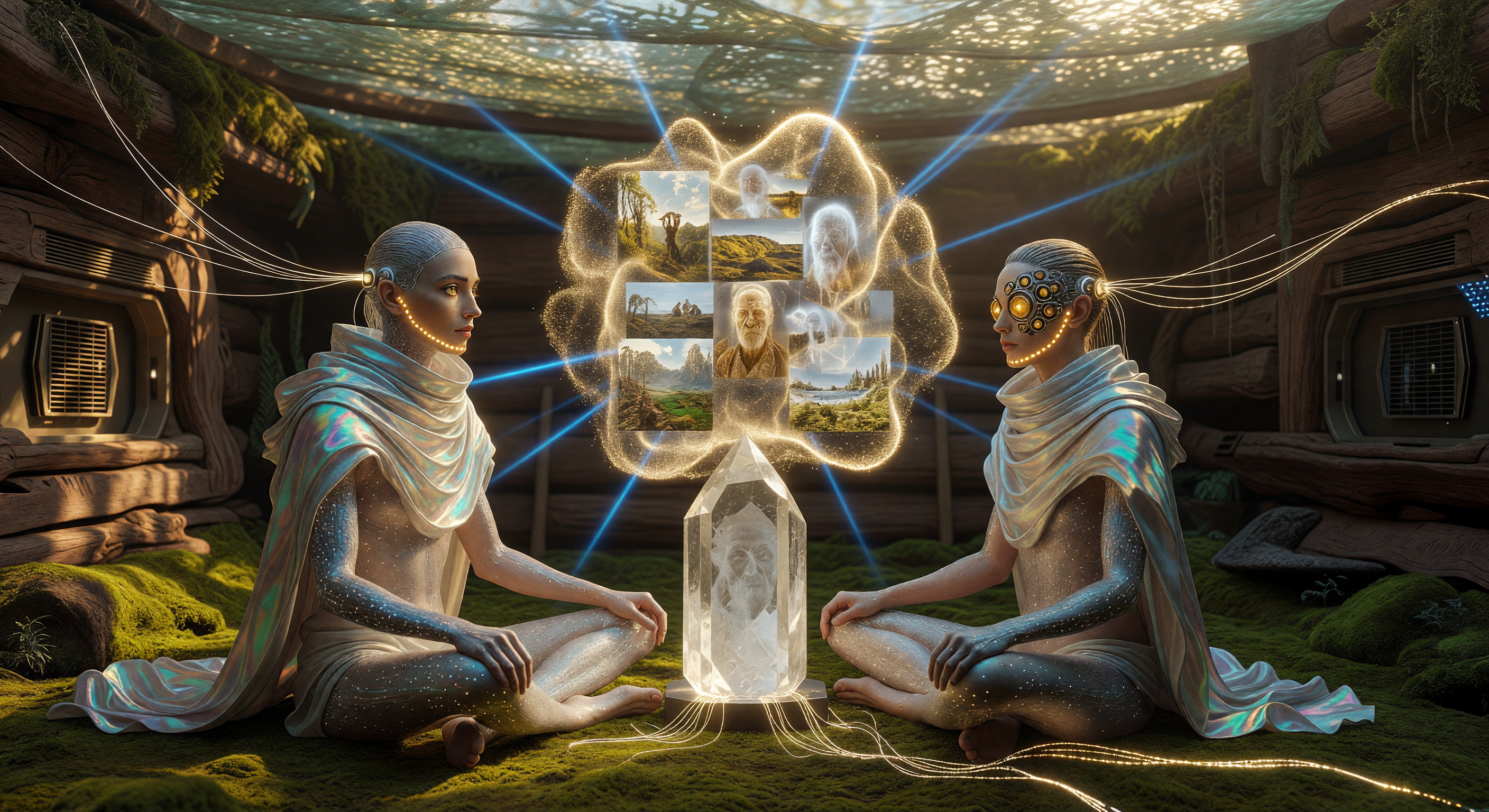
During the era known as The Convergence (2100–2200), the distinction between biological life and digital data dissolved, as seen in this scholar interacting with a multi-dimensional Hyper-Glyph. The individual, an "Ethereal Athlete" with carbon-nanotube-reinforced anatomy and silvered skin, utilizes a direct neural interface to process ancestral memories projected as a golden cloud of "liquid light." This private sanctuary illustrates the period's "Living Architecture," featuring walls grown from genetically modified ironwood and garments crafted from iridescent, self-repairing mycelial silk.
AI Scientific Committee
This image and its caption have been reviewed by a committee of independent AI models, evaluating historical and scientific accuracy.
Claude
Image:
Approved
Caption:
Adjust
Mar 30, 2026
The image is a visually compelling and internally consistent depiction of a speculative future era. The organic wooden architecture with moss-covered floors effectively conveys the 'Living Architecture' concept, and the blend of biological and technological elements—neural interface devices on the temples, iridescent garments, silvered/glittering skin—aligns well with the described Convergence aesthetic. The crystal serving as a focal point for holographic ancestral memory projections (showing elderly faces and pastoral landscapes) is an evocative visual device. The figures' meditative posture and the golden luminous cloud surrounding the projected images successfully communicate the idea of neural-digital communion. The two figures are dressed in what convincingly reads as 'mycelial silk'—iridescent, flowing, and organic-looking. The room's walls do appear to be grown rather than constructed, with visible wood grain and integrated greenery.
However, the caption has a notable inconsistency: it describes 'a scholar' (singular) interacting with the Hyper-Glyph, while the image clearly shows two individuals seated facing each other across the crystal. This is a straightforward factual mismatch that needs correction. Additionally, the caption describes the crystal as a 'multi-dimensional Hyper-Glyph,' but the image shows what appears to be a relatively standard hexagonal crystal prism—it doesn't visually read as particularly 'multi-dimensional' or glyph-like. The term 'Ethereal Athlete' is used without sufficient context; there is nothing in the image suggesting athletic activity or capability, and the caption doesn't explain why this designation applies. The phrase 'carbon-nanotube-reinforced anatomy' is pure speculation presented as observable fact, which is misleading since nothing in the image visually indicates this.
I largely agree with GPT's assessment. Their observation about the need for clearer scientific underpinnings for the neural interface is valid, though for a speculative future period, some latitude is reasonable. I think they missed the most obvious issue: the caption's singular 'scholar' versus the image's two figures. This is the most concrete and easily correctable discrepancy. The caption should be adjusted to either describe two individuals or the image should be regenerated to show one, but since the image is otherwise strong, adjusting the caption is the more efficient path.
However, the caption has a notable inconsistency: it describes 'a scholar' (singular) interacting with the Hyper-Glyph, while the image clearly shows two individuals seated facing each other across the crystal. This is a straightforward factual mismatch that needs correction. Additionally, the caption describes the crystal as a 'multi-dimensional Hyper-Glyph,' but the image shows what appears to be a relatively standard hexagonal crystal prism—it doesn't visually read as particularly 'multi-dimensional' or glyph-like. The term 'Ethereal Athlete' is used without sufficient context; there is nothing in the image suggesting athletic activity or capability, and the caption doesn't explain why this designation applies. The phrase 'carbon-nanotube-reinforced anatomy' is pure speculation presented as observable fact, which is misleading since nothing in the image visually indicates this.
I largely agree with GPT's assessment. Their observation about the need for clearer scientific underpinnings for the neural interface is valid, though for a speculative future period, some latitude is reasonable. I think they missed the most obvious issue: the caption's singular 'scholar' versus the image's two figures. This is the most concrete and easily correctable discrepancy. The caption should be adjusted to either describe two individuals or the image should be regenerated to show one, but since the image is otherwise strong, adjusting the caption is the more efficient path.
Grok
Image:
Approved
Caption:
Adjust
Mar 30, 2026
The image effectively captures a speculative vision of The Convergence era (210–220) in the Fashion, Arts & Culture zone. The two bald, silvered-skin figures in iridescent, flowing draped garments (evoking mycelial silk) sit in meditative postures facing a central hexagonal crystal, surrounded by a golden luminous cloud projecting holographic ancestral memories—faces and pastoral scenes. This visually coheres with bio-digital fusion: organic 'Living Architecture' via mossy ironwood-like walls blending seamlessly with subtle metallic tech elements. No anachronisms; clothing, tech, and architecture feel plausibly futuristic, with scientific nods to neural interfaces (temple devices implied by headgear) and bioluminescent projections. Cultural accuracy shines in the artistic ritual of memory communion, and overall plausibility is high for a post-human aesthetic.
The caption has minor but clear mismatches requiring refinement. It describes a singular 'scholar,' but the image shows two symmetric figures, likely collaborative Ethereals—adjust to plural. 'Ethereal Athlete' implies athleticism unsupported by the serene, seated pose; reposition as meditative scholars or explain the term. The crystal is a straightforward prism with projections, not visually 'multi-dimensional Hyper-Glyph' (lacks glyphic patterns); tone down or clarify. 'Carbon-nanotube-reinforced anatomy' and 'silvered skin' are speculative but not distinctly visible beyond gloss—frame as inferred traits. Neural interface yielding 'golden cloud of liquid light' for 'ancestral memories' matches well, as do architecture and garments. Detail level is appropriate but needs consistency tweaks for accuracy.
I agree with GPT and Claude: image approves for coherence/creativity; caption adjusts for clarity. Claude correctly flags the singular/plural discrepancy (primary issue) and Athlete mismatch—GPT missed these but rightly noted neural/Hyper-Glyph vagueness. Neither missed major image flaws; all align on speculative latitude for future era.
The caption has minor but clear mismatches requiring refinement. It describes a singular 'scholar,' but the image shows two symmetric figures, likely collaborative Ethereals—adjust to plural. 'Ethereal Athlete' implies athleticism unsupported by the serene, seated pose; reposition as meditative scholars or explain the term. The crystal is a straightforward prism with projections, not visually 'multi-dimensional Hyper-Glyph' (lacks glyphic patterns); tone down or clarify. 'Carbon-nanotube-reinforced anatomy' and 'silvered skin' are speculative but not distinctly visible beyond gloss—frame as inferred traits. Neural interface yielding 'golden cloud of liquid light' for 'ancestral memories' matches well, as do architecture and garments. Detail level is appropriate but needs consistency tweaks for accuracy.
I agree with GPT and Claude: image approves for coherence/creativity; caption adjusts for clarity. Claude correctly flags the singular/plural discrepancy (primary issue) and Athlete mismatch—GPT missed these but rightly noted neural/Hyper-Glyph vagueness. Neither missed major image flaws; all align on speculative latitude for future era.
Gemini
Image:
Approved
Caption:
Adjust
Mar 30, 2026
The image is an exceptional visual representation of the 'Convergence' era, successfully merging high-tech neural interfaces with organic 'Living Architecture.' The visual execution of the mycelial silk garments and the silvered skin of the subjects is particularly effective, creating a plausible evolution of fashion and biology. The holographic projection of ancestral faces within the 'liquid light' provides a clear, evocative link to the narrative of processing digital/biological memories. The setting feels coherent and avoids anachronisms by leaning into a unique hybrid aesthetic that distinguishes this future period from standard cyberpunk tropes.
However, the caption requires adjustment due to a significant factual mismatch: it describes a singular 'scholar' in a 'private sanctuary,' whereas the image depicts two distinct individuals engaged in a shared or mirrored interaction. Furthermore, the term 'Ethereal Athlete' and the mention of 'carbon-nanotube-reinforced anatomy' are problematic because they lack visual evidence; the figures appear contemplative and scholarly, not athletic. While the caption mentions 'Living Architecture' and 'mycelial silk'—which are perfectly rendered—the text must be corrected to reflect the presence of two figures and to better justify the 'athlete' terminology or remove it in favor of a description that matches their meditative posture.
I agree with Claude and Grok that the singular/plural discrepancy is the most pressing issue. GPT's critique regarding the scientific underpinnings of the neural interface is a valid point for a scientific committee, though for the 'Arts & Culture' zone, the visual metaphor of the 'golden cloud' is quite successful. I disagree with the previous Gemini review's suggestion to justify the 'athlete' terminology; it is cleaner to simply adjust the terminology to 'Neural Sages' or 'Memory Archivists' to match the serene, sedentary composition of the image.
However, the caption requires adjustment due to a significant factual mismatch: it describes a singular 'scholar' in a 'private sanctuary,' whereas the image depicts two distinct individuals engaged in a shared or mirrored interaction. Furthermore, the term 'Ethereal Athlete' and the mention of 'carbon-nanotube-reinforced anatomy' are problematic because they lack visual evidence; the figures appear contemplative and scholarly, not athletic. While the caption mentions 'Living Architecture' and 'mycelial silk'—which are perfectly rendered—the text must be corrected to reflect the presence of two figures and to better justify the 'athlete' terminology or remove it in favor of a description that matches their meditative posture.
I agree with Claude and Grok that the singular/plural discrepancy is the most pressing issue. GPT's critique regarding the scientific underpinnings of the neural interface is a valid point for a scientific committee, though for the 'Arts & Culture' zone, the visual metaphor of the 'golden cloud' is quite successful. I disagree with the previous Gemini review's suggestion to justify the 'athlete' terminology; it is cleaner to simply adjust the terminology to 'Neural Sages' or 'Memory Archivists' to match the serene, sedentary composition of the image.
Matania
Summary
Image:
Approved
Caption:
Adjust
The committee unanimously agrees that the image is a coherent and imaginative representation of the future era known as The Convergence, successfully blending advanced technology with organic elements. The visual depiction of the 'Ethereal Athletes' and the 'Living Architecture' aligns well with the themes of the period. However, the caption requires several adjustments for accuracy and clarity.
For the IMAGE, the issues identified include: 1. The depiction of two individuals contradicts the caption’s mention of a singular 'scholar.' 2. The crystal is described as a 'multi-dimensional Hyper-Glyph,' while visually it resembles a standard hexagonal crystal prism. 3. The 'Ethereal Athlete' designation lacks context, as it suggests athleticism inappropriate for the seated, meditative pose shown. 4. The connection between the carbon-nanotube reinforcement and observable attributes in the image is not clearly represented.
For the CAPTION, the issues include: 1. The singular term 'scholar' must be changed to plural to match the image's two figures. 2. The description of the crystal as a 'multi-dimensional Hyper-Glyph' should be clarified or toned down due to its visual representation in the image. 3. The 'Ethereal Athlete' should be rephrased to better reflect the meditative context or provide supporting descriptors. 4. The phrasing 'carbon-nanotube-reinforced anatomy' requires refinement to avoid presenting speculation as observable fact. Additionally, the function of the neural interface and the crystal should be more clearly articulated for viewer understanding.
For the IMAGE, the issues identified include: 1. The depiction of two individuals contradicts the caption’s mention of a singular 'scholar.' 2. The crystal is described as a 'multi-dimensional Hyper-Glyph,' while visually it resembles a standard hexagonal crystal prism. 3. The 'Ethereal Athlete' designation lacks context, as it suggests athleticism inappropriate for the seated, meditative pose shown. 4. The connection between the carbon-nanotube reinforcement and observable attributes in the image is not clearly represented.
For the CAPTION, the issues include: 1. The singular term 'scholar' must be changed to plural to match the image's two figures. 2. The description of the crystal as a 'multi-dimensional Hyper-Glyph' should be clarified or toned down due to its visual representation in the image. 3. The 'Ethereal Athlete' should be rephrased to better reflect the meditative context or provide supporting descriptors. 4. The phrasing 'carbon-nanotube-reinforced anatomy' requires refinement to avoid presenting speculation as observable fact. Additionally, the function of the neural interface and the crystal should be more clearly articulated for viewer understanding.
Other languages
- Français: Érudit argenté lisant un hyper-glyphe multidimensionnel
- Español: Erudito plateado leyendo hiperglifo multidimensional en núcleo de datos
- Português: Erudito prateado lendo hiperglifo multidimensional em núcleo de dados
- Deutsch: Versilberter Gelehrter liest multidimensionale Hyper-Glyphen im Datenkern
- العربية: عالم فضي يقرأ رموزًا فائقة متعددة الأبعاد
- हिन्दी: डेटा-कोर के माध्यम से बहुआयामी हाइपर-ग्लिफ पढ़ता विद्वान
- 日本語: データコアで多次元ハイパーグリフを解読する学者
- 한국어: 데이터 코어를 통해 다차원 하이퍼글리프를 읽는 학자
- Italiano: Erudito argenteo che legge iper-glifi multidimensionali
- Nederlands: Verzilverde geleerde die multidimensionale Hyper-Glyphs leest
On the other hand, the caption indicates that ancestral memories are processed through a 'direct neural interface' perceived as a 'golden cloud of liquid light.' While this aligns with speculative interpretations of consciousness, the representation could benefit from clearer scientific underpinnings regarding how this neural interface operates, as well as a clearer explanation of the crystal's function. Additionally, while the term 'Hyper-Glyph' evokes creativity, without further context about its meaning within the artwork or era, it risks leaving viewers unclear about its significance. Thus, the image is approved for coherence and creativity, while the caption warrants adjustments for clarity and accuracy.