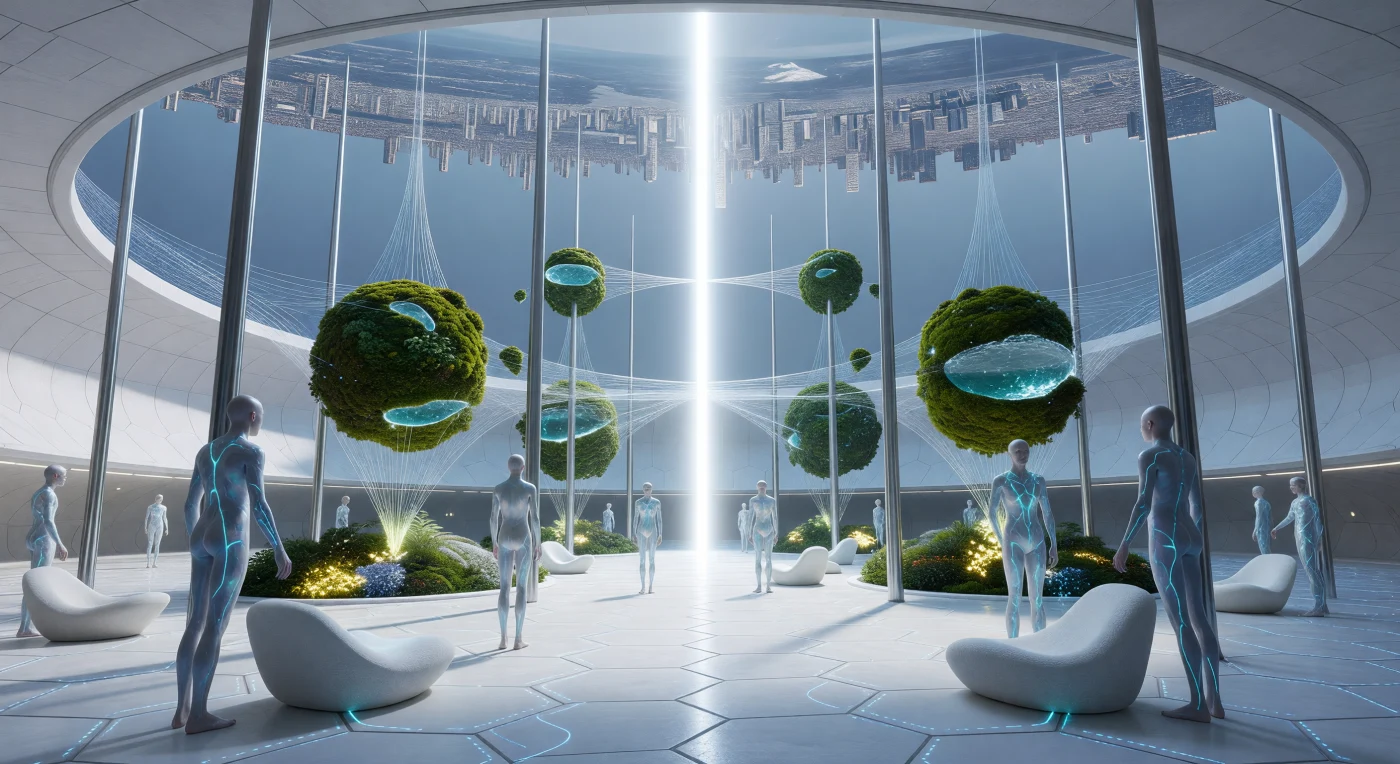
This assembly of the Ecoregional Synod, captured circa 2450 CE during the Great Divergence, depicts baseline *Homo sapiens* deliberating within a pavilion of cross-laminated heritage timber and polished basalt. Centrally suspended is a microwave rectenna array, a translucent lattice that converts high-frequency energy from the Sol-Infrastructural Dyson Swarm to provide localized power for the "Cradle of Stasis" nature reserve. The scene illustrates a society committed to the Sovereignty of Stasis Treaty, maintaining pre-industrial atmospheric conditions (280ppm CO2) and traditional human biology amidst a backdrop of planetary-scale engineering and Pleistocene-hybrid reforestation.

In this 24th-century Siberian landscape, a herd of de-extinct Woolly Mammoths (Mammuthus primigenius) grazes on a restored tundra, their thick coats and spiraled tusks adapted for the sub-zero environment they originally inhabited during the Pleistocene Epoch (2.6 million to 11,700 years ago). These megafauna play a vital role in modern ecological restoration, trampling snow to preserve the underlying permafrost while a wolf-mimetic Sentinel AI monitors the herd's health from a nearby outcrop. In the distance, a colossal Direct Air Capture tower disguised as a redwood tree works alongside high-orbital shading lenses to maintain a stable, pre-industrial climate for the reserve's inhabitants.

Set during the Great Divergence in the 24th century, this scene illustrates the "Cradle of Stasis" on a restored Earth where baseline humans engage in traditional maritime labor within a high-technology nature reserve. Fishermen are depicted harvesting genetically revitalized giant kelp (Macrocystis pyrifera) from a catamaran crafted of cross-laminated timber and self-healing polymers, while a crab-mimetic Sentinel AI monitors the sanctuary's water chemistry. This era is defined by the use of Dyson-scale energy to maintain a pre-industrial 280ppm carbon dioxide concentration, blending advanced custodial stewardship with the preservation of ancestral biological life.
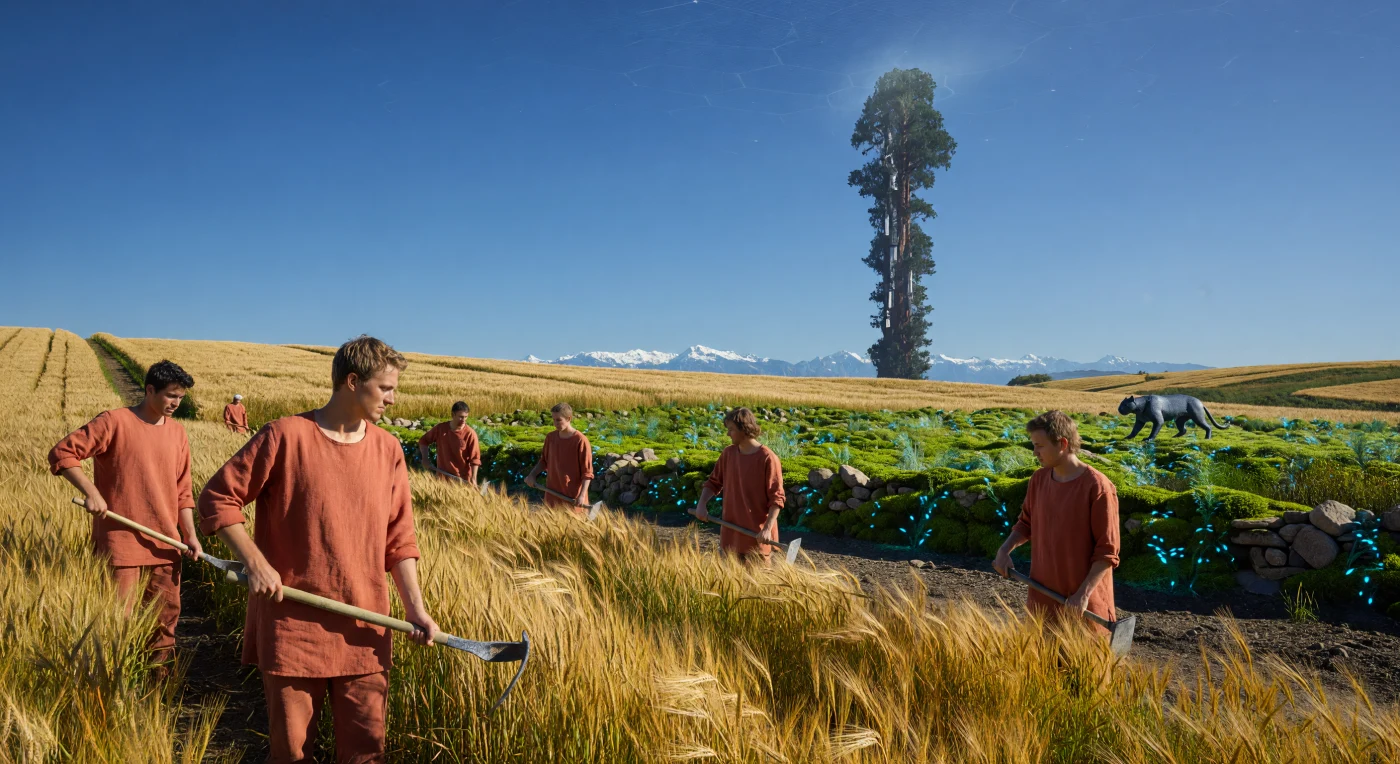
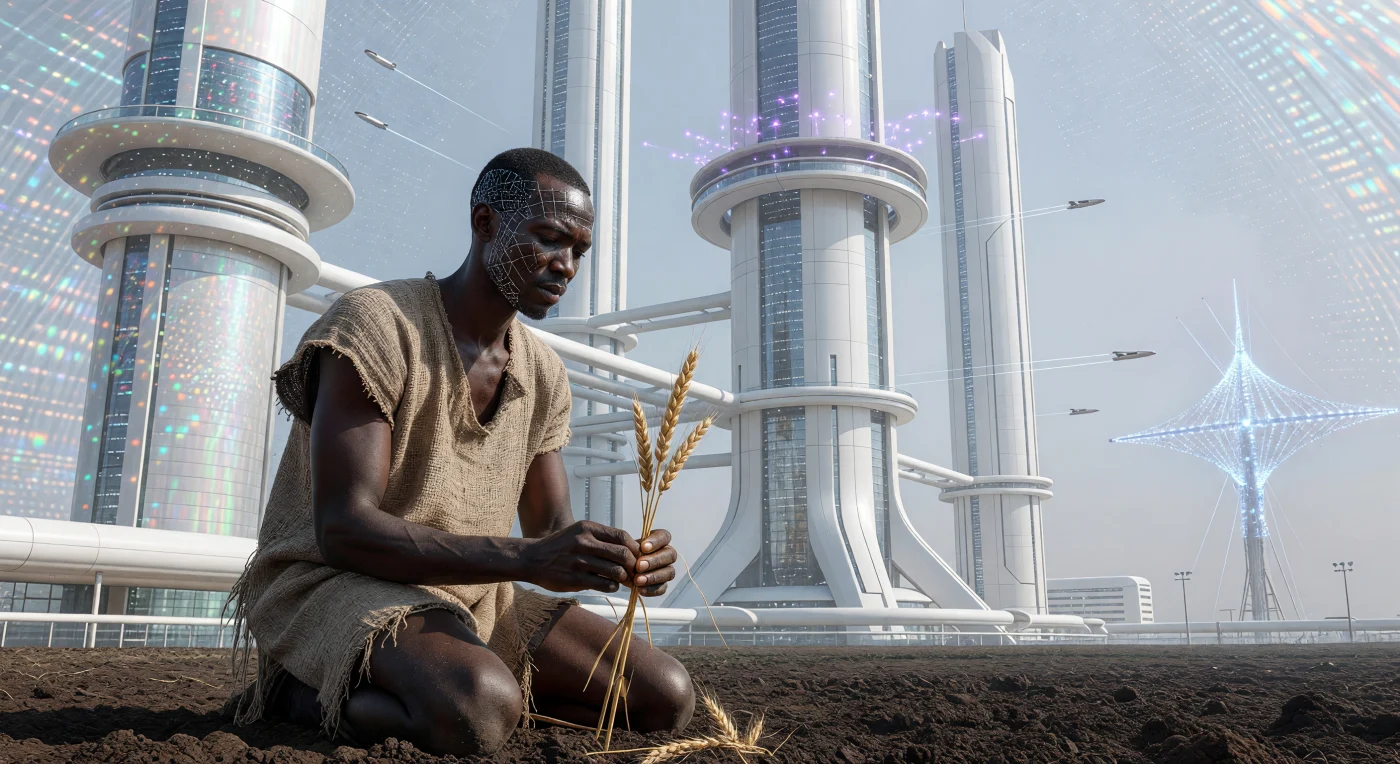
Set within a high-altitude Nature Reserve during the Great Divergence (c. 2200–2500 CE), this scene depicts baseline *Homo sapiens* engaging in "Restoration Labor" to tend heritage wheat. While the laborers utilize traditional agricultural methods, the landscape is supported by hidden, high-level technology, including synthetic "Piezo-Flora" moss that harvests wind energy and a massive Direct Air Capture tower disguised as a 300-meter redwood tree. Overhead, the sky reveals the subtle hexagonal geometry of Orbital Shading Lenses, part of a Dyson Swarm designed to regulate Earth’s climate and maintain a stable, pre-industrial atmospheric transparency.

Located fifty meters beneath the Earth’s Nature Reserves during the Great Divergence (c. 2200–2500 CE), this terminal exemplifies the "Cradle of Stasis" philosophy, using high-tier physics to protect the restored surface environment. Baseline *Homo sapiens*, genetically indistinguishable from 21st-century humans, wait to board a vacuum-sealed maglev pod alongside a deer-mimetic Custodial Sentinel that monitors the biological vitals of the population. The vaulted ceramic architecture is illuminated by bioluminescent synthetic moss known as Piezo-flora, which harvests energy from air vibrations to power the station without ecological leakage.

In this scene from the Great Divergence (c. 2200–2500 CE), a baseline *Homo sapiens* technician repairs a ducted-fan aero-bike using a molecular assembler within a curated Nature Reserve. The environment showcases a "high-tech Neolithic" aesthetic, where children play beneath energy-harvesting Piezo-flora and a disguised Direct Air Capture tower that maintains the atmosphere at a pre-industrial 280ppm CO2. This tableau illustrates the "Cradle of Stasis," a planetary management strategy where human populations live in a technologically supported ecological equilibrium, overseen by animal-mimetic Custodial AI Sentinels and powered by a distant Dyson Swarm.

Set within the Earth’s Nature Reserves during the Great Divergence (c. 2200–2500 CE), this scene depicts baseline humans, or "Naturals," manually grafting resilient coral polyps onto a bio-engineered limestone reef. Assisted by animal-mimetic "Sentinel" drones that scan for contaminants, these divers utilize pressure-regulated stasis-suits to work at depths of 20 meters in a pristine, hyper-managed Pacific lagoon. This restoration effort showcases the era’s commitment to de-extinction and ecological stasis, illuminated by filtered sunlight from an orbital Dyson Swarm and the soft cyan pulse of fiber-optic technology.

In the year 2350, the Great Pyramid of Giza is seen encased within a massive, self-healing polymer membrane, a centerpiece of the Earth’s Nature Reserves during the era of the Great Divergence. This sanctuary preserves unaugmented *Homo sapiens*, or "Naturals," who maintain traditional human customs under the watchful eye of a quadrupedal Custodial AI sentinel. The environment is meticulously regulated by planetary-scale engineering, including orbital shading lenses and synthetic "Piezo-Flora" that harvest ambient energy, reflecting a future dedicated to the obsessive, high-tech preservation of biological and architectural history.