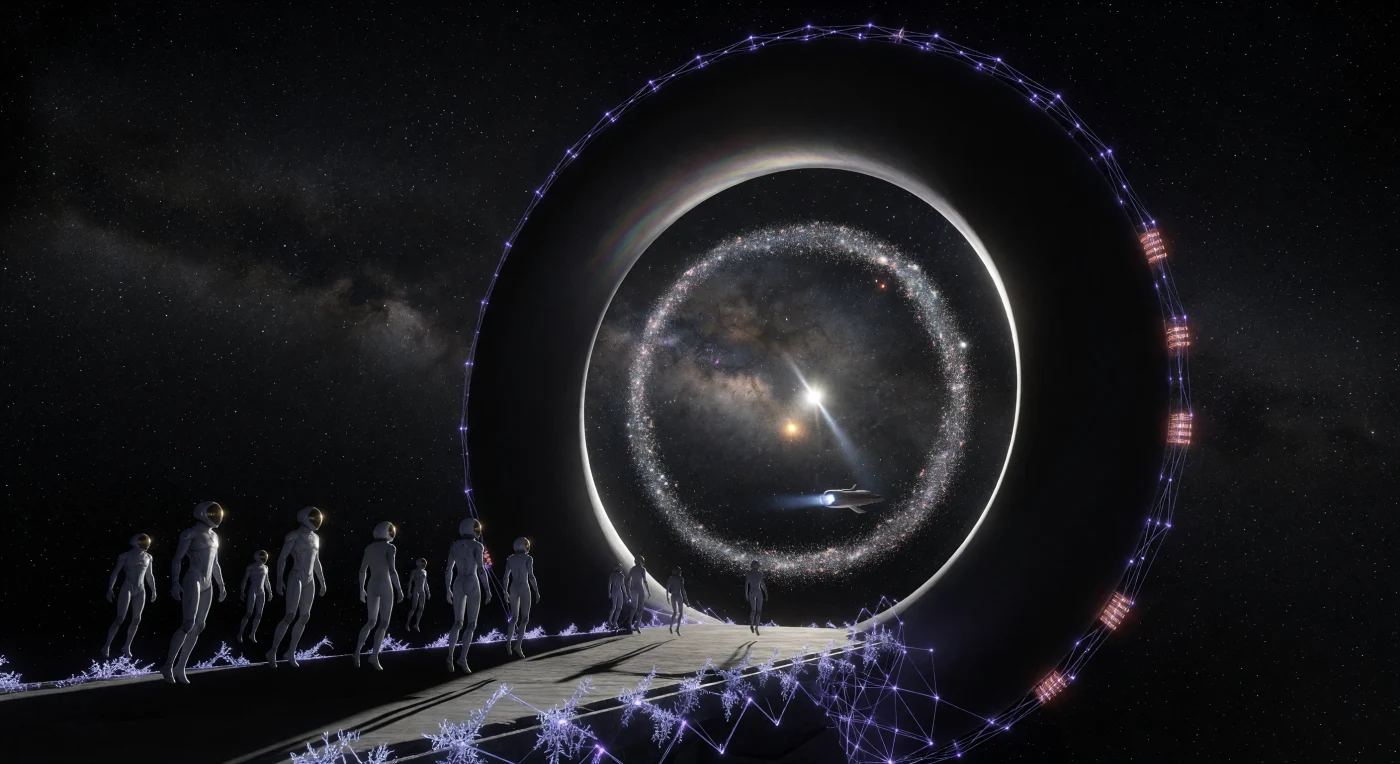
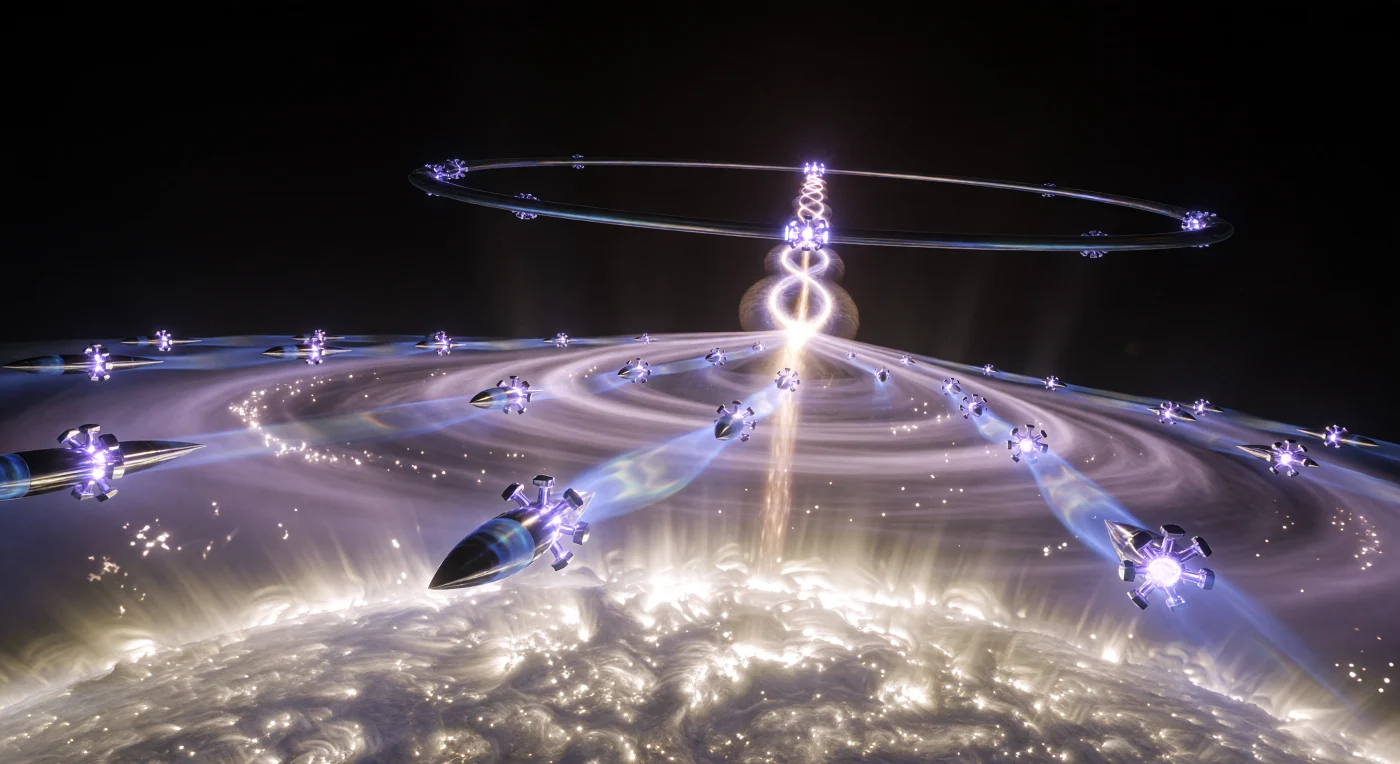
Floating fifty kilometers within the thick, amber haze of the Venusian atmosphere, this colossal geodesic aerostat sustains a lush ecosystem of engineered ferns and ivy during the Solar Expansion era (2500–3000 CE). The scene depicts a group of Aeros—transhuman inhabitants with specialized pulmonary systems and elongated, hollow-bone structures—observing the horizon from a carbon-fiber terrace as a "Photonics" drone communicates with the distant Dyson Swarm. This habitat demonstrates the advanced thermodynamic engineering and biological modification required to maintain Earth-descended life in the high-pressure, 0.9g environment of the Inner Circle.

Set during the Solar Expansion (2500–3000 CE), this scene depicts a "Deep-Diver" expedition harvesting sulfuric compounds within the crushing, high-density lower atmosphere of Venus. At an altitude of 20 kilometers, specialized "Aero" humans—biologically enhanced for high-pressure environments—pilot armored copper-beryllium vessels through a supercritical haze of shimmering amber mists. These submersibles remain tethered to floating aerostat cities by carbon-nanotube cables, utilizing ultraviolet sensors and magnetic induction coils to extract resources in temperatures exceeding 300°C. This industrial feat highlights humanity's advanced adaptation to the extreme thermal and atmospheric gradients of the Inner Circle.
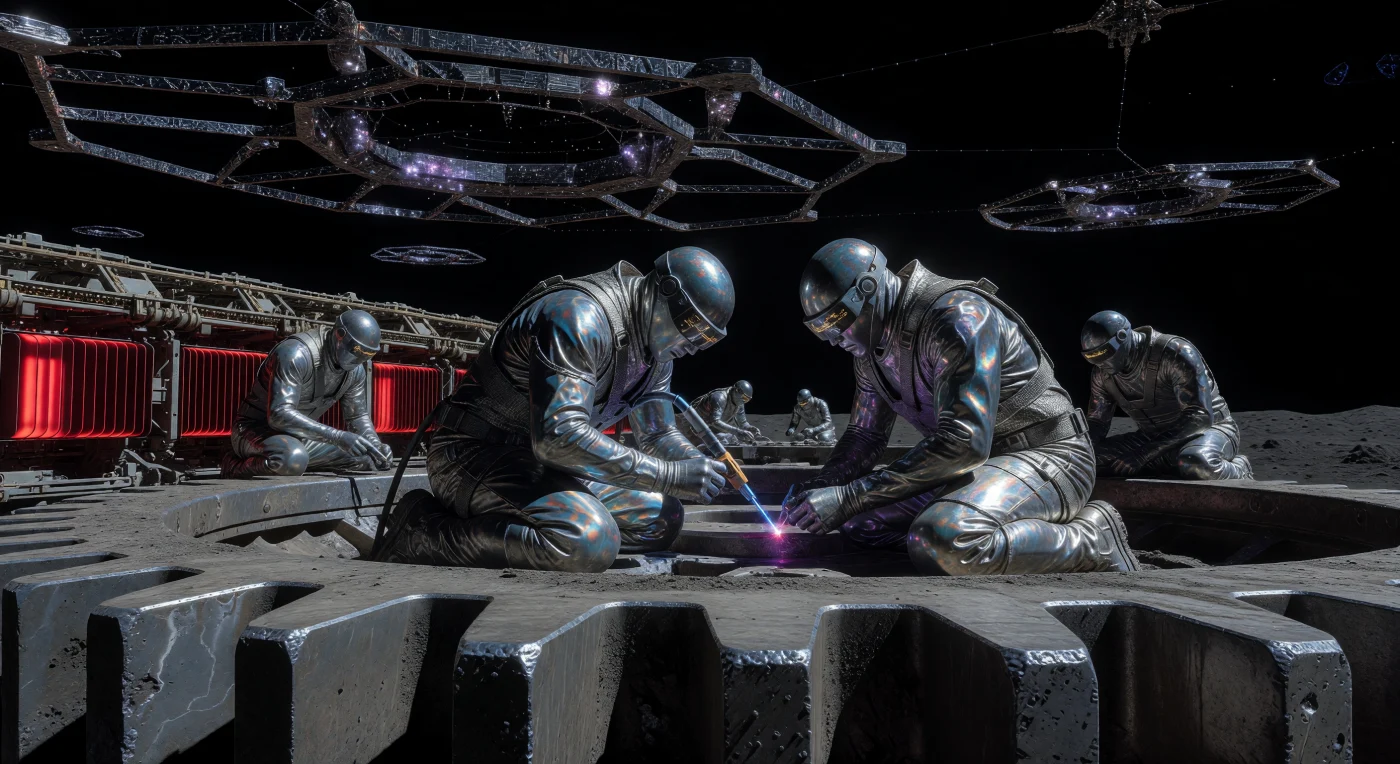
During the Solar Expansion (2500–3000 CE), specialized augmented humans known as Lithomorphs maintained the gargantuan mobile cities of Mercury, such as the "Great Crawl" depicted here. These workers possess shimmering lead-bismuth skin for radiation shielding and augmented-spectrum visors to navigate the planet’s atmosphere-free, high-contrast environment. In the pitch-black sky, the geometric lattice of the Phase I Dyson Swarm signifies a civilization harnessing the massive energy output of its star, marking humanity's advancement to a Kardashev Scale 1.4 society.

In the Venusian atmosphere during the Solar Expansion (2500–3000 CE), vast clouds of engineered, bioluminescent aero-plankton migrate through the temperate "Goldilocks Zone" at an altitude of 50 kilometers. Navigating these shimmering emerald curtains, human "Aeros" pilot massive, manta-shaped gravity-gliders that ride the planet’s 300 km/h super-rotating winds between distant geodesic aerostat cities. These genetically modified inhabitants, adapted with hollow bones and radiation-resistant skin, represent humanity’s transition into a multi-planetary species capable of thriving within the dense, golden-amber clouds of Venus.

Set within a massive aerostat floating 50 kilometers above the Venusian surface, this scene depicts a tense standoff at the base of a carbon-nanotube space elevator during the Solar Expansion era (2500–3000 CE). On the left, biologically modified Venusian Aeros, adapted for high-altitude buoyancy with hollow bones and enhanced pulmonary systems, guard a critical data-uplink terminal against encroaching Mercurian Lithomorphs. These Lithomorphs are specialized for the harsh radiation of the inner solar system, featuring hyper-dense frames and sub-dermal lead-bismuth shielding that gives their skin a metallic, iridescent texture. The lime-green atmosphere and turbulent vapor trails highlight the extreme conditions of Venus's super-rotating winds, where humanity’s descendants have engineered a precarious existence within the planet's sulfuric clouds.

Set during the Solar Expansion era circa 2750 CE, this scene depicts Lithomorphs—augmented humans engineered with sub-dermal lead-bismuth shielding for high-radiation environments—participating in a synchronization ritual at Mercury’s North Pole. Standing on a plaza of polished basalt, the figures use optical-fiber staves to link their neural lattices with the Dyson Swarm, a shimmering golden web of solar-energy collectors visible across the airless, pitch-black sky. This depiction highlights the sophisticated thermodynamics of a Kardashev Scale 1.4 civilization, featuring planetary-scale liquid-sodium radiators and X-ray laser transmissions used to harness the primary energy of the Sun.
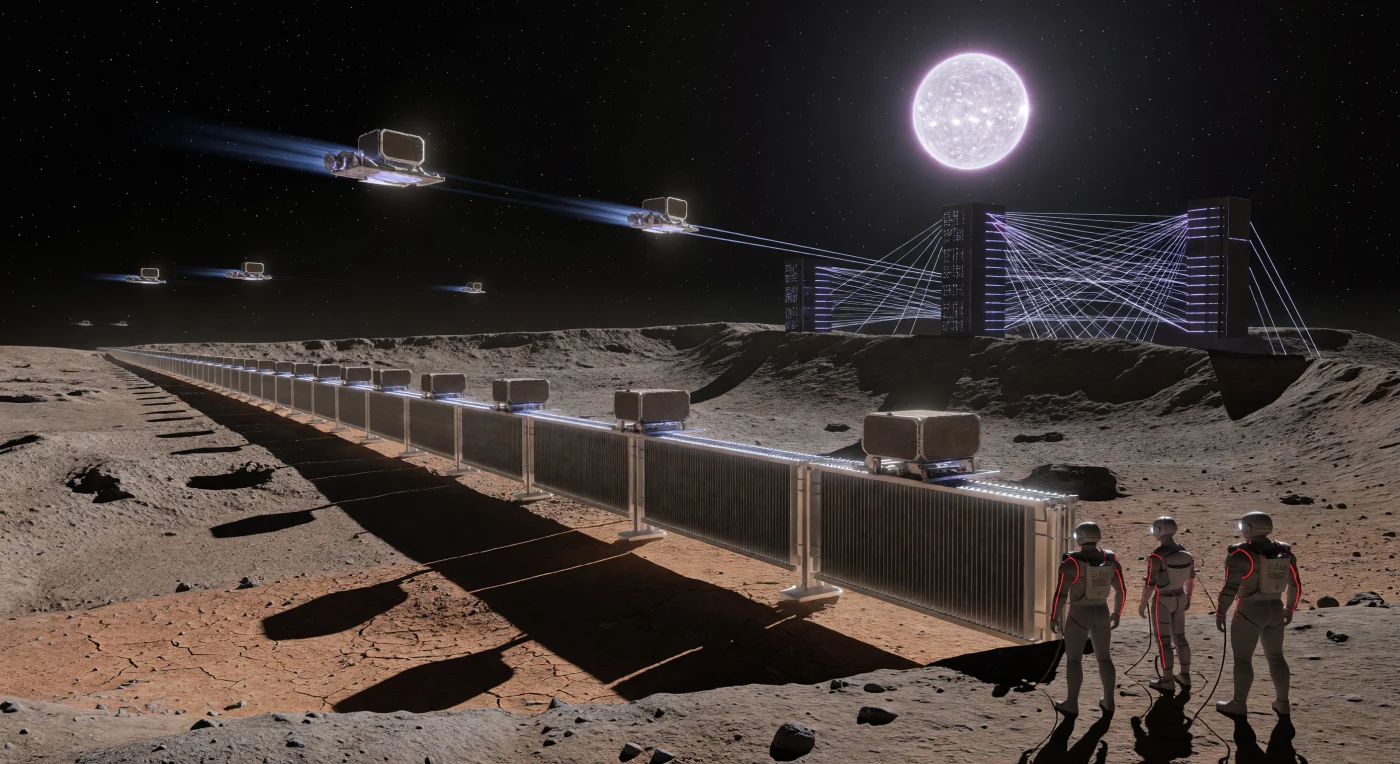
During the Solar Expansion era (2500–3000 CE), the Caloris Basin on Mercury serves as a primary industrial hub for the construction of the Phase I Dyson Swarm. A ten-kilometer electromagnetic mass driver launches canisters of refined regolith into the black, airless sky, powered by the immense solar energy harvested from the nearby sun, which appears three times larger than it does from Earth. In the foreground, radiation-shielded "Lithomorph" technicians and "Photonics" digital entities—communicating via violet-white laser pulses—manage the high-velocity loading sequence amidst a landscape of liquid-sodium radiators and scorched, amber-lit regolith.

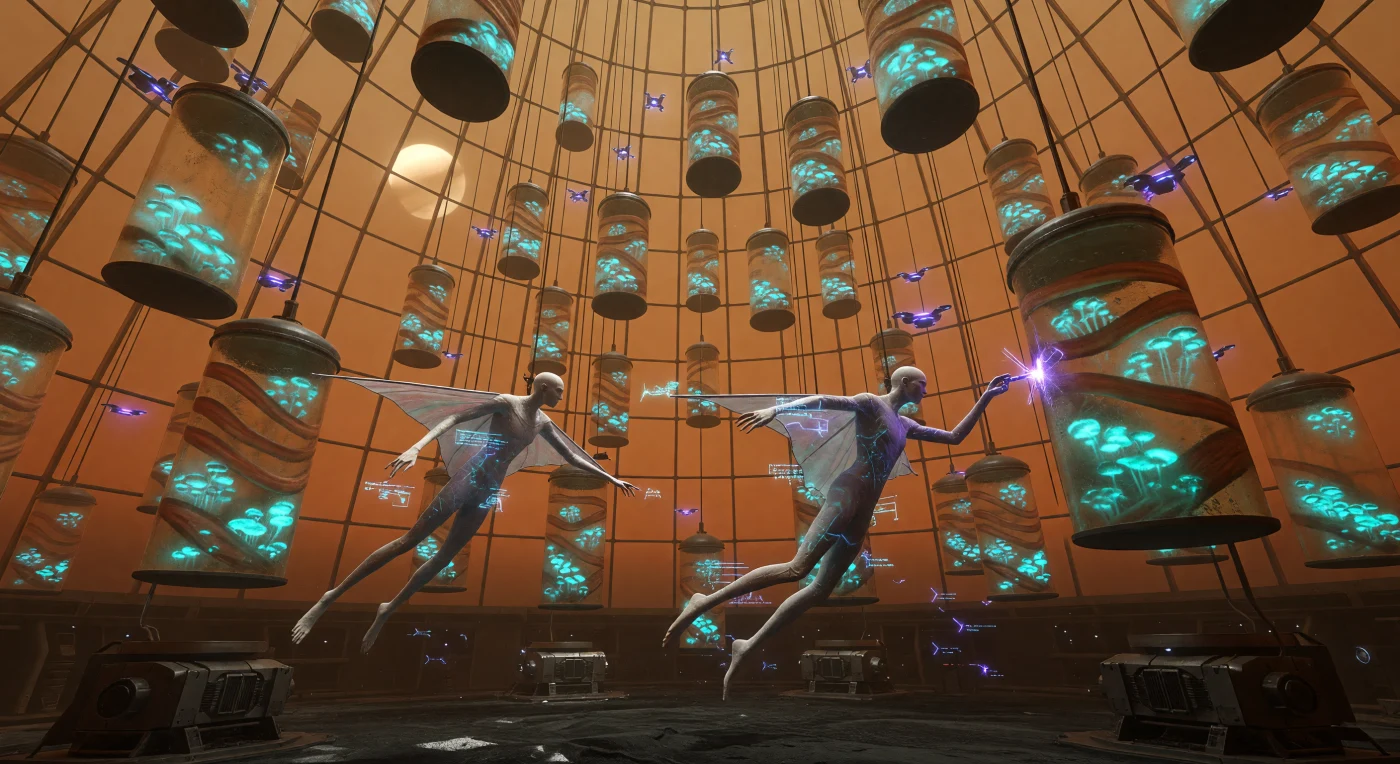
Floating fifty kilometers above the Venusian surface, "Aeros" technicians monitor massive translucent vats where protein is synthesized from atmospheric carbon. This scene from the Solar Expansion era (2500–3000 CE) depicts the industrial heart of a floating aerostat habitat, where human descendants with hollow-bone structures and specialized pulmonary masks manage the Inner Circle’s food supply. The environment is bathed in the "Eternal Sunset," a perpetual amber glow filtered through a thick atmosphere teeming with engineered aero-plankton. This high-energy civilization utilizes the extreme pressure and heat of Venus to power their geodesic cities, representing a pinnacle of post-scarcity biological and mechanical engineering.