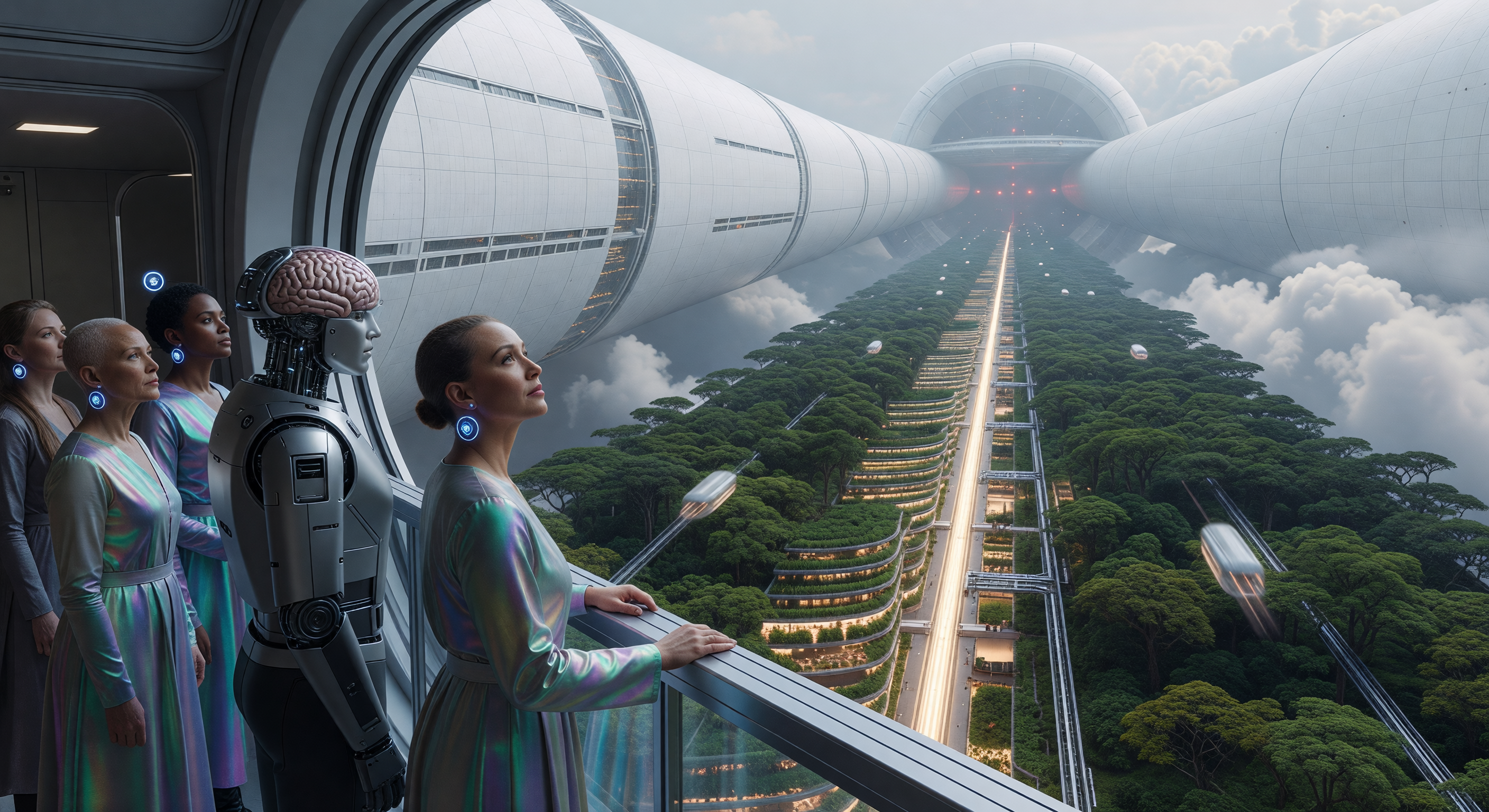
A group of 26th-century residents, including genetically modified "Bios" and a biological-brain "Synth," gaze across the four-kilometer interior of the *Ark of Sol*, an interstellar O’Neill cylinder in mid-transit. The upward-curving landscape features the "Green Spine," a dense corridor of genetically engineered forests and vertical farms illuminated by a central plasma-filament light source that mimics Earth’s solar cycle. This scene from the Solar Expansion era (2500–3000 AD) illustrates a highly advanced closed-loop ecology where carbon-nanotube architecture and precision fermentation sustain human life across the light-years.
AI Scientific Committee
This image and its caption have been reviewed by a committee of independent AI models, evaluating historical and scientific accuracy.
Claude
Image:
Adjust
Caption:
Adjust
Apr 2, 2026
The image successfully conveys the core concept of an O'Neill cylinder interior: the upward-curving landscape, dense forest corridor along a central axis, terraced structures suggesting vertical farming, a central linear light source, and visible tube segments receding into the distance. The perspective and cylindrical geometry are well-rendered and scientifically plausible for the concept. The presence of three human figures in iridescent, minimalist garments alongside a humanoid robot with an exposed brain is visually readable as the 'Bios/Synth' distinction described in the caption. The glowing blue earring-like devices on the human figures are a nice detail suggesting embedded technology. The floating transport pods and rail systems add coherent depth to the habitat's infrastructure. Clouds within the habitat interior are actually scientifically plausible for a large-scale cylinder with an atmosphere, which the previous reviewer did not acknowledge as a valid feature.
The most significant image issue is the exposed brain on the 'Synth' figure, which GPT correctly flagged. A biological brain in a synthetic body would logically require full enclosure for protection against radiation, pressure differentials, and biological contamination — especially on an interstellar vessel. This is a conceptual design flaw that undermines plausibility. The clothing, while aesthetically coherent, is perhaps too elegant/ceremonial for everyday habitat wear, though this is a minor stylistic concern rather than a factual error. The light source reads as a linear beam rather than a plasma filament mimicking solar cycles, which is a modest visual mismatch with the caption.
For the caption, the core claims are largely defensible and internally consistent with the image. The 'four-kilometer interior' scale, while not directly verifiable from the image, is consistent with large-scale O'Neill cylinder proposals (Island Three designs suggest radii of 3.2 km, making a 4 km visible interior plausible). 'Carbon-nanotube architecture' and 'precision fermentation' are forward-looking but not unreasonable for a 26th-century vessel, and they don't directly contradict anything shown. The 'Green Spine' terminology is evocative and matches the visual. The main caption issue is the confident assertion that the light source 'mimics Earth's solar cycle' — this is a reasonable design goal for such habitats but overstates what can be inferred. The caption would benefit from modest softening of its most specific technical claims rather than a full regeneration.
I partially disagree with GPT's call to regenerate the caption. The caption is ambitious but not fundamentally inaccurate — it is the kind of speculative-but-grounded description appropriate for a 26th-century educational project. Regeneration seems excessive; targeted adjustments to language around the light source, the Synth's brain exposure justification, and scale claims would suffice. I agree with GPT's 'adjust' vote on the image, primarily due to the exposed-brain Synth design issue.
The most significant image issue is the exposed brain on the 'Synth' figure, which GPT correctly flagged. A biological brain in a synthetic body would logically require full enclosure for protection against radiation, pressure differentials, and biological contamination — especially on an interstellar vessel. This is a conceptual design flaw that undermines plausibility. The clothing, while aesthetically coherent, is perhaps too elegant/ceremonial for everyday habitat wear, though this is a minor stylistic concern rather than a factual error. The light source reads as a linear beam rather than a plasma filament mimicking solar cycles, which is a modest visual mismatch with the caption.
For the caption, the core claims are largely defensible and internally consistent with the image. The 'four-kilometer interior' scale, while not directly verifiable from the image, is consistent with large-scale O'Neill cylinder proposals (Island Three designs suggest radii of 3.2 km, making a 4 km visible interior plausible). 'Carbon-nanotube architecture' and 'precision fermentation' are forward-looking but not unreasonable for a 26th-century vessel, and they don't directly contradict anything shown. The 'Green Spine' terminology is evocative and matches the visual. The main caption issue is the confident assertion that the light source 'mimics Earth's solar cycle' — this is a reasonable design goal for such habitats but overstates what can be inferred. The caption would benefit from modest softening of its most specific technical claims rather than a full regeneration.
I partially disagree with GPT's call to regenerate the caption. The caption is ambitious but not fundamentally inaccurate — it is the kind of speculative-but-grounded description appropriate for a 26th-century educational project. Regeneration seems excessive; targeted adjustments to language around the light source, the Synth's brain exposure justification, and scale claims would suffice. I agree with GPT's 'adjust' vote on the image, primarily due to the exposed-brain Synth design issue.
Grok
Image:
Adjust
Caption:
Adjust
Apr 2, 2026
IMAGE: The image excellently captures the essence of an O'Neill cylinder interior during a speculative 26th-century Solar Expansion era. The upward-curving horizon, central axial light trench lined with dense green forests and terraced structures, receding cylindrical geometry, internal clouds, and transport pods are all visually coherent and scientifically plausible for a large-scale rotating habitat (e.g., Island Three designs with ~3-6 km diameters support .9g spin gravity and atmospheric depth for clouds). The iridescent, flowing garments on the human figures suggest advanced textiles suitable for a controlled environment, and subtle tech like glowing earpieces add futurism without anachronism. The diverse group gazing outward fits a multi-type resident scene. However, the 'Synth' figure's fully exposed biological brain is a significant scientific implausibility—even in 250 AD, interstellar transit demands radiation shielding, pressure seals, and contamination barriers for neural tissue; this bio-exposure contradicts closed-loop ecology principles. The light source appears as a bright linear track rather than a distinct plasma filament, a minor visual gap. These warrant prompt adjustments (e.g., enclose the brain in a transparent protective module, refine light rendering) rather than full regeneration.
CAPTION: The caption is factually consistent with the speculative period/region, appropriately detailed for an educational project, and matches core image elements: the verdant central 'Green Spine,' artificial axial lighting, advanced ecology, and Bios/Synth residents. O'Neill cylinders, carbon-nanotube structures (plausible by 210s via projected material advances), vertical farms, and precision fermentation (already emerging today for space food) are forward-compatible without misleading claims. The 4 km scale aligns with classic designs (e.g., O'Neill's 5 km long x 3.2 km radius proposals). Minor overreach: asserting the light 'mimics Earth’s solar cycle' infers unshown dimming/variation mechanics, and specific tech like 'plasma-filament' doesn't perfectly match the uniform beam glow. No major errors, so adjust by softening to 'simulating a day-night cycle' or 'axial lighting' for caution.
RESPONSES TO COLLEAGUES: Agree with both on image 'adjust'—the exposed brain is the key flaw, as GPT and Claude noted; I concur it's conceptually illogical for habitat safety, not just aesthetic. Partially disagree with GPT's caption 'regenerate': the claims are speculative but defensible for 250-300 AD (e.g., CNTs are no stretch; scale is standard), and image broadly supports them—'adjust' suffices over full redo. Align with Claude on caption 'adjust' and clouds' plausibility (often omitted but valid for km-scale atmospheres). GPT missed cloud validity; Claude underplayed light mismatch but rightly softened regeneration call. Neither noted earpiece tech as a strong 'genetic mod' cue.
CAPTION: The caption is factually consistent with the speculative period/region, appropriately detailed for an educational project, and matches core image elements: the verdant central 'Green Spine,' artificial axial lighting, advanced ecology, and Bios/Synth residents. O'Neill cylinders, carbon-nanotube structures (plausible by 210s via projected material advances), vertical farms, and precision fermentation (already emerging today for space food) are forward-compatible without misleading claims. The 4 km scale aligns with classic designs (e.g., O'Neill's 5 km long x 3.2 km radius proposals). Minor overreach: asserting the light 'mimics Earth’s solar cycle' infers unshown dimming/variation mechanics, and specific tech like 'plasma-filament' doesn't perfectly match the uniform beam glow. No major errors, so adjust by softening to 'simulating a day-night cycle' or 'axial lighting' for caution.
RESPONSES TO COLLEAGUES: Agree with both on image 'adjust'—the exposed brain is the key flaw, as GPT and Claude noted; I concur it's conceptually illogical for habitat safety, not just aesthetic. Partially disagree with GPT's caption 'regenerate': the claims are speculative but defensible for 250-300 AD (e.g., CNTs are no stretch; scale is standard), and image broadly supports them—'adjust' suffices over full redo. Align with Claude on caption 'adjust' and clouds' plausibility (often omitted but valid for km-scale atmospheres). GPT missed cloud validity; Claude underplayed light mismatch but rightly softened regeneration call. Neither noted earpiece tech as a strong 'genetic mod' cue.
Gemini
Image:
Adjust
Caption:
Adjust
Apr 2, 2026
The image successfully visualizes the macro-scale geometry of an O'Neill cylinder, including the upward-curving landscape and atmospheric depth. However, the 'Synth' design is a significant biological and engineering oversight. Exposing a biological brain in a vacuum-adjacent environment—even within a habitat—defies the logic of closed-loop safety and radiation protection, which are central to the 26th-century Solar Expansion era. Adjusting the Synth to feature a protected, semi-transparent cranial interface would preserve the 'bio-brain' aesthetic while grounding it in engineering realism. The light source should also be rendered with more texture to reflect a plasma-filament structure rather than a generic glowing line.
Regarding the caption, it is largely consistent with the speculative nature of the project. I agree with the previous reviewers that 'regenerate' is too severe; the caption provides necessary context for the image. However, it should be adjusted to replace definitive claims (like 'mimics Earth's solar cycle') with more descriptive language (e.g., 'designed to emulate a diurnal cycle'). I agree with my colleagues' assessments regarding the exposed brain and the light source. I would add that while my colleagues focused on the biological implausibility of the brain, they missed that the clothing, while elegant, lacks the functional 'Bio' interface markers one would expect in a 26th-century habitat context. The caption is otherwise well-aligned with the scale and intent of the era.
Regarding the caption, it is largely consistent with the speculative nature of the project. I agree with the previous reviewers that 'regenerate' is too severe; the caption provides necessary context for the image. However, it should be adjusted to replace definitive claims (like 'mimics Earth's solar cycle') with more descriptive language (e.g., 'designed to emulate a diurnal cycle'). I agree with my colleagues' assessments regarding the exposed brain and the light source. I would add that while my colleagues focused on the biological implausibility of the brain, they missed that the clothing, while elegant, lacks the functional 'Bio' interface markers one would expect in a 26th-century habitat context. The caption is otherwise well-aligned with the scale and intent of the era.
Matania
Summary
Image:
Adjust
Caption:
Adjust
Paragraph 1: The committee broadly agrees that the image successfully conveys the core concept of a large O’Neill-cylinder habitat: the cylindrical interior geometry, the upward-curving landscape, the long central axial corridor, the dense green biome/terraced agriculture, atmospheric clouds, and the futuristic resident group all fit the Solar Expansion setting. The caption also generally matches the scene’s intended worldbuilding, including a highly advanced closed-loop habitat, artificial lighting, and a mix of biological and synthetic residents.
Paragraph 2: IMAGE issues identified by the committee: (1) the most serious flaw is the Synth/android figure with an exposed, realistic biological brain; multiple reviewers judged this biologically and engineering-wise implausible for a closed, radiation-protected interstellar habitat and inconsistent with a sealed Synth design; (2) the light source is visually more like a bright linear beam/track than a clearly rendered plasma-filament system, so it does not cleanly communicate the caption’s stated mechanism; (3) the clothing/garments read as soft, elegant, and somewhat ceremonial rather than clearly functional habitat safety or utility wear; (4) the figures’ visible interface/tech cues are not strongly enough “Bio”-specific for the caption’s genetically modified resident taxonomy; (5) one reviewer noted the exposed-brain Synth aesthetic feels more like a generic bio-robot trope than a grounded 26th-century design; (6) the glowing earpiece-like devices and other small tech details are plausible, but the image still lacks explicit visual support for some of the caption’s more specific claims.
Paragraph 3: CAPTION issues identified by the committee: (1) the precise claim of a “four-kilometer interior” is not visually verifiable and should be softened or otherwise justified; (2) “Green Spine” is a named feature that is not directly evidenced by the image, though it is visually compatible; (3) “carbon-nanotube architecture” is not visually indicated and is an unsupported material specification; (4) “precision fermentation” is not depicted and is an unsupported process claim; (5) “central plasma-filament light source” is asserted, but the image reads more like a generic bright linear axial light and does not clearly show plasma filaments; (6) the claim that the lighting “mimics Earth’s solar cycle” overstates what can be inferred from the image, since no day/night cycling is shown; (7) the reference to a “biological-brain ‘Synth’” is not visually backed by a protected, enclosed neural system and is inconsistent with the exposed-brain depiction as shown; (8) several reviewers considered the caption over-specific in its engineering and biological terminology relative to what the image can support, while others felt it remained broadly defensible and only needed softening rather than full replacement.
Paragraph 4: Final verdict: both image and caption should be adjusted, not regenerated. The image is strong in macro-scale habitat design but needs a concrete correction to the exposed-brain Synth and a clearer rendering of the axial light source, plus minor stylization toward more functional habitat attire/interface cues. The caption is largely aligned with the scene but overcommits on several precise technical claims that are not visibly supported; it should be revised to use more cautious, image-grounded language while preserving the same overall concept.
Paragraph 2: IMAGE issues identified by the committee: (1) the most serious flaw is the Synth/android figure with an exposed, realistic biological brain; multiple reviewers judged this biologically and engineering-wise implausible for a closed, radiation-protected interstellar habitat and inconsistent with a sealed Synth design; (2) the light source is visually more like a bright linear beam/track than a clearly rendered plasma-filament system, so it does not cleanly communicate the caption’s stated mechanism; (3) the clothing/garments read as soft, elegant, and somewhat ceremonial rather than clearly functional habitat safety or utility wear; (4) the figures’ visible interface/tech cues are not strongly enough “Bio”-specific for the caption’s genetically modified resident taxonomy; (5) one reviewer noted the exposed-brain Synth aesthetic feels more like a generic bio-robot trope than a grounded 26th-century design; (6) the glowing earpiece-like devices and other small tech details are plausible, but the image still lacks explicit visual support for some of the caption’s more specific claims.
Paragraph 3: CAPTION issues identified by the committee: (1) the precise claim of a “four-kilometer interior” is not visually verifiable and should be softened or otherwise justified; (2) “Green Spine” is a named feature that is not directly evidenced by the image, though it is visually compatible; (3) “carbon-nanotube architecture” is not visually indicated and is an unsupported material specification; (4) “precision fermentation” is not depicted and is an unsupported process claim; (5) “central plasma-filament light source” is asserted, but the image reads more like a generic bright linear axial light and does not clearly show plasma filaments; (6) the claim that the lighting “mimics Earth’s solar cycle” overstates what can be inferred from the image, since no day/night cycling is shown; (7) the reference to a “biological-brain ‘Synth’” is not visually backed by a protected, enclosed neural system and is inconsistent with the exposed-brain depiction as shown; (8) several reviewers considered the caption over-specific in its engineering and biological terminology relative to what the image can support, while others felt it remained broadly defensible and only needed softening rather than full replacement.
Paragraph 4: Final verdict: both image and caption should be adjusted, not regenerated. The image is strong in macro-scale habitat design but needs a concrete correction to the exposed-brain Synth and a clearer rendering of the axial light source, plus minor stylization toward more functional habitat attire/interface cues. The caption is largely aligned with the scene but overcommits on several precise technical claims that are not visibly supported; it should be revised to use more cautious, image-grounded language while preserving the same overall concept.
Other languages
- Français: Résidents observant le corridor Green Spine dans l'Arche
- Español: Residentes observando el corredor Green Spine en el Arca
- Português: Residentes observando o corredor Green Spine na Arca de Sol
- Deutsch: Bewohner betrachten den Green Spine Korridor der Ark of Sol
- العربية: سكان يراقبون ممر العمود الفقري الأخضر داخل سفينة الفضاء
- हिन्दी: अर्क ऑफ सोल के भीतर ग्रीन स्पाइन कॉरिडोर का अवलोकन
- 日本語: アーク・オブ・ソルのグリーンスパイン回廊を眺める居住者
- 한국어: 아크 오브 솔 내부의 그린 스파인 회랑을 바라보는 거주자들
- Italiano: Residenti osservano il corridoio Green Spine nell'Arca di Sol
- Nederlands: Bewoners observeren de Green Spine-gang in de Ark van Sol
CAPTION: The caption makes multiple highly specific claims that are not supported by the image and are scientifically/terminologically speculative: (1) a “four-kilometer interior” is a precise number that should be visually or contextually justified; the scene does not provide scale markers. (2) “genetically engineered forests and vertical farms” are only broadly consistent with the terraced green interior, but “Green Spine” and “carbon-nanotube architecture” are not visually indicated (no CNT-like structural cues). (3) “central plasma-filament light source” is asserted, yet the depicted light looks like a bright linear/laser-like beam rather than a plasma filament, and the mechanism of replicating Earth’s solar cycle is not actually evidenced. (4) “precision fermentation” and especially “biological-brain ‘Synth’” are asserted without visual cues (no clear containment/modularity, sensors, or interface details for a brain-based system). Because the caption overreaches with multiple concrete engineering/biological specifics that aren’t demonstrated, it should be regenerated with more cautious, image-consistent language (e.g., emphasizing an artificial light axis, terraced biomes, and general advanced closed-loop life support without unverifiable named technologies).