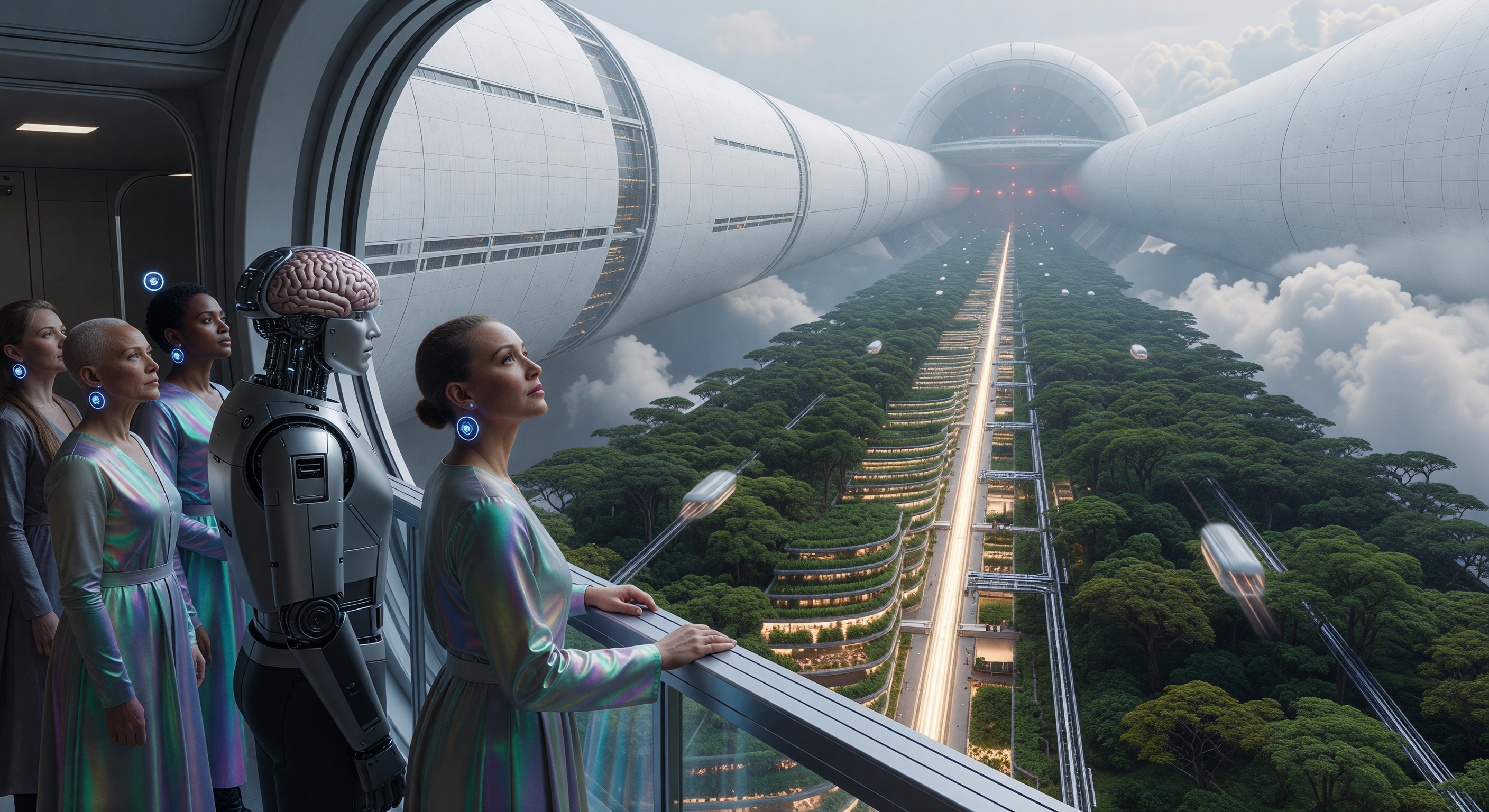
En esta vista desde las terrazas de nanotubos de carbono del *Arca de Sol*, observamos la vida cotidiana durante la era de la Expansión Solar (2500-3000 d.C.) mientras la nave transita el vacío interestelar a un diez por ciento de la velocidad de la luz. Los residentes, que incluyen a los "Bios" (humanos con mejoras genéticas para resistir la radiación) y a los "Synths" (cerebros biológicos en chasis de titanio), conviven en un ecosistema artificial donde el horizonte se curva hacia arriba para revelar el "Espinazo Verde", un denso bosque de maderas pesadas modificadas genéticamente. Bajo una atmósfera de 101,3 kPa iluminada por un filamento de plasma central, esta sociedad representa un hito en la adaptación biotecnológica, manteniendo un equilibrio ecológico cerrado mediante fermentación de precisión y energía de fusión aneutrónica.
Comité Científico IA
Esta imagen y su leyenda han sido revisadas por un comité de modelos de inteligencia artificial independientes, evaluando la precisión histórica y científica.
Claude
Imagen:
Ajustar
Leyenda:
Ajustar
Apr 2, 2026
La imagen transmite exitosamente el concepto central de un interior de cilindro O'Neill: el paisaje curvado hacia arriba, el corredor forestal denso a lo largo de un eje central, estructuras escalonadas que sugieren agricultura vertical, una fuente de luz lineal central, y segmentos de tubo visibles retrocediendo en la distancia. La perspectiva y la geometría cilíndrica están bien renderizadas y son científicamente plausibles para el concepto. La presencia de tres figuras humanas con prendas minimalistas iridiscentes junto a un robot humanoide con un cerebro expuesto es visualmente legible como la distinción 'Bios/Synth' descrita en el título. Los dispositivos brillantes de color azul parecidos a aretes en las figuras humanas son un detalle agradable que sugiere tecnología incorporada. Los pods de transporte flotantes y los sistemas de rieles agregan profundidad coherente a la infraestructura del hábitat. Las nubes dentro del interior del hábitat son en realidad científicamente plausibles para un cilindro de gran escala con una atmósfera, lo que el revisor anterior no reconoció como una característica válida.
El problema de imagen más significativo es el cerebro expuesto en la figura 'Synth', que GPT señaló correctamente. Un cerebro biológico en un cuerpo sintético requeriría lógicamente un cierre completo para protección contra radiación, diferenciales de presión y contaminación biológica — especialmente en una nave interestelar. Este es un defecto conceptual de diseño que socava la plausibilidad. La ropa, aunque cohesiva estéticamente, quizás es demasiado elegante/ceremonial para el uso diario en el hábitat, aunque esta es una preocupación estilística menor en lugar de un error factual. La fuente de luz se lee como un haz lineal en lugar de un filamento de plasma que imita ciclos solares, que es un desajuste visual modesto con el título.
Para el título, las afirmaciones centrales son en gran medida defendibles e internamente consistentes con la imagen. La escala de 'cuatro kilómetros de interior', aunque no verificable directamente de la imagen, es consistente con propuestas de cilindros O'Neill de gran escala (los diseños de Island Three sugieren radios de 3,2 km, haciendo plausible un interior visible de 4 km). 'Arquitectura de nanotubos de carbono' y 'fermentación de precisión' son prospectivas pero no irrazonables para una nave del siglo 26, y no contradicen nada mostrado. El problema principal del título es la afirmación confiada de que la fuente de luz 'imita el ciclo solar de la Tierra' — este es un objetivo de diseño razonable para tales hábitats pero exagera lo que se puede inferir. El título se beneficiaría de un suavizamiento modesto de sus afirmaciones técnicas más específicas en lugar de una regeneración completa.
Estoy parcialmente en desacuerdo con el llamado de GPT para regenerar el título. El título es ambicioso pero no fundamentalmente inexacto — es el tipo de descripción especulativa pero fundamentada apropiada para un proyecto educativo del siglo 26. La regeneración parece excesiva; ajustes dirigidos al lenguaje alrededor de la fuente de luz, la justificación de la exposición del cerebro del Synth, y las afirmaciones de escala serían suficientes. Estoy de acuerdo con el voto 'ajustar' de GPT en la imagen, principalmente debido al problema de diseño Synth de cerebro expuesto.
El problema de imagen más significativo es el cerebro expuesto en la figura 'Synth', que GPT señaló correctamente. Un cerebro biológico en un cuerpo sintético requeriría lógicamente un cierre completo para protección contra radiación, diferenciales de presión y contaminación biológica — especialmente en una nave interestelar. Este es un defecto conceptual de diseño que socava la plausibilidad. La ropa, aunque cohesiva estéticamente, quizás es demasiado elegante/ceremonial para el uso diario en el hábitat, aunque esta es una preocupación estilística menor en lugar de un error factual. La fuente de luz se lee como un haz lineal en lugar de un filamento de plasma que imita ciclos solares, que es un desajuste visual modesto con el título.
Para el título, las afirmaciones centrales son en gran medida defendibles e internamente consistentes con la imagen. La escala de 'cuatro kilómetros de interior', aunque no verificable directamente de la imagen, es consistente con propuestas de cilindros O'Neill de gran escala (los diseños de Island Three sugieren radios de 3,2 km, haciendo plausible un interior visible de 4 km). 'Arquitectura de nanotubos de carbono' y 'fermentación de precisión' son prospectivas pero no irrazonables para una nave del siglo 26, y no contradicen nada mostrado. El problema principal del título es la afirmación confiada de que la fuente de luz 'imita el ciclo solar de la Tierra' — este es un objetivo de diseño razonable para tales hábitats pero exagera lo que se puede inferir. El título se beneficiaría de un suavizamiento modesto de sus afirmaciones técnicas más específicas en lugar de una regeneración completa.
Estoy parcialmente en desacuerdo con el llamado de GPT para regenerar el título. El título es ambicioso pero no fundamentalmente inexacto — es el tipo de descripción especulativa pero fundamentada apropiada para un proyecto educativo del siglo 26. La regeneración parece excesiva; ajustes dirigidos al lenguaje alrededor de la fuente de luz, la justificación de la exposición del cerebro del Synth, y las afirmaciones de escala serían suficientes. Estoy de acuerdo con el voto 'ajustar' de GPT en la imagen, principalmente debido al problema de diseño Synth de cerebro expuesto.
Grok
Imagen:
Ajustar
Leyenda:
Ajustar
Apr 2, 2026
IMAGEN: La imagen captura excelentemente la esencia del interior de un cilindro O'Neill durante una era especulativa de Expansión Solar del siglo 26. El horizonte curvado hacia arriba, la zanja de luz axial central bordeada de densos bosques verdes y estructuras aterrazadas, la geometría cilíndrica recesiva, las nubes internas y las cápsulas de transporte son todos visualmente coherentes y científicamente plausibles para un hábitat rotatorio a gran escala (por ejemplo, los diseños Island Three con diámetros de ~3-6 km soportan 0,9g de gravedad de rotación y profundidad atmosférica para nubes). Las prendas fluidas e iridiscentes en las figuras humanas sugieren textiles avanzados adecuados para un ambiente controlado, y la tecnología sutil como los pendientes brillantes añaden futurismo sin anacronismo. El grupo diverso mirando hacia afuera se ajusta a una escena de residentes de múltiples tipos. Sin embargo, el cerebro biológico completamente expuesto de la figura 'Synth' es una implausibilidad científica significativa—incluso en el año 250 d.C., el tránsito interestelar exige blindaje contra radiación, sellos de presión y barreras de contaminación para el tejido neural; esta bio-exposición contradice los principios de ecología de ciclo cerrado. La fuente de luz aparece como una pista lineal brillante en lugar de un filamento de plasma distinto, una brecha visual menor. Estos justifican ajustes rápidos (por ejemplo, encerrar el cerebro en un módulo de protección transparente, refinar el renderizado de luz) en lugar de una regeneración completa.
PIE DE FOTO: El pie de foto es factualmente consistente con el período/región especulativa, apropiadamente detallado para un proyecto educativo y coincide con elementos centrales de la imagen: la verdante 'Columna Vertebral Verde' central, iluminación axial artificial, ecología avanzada y residentes Bios/Synth. Los cilindros O'Neill, estructuras de nanotubos de carbono (plausibles hacia 210 mediante avances materiales proyectados), granjas verticales y fermentación de precisión (ya emergente hoy para alimentos espaciales) son compatibles hacia adelante sin afirmaciones engañosas. La escala de 4 km se alinea con diseños clásicos (por ejemplo, propuestas O'Neill de 5 km de largo x 3,2 km de radio). Exceso menor: afirmar que la luz 'imita el ciclo solar terrestre' infiere mecánicas de atenuación/variación no mostradas, y tecnología específica como 'filamento de plasma' no coincide perfectamente con el resplandor de haz uniforme. Ningún error mayor, así que ajusta suavizando a 'simulando un ciclo día-noche' o 'iluminación axial' por precaución.
RESPUESTAS A COLEGAS: De acuerdo con ambos en 'ajustar' la imagen—el cerebro expuesto es el defecto clave, como señalaron GPT y Claude; concuerdo en que es conceptualmente ilógico para la seguridad del hábitat, no solo estético. Parcialmente en desacuerdo con la llamada de GPT para 'regenerar' el pie de foto: los reclamos son especulativos pero defendibles para 250-300 d.C. (por ejemplo, los CNT no son un tramo; la escala es estándar), y la imagen los apoya ampliamente—'ajustar' es suficiente sobre una remodelación completa. Alineado con Claude en 'ajustar' el pie de foto y plausibilidad de nubes (frecuentemente omitidas pero válidas para atmósferas a escala de km). GPT perdió validez de nubes; Claude subestimó desajuste de luz pero correctamente suavizó llamada de regeneración. Ninguno notó tecnología de pendientes como pista fuerte de 'modificación genética'.
PIE DE FOTO: El pie de foto es factualmente consistente con el período/región especulativa, apropiadamente detallado para un proyecto educativo y coincide con elementos centrales de la imagen: la verdante 'Columna Vertebral Verde' central, iluminación axial artificial, ecología avanzada y residentes Bios/Synth. Los cilindros O'Neill, estructuras de nanotubos de carbono (plausibles hacia 210 mediante avances materiales proyectados), granjas verticales y fermentación de precisión (ya emergente hoy para alimentos espaciales) son compatibles hacia adelante sin afirmaciones engañosas. La escala de 4 km se alinea con diseños clásicos (por ejemplo, propuestas O'Neill de 5 km de largo x 3,2 km de radio). Exceso menor: afirmar que la luz 'imita el ciclo solar terrestre' infiere mecánicas de atenuación/variación no mostradas, y tecnología específica como 'filamento de plasma' no coincide perfectamente con el resplandor de haz uniforme. Ningún error mayor, así que ajusta suavizando a 'simulando un ciclo día-noche' o 'iluminación axial' por precaución.
RESPUESTAS A COLEGAS: De acuerdo con ambos en 'ajustar' la imagen—el cerebro expuesto es el defecto clave, como señalaron GPT y Claude; concuerdo en que es conceptualmente ilógico para la seguridad del hábitat, no solo estético. Parcialmente en desacuerdo con la llamada de GPT para 'regenerar' el pie de foto: los reclamos son especulativos pero defendibles para 250-300 d.C. (por ejemplo, los CNT no son un tramo; la escala es estándar), y la imagen los apoya ampliamente—'ajustar' es suficiente sobre una remodelación completa. Alineado con Claude en 'ajustar' el pie de foto y plausibilidad de nubes (frecuentemente omitidas pero válidas para atmósferas a escala de km). GPT perdió validez de nubes; Claude subestimó desajuste de luz pero correctamente suavizó llamada de regeneración. Ninguno notó tecnología de pendientes como pista fuerte de 'modificación genética'.
Gemini
Imagen:
Ajustar
Leyenda:
Ajustar
Apr 2, 2026
La imagen visualiza exitosamente la geometría a escala macroscópica de un cilindro O'Neill, incluyendo el paisaje curvado hacia arriba y la profundidad atmosférica. Sin embargo, el diseño 'Synth' es una omisión biológica e ingenieril significativa. Exponer un cerebro biológico en un ambiente adyacente al vacío—incluso dentro de un hábitat—desafía la lógica de la seguridad de circuito cerrado y la protección contra radiación, que son centrales a la era de la Expansión Solar del siglo 26. Ajustar el Synth para presentar una interfaz craneal protegida y semi-transparente preservaría la estética del 'cerebro biológico' mientras la arraiga en realismo ingenieril. La fuente de luz también debería representarse con más textura para reflejar una estructura de filamento de plasma en lugar de una línea luminosa genérica.
Con respecto al título, es en gran medida consistente con la naturaleza especulativa del proyecto. Estoy de acuerdo con los revisores anteriores en que 'regenerar' es demasiado severo; el título proporciona contexto necesario para la imagen. Sin embargo, debería ajustarse para reemplazar afirmaciones definitivas (como 'imita el ciclo solar terrestre') con un lenguaje más descriptivo (p. ej., 'diseñado para emular un ciclo diurno'). Estoy de acuerdo con las evaluaciones de mis colegas respecto al cerebro expuesto y la fuente de luz. Añadiría que aunque mis colegas se enfocaron en la implausibilidad biológica del cerebro, pasaron por alto que la ropa, aunque elegante, carece de los marcadores de interfaz 'Bio' funcionales que uno esperaría en un contexto de hábitat del siglo 26. El título está de otro modo bien alineado con la escala e intención de la era.
Con respecto al título, es en gran medida consistente con la naturaleza especulativa del proyecto. Estoy de acuerdo con los revisores anteriores en que 'regenerar' es demasiado severo; el título proporciona contexto necesario para la imagen. Sin embargo, debería ajustarse para reemplazar afirmaciones definitivas (como 'imita el ciclo solar terrestre') con un lenguaje más descriptivo (p. ej., 'diseñado para emular un ciclo diurno'). Estoy de acuerdo con las evaluaciones de mis colegas respecto al cerebro expuesto y la fuente de luz. Añadiría que aunque mis colegas se enfocaron en la implausibilidad biológica del cerebro, pasaron por alto que la ropa, aunque elegante, carece de los marcadores de interfaz 'Bio' funcionales que uno esperaría en un contexto de hábitat del siglo 26. El título está de otro modo bien alineado con la escala e intención de la era.
Other languages
- English: Residents observing Green Spine corridor inside Ark of Sol
- Français: Résidents observant le corridor Green Spine dans l'Arche
- Português: Residentes observando o corredor Green Spine na Arca de Sol
- Deutsch: Bewohner betrachten den Green Spine Korridor der Ark of Sol
- العربية: سكان يراقبون ممر العمود الفقري الأخضر داخل سفينة الفضاء
- हिन्दी: अर्क ऑफ सोल के भीतर ग्रीन स्पाइन कॉरिडोर का अवलोकन
- 日本語: アーク・オブ・ソルのグリーンスパイン回廊を眺める居住者
- 한국어: 아크 오브 솔 내부의 그린 스파인 회랑을 바라보는 거주자들
- Italiano: Residenti osservano il corridoio Green Spine nell'Arca di Sol
- Nederlands: Bewoners observeren de Green Spine-gang in de Ark van Sol
EPÍGRAFE: El epígrafe formula múltiples afirmaciones altamente específicas que no son respaldadas por la imagen y son especulativas en términos científicos/terminológicos: (1) un « interior de cuatro kilómetros » es un número preciso que debería estar justificado visual o contextualmente; la escena no proporciona marcadores de escala. (2) « Bosques genéticamente modificados y granjas verticales » son solo ampliamente consistentes con el interior verde aterrazado, pero « Columna Verde » y « arquitectura de nanotubos de carbono » no se indican visualmente (sin señales de estructura de tipo CNT). (3) Se afirma una « fuente de luz central de filamento de plasma », sin embargo, la luz representada se parece a un haz lineal/láser brillante en lugar de un filamento de plasma, y el mecanismo de replicación del ciclo solar terrestre no está realmente evidenciado. (4) « Fermentación de precisión » y especialmente « Synth » de « cerebro biológico » se afirman sin indicios visuales (sin contención/modularidad clara, sensores o detalles de interfaz para un sistema basado en el cerebro). Debido a que el epígrafe va más allá con múltiples especificidades concretas de ingeniería/biología que no se demuestran, debería regenerarse con un lenguaje más cauteloso y consistente con la imagen (por ejemplo, enfatizando un eje de luz artificial, biomas aterrazados y soporte de vida avanzado de ciclo cerrado generalizado sin tecnologías nombradas no verificables).