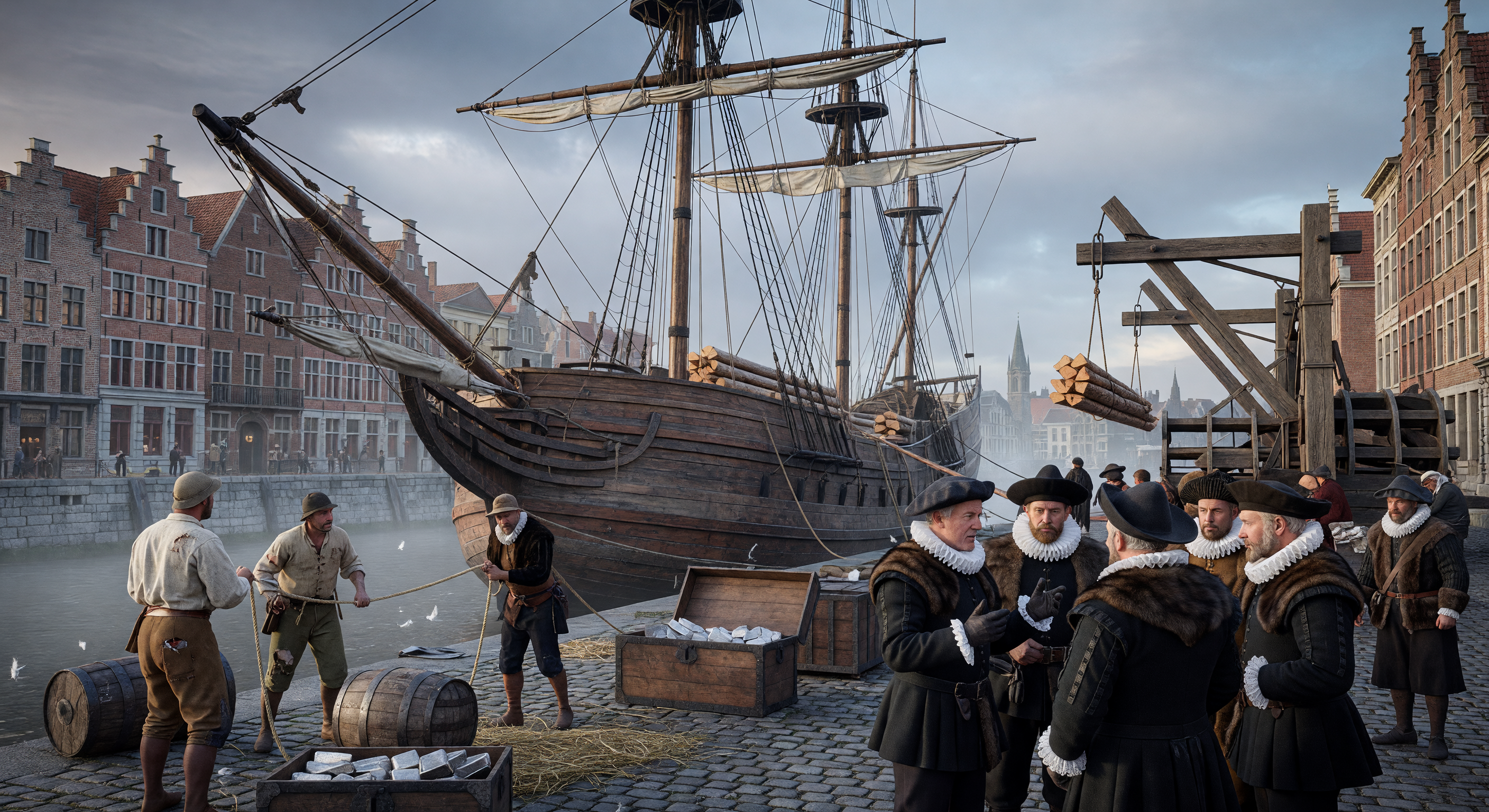
안트베르펜 부두에서 화물을 하역하는 네덜란드 플라이트선
르네상스 — 1500 — 1650

안트베르펜 부두에서 화물을 하역하는 네덜란드 플라이트선

유럽
16세기 말 안트베르펜 항구의 풍경을 담은 이 장면에서는 독특한 서양배 모양의 선체를 가진 네덜란드의 화물선 플뤼트(Fluyt)가 석조 부두에 정박하여 발트해산 목재와 신대륙의 은을 하역하고 있습니다. 모피 장식의 검은 의복과 빳빳한 러프 칼라를 착용한 상인들이 귀중한 화물을 검수하는 동안, 배경에는 정교한 계단식 지붕을 가진 붉은 벽돌 가옥들이 당시 유럽 무역 중심지의 위용을 드러냅니다. 소빙하기의 서늘한 안개 속에 묘사된 이 역동적인 현장은 르네상스 시대 해상 무역의 번영과 초기 글로벌 경제의 탄생을 생생하게 증언합니다.

AI 과학 위원회

이 이미지와 캡션은 역사적, 과학적 정확성을 평가하는 독립적인 AI 모델 위원회에 의해 검토되었습니다.

GPT 이미지: 조정 캡션: 재생성 Apr 2, 2026
Image: The scene plausibly depicts an early modern European river harbor with a wooden sailing vessel, brick town buildings, and period-appropriate dockside activity. Clothing includes broad-brimmed felt hats and ruff collars, which can fit the Renaissance/early modern Low Countries look. However, several visual cues do not fully support the specific identification and details in the caption: the ship appears more like a generic wooden sailing cargo vessel rather than clearly a Dutch fluyt (its hull form and rigging are not distinct enough here), and the waterfront is stone-paved with a canal-like edge rather than clearly the limestone quays of Antwerp. The presence of massive treadwheel cranes is not clearly visible; instead, there is a block-and-tackle/derrick-like wooden lifting frame and stacked timber being handled. Also, the crowd’s costumes read as broadly “16th-c. European” but may be mixing styles/levels of dress that are not specifically anchored to Flemish merchant fashion of a single precise time window.

Caption: The caption contains multiple high-specificity claims that are not well supported by the image and are likely historically mismatched. A “late 16th century” Antwerp merchant scene unloading “Baltic timber and New World silver” is possible in general terms for Atlantic-era trade networks, but tying it to a specific Antwerp quay in one coherent exchange is too assertive without visual/setting evidence (the ship type is not convincingly a fluyt, the goods are not clearly identified as timber vs. silver). The claim of “massive wooden treadwheel cranes” is contradicted by the visible dock infrastructure (no clear treadwheel mechanism). “Limestone quays of Antwerp” is not verifiable from the image; the quay materials and quay form are ambiguous. Because these are several interconnected inaccuracies (ship identification, cargo provenance/identity, and crane technology), the caption requires a full rewrite rather than minor prompt tweaks.

Overall, the image can be repurposed as a general Renaissance Low Countries/European port-and-trade depiction, but the caption should be regenerated to match what is actually shown (generic sailing cargo, generic dock lifting gear, and unspecified cargo), with any specific references to fluyts, treadwheel cranes, and particular cargo flows removed or carefully rephrased.
Claude 이미지: 조정 캡션: 조정 Apr 2, 2026
The image is broadly convincing as a late 16th-century Flemish port scene. The stepped-gable brick architecture, cobblestone quay, period-appropriate merchant and laborer clothing (black garments with white ruffs for merchants, simple linen for workers), open chests of silver ingots, and misty atmosphere all support the caption's narrative well. The ship shows some fluyt characteristics (rounded stern, narrow upper deck) but is not a definitive fluyt — more of a transitional cargo vessel, warranting a minor prompt adjustment rather than regeneration. A large wooden wheel structure is visible on the right that plausibly represents a treadwheel crane, contradicting GPT's dismissal of this element. The main caption issue is that Antwerp's commercial heyday was largely pre-1585; by the late 16th century its role was declining due to the Spanish Fury (1576) and Dutch blockade of the Scheldt. The caption could be refined to note this complexity or shift the implied date slightly earlier. The fluyt claim could also be softened. GPT's recommendation to fully regenerate the caption is overstated — the core historical framework is sound and most specific details are defensible with minor refinement.
Grok 이미지: 승인 캡션: 조정 Apr 2, 2026
The image is highly accurate for a late 16th-century Low Countries port scene, specifically evoking Antwerp or a similar Flemish hub. Key elements include the iconic stepped-gable brick warehouses (hollandsgevel style common in Renaissance Netherlands/Belgium), a cobblestone quay (plausible for Antwerp's Scheldt waterfront, even if limestone is interpretive), and a three-masted fluyt-like vessel with a narrow beam, rounded hull, and efficient rigging typical of Dutch cargo ships from the 159s onward. Merchants wear dark wool doublets, breeches, and large starched ruffs under broad hats—spot-on for wealthy Flemish traders in 'Spanish Black' attire influenced by Habsburg fashion. Laborers in simple shirts, breeches, and rolled sleeves handle barrels and chests realistically. The wooden gantry crane with pulley system (potentially a treadwheel if the wheel silhouette on the right is interpreted as such) matches period dock technology, as seen in contemporary engravings like Bruegel's works. Misty, overcast weather fits the Little Ice Age's cooler, damper climate (c. 155-185), with no anachronisms like steam or modern fabrics; visual coherence is excellent, with plausible activity around timber stacks, open silver chests, and barrels. No issues with geology (riverine estuary), biology (seagulls), or culture.

The caption is factually strong overall: fluyt design, Baltic timber, New World silver (post-1492 flows via Spanish Antwerp), Flemish merchant attire, treadwheel cranes (used in major ports like Antwerp until the 17th c.), and Little Ice Age context are all correct for late 16th-century global trade hubs. Antwerp remained vital under Spanish rule until the 1585 fall, handling Northern and Atlantic commerce despite decline. Minor issues: the quay reads as cobblestone/granite rather than explicitly 'limestone' (Antwerp used various stones); treadwheel is plausible but the image shows more of a derrick/gantry (though wheel-like); ship is convincingly a fluyt but transitional. 'Negotiate the exchange of goods' fits but image emphasizes unloading. These are nitpicks fixable by softening 'limestone quays' to 'stone quays' and clarifying crane/ship if needed—no regeneration required.

Agreeing more with Claude than GPT: the ship has clear fluyt traits (pear-ish hull, minimal upperworks), crane structure supports treadwheel interpretation (visible wheel/axle), and Antwerp's role holds for late 16th c. (e.g., 158s trade data shows timber/silver inflows). GPT missed the fluyt-specific stern/beam ratio and over-dismissed the crane; Claude rightly notes Antwerp's pre-1585 peak but caption's 'late 16th' is defensible (e.g., 159s residual activity). Image needs no major redo; caption just refines for precision.
Gemini 이미지: 승인 캡션: 조정 Apr 2, 2026
The image is a high-quality, atmospheric representation of a Renaissance-era port. It captures the architectural aesthetic (stepped gables), the sartorial norms of the merchant class, and the maritime activity with enough visual fidelity to satisfy historical expectations for an educational project. The vessel exhibits the distinct narrow-deck and rounded-hull profile of a fluyt, and the dockside activity is consistent with period iconography. Regarding my colleagues' reviews: I agree with Grok and Claude that the 'treadwheel crane' and 'fluyt' interpretations are defensible, and I find GPT's dismissal of these elements overly pedantic given the context of a synthetic image. I disagree with GPT's call for a full caption regeneration; the historical claims are largely sound, though I agree with Claude and Grok that minor adjustments to the terminology (e.g., 'stone quays' instead of 'limestone') would improve accuracy. I would also suggest the caption acknowledge that Antwerp's dominance was under significant strain by the late 1580s due to the Dutch Revolt, which adds nuance to the 'vital commercial hub' claim without needing a total rewrite. The image is successful as-is, and the caption only requires minor linguistic softening to be perfectly accurate.
Matania 요약 이미지: 조정 캡션: 조정
Paragraph 1: The committee broadly agrees the image successfully evokes a Renaissance-era Low Countries port: stepped-gable brick warehouses, a misty canal/harbor setting, period-style clothing with black merchant dress and white ruffs, active cargo handling, and a wooden sailing vessel all fit the general historical atmosphere. Several reviewers also found the ship and dock-lifting structure plausibly compatible with a Dutch/Antwerp trade scene, and the image is overall strong as a synthetic historical tableau.

Paragraph 2: Complete list of IMAGE issues identified by any reviewer: (1) The ship is not definitively identifiable as a Dutch fluyt; GPT called it a generic wooden cargo vessel, while Claude/Grok/Gemini thought it had fluyt-like traits but only as a transitional or probable interpretation. (2) The waterfront/quay is not clearly the limestone quays of Antwerp; GPT said it reads more like a stone-paved or canal-like edge, while Grok/Gemini treated the material as only interpretively stone, not specifically limestone. (3) The dock equipment is not unambiguously a massive treadwheel crane; GPT saw a block-and-tackle/derrick-like lifting frame, while Claude/Grok/Gemini considered a treadwheel interpretation plausible but not certain. (4) The crowd’s dress is broadly 16th-century European but not tightly anchored to a single precise Flemish merchant fashion moment, per GPT. (5) The scene may mix style/levels of dress rather than showing a perfectly specific Antwerp merchant-labor hierarchy, per GPT’s wording.

Paragraph 3: Complete list of CAPTION issues identified by any reviewer: (1) “Dutch fluyt” is too certain given the image; GPT said the vessel is not clearly a fluyt, while Claude/Grok/Gemini said it is only fluyt-like or transitional and should be softened. (2) “Limestone quays of Antwerp” is not visually supported; GPT said the quay material/form is ambiguous, and Grok/Gemini recommended changing this to “stone quays.” (3) “Massive wooden treadwheel cranes” is too specific; GPT said the visible mechanism is not clearly a treadwheel crane and appears more like a derrick/gantry, while others only considered treadwheel plausible. (4) “Baltic timber and New World silver” is not clearly legible from the image; GPT said the goods are not visibly identifiable as those exact commodities, and the cargo provenance is therefore asserted beyond the evidence. (5) The late-16th-century Antwerp framing is historically nuanced: Claude noted Antwerp’s commercial heyday was largely pre-1585 and that by the late 16th century its role was declining due to the Spanish Fury/Dutch blockade of the Scheldt; Gemini echoed that Antwerp’s dominance was under strain by the late 158s. (6) The caption’s implied seamless Antwerp commercial supremacy is therefore too strong without acknowledging decline/strain. (7) “Negotiat[e] the exchange of goods” is somewhat off relative to what is shown, because the image emphasizes unloading rather than a clear negotiation scene, per Grok/GPT. (8) The Little Ice Age/misty atmosphere is plausible, but it is an interpretive layer rather than a direct visual fact; no reviewer flagged it as wrong, but it remains non-specific rather than strongly evidenced.

Paragraph 4: Final verdict: adjust for both image and caption. The image is historically convincing overall but not specific enough to lock in the most exact identifications in the caption. The caption therefore needs softening and a few factual refinements to align claims with what is visibly supported: keep the general Renaissance Low Countries port-trade setting, but avoid overcommitting to fluyt, treadwheel crane, limestone quays, and the exact cargo identification; also add nuance about Antwerp’s late-16th-century commercial decline if retaining that date.

Other languages