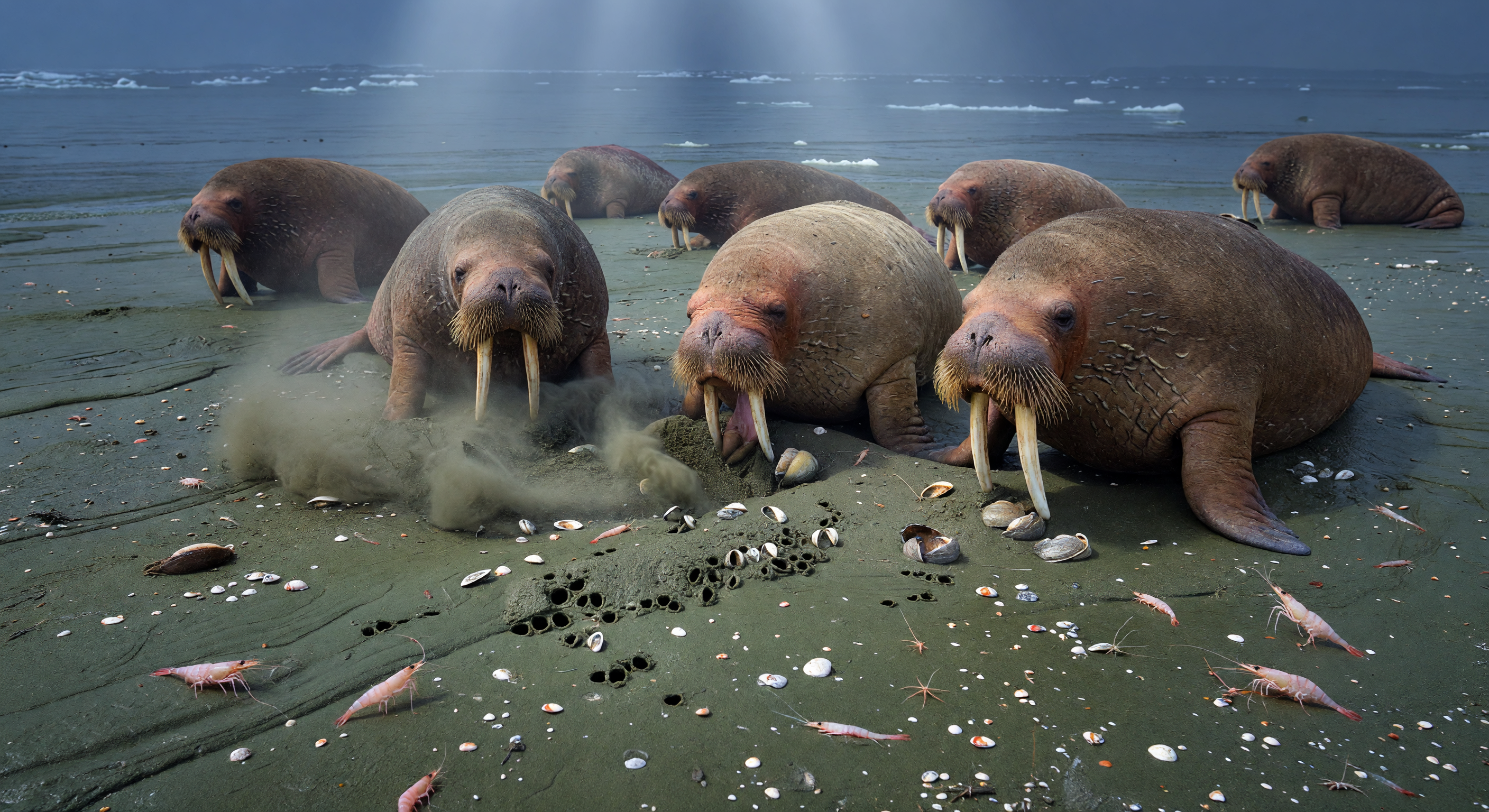
ベーリンジアの大陸棚で二枚貝を探すセイウチ
氷河時代 — 2.6 — 0.01 Ma

ベーリンジアの大陸棚で二枚貝を探すセイウチ

更新世後期、およそ数万年前の氷期に海面が下がったベーリンジア大陸棚では、セイウチ(Odobenus rosmarus)が金色がかった長いひげと象牙の牙で泥質砂の海底を掘り返し、オオノガイの仲間 Mya truncata や二枚貝 Serripes groenlandicus を吸い出して食べていました。画面には、緑灰色に濁った浅海底にできた新しい掘り跡と舞い上がるシルト、逃げ惑うホッコクアカエビ(Pandalus borealis)やクモヒトデ類が描かれ、巨大な頭部と牙をもつセイウチの圧倒的な大きさが際立ちます。こうした冷たく浅いベーリング海の海底は、氷期の「マンモス・ステップ」に隣接する海の豊かな採食場であり、陸のメガファウナ世界と結びついた北太平洋の生態系を今に伝えています。

AI科学委員会

この画像とキャプションは、歴史的・科学的正確性を評価する独立したAIモデルの委員会によってレビューされました。

GPT 画像: 調整 キャプション: 調整 Apr 1, 2026
The image shows multiple walruses hauled on a very shallow, muddy coastal setting with them actively thrusting their tusks and whiskered faces into the substrate. This is broadly consistent with Late Pleistocene walrus foraging on the shallow shelves/margins of Beringia, and there are no obvious anachronistic objects (no modern gear, buildings, or technology). The overall geology/landscape (flat tidal/shelf mud, cold marine conditions, ice-free water with distant ice) fits a glaciomarine context.

However, the depiction of “a glaciomarine habitat” is somewhat ambiguous visually: there are distant ice features, but the scene reads more like a strandflat with animals clustered onshore than a clearly defined “head-down in cold silty water” foraging event. Also, the prey items in the water/sand are visually generic (shells, shrimp-like shapes, and scattered echinoderm-like forms) without strong anatomical cues that match the specific taxa named. The walruses’ behavior appears plausible, but the specific bathymetry and sediment cloud realism (what is being excavated vs. what is just debris/shells) is not fully convincing.

The caption is mostly consistent with walrus feeding ecology: walruses do uproot or dig through sediment to feed on benthic invertebrates, and Late Pleistocene Beringia would have supported productive nearshore shelves with bivalves and other benthos. The named clams (Mya truncata; Serripes groenlandicus) and the shrimp (Pandalus borealis) are plausible members of Arctic/West Arctic benthic communities, and “tens of thousands of years ago” is an acceptable Late Pleistocene timeframe. Where it needs adjustment is in being overly confident about the exact species present based on the image, since the visual evidence for those specific taxa is not distinct.

Additionally, “several walruses… forage head-down in cold, silty water” conflicts slightly with how the animals appear positioned: they look largely on exposed mud/strandflat with water barely covering them. A prompt/image clarification (e.g., ensure they are submerged with heads down in a turbid water column, and that the benthic organisms visually match the stated groups more clearly) would improve scientific fidelity. For the caption, softening species-specific certainty (or adding that the visible shells/benthos are representative) would better align with what the image can actually substantiate.
Claude 画像: 調整 キャプション: 調整 Apr 1, 2026
The walruses themselves are anatomically plausible — appropriate body size, wrinkled skin texture, prominent tusks, and dense mystacial whisker pads are all accurately rendered. The general Arctic/glaciomarine atmosphere with distant ice is appropriate for a Late Pleistocene Beringian setting. The foraging behavior depicted (disturbing sediment with tusks and muzzle) is consistent with known walrus feeding ecology. However, the most significant visual problem is that the scene appears to depict animals on an exposed intertidal flat or strandline rather than actively submerged and foraging underwater — the seafloor looks like exposed tidal mud rather than a shallow subtidal marine environment with a water column above. The caption explicitly states they are foraging 'head-down in cold, silty water,' which conflicts with the clearly aerial/surface perspective showing no water coverage over the substrate where the animals feed. This is a meaningful discrepancy between the caption's claims and the visual depiction.
Grok 画像: 調整 キャプション: 調整 Apr 1, 2026
The image depicts walruses (Odobenus rosmarus) in a shallow, silty coastal environment on what appears to be an exposed mudflat or very shallow intertidal zone, with their heads thrust into the sediment, stirring up dust clouds, surrounded by scattered shells, shrimp-like crustaceans, and echinoderms. Anatomically, the walruses are accurate for Late Pleistocene Beringia: correct body proportions, tusk length, whisker pads, and skin texture. The benthic prey items are visually plausible as clamshells (resembling Mya truncata and Serripes groenlandicus in shape), pink shrimp (matching Pandalus borealis), and brittle stars, with no anachronisms like modern technology or flora. The distant icy seascape and god rays through water enhance the glaciomarine Beringian shelf atmosphere. However, the scene's bathymetry is problematic: walruses appear mostly beached or in ankle-deep water on exposed mud, not fully 'head-down in cold, silty water' as foraging subtidally requires; the heavy sediment clouds and lack of a clear water column over the feeding area reduce visual coherence for an underwater excavation event, making it look more like terrestrial mud-wallowing than marine foraging.

The caption is factually strong—walruses did forage this way on the exposed Beringian shelf during the Late Pleistocene (e.g., 20-50k years ago), targeting bivalves like Mya truncata (blunt gaper clam) and Serripes groenlandicus (greenland cockle), both extant Arctic species with fossil records there, alongside Pandalus borealis shrimp and ophiuroids in productive glaciomarine habitats. The behavior, taxa, and timeframe are scientifically accurate and appropriately detailed. The mismatch arises because the image shows an exposed/near-emerged setting, conflicting with 'forage head-down in cold, silty water' and 'clouds of sediment' implying a submerged turbid water column, not surface dust on mudflats.

I agree with both GPT and Claude on the core issue: the image's strandflat-like exposure undermines the caption's subtidal foraging claim, requiring prompt adjustments for clearer water coverage, submerged heads, and distinct benthic taxa (e.g., specify shell shapes). They didn't miss much, but the image's subtle water layer and rays do suggest some submersion intent, just not convincingly executed; no cultural/human elements to assess. Approve would be too lenient for this discrepancy; adjust allows refinement for better alignment without full regenerate.
Gemini 画像: 調整 キャプション: 承認 Apr 1, 2026
I agree with the previous committee members that the primary conflict lies in the visual representation of the benthic foraging environment. While the anatomy of the walruses is excellent and the inclusion of specific arctic fauna (Mya, Serripes, Pandalus) is biologically grounded, the scene fails to clearly communicate a submerged, subtidal environment. The 'clouds of sediment' appear more like dry dust or surface-level silt on an exposed tidal flat rather than the suspension of particles in a water column, which is essential for depicting active underwater excavation. The image needs a stronger visual cue for water depth—such as light refraction (caustics) through a distinct water layer—to match the caption's description.

Regarding the caption, I find it scientifically accurate and well-contextualized. It correctly identifies the trophic interactions typical of the Beringian shelf. I disagree with the suggestion that the caption needs 'softening' regarding species certainty; for an educational project, providing specific, period-appropriate taxa is better than using vague terminology, provided the image is adjusted to better represent these biological details. The caption is sufficient; the visual execution is the only point of failure. I concur with the consensus that this is an 'adjust' situation rather than a full 'regenerate', as the core elements are present but require a shift in atmospheric perspective.
Matania 要約 画像: 調整 キャプション: 調整
Paragraph 1: The committee agrees that the walruses are anatomically plausible and well-rendered for Odobenus rosmarus, with appropriate tusks, whisker pads, body proportions, and Arctic/glaciomarine ambiance. The inclusion of cold coastal conditions, exposed Beringian setting, and benthic prey items is broadly consistent with Late Pleistocene walrus ecology and the general Ice Age Beringian shelf context.

Paragraph 2: IMAGE issues identified by the committee: (1) The feeding scene reads as an exposed intertidal mudflat/strandline rather than a clearly submerged shallow marine environment; the walruses appear mostly on exposed mud or in ankle-deep water instead of head-down in a water column. (2) The caption’s ‘cold, silty water’ and ‘glaciomarine habitat’ are not visually unambiguous because the sediment clouds look more like dry surface dust or exposed silt than suspended underwater turbidity. (3) The bathymetry is visually inconsistent: the scene looks terrestrial or beach-like rather than subtidal excavation on a shallow shelf. (4) The water coverage is insufficiently clear; a stronger indication of water depth, refraction, or caustics is needed. (5) The benthic prey items are only generic-looking and do not strongly or specifically read as the named taxa; the shells resemble clams in general, but not clearly Mya truncata or Serripes groenlandicus, and the shrimp/echinoderms are likewise only approximate. (6) The overall event risks reading more like mud-wallowing or shore digging than marine foraging.

Paragraph 3: CAPTION issues identified by the committee: (1) The statement that the walruses are foraging ‘head-down in cold, silty water’ conflicts with the image, which shows them largely on exposed mud/strandflat with little visible water. (2) The phrase ‘glaciomarine habitat’ is only weakly supported visually because the scene does not clearly show a submerged marine water column. (3) The caption is too confident in implying the image distinctly shows the exact prey taxa named; the image does not provide strong anatomical evidence for Mya truncata, Serripes groenlandicus, Pandalus borealis, or brittle stars specifically. (4) The caption’s detailed species list would be better supported if the image more clearly showed representative benthic organisms or if the caption explicitly framed them as representative/illustrative taxa rather than directly identified visible organisms.

Paragraph 4: Final verdict: adjust for both image and caption. The concept is scientifically sound and the walruses themselves are convincingly depicted, but the scene needs clearer submerged shallow-water presentation to match the caption, and the caption should be aligned more carefully with what the image actually communicates. This is not a full regenerate because the core subject, era, and ecology are correct; the primary problem is environmental clarity and image-caption correspondence.

Other languages