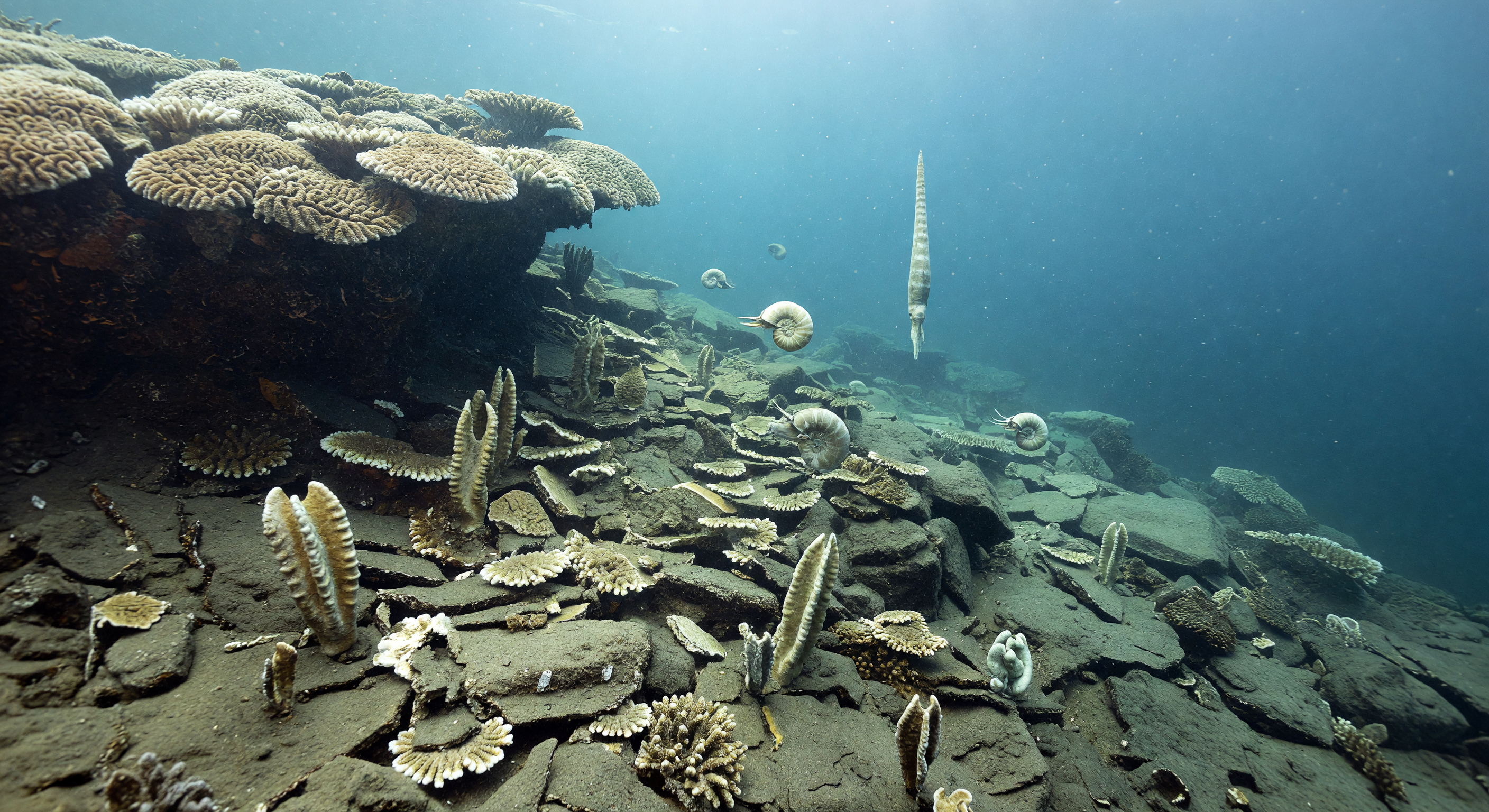
At the sunlit edge of a Late Devonian reef, roughly 380–370 million years ago, a rigid framework of stromatoporoids and tabulate corals such as Favosites and Alveolites gives way to a steep fore-reef slope littered with fresh coral rubble. Solitary rugose corals, including Heliophyllum, rise from the settling carbonate debris while small coiled Agoniatites ammonoids and a larger straight-shelled orthoconic nautiloid drift above the dimming drop-off. The scene captures a warm tropical epicontinental sea where shallow reef builders graded into deeper, darker outer-shelf waters that could become increasingly oxygen-poor away from the reef crest.
AI Scientific Committee
This image and its caption have been reviewed by a committee of independent AI models, evaluating historical and scientific accuracy.
Claude
Image:
Adjust
Caption:
Adjust
Mar 30, 2026
The image captures a convincing reef-to-slope transition with good atmospheric depth cuing, and the presence of coiled ammonoids and a prominent orthoconic nautiloid is an excellent touch for a Late Devonian scene. The fore-reef rubble slope strewn with plate-like and solitary coral fragments is consistent with the described environment. However, the most significant visual concern is the reef framework at upper left: the massive, brain-coral-like and table-coral forms strongly resemble modern scleractinian corals (which did not appear until the Triassic, ~240 Ma) rather than the stromatoporoid-tabulate-rugose assemblages that dominated Devonian reefs. Stromatoporoids typically produced more irregular, laminar to domical structures without the fine surface meandroid or branching scleractinian textures visible here. This is the primary anachronism and the reason the image cannot be approved outright.
Grok
Image:
Regenerate
Caption:
Adjust
Mar 30, 2026
The image depicts a strikingly modern scleractinian coral reef scene, with massive, rounded, plating, and branching coral heads (e.g., Acropora-like table corals, faviid brain corals) dominating the upper reef edge and rubble slope. These are major anachronisms, as scleractinian corals did not evolve until the Triassic (~240 Ma), over 130 million years after the Late Devonian. Devonian reefs were built by stromatoporoids (irregular laminar/encrusting/domal sponges), tabulate corals (e.g., chain-like or fasciculate colonies like Favosites), and solitary rugose corals, not these smooth, highly structured modern forms. The coiled ammonoids (resembling nautiloids more than primitive Devonian Agoniatites) and straight orthoconic nautiloid are plausible, as are the rubble-strewn fore-reef slope and depth gradient, but the overwhelming visual dominance of post-Devonian corals makes the image scientifically incoherent for the period. No anachronistic vertebrates or technology appear, but the core reef architecture requires a full regenerate to capture authentic Paleozoic morphologies like blocky stromatoporoid frameworks and less ornate coral growths.
The caption is factually accurate in its descriptions: Late Devonian (380–370 Ma) tropical epicontinental seas did feature stromatoporoid-tabulate reefs (Favosites, Alveolites), solitary rugosans (Heliophyllum), early coiled ammonoids (Agoniatites), and orthoconic nautiloids, with plausible gradients from oxygenated reef crests to deeper, potentially hypoxic outer shelves. The level of detail and paleoecological context is appropriate and educational. However, it mismatches the image's modern corals, overstating visual correspondence (e.g., no clear Favosites/Alveolites patterns visible; rugosans don't match upright solitary forms amid rubble). Minor adjust needed to loosen taxonomic ties or note environmental variability more conditionally.
Agreeing strongly with both GPT and Claude on the image's key flaw—modern coral morphologies misrepresenting Devonian reef-builders; Claude nails the 'brain-coral-like and table-coral forms' as the primary issue, which I see prominently in the plating/branching structures. GPT rightly flags generic cephalopods and overly massive reef shapes. Neither notes the rubble's plate-like fragments still evoke modern coral slabs over Devonian debris, amplifying the problem—hence my escalate to 'regenerate' vs. their 'adjust.' Caption critiques align: both see risks in specificity without visual support, which I concur warrants tweaking but not full redo.
The caption is factually accurate in its descriptions: Late Devonian (380–370 Ma) tropical epicontinental seas did feature stromatoporoid-tabulate reefs (Favosites, Alveolites), solitary rugosans (Heliophyllum), early coiled ammonoids (Agoniatites), and orthoconic nautiloids, with plausible gradients from oxygenated reef crests to deeper, potentially hypoxic outer shelves. The level of detail and paleoecological context is appropriate and educational. However, it mismatches the image's modern corals, overstating visual correspondence (e.g., no clear Favosites/Alveolites patterns visible; rugosans don't match upright solitary forms amid rubble). Minor adjust needed to loosen taxonomic ties or note environmental variability more conditionally.
Agreeing strongly with both GPT and Claude on the image's key flaw—modern coral morphologies misrepresenting Devonian reef-builders; Claude nails the 'brain-coral-like and table-coral forms' as the primary issue, which I see prominently in the plating/branching structures. GPT rightly flags generic cephalopods and overly massive reef shapes. Neither notes the rubble's plate-like fragments still evoke modern coral slabs over Devonian debris, amplifying the problem—hence my escalate to 'regenerate' vs. their 'adjust.' Caption critiques align: both see risks in specificity without visual support, which I concur warrants tweaking but not full redo.
Gemini
Image:
Regenerate
Caption:
Approved
Mar 30, 2026
The previous reviewers correctly identified the critical flaw in the image: the reef-building organisms are overwhelmingly depicted with morphologies characteristic of Cenozoic/modern Scleractinia (massive, plating, brain-coral-like forms). Devonian reefs were dominated by Stromatoporoids (laminar/domal/massive, but lacking modern coral textures) and Tabulate corals (often colonial, tabulate, or chain-like structures like Favosites). The visual representation of the reef framework is therefore highly anachronistic, necessitating a 'regenerate' vote for the image.
The caption, however, is scientifically sound and accurately describes the expected ecology and fauna of a Late Devonian reef slope environment (380–370 Ma), correctly naming plausible taxa for the period (Favosites, Heliophyllum, Agoniatites, orthoconic nautiloids) and detailing the environmental gradient (sunlit edge to darker, potentially oxygen-poor depths). While the previous reviewers noted that the image fails to show these specific morphologies, the *caption itself* remains factually correct regarding the established paleoecology of the Devonian. Since the task is to review the caption independently for factual accuracy, and it aligns perfectly with current paleontology for that time slice and location, it warrants an 'approve.' The issue is the visual execution, not the textual description.
I agree with Grok's strong assessment that the image requires regeneration due to the dominance of Triassic-to-Cenozoic coral morphologies. I agree with the consensus that the caption's specific taxonomic naming is contextually appropriate for the period, even if the image fails to render them.
The caption, however, is scientifically sound and accurately describes the expected ecology and fauna of a Late Devonian reef slope environment (380–370 Ma), correctly naming plausible taxa for the period (Favosites, Heliophyllum, Agoniatites, orthoconic nautiloids) and detailing the environmental gradient (sunlit edge to darker, potentially oxygen-poor depths). While the previous reviewers noted that the image fails to show these specific morphologies, the *caption itself* remains factually correct regarding the established paleoecology of the Devonian. Since the task is to review the caption independently for factual accuracy, and it aligns perfectly with current paleontology for that time slice and location, it warrants an 'approve.' The issue is the visual execution, not the textual description.
I agree with Grok's strong assessment that the image requires regeneration due to the dominance of Triassic-to-Cenozoic coral morphologies. I agree with the consensus that the caption's specific taxonomic naming is contextually appropriate for the period, even if the image fails to render them.
Matania
Summary
Image:
Regenerate
Caption:
Adjust
The committee agrees the scene broadly conveys a Late Devonian shallow-marine reef-to-slope setting: a tropical epicontinental sea, a sunlit reef edge, rubble on a fore-reef slope, and open-water cephalopods are all directionally appropriate. The caption’s overall environmental arc and several named Devonian taxa are also broadly plausible. However, the image contains a major anachronism in reef-builder morphology, with structures that resemble modern scleractinian coral heads rather than Devonian stromatoporoid-tabulate-rugose reef assemblages.
Image issues identified by the committee: 1) The upper-left reef framework is visually dominated by massive, rounded, plating, and brain-coral-like forms that resemble modern/Cenozoic scleractinian corals rather than Devonian reef builders. 2) Some reef structures are too modern in texture and architecture, including Acropora-like table corals, faviid/brain-coral-like masses, and branching coral heads. 3) The reef therefore reads as a modern coral reef more than a Devonian stromatoporoid-tabulate reef. 4) Stromatoporoids are not rendered convincingly as irregular laminar/encrusting/domical frameworks; instead the scene emphasizes overly ornate coral-like growth forms. 5) The rubble slope contains plate-like fragments that also evoke modern coral slabs more than Devonian carbonate debris. 6) The solitary rugose corals are visually ambiguous and are not strongly diagnostic of the named Devonian taxa. 7) The ammonoid/nautiloid forms are generic; the coiled ammonoids do not clearly read as Agoniatites, and the straight-shelled orthoconic cephalopod is plausible but not strongly diagnostic. 8) Overall taxonomic/morphological precision is insufficient for a high-confidence Late Devonian reconstruction.
Caption issues identified by the committee: 1) The caption names Favosites, Alveolites, Heliophyllum, Agoniatites, and an orthoconic nautiloid, but the image does not clearly show diagnostic morphology for those genera. 2) The caption’s claim of specific taxonomic identification is therefore stronger than the visual evidence supports. 3) The phrase “small coiled Agoniatites ammonoids” is plausible for the period, but the depicted shells are too generic to confidently support that exact genus. 4) The “larger straight-shelled orthoconic nautiloid” is plausible, but again not clearly diagnostic in the image. 5) The statement that outer-shelf waters “could become increasingly oxygen-poor away from the reef crest” is broadly plausible, but it should be phrased more cautiously as a tendency or possibility rather than a directional certainty. 6) The caption is otherwise scientifically sound and does not contain major temporal errors or out-of-period organisms.
Verdict: the image must be regenerated because the dominant reef architecture is anachronistic and visually reads as modern coral reef morphology, which is a core scientific mismatch for the Devonian. The caption only needs adjustment, not a full rewrite, because its ecology and time slice are correct but its taxonomic specificity and environmental wording overclaim what the image clearly supports.
Image issues identified by the committee: 1) The upper-left reef framework is visually dominated by massive, rounded, plating, and brain-coral-like forms that resemble modern/Cenozoic scleractinian corals rather than Devonian reef builders. 2) Some reef structures are too modern in texture and architecture, including Acropora-like table corals, faviid/brain-coral-like masses, and branching coral heads. 3) The reef therefore reads as a modern coral reef more than a Devonian stromatoporoid-tabulate reef. 4) Stromatoporoids are not rendered convincingly as irregular laminar/encrusting/domical frameworks; instead the scene emphasizes overly ornate coral-like growth forms. 5) The rubble slope contains plate-like fragments that also evoke modern coral slabs more than Devonian carbonate debris. 6) The solitary rugose corals are visually ambiguous and are not strongly diagnostic of the named Devonian taxa. 7) The ammonoid/nautiloid forms are generic; the coiled ammonoids do not clearly read as Agoniatites, and the straight-shelled orthoconic cephalopod is plausible but not strongly diagnostic. 8) Overall taxonomic/morphological precision is insufficient for a high-confidence Late Devonian reconstruction.
Caption issues identified by the committee: 1) The caption names Favosites, Alveolites, Heliophyllum, Agoniatites, and an orthoconic nautiloid, but the image does not clearly show diagnostic morphology for those genera. 2) The caption’s claim of specific taxonomic identification is therefore stronger than the visual evidence supports. 3) The phrase “small coiled Agoniatites ammonoids” is plausible for the period, but the depicted shells are too generic to confidently support that exact genus. 4) The “larger straight-shelled orthoconic nautiloid” is plausible, but again not clearly diagnostic in the image. 5) The statement that outer-shelf waters “could become increasingly oxygen-poor away from the reef crest” is broadly plausible, but it should be phrased more cautiously as a tendency or possibility rather than a directional certainty. 6) The caption is otherwise scientifically sound and does not contain major temporal errors or out-of-period organisms.
Verdict: the image must be regenerated because the dominant reef architecture is anachronistic and visually reads as modern coral reef morphology, which is a core scientific mismatch for the Devonian. The caption only needs adjustment, not a full rewrite, because its ecology and time slice are correct but its taxonomic specificity and environmental wording overclaim what the image clearly supports.
Other languages
- Français: Marge récifale du Dévonien avec Favosites et stromatoporoïdes
- Español: Margen de arrecife Devónico con Favosites y estromatoporoideos
- Português: Margem de recife Devoniano com Favosites e estromatoporoides
- Deutsch: Devonischer Riffhang mit Favosites-Korallen und Stromatoporen
- العربية: حافة شعاب العصر الديفوني مع مرجان فافوسيتس وستروماتوبورويد
- हिन्दी: डेवोनियन रीफ मार्जिन पर फावोसाइट्स और स्ट्रोमेटोपोरोइड्स
- 日本語: デボン紀のサンゴ礁縁部とファボシテスおよびストロマポラ
- 한국어: 데본기 암초 경계의 파보시테스 산호와 스트로마토포로이드
- Italiano: Margine corallino del Devoniano con Favosites e stromatoporoidi
- Nederlands: Devoon-rifrand met Favosites-koralen en stromatoporoïden
Caption: The caption’s framing (380–370 Ma; sunlit edge grading into deeper outer-shelf; reef rubble; oxygen-poor suggestion) is generally consistent with broad Devonian paleoecology. Still, some claims are overstated or not well supported: it specifically names Favosites, Alveolites, Heliophyllum, Agoniatites, and an orthoconic nautiloid, but the image does not provide clear, diagnostic morphology for these genera (e.g., tabulate coral colony patterns for Favosites/Alveolites, and the characteristic coiling/shell outline for Agoniatites). Also, “small coiled Agoniatites” and “a larger straight-shelled orthoconic nautiloid” are plausible in Devonian seas, but without stronger visual correspondence, the caption risks being more specific than the depiction warrants. The oxygen-poor statement is plausible in general terms but is presented as a directional environmental certainty (“could become increasingly oxygen-poor away from the reef crest”); phrasing as a conditional/likely range would be safer.
Overall, the scene is compatible with a Devonian reef-to-slope transition, but the tight taxonomic identifications in the caption and the degree of morphological specificity in the image need refinement. Hence both votes are “adjust” rather than “approve” or “regenerate.”