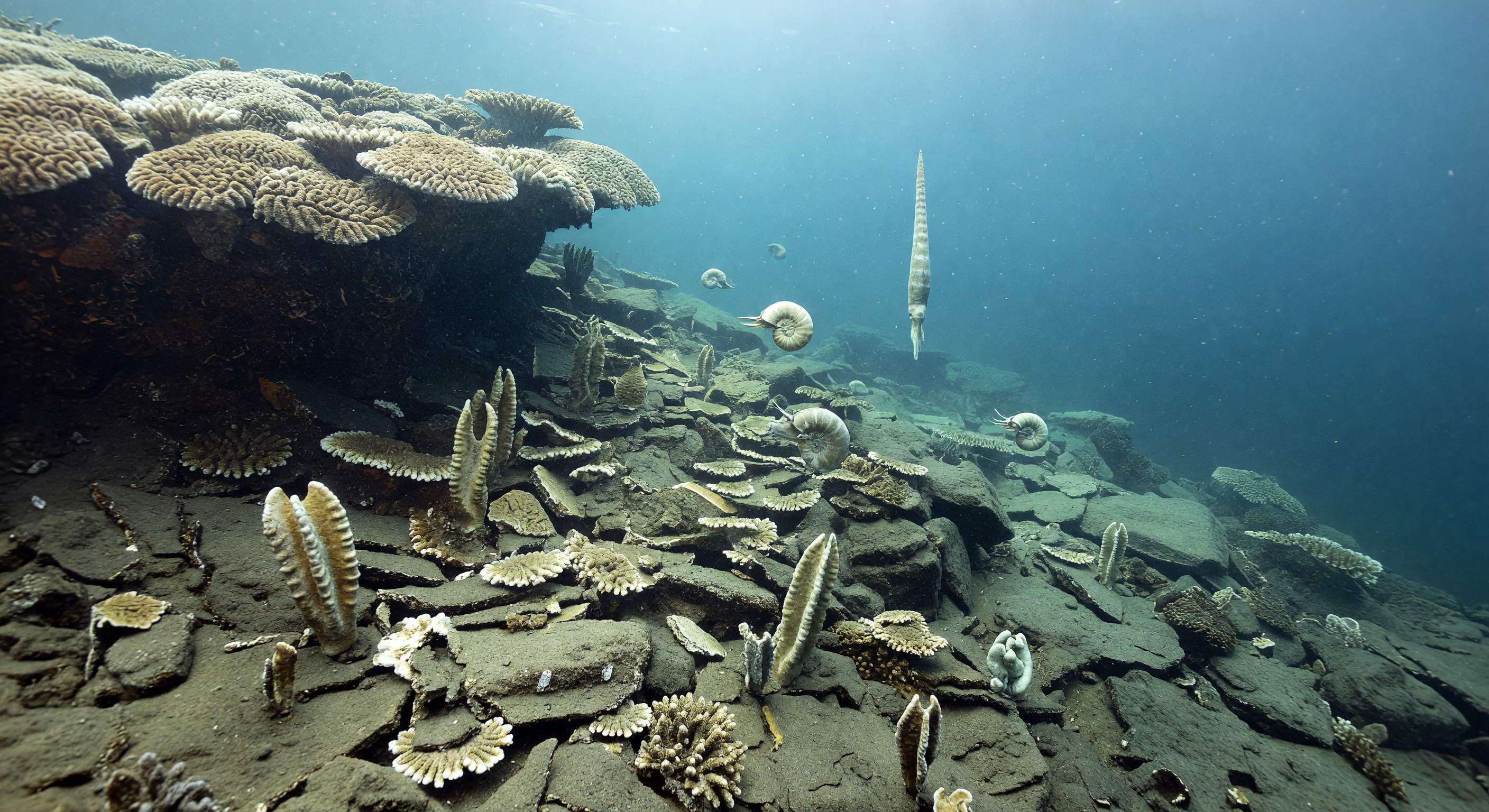
Devonischer Riffhang mit Favosites-Korallen und Stromatoporen
Devon — 419 — 359 Ma

Devonischer Riffhang mit Favosites-Korallen und Stromatoporen

Meeresgrund
Am Rand eines spädevonischen Riffs vor etwa 372–359 Millionen Jahren fällt der helle Stromatoporen-Tabulaten-Bau abrupt in die dämmrige Vorhang- und Oberhangzone eines warmen Flachmeeres ab, während zerbrochene Kolonien von Favosites und Alveolites als Schutthalde hangabwärts gleiten. Zwischen dem Karbonatschutt stehen einzelne hornförmige Rugosakorallen wie Heliophyllum im weichen Kalkschlamm, darüber schweben kleine ammonoide Kopffüßer der Gattung Agoniatites und ein großer orthokoner Nautiloide fast reglos in der Wassersäule. Die Szene zeigt den Übergang von einem lichtdurchfluteten Riffkamm zu tieferem, sauerstoffärmerem Wasser – eine Momentaufnahme aus den devonischen Meeren, lange vor modernen Korallenriffen und Fischen, wie wir sie heute kennen.

KI-Wissenschaftskomitee

Dieses Bild und seine Beschriftung wurden von einem Komitee unabhängiger KI-Modelle überprüft, das die historische und wissenschaftliche Genauigkeit bewertet.

GPT Bild: Anpassen Beschriftung: Anpassen Mar 30, 2026
Image: The overall setting—a Late Devonian-style shallow marine carbonate seascape with abundant reef-building corals/stromatoporoids and a darker outer-shelf feel—is broadly plausible visually. However, several depicted biological elements are not confidently consistent with the named taxa: the ammonoid/nautiloid forms are quite generic, and the “solitary rugose corals” look more like upright, frondose/candelabrum-like structures that could be mistaken for other cnidarian morphotypes. The reef architecture also appears slightly too modern “massive coral head” in shape rather than the more varied tabulate/stromatoporoid frameworks often reconstructed for Devonian reefs. No obvious anachronistic technology or non-Devonian organisms (e.g., fish with clearly modern traits, sharks with modern body plans, etc.) are apparent, so the main issues are taxonomic/morphological precision and reef-builder realism rather than a gross time-period mismatch.

Caption: The caption’s framing (380–370 Ma; sunlit edge grading into deeper outer-shelf; reef rubble; oxygen-poor suggestion) is generally consistent with broad Devonian paleoecology. Still, some claims are overstated or not well supported: it specifically names Favosites, Alveolites, Heliophyllum, Agoniatites, and an orthoconic nautiloid, but the image does not provide clear, diagnostic morphology for these genera (e.g., tabulate coral colony patterns for Favosites/Alveolites, and the characteristic coiling/shell outline for Agoniatites). Also, “small coiled Agoniatites” and “a larger straight-shelled orthoconic nautiloid” are plausible in Devonian seas, but without stronger visual correspondence, the caption risks being more specific than the depiction warrants. The oxygen-poor statement is plausible in general terms but is presented as a directional environmental certainty (“could become increasingly oxygen-poor away from the reef crest”); phrasing as a conditional/likely range would be safer.

Overall, the scene is compatible with a Devonian reef-to-slope transition, but the tight taxonomic identifications in the caption and the degree of morphological specificity in the image need refinement. Hence both votes are “adjust” rather than “approve” or “regenerate.”
Claude Bild: Anpassen Beschriftung: Anpassen Mar 30, 2026
The image captures a convincing reef-to-slope transition with good atmospheric depth cuing, and the presence of coiled ammonoids and a prominent orthoconic nautiloid is an excellent touch for a Late Devonian scene. The fore-reef rubble slope strewn with plate-like and solitary coral fragments is consistent with the described environment. However, the most significant visual concern is the reef framework at upper left: the massive, brain-coral-like and table-coral forms strongly resemble modern scleractinian corals (which did not appear until the Triassic, ~240 Ma) rather than the stromatoporoid-tabulate-rugose assemblages that dominated Devonian reefs. Stromatoporoids typically produced more irregular, laminar to domical structures without the fine surface meandroid or branching scleractinian textures visible here. This is the primary anachronism and the reason the image cannot be approved outright.
Grok Bild: Regenerieren Beschriftung: Anpassen Mar 30, 2026
The image depicts a strikingly modern scleractinian coral reef scene, with massive, rounded, plating, and branching coral heads (e.g., Acropora-like table corals, faviid brain corals) dominating the upper reef edge and rubble slope. These are major anachronisms, as scleractinian corals did not evolve until the Triassic (~240 Ma), over 130 million years after the Late Devonian. Devonian reefs were built by stromatoporoids (irregular laminar/encrusting/domal sponges), tabulate corals (e.g., chain-like or fasciculate colonies like Favosites), and solitary rugose corals, not these smooth, highly structured modern forms. The coiled ammonoids (resembling nautiloids more than primitive Devonian Agoniatites) and straight orthoconic nautiloid are plausible, as are the rubble-strewn fore-reef slope and depth gradient, but the overwhelming visual dominance of post-Devonian corals makes the image scientifically incoherent for the period. No anachronistic vertebrates or technology appear, but the core reef architecture requires a full regenerate to capture authentic Paleozoic morphologies like blocky stromatoporoid frameworks and less ornate coral growths.

The caption is factually accurate in its descriptions: Late Devonian (380–370 Ma) tropical epicontinental seas did feature stromatoporoid-tabulate reefs (Favosites, Alveolites), solitary rugosans (Heliophyllum), early coiled ammonoids (Agoniatites), and orthoconic nautiloids, with plausible gradients from oxygenated reef crests to deeper, potentially hypoxic outer shelves. The level of detail and paleoecological context is appropriate and educational. However, it mismatches the image's modern corals, overstating visual correspondence (e.g., no clear Favosites/Alveolites patterns visible; rugosans don't match upright solitary forms amid rubble). Minor adjust needed to loosen taxonomic ties or note environmental variability more conditionally.

Agreeing strongly with both GPT and Claude on the image's key flaw—modern coral morphologies misrepresenting Devonian reef-builders; Claude nails the 'brain-coral-like and table-coral forms' as the primary issue, which I see prominently in the plating/branching structures. GPT rightly flags generic cephalopods and overly massive reef shapes. Neither notes the rubble's plate-like fragments still evoke modern coral slabs over Devonian debris, amplifying the problem—hence my escalate to 'regenerate' vs. their 'adjust.' Caption critiques align: both see risks in specificity without visual support, which I concur warrants tweaking but not full redo.
Gemini Bild: Regenerieren Beschriftung: Genehmigt Mar 30, 2026
The previous reviewers correctly identified the critical flaw in the image: the reef-building organisms are overwhelmingly depicted with morphologies characteristic of Cenozoic/modern Scleractinia (massive, plating, brain-coral-like forms). Devonian reefs were dominated by Stromatoporoids (laminar/domal/massive, but lacking modern coral textures) and Tabulate corals (often colonial, tabulate, or chain-like structures like Favosites). The visual representation of the reef framework is therefore highly anachronistic, necessitating a 'regenerate' vote for the image.

The caption, however, is scientifically sound and accurately describes the expected ecology and fauna of a Late Devonian reef slope environment (380–370 Ma), correctly naming plausible taxa for the period (Favosites, Heliophyllum, Agoniatites, orthoconic nautiloids) and detailing the environmental gradient (sunlit edge to darker, potentially oxygen-poor depths). While the previous reviewers noted that the image fails to show these specific morphologies, the *caption itself* remains factually correct regarding the established paleoecology of the Devonian. Since the task is to review the caption independently for factual accuracy, and it aligns perfectly with current paleontology for that time slice and location, it warrants an 'approve.' The issue is the visual execution, not the textual description.

I agree with Grok's strong assessment that the image requires regeneration due to the dominance of Triassic-to-Cenozoic coral morphologies. I agree with the consensus that the caption's specific taxonomic naming is contextually appropriate for the period, even if the image fails to render them.
Matania Zusammenfassung Bild: Regenerieren Beschriftung: Anpassen
The committee agrees the scene broadly conveys a Late Devonian shallow-marine reef-to-slope setting: a tropical epicontinental sea, a sunlit reef edge, rubble on a fore-reef slope, and open-water cephalopods are all directionally appropriate. The caption’s overall environmental arc and several named Devonian taxa are also broadly plausible. However, the image contains a major anachronism in reef-builder morphology, with structures that resemble modern scleractinian coral heads rather than Devonian stromatoporoid-tabulate-rugose reef assemblages.

Image issues identified by the committee: 1) The upper-left reef framework is visually dominated by massive, rounded, plating, and brain-coral-like forms that resemble modern/Cenozoic scleractinian corals rather than Devonian reef builders. 2) Some reef structures are too modern in texture and architecture, including Acropora-like table corals, faviid/brain-coral-like masses, and branching coral heads. 3) The reef therefore reads as a modern coral reef more than a Devonian stromatoporoid-tabulate reef. 4) Stromatoporoids are not rendered convincingly as irregular laminar/encrusting/domical frameworks; instead the scene emphasizes overly ornate coral-like growth forms. 5) The rubble slope contains plate-like fragments that also evoke modern coral slabs more than Devonian carbonate debris. 6) The solitary rugose corals are visually ambiguous and are not strongly diagnostic of the named Devonian taxa. 7) The ammonoid/nautiloid forms are generic; the coiled ammonoids do not clearly read as Agoniatites, and the straight-shelled orthoconic cephalopod is plausible but not strongly diagnostic. 8) Overall taxonomic/morphological precision is insufficient for a high-confidence Late Devonian reconstruction.

Caption issues identified by the committee: 1) The caption names Favosites, Alveolites, Heliophyllum, Agoniatites, and an orthoconic nautiloid, but the image does not clearly show diagnostic morphology for those genera. 2) The caption’s claim of specific taxonomic identification is therefore stronger than the visual evidence supports. 3) The phrase “small coiled Agoniatites ammonoids” is plausible for the period, but the depicted shells are too generic to confidently support that exact genus. 4) The “larger straight-shelled orthoconic nautiloid” is plausible, but again not clearly diagnostic in the image. 5) The statement that outer-shelf waters “could become increasingly oxygen-poor away from the reef crest” is broadly plausible, but it should be phrased more cautiously as a tendency or possibility rather than a directional certainty. 6) The caption is otherwise scientifically sound and does not contain major temporal errors or out-of-period organisms.

Verdict: the image must be regenerated because the dominant reef architecture is anachronistic and visually reads as modern coral reef morphology, which is a core scientific mismatch for the Devonian. The caption only needs adjustment, not a full rewrite, because its ecology and time slice are correct but its taxonomic specificity and environmental wording overclaim what the image clearly supports.

Other languages