Within the cramped, seafoam-green mess deck of a Royal Canadian Navy Flower-class corvette, sailors huddle over a meal of "bully beef" amidst a North Atlantic storm in 1943. This scene captures the claustrophobic and grueling reality of life during the Battle of the Atlantic, where crews endured constant motion, dampness, and the perpetual threat of U-boat attacks. The utilitarian space, marked by riveted steel and lashed hammocks, underscores the vital yet humble role these small warships played in escorting merchant convoys to ensure the Allied supply line remained open.

This scene depicts the interior of the Keroman submarine pens in Lorient, France, circa 1942, a vital hub for the German Kriegsmarine during the Battle of the Atlantic. Two Type VIIc U-boats are docked within the cavernous, reinforced concrete bunker, shielded by "Fangrost" roof beams designed to neutralize Allied aerial bombardment. Dockworkers in period-accurate indigo denim overalls labor on timber scaffolding to maintain the vessels, highlighting the immense industrial effort required to sustain the U-boat campaign. These monolithic fortresses remain some of the most enduring architectural remnants of the Second World War’s naval front, illustrating the brutalist scale of the Atlantic Wall’s coastal defenses.

A merchant mariner and a South Asian sailor keep a tense lookout from the bridge of a British tramp steamer, its hull painted in "dazzle" camouflage to disrupt German torpedo aim. In the background, the menacing silhouette of a Type VII-C U-boat emerges from the mist of the St. Lawrence River during the height of the 1942 U-boat campaign in Canadian waters. This scene captures the diversity and extreme danger faced by the Merchant Navy, who navigated frigid, sub-arctic conditions while being hunted by "wolf packs" in the vital shipping lanes of the North Atlantic.

Resting on the seabed of the North Atlantic, the rusted hull of a sunken merchant steamer serves as a silent monument to the maritime struggles of the World Wars. Beneath thick layers of kelp and barnacles, the ship’s riveted steel ribs and faint traces of Dazzle camouflage reveal its wartime origins, while a curious harbor seal and shimmering schools of Atlantic herring reclaim the wreckage as a thriving marine habitat. Such wrecks are numerous throughout the Gulf of St. Lawrence, marking the sites of perilous naval engagements where merchant vessels faced constant threats from submarine warfare while transporting vital supplies and munitions.
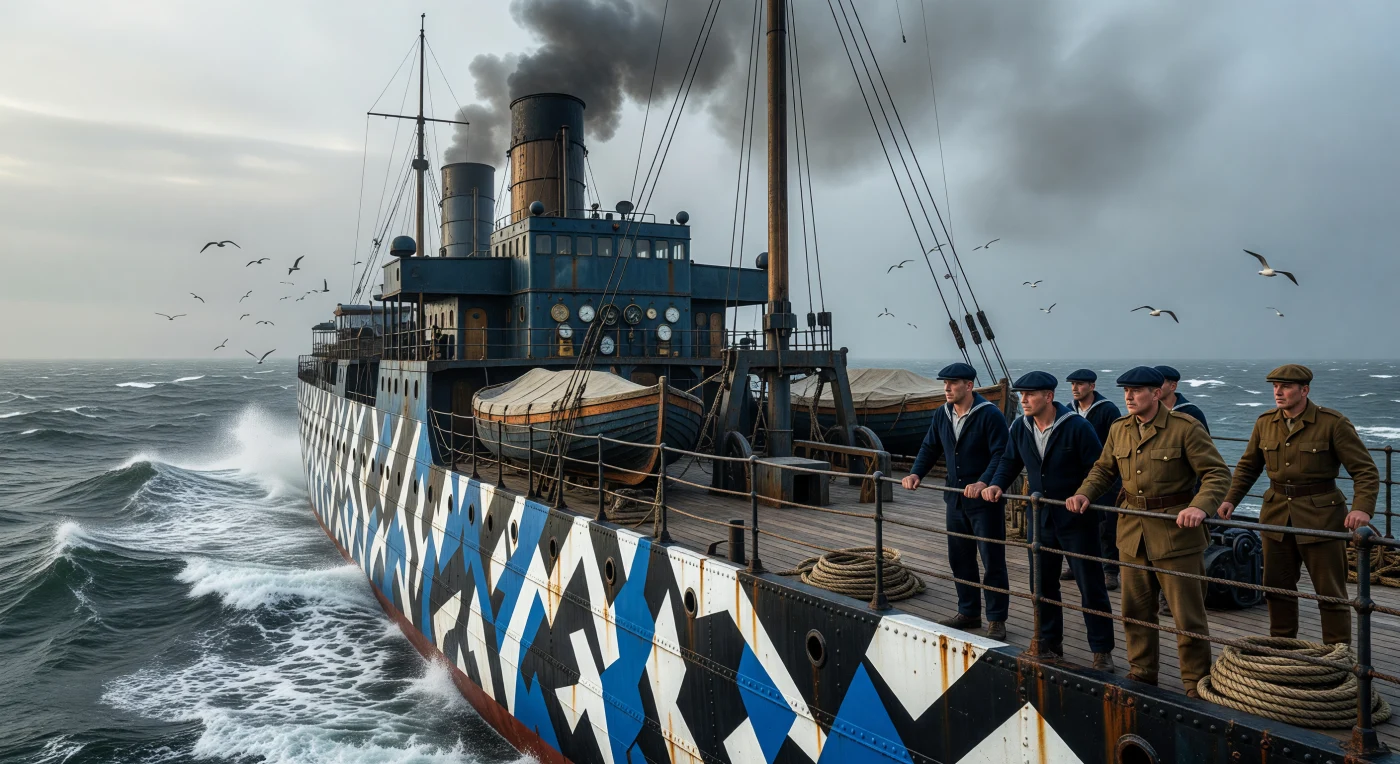
A massive troopship navigates the turbulent North Atlantic, its hull obscured by high-contrast "dazzle" camouflage designed to confuse enemy submarine rangefinders during the First World War. On deck, Canadian soldiers and Royal Navy sailors stand watch amidst the coal smoke and salt spray, representing the perilous journey undertaken by thousands of troops crossing from North America to the Western Front. This striking visual strategy transformed functional vessels into floating pieces of avant-garde art to survive the deadly U-boat threats of the era.

This scene depicts a high-stakes naval operations room in Quebec City during the 1943 Battle of the Atlantic, where Royal Canadian Navy officers and members of the Women's Royal Canadian Naval Service (WRCNS) track Allied merchant convoys. Using long-handled pushers to move markers across a Great Circle projection map, these personnel coordinated the movement of vital supplies against the persistent threat of German U-boat "wolf packs." The presence of the "Wrens" highlights the essential role women played in naval intelligence, while the Flower-class corvette visible through the window underscores Canada’s significant maritime contribution to the Allied victory.

A Royal Canadian Navy navigator braces against the freezing spray of a North Atlantic gale to take a celestial sighting from the open bridge of a Tribal-class destroyer. Clad in a traditional heavy-knit "Submarine" sweater, he relies on a brass sextant alongside early technological innovations like the Type 271 radar antenna and a magnetic binnacle. This scene illustrates the perilous and physically demanding nature of escort duty during the 1943 Battle of the Atlantic, where Allied crews navigated extreme weather and constant tension to protect vital supply lines.

In this poignant scene from 1943, an officer and crew members of a Royal Canadian Navy Flower-class corvette conduct a burial at sea during a mid-winter crossing of the North Atlantic. The deceased sailor, sewn into a weighted canvas hammock, is committed to the deep according to naval tradition, reflecting the stark reality and high casualty rates of the Battle of the Atlantic. The ship's weathered "Western Approaches" camouflage and the primed depth charge thrower in the background serve as reminders of the constant vigilance required against the submarine threat during the Second World War.