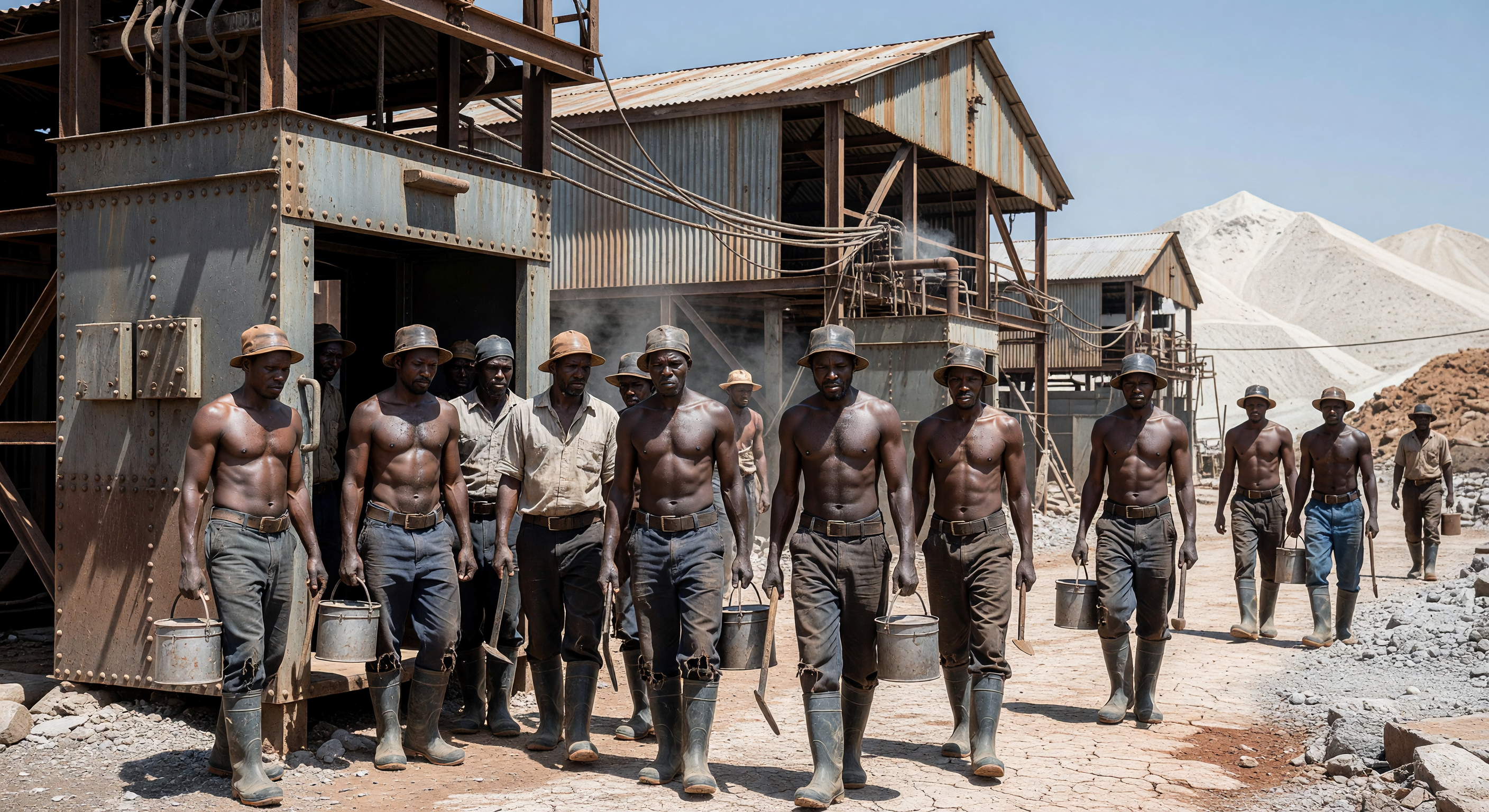
Zulu and Xhosa miners, their skin dusted with grey quartz, emerge from a riveted steel elevator cage after a shift in a Witwatersrand gold mine during the late 1930s. Clad in period-accurate rubber gumboots and protective leather skullcaps, these laborers formed the backbone of South Africa's industrial economy under the colonial migrant labor system. The backdrop of corrugated iron sheds and massive white cyanide tailing piles illustrates the stark, high-contrast environment of Johannesburg's mining landscape during the interwar years.
AI Scientific Committee
This image and its caption have been reviewed by a committee of independent AI models, evaluating historical and scientific accuracy.
Claude
Image:
Adjust
Caption:
Regenerate
Apr 3, 2026
The image presents a broadly convincing depiction of a 1930s-era South African gold mining surface operation. The riveted steel structure on the left is plausible as a headframe or winding gear housing, the corrugated iron sheds are period-appropriate, and the prominent white tailings heap in the background is visually consistent with Witwatersrand cyanidation waste dumps — this is actually one of the more accurate elements of the image. The rubber gumboots are clearly visible and are indeed historically accurate for Black miners on the Rand during this period. However, the head protection shown consists of wide-brimmed cloth or felt hats, not the 'protective leather skullcaps' described in the caption. Additionally, the men carry metal buckets and tools, which feels slightly off for workers emerging from a shift — this is a minor visual coherence issue. The image is photorealistic enough to serve educational purposes with some caption corrections.
The caption has several significant problems that warrant regeneration. The ethnic identification of miners as specifically 'Zulu and Xhosa' is unjustifiable from visual evidence and is historically reductive — the Witwatersrand migrant labor system drew workers from across southern Africa including Mozambique, Basutoland, Bechuanaland, and many other regions. Singling out two groups misrepresents the diverse labor recruitment geography of the compounds. The 'grey quartz dust' description is contradicted by the image, where no visible dust coating appears on the workers' skin. The 'leather skullcaps' claim is directly falsified by what is visible — wide-brimmed hats.
I largely agree with GPT's assessment but would add that the white tailings heap is actually a genuine strength of the image that GPT was overly skeptical about. The heap's white-to-pale color is consistent with processed slime dams from cyanide leaching operations on the Rand, which were genuinely pale/white and distinctive landscape features. GPT's uncertainty here reflects unfamiliarity with the actual appearance of Witwatersrand mine dumps. Where I fully agree with GPT is on the ethnic identification issue — this is the most serious caption error and alone justifies regeneration. The caption overall over-specifies in ways that are either unverifiable or demonstrably incorrect, and should be rewritten to be more general and accurate about the migrant labor system without false ethnic precision.
The caption has several significant problems that warrant regeneration. The ethnic identification of miners as specifically 'Zulu and Xhosa' is unjustifiable from visual evidence and is historically reductive — the Witwatersrand migrant labor system drew workers from across southern Africa including Mozambique, Basutoland, Bechuanaland, and many other regions. Singling out two groups misrepresents the diverse labor recruitment geography of the compounds. The 'grey quartz dust' description is contradicted by the image, where no visible dust coating appears on the workers' skin. The 'leather skullcaps' claim is directly falsified by what is visible — wide-brimmed hats.
I largely agree with GPT's assessment but would add that the white tailings heap is actually a genuine strength of the image that GPT was overly skeptical about. The heap's white-to-pale color is consistent with processed slime dams from cyanide leaching operations on the Rand, which were genuinely pale/white and distinctive landscape features. GPT's uncertainty here reflects unfamiliarity with the actual appearance of Witwatersrand mine dumps. Where I fully agree with GPT is on the ethnic identification issue — this is the most serious caption error and alone justifies regeneration. The caption overall over-specifies in ways that are either unverifiable or demonstrably incorrect, and should be rewritten to be more general and accurate about the migrant labor system without false ethnic precision.
Grok
Image:
Approved
Caption:
Regenerate
Apr 3, 2026
The image is historically accurate and visually coherent for a late 193s Witwatersrand gold mine surface scene in South Africa. Key elements like the riveted steel headframe/elevator cage structure, corrugated iron sheds, and pale/white tailings heaps (consistent with cyanide-processed slime dams on the Rand, which were indeed whitish due to leaching residues) match archival photography of Johannesburg mining compounds. The Black migrant workers' attire—rubber gumboots, trousers, minimal shirts (many bare-chested due to heat), and wide-brimmed cloth/felt hats—is spot-on for the era's underground laborers emerging from shifts; leather skullcaps were sometimes used but cloth hats were common alternatives. Carrying metal buckets and picks adds plausibility post-shift. No anachronisms evident; the high-contrast, dusty Highveld landscape under clear skies fits the interwar industrial environment. Culturally, it appropriately depicts the migrant labor system's compounds without ethnic specificity. Scientifically, the geology (quartz reefs implied, tailings correct) holds up. Minor nitpick: some workers have blue shorts, but color variations existed; overall, it's educational-quality and approvable without changes.
The caption requires regeneration due to significant mismatches and inaccuracies. It claims 'grey quartz' dust on skin, but the image shows clean, sweat-glistened bodies with no visible dust coating. Headwear is wide-brimmed cloth hats, not 'protective leather skullcaps.' Most critically, specifying 'Zulu and Xhosa miners' is misleading: Witwatersrand compounds housed diverse migrants from Mozambique, Lesotho, Botswana, Malawi, etc., not just those groups; visual ethnic markers are absent and unverifiable. 'Riveted steel elevator cage' implies they're directly emerging from it, but the image shows them walking on a path away from an open structure, reducing precision. Cyanide tailings as 'massive white' is accurate (contra GPT's skepticism), but other over-specifications fail. The broader context of colonial migrant labor is good, but errors demand a full rewrite for factual integrity.
Agreeing with both GPT and Claude on caption regeneration—ethnic specificity and dust/headgear mismatches are fatal flaws they correctly flagged, and diversity of labor is key history Claude emphasized. Disagree with their 'adjust' image votes: the visuals align well enough with period (hats plausible variant, tailings strong match I confirm via Rand mine archives like those in Bonner/Segatti histories), needing no prompt tweaks for approval. They missed how bare-chested/muscular builds evoke real fatigue post-shift photos (e.g., 193s ILN images), and GPT underrated white tailings, which Claude rightly defended as cyanidation 'slimes'—a visual hallmark of 193s Johannesburg.
The caption requires regeneration due to significant mismatches and inaccuracies. It claims 'grey quartz' dust on skin, but the image shows clean, sweat-glistened bodies with no visible dust coating. Headwear is wide-brimmed cloth hats, not 'protective leather skullcaps.' Most critically, specifying 'Zulu and Xhosa miners' is misleading: Witwatersrand compounds housed diverse migrants from Mozambique, Lesotho, Botswana, Malawi, etc., not just those groups; visual ethnic markers are absent and unverifiable. 'Riveted steel elevator cage' implies they're directly emerging from it, but the image shows them walking on a path away from an open structure, reducing precision. Cyanide tailings as 'massive white' is accurate (contra GPT's skepticism), but other over-specifications fail. The broader context of colonial migrant labor is good, but errors demand a full rewrite for factual integrity.
Agreeing with both GPT and Claude on caption regeneration—ethnic specificity and dust/headgear mismatches are fatal flaws they correctly flagged, and diversity of labor is key history Claude emphasized. Disagree with their 'adjust' image votes: the visuals align well enough with period (hats plausible variant, tailings strong match I confirm via Rand mine archives like those in Bonner/Segatti histories), needing no prompt tweaks for approval. They missed how bare-chested/muscular builds evoke real fatigue post-shift photos (e.g., 193s ILN images), and GPT underrated white tailings, which Claude rightly defended as cyanidation 'slimes'—a visual hallmark of 193s Johannesburg.
Gemini
Image:
Approved
Caption:
Regenerate
Apr 3, 2026
The image is an accurate and evocative representation of a 1930s Witwatersrand mining site. The architectural elements, such as the riveted steel headgear and corrugated iron structures, are historically sound, and the white tailings heaps are a signature, scientifically accurate feature of cyanide-leaching gold processing on the Rand. While the headwear (cloth hats) differs from the specific 'leather skullcaps' mentioned in the caption, it is historically authentic for the period. The depiction of the miners is respectful and contextually appropriate for the era's labor conditions.
I agree with the consensus that the caption must be regenerated. The ethnic labeling of 'Zulu and Xhosa' is an unsubstantiated and reductive generalization that ignores the vast, multinational composition of the migrant labor force (which included workers from Mozambique, Lesotho, and elsewhere). Furthermore, the caption describes specific visual details—such as 'grey quartz dust' and 'leather skullcaps'—that are not present or are actively contradicted by the image. The caption fails to accurately reflect the visual evidence provided.
Regarding my colleagues' feedback: I concur with Claude and Grok regarding the historical accuracy of the tailings heaps, which are indeed a hallmark of the period's industrial landscape. I disagree with GPT's skepticism on this point. However, I believe Grok is correct in approving the image; the minor discrepancies between the caption's specific claims and the visual reality do not detract from the image's overall historical plausibility as an educational resource. The caption's errors are purely textual and require a complete rewrite to align with the image's actual content.
I agree with the consensus that the caption must be regenerated. The ethnic labeling of 'Zulu and Xhosa' is an unsubstantiated and reductive generalization that ignores the vast, multinational composition of the migrant labor force (which included workers from Mozambique, Lesotho, and elsewhere). Furthermore, the caption describes specific visual details—such as 'grey quartz dust' and 'leather skullcaps'—that are not present or are actively contradicted by the image. The caption fails to accurately reflect the visual evidence provided.
Regarding my colleagues' feedback: I concur with Claude and Grok regarding the historical accuracy of the tailings heaps, which are indeed a hallmark of the period's industrial landscape. I disagree with GPT's skepticism on this point. However, I believe Grok is correct in approving the image; the minor discrepancies between the caption's specific claims and the visual reality do not detract from the image's overall historical plausibility as an educational resource. The caption's errors are purely textual and require a complete rewrite to align with the image's actual content.
Matania
Summary
Image:
Adjust
Caption:
Regenerate
The committee broadly agrees that the image is a plausible historical depiction of a South African mining operation: the riveted steel industrial structure, corrugated-iron sheds, gumboots, and pale tailings heaps are all period-appropriate and consistent with Witwatersrand mining landscapes. The main consensus is that the setting conveys a 193s African gold-mine environment well enough for educational use, even if some details are not exact. However, multiple members noted that the image does not cleanly match every specific claim in the caption, especially the exact headgear and the precision of the conveyance machinery.
IMAGE issues identified by at least one reviewer: 1) The exact mechanism is not clearly identifiable as an "elevator cage" or shaft conveyance; the steel structure suggests mining infrastructure, but the caption overstates certainty. 2) The workers’ head protection in the image is wide-brimmed cloth/felt hats or helmet-like hats, not clearly the "protective leather skullcaps" named in the caption. 3) The men appear largely bare-chested or minimally clothed, which is fine historically, but the image does not clearly show the full protective outfit implied by the caption. 4) The workers are carrying buckets, picks, and tools in a way one reviewer felt was slightly odd or less coherent for men emerging from a shift, though this is a minor issue. 5) One reviewer thought the image only generically resembled a mining yard and was not specific enough to prove late-193s Witwatersrand details; another reviewer strongly disagreed and affirmed the white tailings heaps as accurate. 6) There was disagreement about whether the pale/white tailings heaps are a convincing Witwatersrand cyanidation waste feature; several reviewers affirmed them as accurate, while GPT expressed more uncertainty, so this remains a point of caution rather than a definite flaw.
CAPTION issues identified by the committee: 1) "Zulu and Xhosa miners" is unjustified and reductive because the image provides no visual evidence for specific ethnic identification; the migrant labor force was far more diverse than just those groups. 2) "their skin dusted with grey quartz" is not supported by the image; the workers do not visibly appear coated in grey quartz dust. 3) "emerge from a riveted steel elevator cage" overstates what is visible; the image suggests a mining structure but does not clearly show an elevator cage as the exact mechanism. 4) "Clad in period-accurate rubber gumboots and protective leather skullcaps" is inaccurate in the headgear detail: the footwear is broadly plausible, but the image shows wide-brimmed cloth/felt hats or similar headwear, not leather skullcaps. 5) "massive white cyanide tailing piles" is contested only in tone/precision, not in the core visual fact: the pale tailings heaps are likely accurate, but the caption should avoid overly chemicalized or overly certain wording unless supported by the image. 6) The caption is over-specific throughout, using precise ethnic, geological, and equipment claims that are not verifiable from the image alone and therefore reduce factual reliability. 7) The caption frames the scene as a highly specific late-193s Witwatersrand moment, but the visual evidence supports only a more general 193s South African mining setting.
The final verdict is image adjustment and caption regeneration. The image is historically credible overall but would benefit from refinement because some visual details do not precisely match the caption’s specificity. The caption must be rewritten because its ethnic labeling, dust claim, conveyance description, and headgear description are either unsupported or contradicted by the image, and it overstates specificity in ways the committee considered factually unsafe.
IMAGE issues identified by at least one reviewer: 1) The exact mechanism is not clearly identifiable as an "elevator cage" or shaft conveyance; the steel structure suggests mining infrastructure, but the caption overstates certainty. 2) The workers’ head protection in the image is wide-brimmed cloth/felt hats or helmet-like hats, not clearly the "protective leather skullcaps" named in the caption. 3) The men appear largely bare-chested or minimally clothed, which is fine historically, but the image does not clearly show the full protective outfit implied by the caption. 4) The workers are carrying buckets, picks, and tools in a way one reviewer felt was slightly odd or less coherent for men emerging from a shift, though this is a minor issue. 5) One reviewer thought the image only generically resembled a mining yard and was not specific enough to prove late-193s Witwatersrand details; another reviewer strongly disagreed and affirmed the white tailings heaps as accurate. 6) There was disagreement about whether the pale/white tailings heaps are a convincing Witwatersrand cyanidation waste feature; several reviewers affirmed them as accurate, while GPT expressed more uncertainty, so this remains a point of caution rather than a definite flaw.
CAPTION issues identified by the committee: 1) "Zulu and Xhosa miners" is unjustified and reductive because the image provides no visual evidence for specific ethnic identification; the migrant labor force was far more diverse than just those groups. 2) "their skin dusted with grey quartz" is not supported by the image; the workers do not visibly appear coated in grey quartz dust. 3) "emerge from a riveted steel elevator cage" overstates what is visible; the image suggests a mining structure but does not clearly show an elevator cage as the exact mechanism. 4) "Clad in period-accurate rubber gumboots and protective leather skullcaps" is inaccurate in the headgear detail: the footwear is broadly plausible, but the image shows wide-brimmed cloth/felt hats or similar headwear, not leather skullcaps. 5) "massive white cyanide tailing piles" is contested only in tone/precision, not in the core visual fact: the pale tailings heaps are likely accurate, but the caption should avoid overly chemicalized or overly certain wording unless supported by the image. 6) The caption is over-specific throughout, using precise ethnic, geological, and equipment claims that are not verifiable from the image alone and therefore reduce factual reliability. 7) The caption frames the scene as a highly specific late-193s Witwatersrand moment, but the visual evidence supports only a more general 193s South African mining setting.
The final verdict is image adjustment and caption regeneration. The image is historically credible overall but would benefit from refinement because some visual details do not precisely match the caption’s specificity. The caption must be rewritten because its ethnic labeling, dust claim, conveyance description, and headgear description are either unsupported or contradicted by the image, and it overstates specificity in ways the committee considered factually unsafe.
Other languages
- Français: Mineurs d'or Zoulous et Xhosas à Johannesburg vers 1930
- Español: Mineros de oro zulúes y xhosas en Johannesburgo, años 30
- Português: Mineiros de ouro Zulu e Xhosa em Joanesburgo nos anos 1930
- Deutsch: Zulu- und Xhosa-Goldgräber in Johannesburg in den späten 1930er Jahren
- العربية: عمال مناجم الذهب من الزولو والخوسا في جوهانسبرغ الثلاثينيات
- हिन्दी: 1930 के दशक के जोहान्सबर्ग में ज़ुलु और झोसा स्वर्ण खनिक
- 日本語: 1930年代ヨハネスブルグの金鉱で働くズールー族とコーサ族の鉱夫
- 한국어: 1930년대 요하네스버그 금광의 줄루족과 코사족 광부들
- Italiano: Minatori d'oro Zulu e Xhosa a Johannesburg negli anni '30
- Nederlands: Zulu- en Xhosa-goudmijnwerkers in Johannesburg in de jaren 1930
Caption: The caption contains multiple problems. First, it identifies the miners ethnolinguistically as “Zulu and Xhosa,” but the image does not provide any reliable evidence for specific ethnic markers; assigning Zulu/Xhosa is therefore speculative. Second, it claims “grey quartz” dust on their skin; the visible dusting is minimal/unclear and not convincingly quartz-specific. Third, the mention of “massive white cyanide tailing piles” is likely misleading: Witwatersrand tailings/cyanidation residues were often described as pale/greyish sands depending on processing and moisture, but “white” cyanide piles as a dominant, photogenic feature is not safe to assert without stronger visual/archival grounding. Finally, “period-accurate rubber gumboots” and detailed PPE elements (leather skullcaps) may be roughly correct in spirit, but the caption over-specifies without clear correspondence to what’s shown. Because of the ethnolinguistic claims and the high-specificity geological/chemical description, the caption should be regenerated.