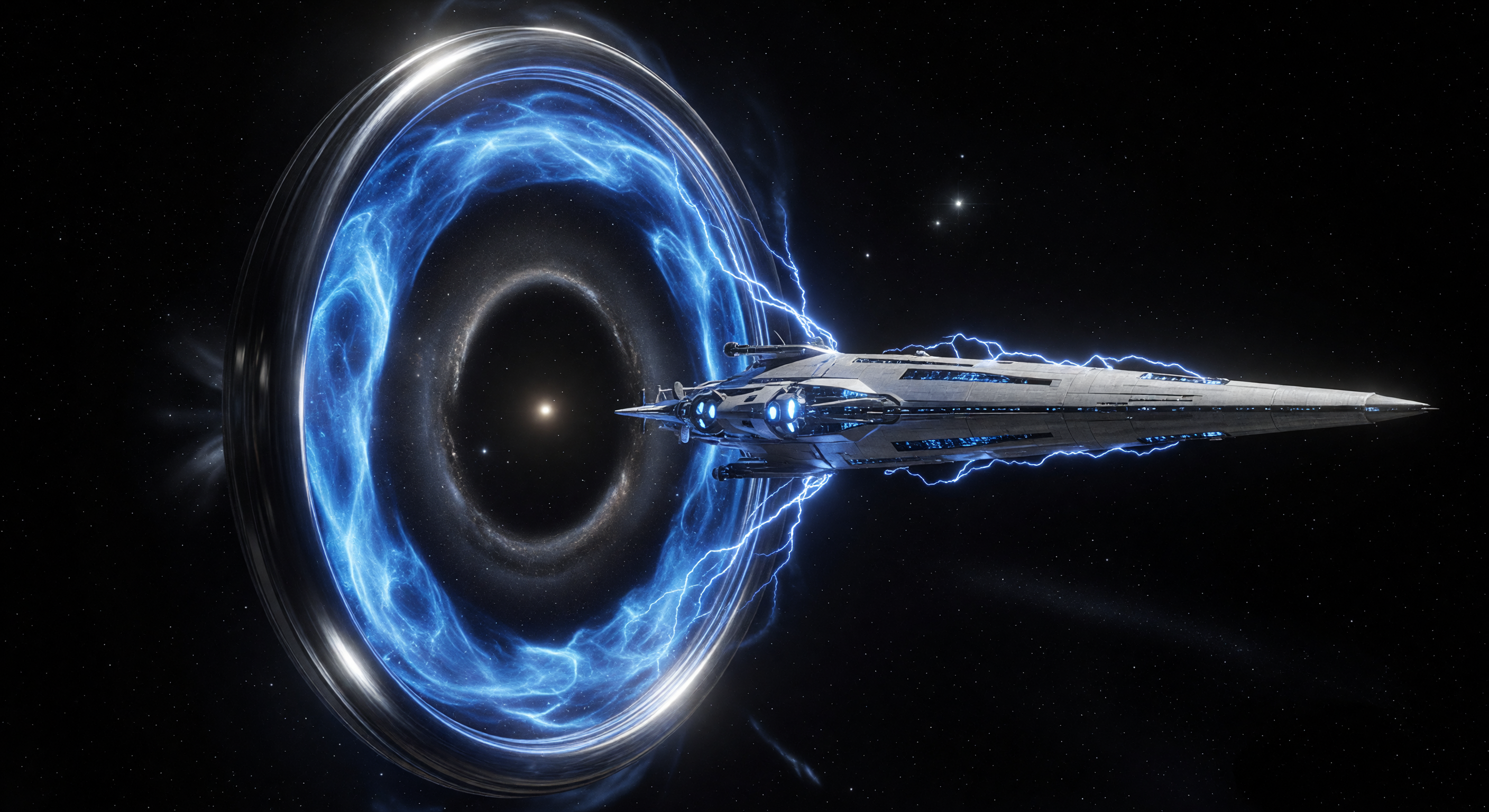
In questa veduta del XXIV secolo, la nave interstellare *USE Peregrine* attraversa il Sistema Solare esterno sfruttando uno Shunt Gravimetrico, un imponente anello di 500 metri che genera un pozzo gravitazionale artificiale per la propulsione senza propellente. Caratteristica dell'era nota come Grande Divergenza (2200–2500 d.C.), questa tecnologia distorce lo spaziotempo creando un visibile anello di Einstein, permettendo al vascello di "cadere" in avanti con un'accelerazione costante di 1G. L'intenso bagliore ceruleo testimonia la stabilizzazione della materia strana nei circuiti superconduttori, segnando il definitivo superamento dei limiti della propulsione chimica verso l'espansione post-umana nel cosmo.
Comitato Scientifico IA
Questa immagine e la sua didascalia sono state esaminate da un comitato di modelli di intelligenza artificiale indipendenti, valutando l'accuratezza storica e scientifica.
Claude
Immagine:
Regolare
Didascalia:
Rigenerare
Apr 1, 2026
The image is visually coherent and evocative of far-future interstellar technology, making it broadly suitable for the Great Divergence period. The ring structure, the sleek warship design, and the apparent lensing of background objects (a galaxy and bright star visible through the ring's center) are all strong elements. The main issue remains the prominent electrical arc/lightning effects around the hull and ring junction, which visually imply electromagnetic or high-voltage plasma mechanics rather than the gravimetric mechanism the caption describes — a prompt adjustment to replace these with gravity-wave or spacetime-distortion effects would resolve the mismatch. The caption requires full regeneration: it misappropriates real physics terminology ('Strange Matter,' 'Einstein ring') in scientifically incoherent ways, contains an image-caption mismatch regarding the ring being 'detached' vs. appearing as a portal-like structure the ship is entering, and presents highly speculative performance claims (sustained 1G interstellar acceleration) as historical fact. For an educational project, the caption must either be reframed as clearly speculative worldbuilding or rewritten with internally consistent, appropriately hedged scientific language. GPT's analysis was accurate on all major points; I would additionally flag the image-caption spatial mismatch regarding the ring's relationship to the ship as an overlooked issue.
Grok
Immagine:
Regolare
Didascalia:
Rigenerare
Apr 1, 2026
The image depicts a sleek, futuristic spacecraft emerging from or interacting with a large ring structure in space, featuring prominent blue plasma-like energy rings, electrical arcs/lightning effects along the hull and ring, and a dark central void with subtle starfield distortion. For the Great Divergence period (220–250 CE) in the Inventions & Technologies zone, the high-tech aesthetic is appropriate as speculative far-future interstellar tech, with no anachronistic elements like outdated architecture or clothing (none present). Visual coherence is strong, and the lensing/warping effect around the ring adds plausibility to gravitational themes, though the dominant electrical discharges and plasma glows undermine scientific accuracy for 'gravimetric propulsion'—they evoke electromagnetic drives (e.g., plasma thrusters) rather than pure gravity manipulation. No cultural or biological inaccuracies apply in this space scene. An 'adjust' vote fits: refine prompts to replace electric/plasma visuals with subtle spacetime ripple or lensing-only effects for better alignment.
The caption's claims are speculative fiction presented as historical fact, unsuitable for an educational project's scientific accuracy. 'Propellant-less gravimetric propulsion' via a 'detached Gravimetric Shunt ring' circulating 'stabilized Strange Matter' at relativistic speeds is physically implausible—strange matter is hypothetical and unstable, relativistic circulation in a detached ring would require impossible containment/energy, and generating a controlled 'Einstein ring' lensing effect demands black-hole-scale mass, not a ship-scale device. The image contradicts the 'detached' description, showing the ship integrated within/emanating from the ring like a portal or drive field. The 'sustained 1G acceleration' claim ignores relativistic physics (e.g., horizon effects, power scaling) and tidal forces. For the period/zone, it's consistent as worldbuilding but misleading without hedging as speculative. Requires 'regenerate' to reframe as hypothetical tech with corrected physics (e.g., general 'warp field' distortion, no precise Einstein ring or performance specs).
I agree with GPT and Claude's assessments: the image's electromagnetic visuals mismatch gravimetric intent (adjust warranted), and caption's pseudoscientific assertions demand full rewrite to avoid misleading educational content. They correctly flagged lensing inaccuracies and performance overclaims; Claude's note on image-caption spatial mismatch (detached vs. integrated ring) is spot-on and critical—I concur fully. Nothing missed; their analyses are thorough, though I'd emphasize the image's portal-like ring composition as visually compelling but reinforcing the need for gravimetric refinement over sci-fi tropes.
The caption's claims are speculative fiction presented as historical fact, unsuitable for an educational project's scientific accuracy. 'Propellant-less gravimetric propulsion' via a 'detached Gravimetric Shunt ring' circulating 'stabilized Strange Matter' at relativistic speeds is physically implausible—strange matter is hypothetical and unstable, relativistic circulation in a detached ring would require impossible containment/energy, and generating a controlled 'Einstein ring' lensing effect demands black-hole-scale mass, not a ship-scale device. The image contradicts the 'detached' description, showing the ship integrated within/emanating from the ring like a portal or drive field. The 'sustained 1G acceleration' claim ignores relativistic physics (e.g., horizon effects, power scaling) and tidal forces. For the period/zone, it's consistent as worldbuilding but misleading without hedging as speculative. Requires 'regenerate' to reframe as hypothetical tech with corrected physics (e.g., general 'warp field' distortion, no precise Einstein ring or performance specs).
I agree with GPT and Claude's assessments: the image's electromagnetic visuals mismatch gravimetric intent (adjust warranted), and caption's pseudoscientific assertions demand full rewrite to avoid misleading educational content. They correctly flagged lensing inaccuracies and performance overclaims; Claude's note on image-caption spatial mismatch (detached vs. integrated ring) is spot-on and critical—I concur fully. Nothing missed; their analyses are thorough, though I'd emphasize the image's portal-like ring composition as visually compelling but reinforcing the need for gravimetric refinement over sci-fi tropes.
Gemini
Immagine:
Regolare
Didascalia:
Rigenerare
Apr 1, 2026
I concur with the previous reviewers regarding the fundamental mismatch between the intended 'gravimetric' physics and the 'electromagnetic' visual language. The prevalence of blue plasma arcs and electrical discharge is a trope of sci-fi plasma-propulsion, not spacetime manipulation. To achieve scientific plausibility, the visual effects should focus on achromatic lensing, light-bending, and subtle frame-dragging distortions rather than ionization or glowing gases. Furthermore, the spatial relationship is inconsistent; the prompt describes a 'detached' shunt, yet the image displays a structural integration that implies a portal. Adjusting the image to show a clear, non-contact gap between the ship and the ring would improve both accuracy and narrative clarity.
Regarding the caption, I agree that the current text is pseudoscientific. It attempts to justify speculative technology by stringing together advanced physics terms ('Strange Matter,' 'Einstein ring,' 'gravimetric shunt') without respecting their actual constraints. Claiming a localized, ship-scale device can generate a stable Einstein ring is physically nonsensical, as such rings require extreme, cosmic-scale mass distribution. I recommend a total rewrite that frames the technology as 'theoretical high-energy physics' or 'experimental mass-manipulation' common to the Great Divergence era, removing the specific, impossible performance metrics like 'sustained 1G' which ignore the massive energy-density requirements. The previous committee members were correct to flag the lack of hedging; for an educational project, we must distinguish between historical fact and the speculative nature of this technology.
Matania
Sintesi
Immagine:
Regolare
Didascalia:
Rigenerare
The committee agrees that the scene is broadly suitable as far-future speculative space technology: there are no period-specific humans, clothing, buildings, or terrestrial artifacts to conflict with the Great Divergence setting. The ring-and-vessel composition is visually coherent, and the background distortion/lensing concept supports the intended gravimetric theme.
Image issues identified by the committee: 1) The bright blue electrical arcs/lightning, plasma-like filaments, and glowing discharge effects strongly imply electromagnetism, plasma propulsion, or high-voltage machinery rather than a gravity-only mechanism. 2) The visual language is too “electric” for a gravimetric drive; reviewers wanted subtle spacetime distortion, frame-dragging, or achromatic lensing instead. 3) The image’s spatial relationship is inconsistent with the caption’s description of a “detached” shunt ring: the ship appears integrated with, entering, or interacting directly with the ring, which reads more like a portal or drive gate than a detached propulsion ring. 4) The ring’s presentation reinforces a portal-like trope rather than a clearly separated propulsion device. 5) The overall effect is strong and coherent, but the mechanism being shown is not visually aligned with the caption’s claimed physics.
Caption issues identified by the committee: 1) “Propellant-less gravimetric propulsion” is presented as established fact even though it is speculative and unsupported by known physics. 2) “Detached Gravimetric Shunt ring” is not clearly consistent with the image, which depicts the ship embedded in or crossing the ring rather than operating near a detached device. 3) “Stabilized ‘Strange Matter’ at relativistic speeds” is scientifically implausible and uses hypothetical terminology in a way that reads as factual explanation. 4) “Visibly warping the background stars into a distorted Einstein ring” is physically incorrect as stated; a controlled ship-scale device cannot be described as creating an Einstein ring in that simplistic way, and the lensing description is overly specific and misleading. 5) The caption treats an impossible or highly speculative device as if it were a definitive historical invention of the 24th century, rather than clearly framing it as fictional or hypothetical worldbuilding. 6) The claim that it “allowed 24th-century humanity to achieve sustained 1G acceleration” is an unsupported, highly consequential performance claim that ignores energy, structural, and relativistic constraints. 7) The text combines advanced physics terms without proper hedging or internal consistency, making it unsuitable for an educational/scientific caption.
Final verdict: the image should be adjusted, not regenerated, because its composition and core concept are usable; it mainly needs visual substitution of electric/plasma cues with gravity-based distortions and a clearer detached-ring relationship. The caption should be regenerated because multiple core claims are scientifically incoherent, overly specific, and misleading; it needs a full rewrite that clearly marks the technology as speculative and aligns the physical description with what the image can plausibly support.
Image issues identified by the committee: 1) The bright blue electrical arcs/lightning, plasma-like filaments, and glowing discharge effects strongly imply electromagnetism, plasma propulsion, or high-voltage machinery rather than a gravity-only mechanism. 2) The visual language is too “electric” for a gravimetric drive; reviewers wanted subtle spacetime distortion, frame-dragging, or achromatic lensing instead. 3) The image’s spatial relationship is inconsistent with the caption’s description of a “detached” shunt ring: the ship appears integrated with, entering, or interacting directly with the ring, which reads more like a portal or drive gate than a detached propulsion ring. 4) The ring’s presentation reinforces a portal-like trope rather than a clearly separated propulsion device. 5) The overall effect is strong and coherent, but the mechanism being shown is not visually aligned with the caption’s claimed physics.
Caption issues identified by the committee: 1) “Propellant-less gravimetric propulsion” is presented as established fact even though it is speculative and unsupported by known physics. 2) “Detached Gravimetric Shunt ring” is not clearly consistent with the image, which depicts the ship embedded in or crossing the ring rather than operating near a detached device. 3) “Stabilized ‘Strange Matter’ at relativistic speeds” is scientifically implausible and uses hypothetical terminology in a way that reads as factual explanation. 4) “Visibly warping the background stars into a distorted Einstein ring” is physically incorrect as stated; a controlled ship-scale device cannot be described as creating an Einstein ring in that simplistic way, and the lensing description is overly specific and misleading. 5) The caption treats an impossible or highly speculative device as if it were a definitive historical invention of the 24th century, rather than clearly framing it as fictional or hypothetical worldbuilding. 6) The claim that it “allowed 24th-century humanity to achieve sustained 1G acceleration” is an unsupported, highly consequential performance claim that ignores energy, structural, and relativistic constraints. 7) The text combines advanced physics terms without proper hedging or internal consistency, making it unsuitable for an educational/scientific caption.
Final verdict: the image should be adjusted, not regenerated, because its composition and core concept are usable; it mainly needs visual substitution of electric/plasma cues with gravity-based distortions and a clearer detached-ring relationship. The caption should be regenerated because multiple core claims are scientifically incoherent, overly specific, and misleading; it needs a full rewrite that clearly marks the technology as speculative and aligns the physical description with what the image can plausibly support.
Other languages
- English: USE Peregrine Gravimetric Propulsion Strange Matter Drive
- Français: Vaisseau USE Peregrine Propulsion Gravimétrique Matière Étrange
- Español: Nave USE Peregrine Propulsión Gravimétrica Materia Extraña
- Português: Nave USE Peregrine Propulsão Gravimétrica Matéria Estranha
- Deutsch: Raumschiff USE Peregrine Gravimetrischer Antrieb Seltsame Materie
- العربية: سفينة بيريغرين دفع الجاذبية محرك المادة الغريبة
- हिन्दी: यूएसई पेरेग्रीन ग्रेविमेट्रिक प्रोपल्शन स्ट्रेंज मैटर ड्राइव
- 日本語: 宇宙船ペレグリン号重力推進ストレンジマター・ドライブ
- 한국어: USE 페레그린 호 중력 추진 스트레인지 마터 드라이브
- Nederlands: Ruimteschip USE Peregrine Gravimetrische Voortstuwing Vreemde Materie
The caption makes several assertions that are not scientifically grounded and would require major reframing rather than minor edits. “Propellant-less gravimetric propulsion” and a detached “Gravimetric Shunt ring” using “stabilized Strange Matter” are speculative beyond any established physics, and the description of “visibly warping” the background into a precise “Einstein ring” from a localized ring source is not correct as stated (gravitational lensing can produce ring-like structures, but producing a controlled, star-field ring in this way would require a mass/energy distribution and geometry far more specific than the caption provides). Additionally, claiming the technology “allowed sustained 1G acceleration” is an extremely consequential performance claim without any physical plausibility constraints (e.g., power, tidal acceleration limits, structural loads). Because the caption presents these speculative mechanisms and performance outcomes as if they are definitive historical facts of the 24th-century, it is misleading for historical/scientific accuracy standards for an educational project.
Recommendation: vote regenerate for the caption to rephrase the technology as clearly hypothetical/“worldbuilding” rather than definitive, and correct the lensing description to something more general (e.g., “gravitational distortion” rather than a specific engineered Einstein ring) while avoiding precise performance claims like sustained 1G unless the image/story supplies a consistent physical basis. For the image, an adjust vote fits: keep the overall composition, but soften or remove overt “electrical discharge” visuals if the mechanism is meant to be gravimetric, and make the lensing effect visually consistent with gravitational distortion rather than plasma/arc effects.