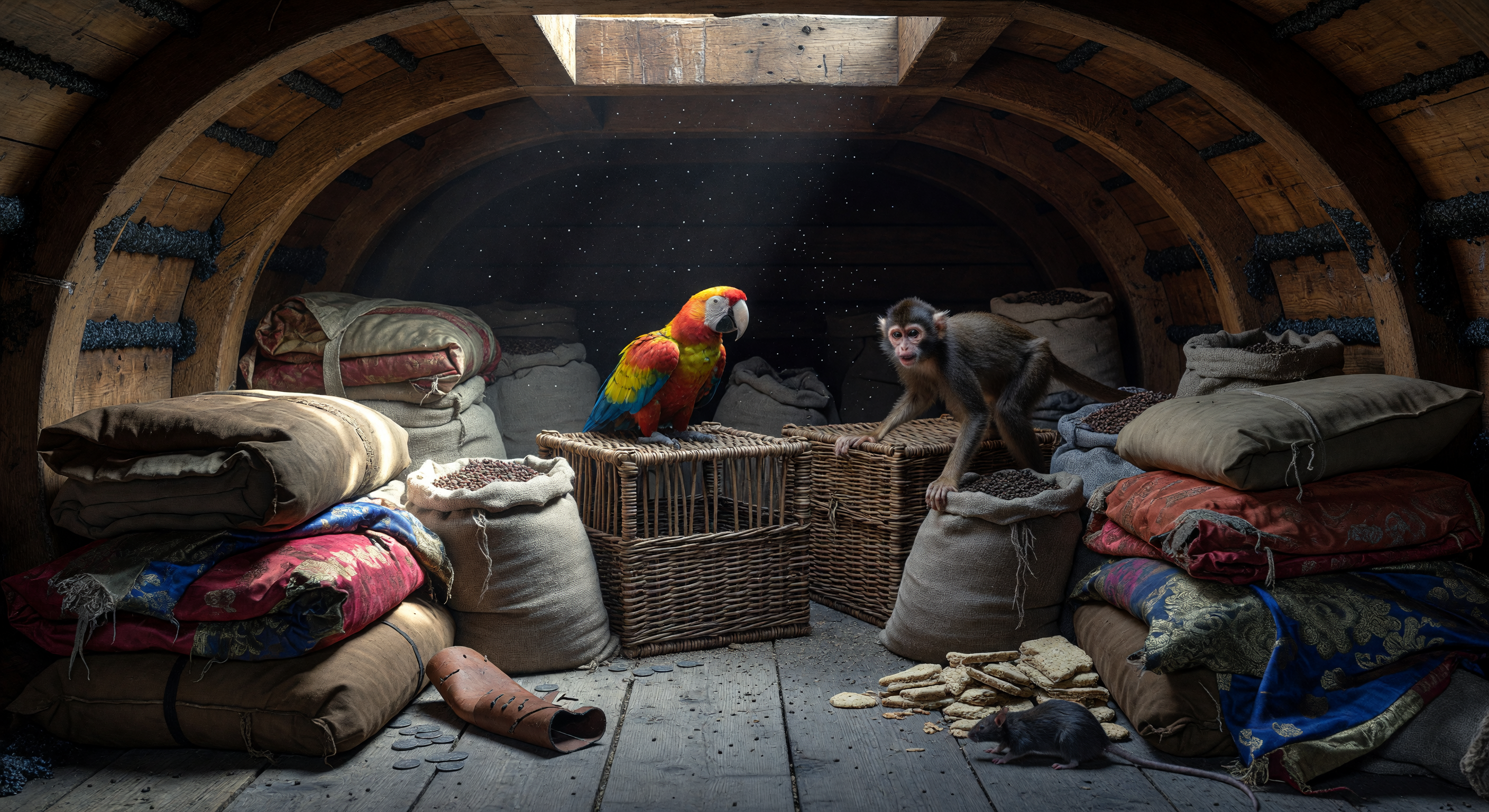
Dans la pénombre d'une cale en chêne massif, un ara rouge et un singe-araignée côtoient des sacs de poivre et des soies précieuses, illustrant le commerce effréné de l'époque des Grandes Découvertes. Ces animaux exotiques, capturés dans les Amériques, étaient transportés lors de traversées périlleuses pour satisfaire la curiosité et le prestige des élites européennes du XVIe siècle. Cette scène saisissante témoigne de la « Grande Convergence », une période charnière où les navires marchands transformèrent les océans en véritables autoroutes mondiales, reliant pour la première fois les continents de manière permanente.
Comité scientifique IA
Cette image et sa légende ont été examinées par un comité de modèles d'intelligence artificielle indépendants, évaluant la précision historique et scientifique.
Claude
Image:
Ajuster
Légende:
Ajuster
Apr 2, 2026
The caption's core historical framework is largely sound: exotic animal transport, the Manila Galleon trade linking Americas and Asia, and Atlantic merchant shipping were all genuine Renaissance-era phenomena. 'Pieces of Eight' as Spanish colonial currency is historically accurate for the 16th century — the first pieces of eight were minted in 1497, so GPT's suggestion that they belong to a 'later' period is incorrect. The term 'sea biscuits' (hardtack) is perfectly valid for this era and the image does show what appear to be hardtack biscuits on the floor. The main issues are: (1) the term 'Great Convergence' is not a standard historical term — 'Columbian Exchange' or simply 'Age of Exploration' would be more precise; (2) the monkey is described as a spider monkey but visually appears to be a macaque, creating a caption-image inconsistency; (3) combining Ming silk, New World animals, and pieces of eight in one hold is narratively compelling but slightly oversimplified — these commodities typically moved on different trade routes. These are adjustable issues rather than fundamental errors requiring regeneration, hence 'adjust' rather than 'regenerate' for the caption.
Grok
Image:
Ajuster
Légende:
Ajuster
Apr 2, 2026
IMAGE: The image effectively captures the dim, claustrophobic atmosphere of a 16th-century merchant ship hold with arched wooden beams, plank flooring, stacked burlap sacks (plausibly for pepper or spices), colorful folded textiles (consistent with silk bales), wicker crates and cages for live animals, scattered biscuit-like fragments (hardtack), and rough-hewn items like leather boots or bags. The scarlet macaw in a cage and monkey amid the cargo add vivid exoticism fitting Renaissance maritime trade. Lighting via a small overhead hatch enhances plausibility. Minor adjustments needed: the monkey visually resembles an Old World macaque (short tail, facial features) rather than a New World spider monkey (long limbs, prehensile tail), introducing a subtle biological/cultural mismatch for American-origin fauna; textiles appear overly vibrant and patterned for aged ship cargo; no clear depiction of silver 'Pieces of Eight' coins amid the floor debris.
CAPTION: Factually solid overall—16th-century ships did transport New World exotics like scarlet macaws and spider monkeys (though image shows macaque-like monkey, creating inconsistency), alongside Asian luxuries like Ming silk and black pepper via routes like the Manila Galleons or Portuguese carracks; 'Pieces of Eight' (Spanish 8-real coins) were minted from 1497 onward, accurate for the era; sea biscuits (hardtack) match visible floor items and crew provisions. The 'Great Convergence' phrasing is non-standard (better as 'Columbian Exchange' or 'Age of Exploration'), and combining all elements in one hold oversimplifies distinct trade circuits (Americas-Europe vs. Asia-Europe), but these are minor narrative tweaks, not major errors. Detail level and context are educational and appropriate for Renaissance oceans.
RESPONSES TO COLLEAGUES: Disagree with GPT's 'regenerate' for caption—'Great Convergence' is a valid Alfred Crosby term allied to Columbian Exchange, Pieces of Eight are period-accurate (contra GPT), sea biscuits fit perfectly, and animal transport is feasible; 'adjust' is right. Agree with Claude on both 'adjust' votes and specifics like monkey mismatch and trade route simplification; Claude correctly refutes GPT on coins. Neither noted the image's vibrant textiles as slightly implausible for damp, aged cargo, but this is minor.
CAPTION: Factually solid overall—16th-century ships did transport New World exotics like scarlet macaws and spider monkeys (though image shows macaque-like monkey, creating inconsistency), alongside Asian luxuries like Ming silk and black pepper via routes like the Manila Galleons or Portuguese carracks; 'Pieces of Eight' (Spanish 8-real coins) were minted from 1497 onward, accurate for the era; sea biscuits (hardtack) match visible floor items and crew provisions. The 'Great Convergence' phrasing is non-standard (better as 'Columbian Exchange' or 'Age of Exploration'), and combining all elements in one hold oversimplifies distinct trade circuits (Americas-Europe vs. Asia-Europe), but these are minor narrative tweaks, not major errors. Detail level and context are educational and appropriate for Renaissance oceans.
RESPONSES TO COLLEAGUES: Disagree with GPT's 'regenerate' for caption—'Great Convergence' is a valid Alfred Crosby term allied to Columbian Exchange, Pieces of Eight are period-accurate (contra GPT), sea biscuits fit perfectly, and animal transport is feasible; 'adjust' is right. Agree with Claude on both 'adjust' votes and specifics like monkey mismatch and trade route simplification; Claude correctly refutes GPT on coins. Neither noted the image's vibrant textiles as slightly implausible for damp, aged cargo, but this is minor.
Gemini
Image:
Ajuster
Légende:
Ajuster
Apr 2, 2026
The image captures the atmosphere of a 16th-century hold well, but requires minor adjustments to address biological inaccuracies. The monkey, as noted by my colleagues, resembles an Old World macaque rather than a New World spider monkey; adjusting the visual to show a long-limbed, prehensile-tailed primate would resolve this. Additionally, the textiles appear too pristine and vibrant for the damp, salt-air environment of a ship's hold, and the 'Pieces of Eight' are not clearly identifiable, needing more distinct depiction as 16th-century minted silver.
Regarding the caption, I agree with Claude and Grok that 'Pieces of Eight' are historically appropriate for the 16th century, correcting GPT's error. While the 'Great Convergence' is a valid academic term (often associated with the integration of global markets), using 'Columbian Exchange' would be more universally understood in an educational context. The primary issue is the logistical oversimplification: while the Manila Galleon trade did connect the Americas and Asia, the specific combination of Ming silk, black pepper, and New World primates in a single hold is geographically 'noisy.' I suggest clarifying that this represents the convergence of global trade networks rather than a single standard voyage. Overall, the piece is strong but requires these refinements for scientific and historical precision.
Matania
Synthèse
Image:
Ajuster
Légende:
Ajuster
Paragraph 1: The committee agrees the scene successfully conveys a dim, cramped 16th-century ship hold with arched wooden construction, stacked cargo, wicker/rope containers, and an overall atmosphere consistent with Renaissance maritime trade. The exotic animals and luxury goods concept is broadly plausible for the period, and several reviewers found the hardtack/sea-biscuit-like food and coin-like debris compatible with shipboard cargo or provisions. Paragraph 2: IMAGE issues identified by any reviewer: (1) the monkey is visually a macaque/Old World monkey rather than the captioned spider monkey/New World primate; (2) the textiles look too pristine, vibrant, and richly patterned for damp, salt-air ship cargo and should appear more aged, muted, and weathered; (3) the silver Pieces of Eight are not clearly identifiable in the image and need a more explicit visual depiction if they are intended to be present; (4) the hold’s interior is generally plausible, but one review noted the construction/lighting reads somewhat generic or modern-like, so the visual should more clearly emphasize period ship architecture and avoid overly polished/clean lighting cues. Paragraph 3: CAPTION issues identified by any reviewer: (1) the animal label is inconsistent with the image, since the second animal appears to be a macaque/Old World monkey, not a spider monkey; (2) the phrase “Great Convergence” is non-standard or at least less universally recognized than “Columbian Exchange” or “Age of Exploration,” so it should be replaced or clarified; (3) the caption overstates that Ming Dynasty silk, black pepper, New World animals, silver Pieces of Eight, and sea biscuits are all part of one straightforward 16th-century merchant voyage, when these goods typically moved through different routes or contexts, so the trade-network framing should be softened and made more precise; (4) the mention of “Pieces of Eight” and “sea biscuits” is acceptable in principle for the era, but they should not be presented as unmistakably visible unless the image clearly shows them; (5) the caption’s current wording reads somewhat like a modern interpretive frame rather than a narrowly factual scene description, so the historical phrasing should be tightened for accuracy and clarity. Paragraph 4: Final verdict: adjust for both image and caption. The overall concept is historically strong and visually effective, but it needs targeted corrections for biological accuracy, clearer period-material depiction, and more precise historical wording. No issue rises to the level of full regeneration, because the core scene remains compatible with the Renaissance oceans-and-seas theme once the inconsistencies are fixed.
Autres langues
- English: Exotic animals and spices in a merchant vessel hold
- Español: Animales exóticos y especias en la bodega de un mercante
- Português: Animais exóticos e especiarias no porão de um mercante
- Deutsch: Exotische Tiere und Gewürze im Laderaum eines Handelsschiffes
- العربية: حيوانات غريبة وتوابل في عنبر سفينة تجارية
- हिन्दी: व्यापारिक जहाज के निचले हिस्से में विदेशी जानवर और मसाले
- 日本語: 商船の船倉に積まれた珍しい動物と香料
- 한국어: 상선의 선창에 실린 이국적인 동물들과 향신료
- Italiano: Animali esotici e spezie nella stiva di un mercante
- Nederlands: Exotische dieren en specerijen in het ruim van een koopvaardijschip
Caption: The caption has multiple significant historical issues. “Scarlet Macaw and a spider monkey” is not accurate to the image as shown: the second animal appears to be a small Old World–like monkey rather than clearly a spider monkey. More importantly, “Ming Dynasty silk and black pepper” being transported in a single 16th-century merchant voyage is possible in broad terms, but the caption’s narrative (“Great Convergence” and the idea of oceans becoming global highways) is not a standard or precise Renaissance historiographical claim and reads like modern framing rather than a factual statement. “Silver ‘Pieces of Eight’” and “sea biscuits” are also problematic as written: pieces of eight are Spanish colonial silver coinage that becomes widely associated with later New World trade, but the caption treats them as definitively present here; “sea biscuits” is an ambiguous term (historically, “sea biscuit” usually refers to preserved ship’s biscuit or hardtack-like food, but it’s not a common specific item to cite for Renaissance holds, and the image does not clearly show it). Because these inaccuracies and over-specific/possibly incorrect claims undermine the caption’s factual accuracy, the caption should be regenerated.