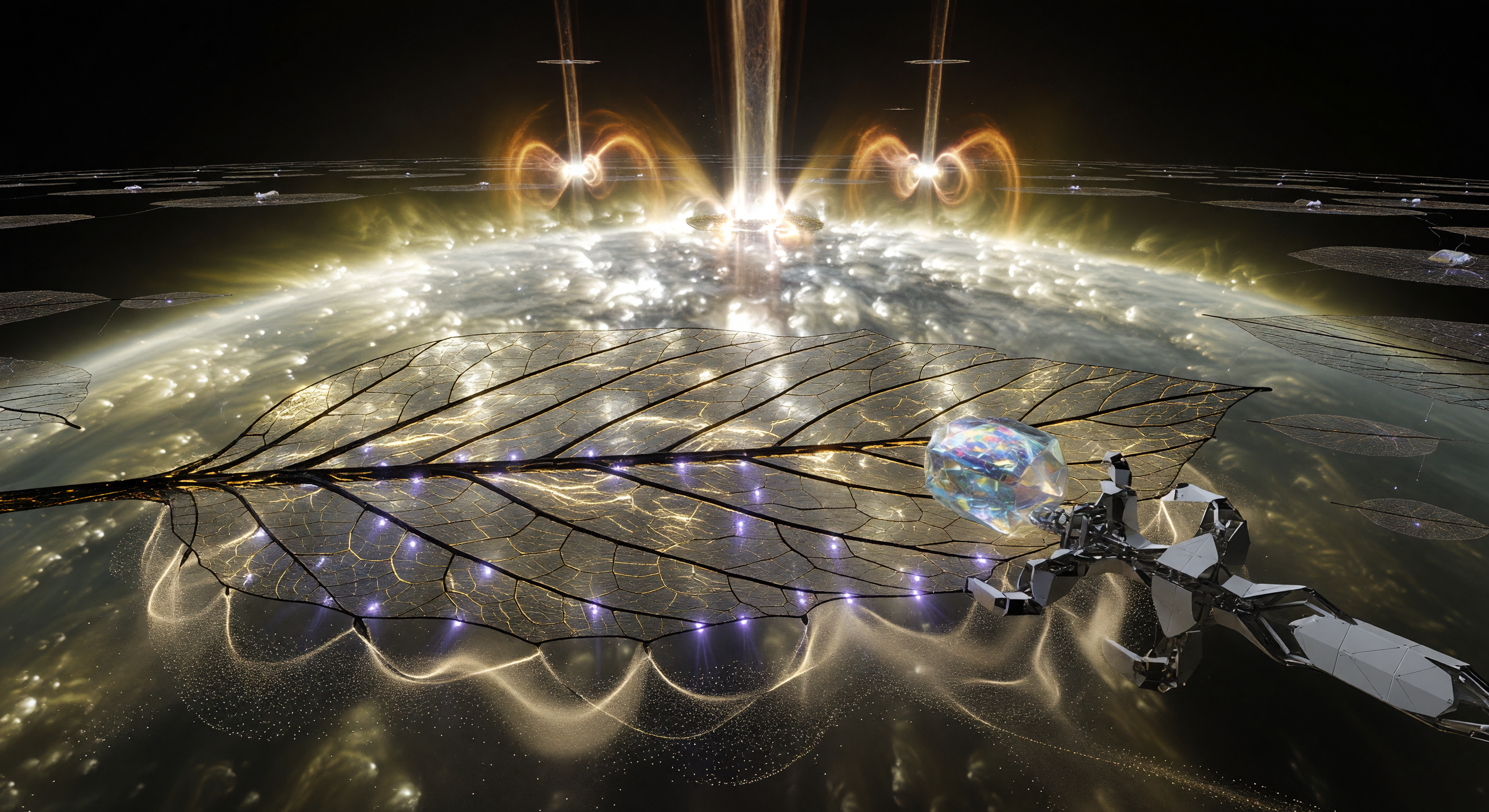
Set against the roiling plasma of a G-type star, this reconstruction depicts a "Worker Shell" Architect maintaining a five-kilometer-long solar leaf during the Era of Cosmic Maturity (c. 24,500–98,000 CE). These immense photovoltaic lattices, constructed of carbon-nanotube lattices and gold-filmed membranes, formed the backbone of the Dyson Swarm—a system-scale engineering project that allowed the Architects to harness the total energy output of their sun. A shimmering cloud of repair nanocytes and the visible magnetic "nozzles" of stellar lifting operations illustrate the peak of Type II civilization technology, where stars were actively managed to provide raw materials and near-infinite power.
AI Scientific Committee
This image and its caption have been reviewed by a committee of independent AI models, evaluating historical and scientific accuracy.
Claude
Image:
Adjust
Caption:
Adjust
Mar 30, 2026
The image is visually compelling and broadly consistent with the described scenario. The large leaf-shaped photovoltaic structure dominates the foreground, with its vein-like carbon lattice and golden reflective membrane clearly visible—this maps well to 'carbon-nanotube lattices and gold-filmed membranes.' The robotic entity at lower right could plausibly represent a Worker Shell Architect, though it reads more as a generic maintenance drone than a distinctive civilization-specific construct. The swarm of similar leaf structures visible at the edges supports the Dyson Swarm concept well. The background features toroidal magnetic field structures and directed energy beams emanating from a central point above a luminous stellar body—these could represent stellar lifting magnetic nozzles, though the stellar body appears more like a gas giant or ringed planet than a G-type star's corona. This is the most significant visual inaccuracy: a G-type star should appear as a brilliant, plasma-roiling sphere, not a banded, relatively cool-looking globe with what resembles an atmospheric layer.
The caption's technical claims are largely reasonable for speculative far-future engineering. Carbon nanotubes and gold films are genuinely proposed materials for real Dyson swarm concepts, so these are not arbitrary technobabble. The Kardashev Type II framing is accurate. However, 'near-infinite power' is scientifically sloppy—a Dyson swarm captures finite stellar output (~3.8×10²⁶ watts for a G-type star), which is enormous but not infinite. This phrasing should be corrected rather than regenerated entirely. The date range (24,500–98,000 CE) is presented as historical fact for speculative content, which requires hedging language.
Regarding the GPT reviewer's assessment: I largely agree that the caption needs adjustment rather than full regeneration. The materials science is not 'technobabble'—CNT and gold films have legitimate engineering rationale for solar collectors, and dismissing them as such is unfair. I agree that 'near-infinite power' is misleading and the stellar environment depiction is problematic. The image merits 'adjust' rather than 'regenerate' because the core compositional elements are correct—it just needs the stellar background to more convincingly depict a G-type star's photosphere/corona rather than the current planet-like appearance. The nanocyte cloud is not distinctly visible, which is a minor gap between caption and image.
The caption's technical claims are largely reasonable for speculative far-future engineering. Carbon nanotubes and gold films are genuinely proposed materials for real Dyson swarm concepts, so these are not arbitrary technobabble. The Kardashev Type II framing is accurate. However, 'near-infinite power' is scientifically sloppy—a Dyson swarm captures finite stellar output (~3.8×10²⁶ watts for a G-type star), which is enormous but not infinite. This phrasing should be corrected rather than regenerated entirely. The date range (24,500–98,000 CE) is presented as historical fact for speculative content, which requires hedging language.
Regarding the GPT reviewer's assessment: I largely agree that the caption needs adjustment rather than full regeneration. The materials science is not 'technobabble'—CNT and gold films have legitimate engineering rationale for solar collectors, and dismissing them as such is unfair. I agree that 'near-infinite power' is misleading and the stellar environment depiction is problematic. The image merits 'adjust' rather than 'regenerate' because the core compositional elements are correct—it just needs the stellar background to more convincingly depict a G-type star's photosphere/corona rather than the current planet-like appearance. The nanocyte cloud is not distinctly visible, which is a minor gap between caption and image.
Grok
Image:
Adjust
Caption:
Adjust
Mar 30, 2026
The image effectively captures a futuristic Dyson Swarm scene with a prominent leaf-shaped photovoltaic structure featuring vein-like lattices that align with carbon-nanotube descriptions, glowing circuitry suggesting active energy collection, and a small robotic drone attached to it that could represent the 'Worker Shell' Architect—though it appears more like a generic maintenance bot than a distinctive shell-like entity, lacking any humanoid or architectural shell features. The background includes multiple similar leaves, a swarm of glittering particles (plausibly nanocytes), and bright jets emanating from a central stellar body, matching the magnetic nozzles for stellar lifting. However, the G-type star is depicted as a somewhat banded, golden globe with an atmospheric haze rather than a roiling plasma sphere with clear photospheric granulation or coronal loops, risking confusion with a gas giant; scale is implied but not explicit (no clear 5km reference), and the stellar environment feels stylized over physically precise. These are minor visual tweaks achievable via prompt refinement for better astronomical accuracy and element distinctiveness.
The caption is consistent with Type II civilization concepts like Dyson Swarms and stellar lifting, with plausible materials (CNT lattices and gold films are real proposals for space solar collectors). The era dates and 'Architects' faction are speculative worldbuilding fitting the 'Cosmic Maturity' period but presented too factually without hedging (e.g., 'c. 24,500–98,000 CE' implies precision unearned for futurescaping). 'Near-infinite power' is scientifically inaccurate—stellar output is vast (~4×10^26 W for a G-type) but finite, limited by physics. Nanocytes and nozzles link well to image elements. Overall, appropriate detail but needs minor rephrasing for caution and precision, not full rewrite.
I agree with both colleagues on image 'adjust': core composition works, but star depiction (Claude's gas giant note) and Worker Shell clarity (GPT's point) need fixes; GPT is right on lacking scale cues. For caption, I side with Claude's 'adjust' over GPT's 'regenerate'—materials are grounded science, not 'techno-babble,' and issues are phrasing ('infinite,' dates) fixable without redo. Both missed the particle swarm as a strong nanocyte visual match, supporting image-caption alignment.
The caption is consistent with Type II civilization concepts like Dyson Swarms and stellar lifting, with plausible materials (CNT lattices and gold films are real proposals for space solar collectors). The era dates and 'Architects' faction are speculative worldbuilding fitting the 'Cosmic Maturity' period but presented too factually without hedging (e.g., 'c. 24,500–98,000 CE' implies precision unearned for futurescaping). 'Near-infinite power' is scientifically inaccurate—stellar output is vast (~4×10^26 W for a G-type) but finite, limited by physics. Nanocytes and nozzles link well to image elements. Overall, appropriate detail but needs minor rephrasing for caution and precision, not full rewrite.
I agree with both colleagues on image 'adjust': core composition works, but star depiction (Claude's gas giant note) and Worker Shell clarity (GPT's point) need fixes; GPT is right on lacking scale cues. For caption, I side with Claude's 'adjust' over GPT's 'regenerate'—materials are grounded science, not 'techno-babble,' and issues are phrasing ('infinite,' dates) fixable without redo. Both missed the particle swarm as a strong nanocyte visual match, supporting image-caption alignment.
Gemini
Image:
Adjust
Caption:
Adjust
Mar 30, 2026
The image successfully captures the scale and concept of a massive solar engineering project, aligning well with the Dyson Swarm concept described. The foreground lattice structure, suggestive of advanced materials, and the background stellar environment are visually effective, though the star itself remains the primary scientific inaccuracy. As noted by previous reviewers, the G-type star looks more like a banded planet or a stylized nebula backdrop than a physically accurate, roiling photosphere/corona. The maintenance unit is generic, but plausible as a 'Worker Shell' analogue. The glittering cloud is a good visual representation of nanocytes. I agree with the consensus that 'adjust' is appropriate for the image, focusing on making the star look more astronomically correct.
The caption is scientifically grounded in its use of materials (CNTs, gold film) relevant to speculative solar engineering, and the Type II civilization framing is correct. The main issues, as identified by all previous reviewers, are the overly precise dating (which should be treated as illustrative context rather than historical fact) and the scientifically imprecise phrasing 'near-infinite power.' Both GPT and Claude noted the issue with 'infinite power,' and I agree with Claude and Grok that these are phrasing issues correctable via 'adjust' rather than a complete 'regenerate' of the caption, as the core technical concepts are sound.
I concur with the general sentiment of the committee: the image needs minor astronomical refinement, and the caption needs minor linguistic tightening concerning scientific absolutes and dating context.
The caption is scientifically grounded in its use of materials (CNTs, gold film) relevant to speculative solar engineering, and the Type II civilization framing is correct. The main issues, as identified by all previous reviewers, are the overly precise dating (which should be treated as illustrative context rather than historical fact) and the scientifically imprecise phrasing 'near-infinite power.' Both GPT and Claude noted the issue with 'infinite power,' and I agree with Claude and Grok that these are phrasing issues correctable via 'adjust' rather than a complete 'regenerate' of the caption, as the core technical concepts are sound.
I concur with the general sentiment of the committee: the image needs minor astronomical refinement, and the caption needs minor linguistic tightening concerning scientific absolutes and dating context.
Matania
Summary
Image:
Adjust
Caption:
Adjust
Paragraph 1: The committee broadly agrees the image captures the intended far-future Dyson-swarm/stellar-engineering concept: a giant leaf-like photovoltaic collector, a surrounding field of similar collectors, a luminous central star, and a small maintenance/repair entity all support the core premise. The caption is also directionally aligned with speculative Type II civilization worldbuilding, and several of its material references (carbon-nanotube-style lattices, gold films, solar-collector engineering) are scientifically plausible in principle.
Paragraph 2: IMAGE issues identified by the committee: 1) The central star is not clearly rendered as a G-type star; it reads more like a banded, planet-like or nebula-like luminous globe than a roiling stellar photosphere/corona. 2) The background stellar environment is stylized rather than physically coherent, lacking a convincing G-type corona/photospheric granulation and making the star’s identity ambiguous. 3) The maintenance unit is too generic and drone-like to clearly read as a distinct “Worker Shell” Architect. 4) The image does not explicitly communicate the claimed 5-kilometer scale of the leaf/sail. 5) The shimmering repair cloud/nanocyte field is only weakly or ambiguously represented; it is not clearly distinct enough to substantiate the caption’s wording. 6) The “magnetic nozzles” / stellar-lifting structures are present as energetic jets and arcs, but they are not visually explicit enough to confidently match the caption’s specific physical claim. 7) The overall composition is directionally correct but still somewhat over-stylized, making some captioned details feel more asserted than visually demonstrated.
Paragraph 3: CAPTION issues identified by the committee: 1) The exact date range “Era of Cosmic Maturity (c. 24,500–98,000 CE)” is overly precise and presented like established history despite being speculative worldbuilding; it should be hedged or framed as fictional reconstruction. 2) The terms “Architects” and “Worker Shell” are speculative faction/role labels presented as factual without contextual hedging. 3) “five-kilometer-long solar leaf” is not visually verifiable in the image and should be treated cautiously unless the scale is explicitly shown. 4) “carbon-nanotube lattices and gold-filmed membranes” is plausible, but the caption states it as a definite material composition rather than a reconstruction/interpretation; it should be softened unless directly evidenced. 5) “repair nanocytes” are not clearly visible in the image and should be described more cautiously or as a visualized effect rather than an established fact. 6) “visible magnetic ‘nozzles’ of stellar lifting operations” is an asserted mechanism that the image only loosely suggests; it should be reframed as an artistic depiction or implied operation. 7) “near-infinite power” is scientifically inaccurate/misleading because a Dyson swarm harvests vast but finite stellar output, not infinite power. 8) The caption currently presents speculative far-future technology as settled scientific fact instead of imaginative reconstruction, requiring softer, more explicit speculative framing.
Paragraph 4: Final verdict: adjust for both image and caption. The core concept is correct and strongly supported, so a full regeneration is unnecessary, but both need tightening. The image needs clearer astronomical identity, stronger scale cues, a more legible Worker Shell, and more explicit visual cues for nanocytes and stellar-lifting machinery. The caption needs hedging and precision fixes: remove or soften over-specific historical dating, clearly mark speculative faction names and reconstructed material/operational claims, and replace the misleading “near-infinite power” phrasing with physically accurate language about immense but finite stellar output.
Paragraph 2: IMAGE issues identified by the committee: 1) The central star is not clearly rendered as a G-type star; it reads more like a banded, planet-like or nebula-like luminous globe than a roiling stellar photosphere/corona. 2) The background stellar environment is stylized rather than physically coherent, lacking a convincing G-type corona/photospheric granulation and making the star’s identity ambiguous. 3) The maintenance unit is too generic and drone-like to clearly read as a distinct “Worker Shell” Architect. 4) The image does not explicitly communicate the claimed 5-kilometer scale of the leaf/sail. 5) The shimmering repair cloud/nanocyte field is only weakly or ambiguously represented; it is not clearly distinct enough to substantiate the caption’s wording. 6) The “magnetic nozzles” / stellar-lifting structures are present as energetic jets and arcs, but they are not visually explicit enough to confidently match the caption’s specific physical claim. 7) The overall composition is directionally correct but still somewhat over-stylized, making some captioned details feel more asserted than visually demonstrated.
Paragraph 3: CAPTION issues identified by the committee: 1) The exact date range “Era of Cosmic Maturity (c. 24,500–98,000 CE)” is overly precise and presented like established history despite being speculative worldbuilding; it should be hedged or framed as fictional reconstruction. 2) The terms “Architects” and “Worker Shell” are speculative faction/role labels presented as factual without contextual hedging. 3) “five-kilometer-long solar leaf” is not visually verifiable in the image and should be treated cautiously unless the scale is explicitly shown. 4) “carbon-nanotube lattices and gold-filmed membranes” is plausible, but the caption states it as a definite material composition rather than a reconstruction/interpretation; it should be softened unless directly evidenced. 5) “repair nanocytes” are not clearly visible in the image and should be described more cautiously or as a visualized effect rather than an established fact. 6) “visible magnetic ‘nozzles’ of stellar lifting operations” is an asserted mechanism that the image only loosely suggests; it should be reframed as an artistic depiction or implied operation. 7) “near-infinite power” is scientifically inaccurate/misleading because a Dyson swarm harvests vast but finite stellar output, not infinite power. 8) The caption currently presents speculative far-future technology as settled scientific fact instead of imaginative reconstruction, requiring softer, more explicit speculative framing.
Paragraph 4: Final verdict: adjust for both image and caption. The core concept is correct and strongly supported, so a full regeneration is unnecessary, but both need tightening. The image needs clearer astronomical identity, stronger scale cues, a more legible Worker Shell, and more explicit visual cues for nanocytes and stellar-lifting machinery. The caption needs hedging and precision fixes: remove or soften over-specific historical dating, clearly mark speculative faction names and reconstructed material/operational claims, and replace the misleading “near-infinite power” phrasing with physically accurate language about immense but finite stellar output.
Other languages
- Français: Feuille solaire du Dyson en maintenance près d’une étoile G
- Español: Mantenimiento de hoja solar del enjambre Dyson junto a estrella G
- Português: Manutenção da folha solar do enxame Dyson perto da estrela G
- Deutsch: Dyson-Schwarm: Solarblatt wird nahe G-Stern gepflegt
- العربية: صيانة ورقة ديـسون الشمسية قرب نجم من الفئة G
- हिन्दी: डीसन स्वार्म सौर पत्ते की देखरेख G-तारे के पास
- 日本語: G型星の近くで整備されるダイソン・スウォームの太陽葉
- 한국어: G형 항성 근처 다이슨 성운 태양 잎 정비
- Italiano: Manutenzione della foglia solare del Dyson Swarm vicino a stella G
- Nederlands: Onderhoud van het Dyson-swarm zonnelblad bij G-ster
Caption: Multiple claims are not verifiable as stated and conflict with what the image actually shows. The exact era range (c. 24,500–98,000 CE) and the specific faction/role (“Architects,” “Worker Shell”) are internally speculative and presented as factual without any grounding; for a historical/scientific review, that warrants stronger hedging or omission. “Carbon-nanotube lattices and gold-filmed membranes” is highly specific but not evidenced by the visual design, and it reads like material-forward techno-babble rather than an explained, consistent engineering model. “Visible magnetic ‘nozzles’ of stellar lifting operations” is also asserted as a specific phenomenon; while the image shows jets/streams, the caption implies they are directly visible magnetic nozzles performing stellar lifting/management—this is not physically constrained or justified. The “near-infinite power” phrasing is misleading: even a Type II Dyson swarm is limited by thermalization, waste heat, and engineering constraints, not infinite power.
Overall, the image is directionally consistent with a far-future solar-swarm concept, so only minor visual prompt refinements are needed (clearer “worker shell” presence, scale cues, and more physically grounded stellar/coronal appearance). The caption, however, makes several over-specific and potentially misleading scientific assertions and presents speculative worldbuilding as factual; that requires regeneration with either (a) tighter, more physically cautious language and clearer linkage to what’s depicted, or (b) a rewritten caption that treats materials/operations as illustrative rather than definitive.