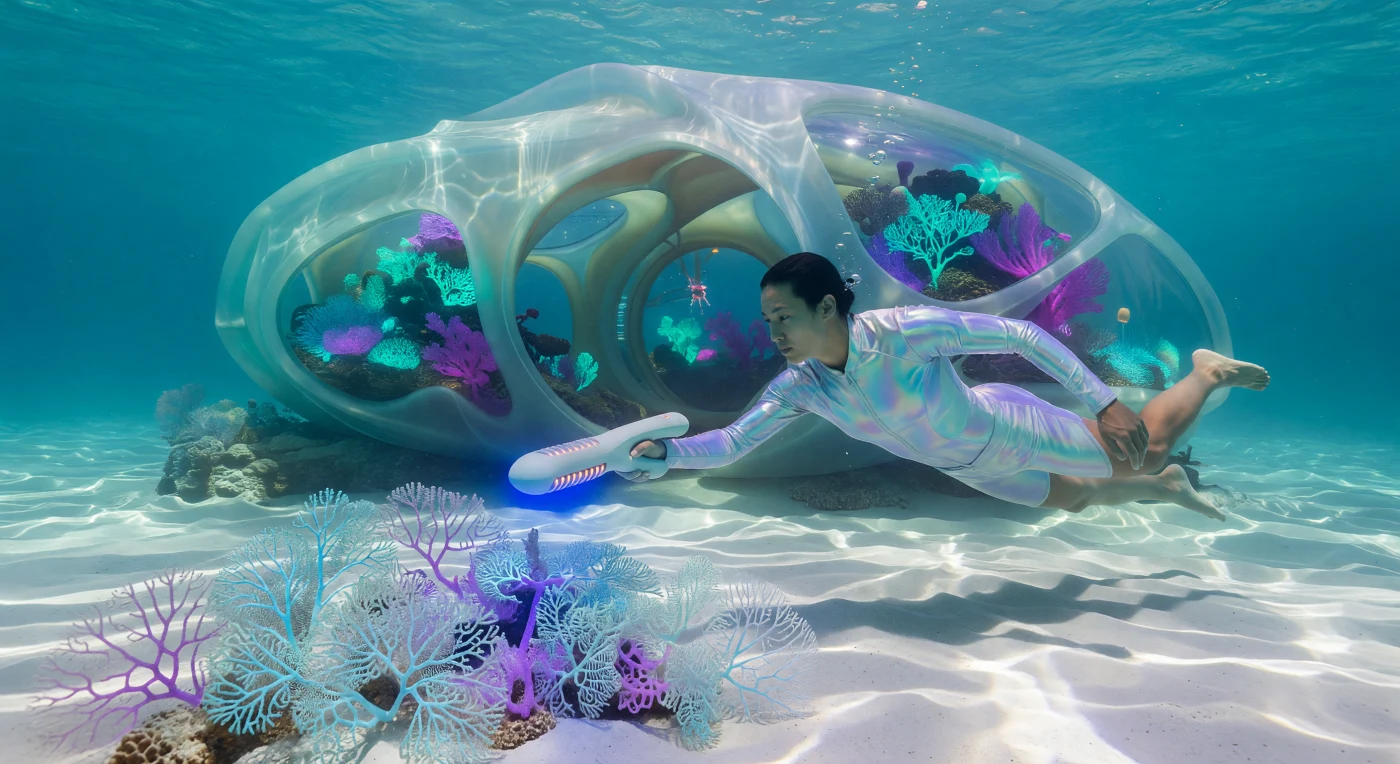
Set during the era of Cosmic Maturity (approximately 20,000–100,000 CE), this scene illustrates the pinnacle of Ontological Engineering where architecture and biology converge. A 50-meter Symbiont Pod residence, grown from the planetary crust via ultrasonic Lithic Grafting, glows with violet bioluminescence under the dual light of a binary star system. In the foreground, post-human inhabitants—physically adapted for low-gravity environments—interact with haptic interfaces amidst a grove of data-storing, genetically engineered flora. This period marks the transition from planetary exploitation to stellar stewardship, characterized by structures like the distant Stellar Ring and Gravity Spire that seamlessly integrate civilization into the cosmic landscape.

Deep within a planetary crust during the era of Cosmic Maturity (c. 20,000–100,000 CE), this sub-tectonic refinery demonstrates the pinnacle of Ontological Engineering where geology and technology converge. The chamber, carved from self-repairing Programmable Basalt and powered by pulsing conduits of liquid chrome, houses a massive Femto-Assembly array that disassembles raw asteroid matter at the sub-atomic level. Post-human Maintenance Custodians, specialized for high-pressure environments with iridescent carbon-nanotube skin and magnetic-flux sensors, navigate the gargantuan vault to oversee the conversion of cosmic debris into the essential building blocks of a star-faring civilization.
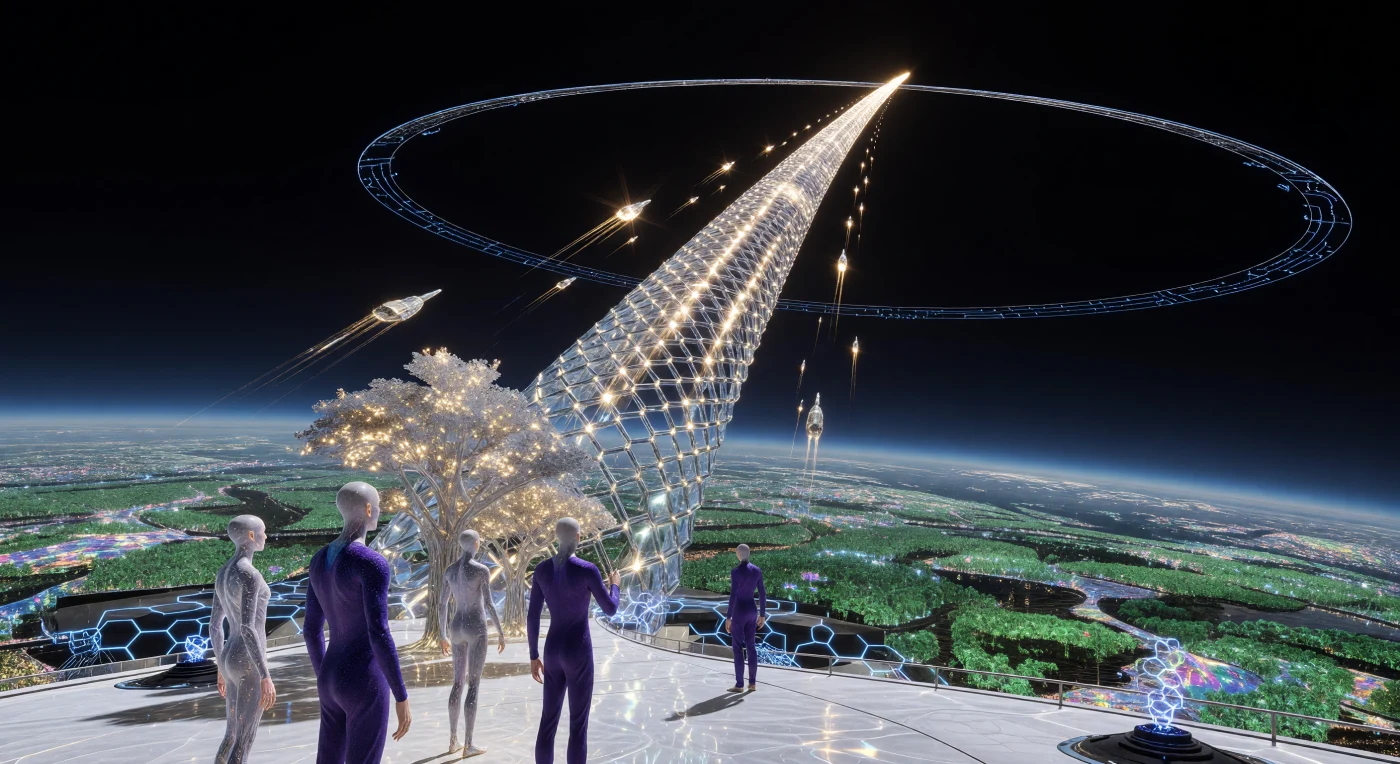
In the era of Cosmic Maturity (20,000–100,000 CE), the transition from planetary civilization to stellar stewardship is epitomized by the Gravity Spire, a monumental tether of nucleated diamondoid stretching 384,400 kilometers to connect the Earth and Moon. From a floating Synthesis Plaza in the mesosphere, post-human observers—biologically adapted with neural filaments and translucent skin—overlook a transformed Earth where bioluminescent emerald forests and a planetary "Rhizome Grid" have replaced traditional urban centers. This scene illustrates the pinnacle of Ontological Engineering, where the boundaries between biological life, crystalline technology, and planetary geology have entirely dissolved.

Set during the Era of Cosmic Maturity (approximately 20,000–100,000 CE), this scene illustrates the pinnacle of ontological engineering: a five-kilometer Neural Observatory suspended above a shifting Synthesis Plaza. The structure, composed of light-absorbing Void-Glass, looms over a landscape where post-human "Sylphs" navigate a shimmering Flux-Bridge of magnetic force. These specialized beings exhibit bioluminescent neural networks and iridescent sensory bands, reflecting the advanced biological integration of this future epoch. Above, an artificial Magnetospheric Shell diffuses starlight into a vibrant emerald and gold aurora, highlighting the seamless blend of planetary stewardship and monumental architecture.

This reconstruction of a Synthesis Plaza during the Era of Cosmic Maturity (c. 20,000–100,000 CE) illustrates the pinnacle of ontological engineering on a low-gravity moon within a binary star system. Post-human inhabitants with bioluminescent neural networks and crystalline Void-Glass entities traverse a rippling, non-Newtonian Neo-Quartz floor, flanked by towering spires of Programmable Basalt that shift their geometry for thermal regulation. Overhead, a Hard-Light ceiling projects a volumetric view of the Andromeda Galaxy, casting a soft violet glow over a civilization that has seamlessly merged biological evolution with stellar-scale architecture.

In the Era of Cosmic Maturity (c. 20,000–100,000 CE), the boundary between biology and architecture dissolved through the practice of ontological engineering. This scene depicts a "Vertical Orchard," a three-kilometer-wide mass of genetically engineered vegetation held aloft by internal hydrogen bladders and tethered to the planet by diamondoid vines that wick nutrients upward in glowing streams. Post-biological Harvesters, featuring carbon-lattice frames and multispectral sensors, navigate these floating monoliths to prune and maintain the ecosystem, representing a pinnacle of stellar stewardship where planetary resources are managed with surgical precision.

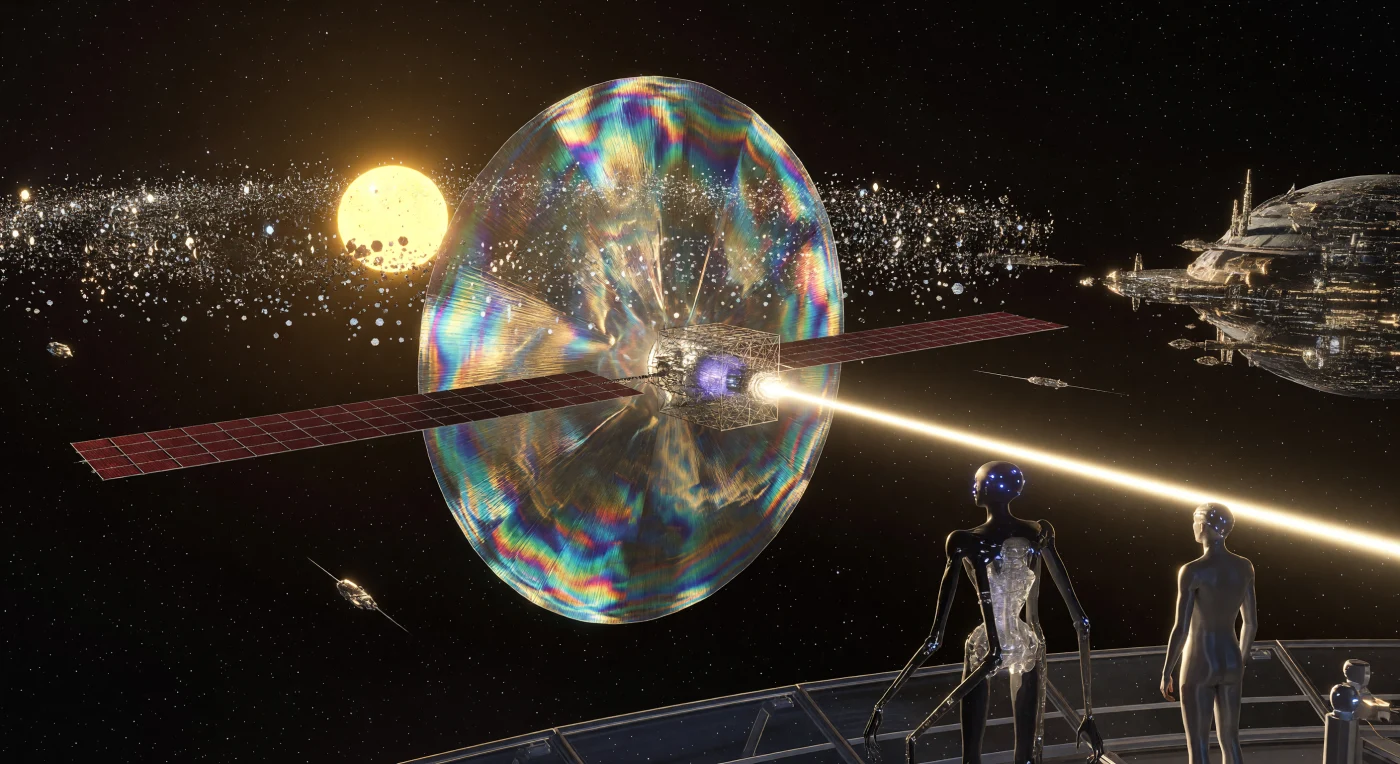
This view from the inner surface of the Aethelgard Ring illustrates the scale of stellar stewardship during the Era of Cosmic Maturity (20,000–100,000 CE). The horizon curves upward into a 1,000-kilometer-wide ribbon of nucleated diamondoid, powered by the central G-type star and maintained by laser-based construction arrays known as the Architect’s Loom. On the Synthesis Plaza below, post-human inhabitants—biologically optimized for the ring's 0.8g environment—interact with living Symbiont Pods and floating genetically engineered flora, demonstrating the seamless integration of biology and advanced materials science.

Set during the Era of Cosmic Maturity (approximately 20,000–100,000 CE), this scene depicts post-human travelers of the Sylvan-Crystalline lineage crossing a Flux-Bridge of shimmering magnetic force between two High-Synthesis spires. These monolithic structures, anchored into the walls of a ten-kilometer-deep canyon, utilize Photon-Trapped Glass and Programmable Basalt to harvest and store solar energy from the binary suns above. This landscape illustrates a pinnacle of ontological engineering, where bioluminescent mycelium and genetically modified teal forests form a living planetary network that bridges the gap between artificial architecture and the natural world.