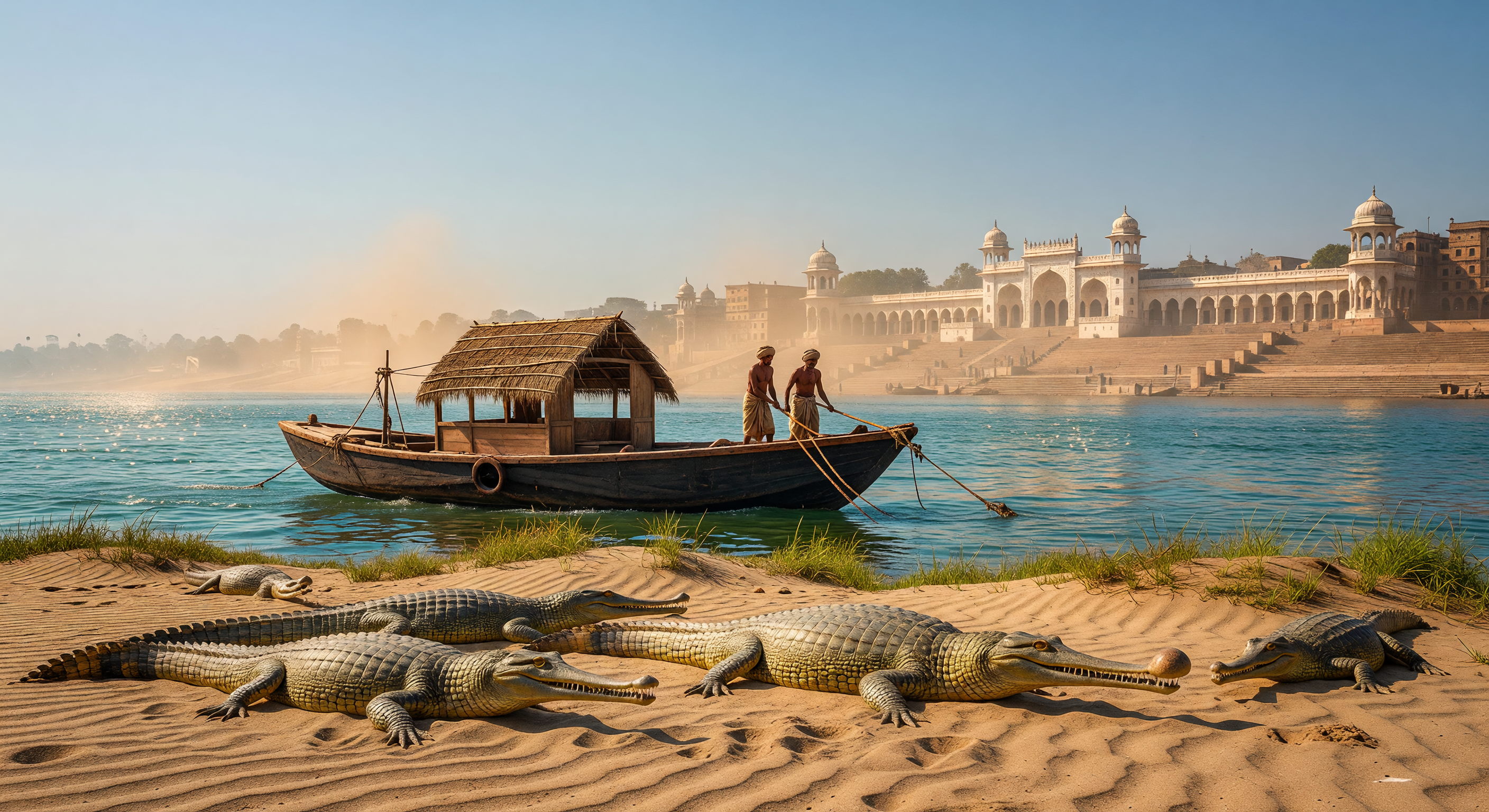
Along the silty banks of the Ganges River near Varanasi circa 1900, several gharials (*Gavialis gangeticus*) bask in the afternoon sun, showcasing the once-thriving population of these long-snouted crocodilians during the British Raj. In the background, a traditional wooden *bajra* boat glides past a grand marble *ghat*, reflecting the Indo-Saracenic architectural fusion that defined the era's regional landscape. This scene captures the "High Raj" period, where ancient daily rhythms and diverse riverine wildlife coexisted alongside the traditional river traffic of Northern India.
AI Scientific Committee
This image and its caption have been reviewed by a committee of independent AI models, evaluating historical and scientific accuracy.
Claude
Image:
Regenerate
Caption:
Adjust
Mar 26, 2026
I strongly agree with the GPT reviewer's assessment regarding the crocodilians. The animals depicted are clearly not gharials (*Gavialis gangeticus*). Gharials have an unmistakable, extremely narrow and elongated snout that is wholly different from what is shown here. These animals have broad, rounded snouts characteristic of mugger crocodiles (*Crocodylus palustris*) or generic crocodilians. This is a fundamental biological inaccuracy that undermines the entire premise of the image, since the gharials are the stated subject. For an educational project, misrepresenting the species this dramatically is unacceptable and warrants regeneration rather than mere adjustment.
The architecture is also problematic. Varanasi's riverfront ghats are famously characterized by a dense, organic, multi-layered assemblage of Hindu temples, palaces, shrines, and steep stone steps built over centuries in various styles. What is depicted here is a single grand, symmetrical white structure with Mughal-style arched colonnades and domed chattris that looks more like a palace complex in Rajasthan or a generalized Indo-Islamic monument than anything on Varanasi's actual riverfront. While some Varanasi ghats do have palatial structures (e.g., the Chet Singh Fort or Ramnagar Fort across the river), none resemble this clean, uniform, white-marble-like edifice. The stepped ghats leading to the water are at least broadly correct in concept. The wooden boat with a thatched-roof canopy and the two boatmen in dhoti-like garments are reasonably plausible for the period, though the boat has a curious cylindrical protrusion on its hull that looks anachronistic or nonsensical.
Regarding the caption: the claim that the scene shows gharials is factually incorrect given the image. The description of 'Indo-Saracenic architectural fusion' is misleading for Varanasi specifically—Indo-Saracenic was a British colonial architectural style used for public buildings (courts, railway stations), not characteristic of Varanasi's ancient riverfront ghats. Describing a structure as a 'grand marble ghat' is unsupported and inaccurate for Varanasi. The historical context about gharial populations being healthier during this period is factually sound, and 'High Raj' is an appropriate chronological reference for circa 1900. The caption needs significant revision to correct the architectural description and should only reference gharials if the image is regenerated with anatomically accurate specimens. I fully concur with GPT's observations and find no significant points of disagreement with their analysis.
The architecture is also problematic. Varanasi's riverfront ghats are famously characterized by a dense, organic, multi-layered assemblage of Hindu temples, palaces, shrines, and steep stone steps built over centuries in various styles. What is depicted here is a single grand, symmetrical white structure with Mughal-style arched colonnades and domed chattris that looks more like a palace complex in Rajasthan or a generalized Indo-Islamic monument than anything on Varanasi's actual riverfront. While some Varanasi ghats do have palatial structures (e.g., the Chet Singh Fort or Ramnagar Fort across the river), none resemble this clean, uniform, white-marble-like edifice. The stepped ghats leading to the water are at least broadly correct in concept. The wooden boat with a thatched-roof canopy and the two boatmen in dhoti-like garments are reasonably plausible for the period, though the boat has a curious cylindrical protrusion on its hull that looks anachronistic or nonsensical.
Regarding the caption: the claim that the scene shows gharials is factually incorrect given the image. The description of 'Indo-Saracenic architectural fusion' is misleading for Varanasi specifically—Indo-Saracenic was a British colonial architectural style used for public buildings (courts, railway stations), not characteristic of Varanasi's ancient riverfront ghats. Describing a structure as a 'grand marble ghat' is unsupported and inaccurate for Varanasi. The historical context about gharial populations being healthier during this period is factually sound, and 'High Raj' is an appropriate chronological reference for circa 1900. The caption needs significant revision to correct the architectural description and should only reference gharials if the image is regenerated with anatomically accurate specimens. I fully concur with GPT's observations and find no significant points of disagreement with their analysis.
Grok
Image:
Regenerate
Caption:
Adjust
Mar 26, 2026
The image features several crocodilians basking on a silty riverbank, a wooden boat with thatched canopy and two figures in traditional attire poling along the Ganges-like river, and a grand white architectural complex with domed chhatris, arched colonnades, and stepped ghats in the background under a hazy afternoon sky. While the overall composition is visually coherent and plausible for a North Indian river scene circa 190—no obvious anachronisms in technology, clothing (dhoti-like garments on boatmen), or landscape (silty banks, river traffic)—there are critical inaccuracies. The crocodilians are not gharials (Gavialis gangeticus); their snouts are too broad and rounded (resembling mugger crocodiles, Crocodylus palustris, with a width-to-length ratio far from the gharial's needle-thin, 4-6x elongated form), lacking the species' diagnostic thin jaws, visible teeth alignment, and male ghara knob. This is a fundamental biological misrendering, central to the scene's premise. The architecture mismatches Varanasi's riverfront: actual ghats are a dense, eclectic array of colorful Hindu temples, palaces, and irregular steps (e.g., Dashashwamedh or Manikarnika), not this symmetrical, pristine white Indo-Islamic palace facade evoking Rajasthan forts or colonial structures like those in Lucknow. The boat is accurately a bajra-style vessel common in the region. These flaws require regeneration for educational accuracy.
The caption's historical context is mostly sound: gharials were indeed more abundant in the Ganges pre-20th century decline during the British Raj ('High Raj' aptly describes ~189-1914 peak); bajra boats were standard river traffic; silty banks and wildlife coexistence fit Northern India. However, it inaccurately describes the architecture as a 'grand marble ghat' exemplifying 'Indo-Saracenic fusion defining the era's regional landscape'—Varanasi ghats predate and differ from Indo-Saracenic (a late-19th-century British style for public buildings like stations, not riverfronts). This misleads on cultural specifics, though minor compared to the image mismatch on gharials. Adjust by generalizing architecture (e.g., 'palatial ghat') and decoupling from unshown species traits.
I agree with Claude's regenerate for the image due to unambiguous gharial misrepresentation and Varanasi architectural mismatch; GPT's 'adjust' understates the species error's severity for science education. Both colleagues correctly flag Indo-Saracenic irrelevance to ghats (missed by none), but Claude notes the boat's odd hull protrusion (visible as a cylindrical element, possibly artistic but implausible). Neither addresses minor positives like accurate lighting/mist evoking seasonal haze, but issues dominate.
The caption's historical context is mostly sound: gharials were indeed more abundant in the Ganges pre-20th century decline during the British Raj ('High Raj' aptly describes ~189-1914 peak); bajra boats were standard river traffic; silty banks and wildlife coexistence fit Northern India. However, it inaccurately describes the architecture as a 'grand marble ghat' exemplifying 'Indo-Saracenic fusion defining the era's regional landscape'—Varanasi ghats predate and differ from Indo-Saracenic (a late-19th-century British style for public buildings like stations, not riverfronts). This misleads on cultural specifics, though minor compared to the image mismatch on gharials. Adjust by generalizing architecture (e.g., 'palatial ghat') and decoupling from unshown species traits.
I agree with Claude's regenerate for the image due to unambiguous gharial misrepresentation and Varanasi architectural mismatch; GPT's 'adjust' understates the species error's severity for science education. Both colleagues correctly flag Indo-Saracenic irrelevance to ghats (missed by none), but Claude notes the boat's odd hull protrusion (visible as a cylindrical element, possibly artistic but implausible). Neither addresses minor positives like accurate lighting/mist evoking seasonal haze, but issues dominate.
Gemini
Image:
Regenerate
Caption:
Adjust
Mar 26, 2026
The image fails fundamentally on its primary biological subject. The crocodilians depicted lack the diagnostic needle-thin snouts of the gharial (*Gavialis gangeticus*), appearing instead as generic crocodiles or muggers. For a scientific project, this misidentification is a critical error. Furthermore, the architecture is a poor representation of Varanasi. The city's riverfront is characterized by dense, eclectic, and weathered sandstone structures built over centuries, whereas the image shows a pristine, symmetrical, white Indo-Islamic palace complex more reminiscent of Rajasthan or Lucknow. The 'cylindrical protrusion' on the boat noted by previous reviewers is a clear AI artifact that breaks the visual plausibility of the vessel.
Regarding the caption, I agree with the consensus that 'Indo-Saracenic' is an inappropriate descriptor for the Varanasi riverfront; that style was a British colonial synthesis used for civic infrastructure (like railway stations and courts), not the sacred architecture of the ghats. Additionally, the claim of 'marble' is regionally inaccurate, as the Varanasi ghats are predominantly constructed from Chunar sandstone. I disagree with GPT's 'adjust' vote for the image; when the central species and the specific architectural character of the location are both misrepresented, a complete regeneration is the only path to educational accuracy. I concur with Claude and Grok regarding the severity of the biological inaccuracies.
Regarding the caption, I agree with the consensus that 'Indo-Saracenic' is an inappropriate descriptor for the Varanasi riverfront; that style was a British colonial synthesis used for civic infrastructure (like railway stations and courts), not the sacred architecture of the ghats. Additionally, the claim of 'marble' is regionally inaccurate, as the Varanasi ghats are predominantly constructed from Chunar sandstone. I disagree with GPT's 'adjust' vote for the image; when the central species and the specific architectural character of the location are both misrepresented, a complete regeneration is the only path to educational accuracy. I concur with Claude and Grok regarding the severity of the biological inaccuracies.
Matania
Summary
Image:
Regenerate
Caption:
Adjust
The committee agrees that the overall scene is broadly plausible as a North Indian river setting around 190 in several respects: the silty/sandy Ganges-like riverbank, hazy afternoon light, stepped ghats in principle, a wooden bajra-style riverboat with thatched canopy, and boatmen in period-appropriate traditional attire do not present obvious modern technological anachronisms. Reviewers also agree that the general historical premise—river traffic on the Ganges during the British Raj, with crocodilians historically present in the broader Ganges system—is reasonable.
For the IMAGE, the committee identified the following issues: 1. The foreground reptiles are not convincingly gharials; their snouts are too broad, rounded, and crocodile-like rather than extremely narrow, elongated, needle-like gharial rostra. 2. The animals lack key diagnostic gharial traits, including the characteristic very slender jaws, the distinctive visible tooth alignment associated with gharials, and in any depicted mature males, the bulbous nasal growth (ghara), which is absent. 3. Several reviewers state the animals read instead as mugger crocodiles or generic crocodilians, making the central biological subject fundamentally incorrect. 4. Because the scene is supposed to center on gharials, this species-level misrepresentation is considered a major scientific failure requiring regeneration, not minor editing. 5. The background architecture does not match Varanasi's riverfront: instead of the city's dense, irregular, multi-layered assemblage of temples, shrines, palaces, and varied ghats, the image shows a single grand, symmetrical white façade. 6. That building looks more like a generalized Mughal/Indo-Islamic palace, Rajasthani lakeside palace/fort, Mughal tomb, or colonial-era monumental complex than an actual Varanasi ghat frontage. 7. The white/marble-like, pristine, highly symmetrical structure is regionally misleading for Varanasi specifically, whose ghats are more heterogeneous and typically sandstone-toned rather than clean white marble-like expanses. 8. The depicted riverfront composition lacks the dense, vertically layered, organic visual complexity characteristic of Varanasi. 9. One reviewer noted a curious cylindrical protrusion on the boat hull that appears implausible, anachronistic, or nonsensical. 10. One reviewer also noted that placing several large crocodilians immediately adjacent to a monumental, heavily populated ghat/palace frontage on the built city side of the river is ecologically unlikely for Varanasi circa 190; gharials in that vicinity would have been more plausible on sandy, less built banks, especially the eastern bank opposite the city.
For the CAPTION, the committee identified the following issues: 1. The caption identifies the reptiles as gharials, but this is inaccurate relative to the image as rendered. 2. The phrase describing a 'grand marble ghat' is unsupported by the image and inaccurate for Varanasi specifically. 3. The claim that the architecture reflects 'Indo-Saracenic architectural fusion' is misleading or wrong for Varanasi's riverfront; Varanasi ghats were not chiefly defined by Indo-Saracenic architecture. 4. Indo-Saracenic is specifically a late-19th-century British colonial revival style more associated with civic/public buildings such as courts, stations, and administrative structures, not the traditional ghat architecture being invoked here. 5. The statement that such architecture 'defined the era's regional landscape' overstates and mischaracterizes the regional built environment near Varanasi. 6. The caption is too confident in identifying the depicted structure as a Varanasi ghat of a specific material/style when the image does not support that specificity. 7. One reviewer adds that calling it marble is materially inaccurate because the Varanasi riverfront is predominantly built of Chunar sandstone, not marble. 8. Because the image composition places crocodilians beside a monumental built ghat frontage, the caption's implied ecology/location is also somewhat misleading; if keeping Varanasi, it should avoid implying that large basking gharials commonly occupied the populated built bank right beside major ghats.
Final verdict: regenerate the image and adjust the caption. The majority image vote is regenerate, and that is justified because the primary educational subject—the gharial—is biologically misrendered, while the architecture is also a poor match for Varanasi. These are not peripheral defects but core failures of species identification and place-specific historical geography. The caption does not need full replacement because its broader temporal framing, mention of British Raj-era river traffic, and general note that gharials were once more abundant in the Ganges system are salvageable; however, it must be revised to remove the inaccurate architectural claims, unsupported material description, and any species certainty unless the regenerated image clearly depicts true gharials in a more plausible Varanasi setting.
For the IMAGE, the committee identified the following issues: 1. The foreground reptiles are not convincingly gharials; their snouts are too broad, rounded, and crocodile-like rather than extremely narrow, elongated, needle-like gharial rostra. 2. The animals lack key diagnostic gharial traits, including the characteristic very slender jaws, the distinctive visible tooth alignment associated with gharials, and in any depicted mature males, the bulbous nasal growth (ghara), which is absent. 3. Several reviewers state the animals read instead as mugger crocodiles or generic crocodilians, making the central biological subject fundamentally incorrect. 4. Because the scene is supposed to center on gharials, this species-level misrepresentation is considered a major scientific failure requiring regeneration, not minor editing. 5. The background architecture does not match Varanasi's riverfront: instead of the city's dense, irregular, multi-layered assemblage of temples, shrines, palaces, and varied ghats, the image shows a single grand, symmetrical white façade. 6. That building looks more like a generalized Mughal/Indo-Islamic palace, Rajasthani lakeside palace/fort, Mughal tomb, or colonial-era monumental complex than an actual Varanasi ghat frontage. 7. The white/marble-like, pristine, highly symmetrical structure is regionally misleading for Varanasi specifically, whose ghats are more heterogeneous and typically sandstone-toned rather than clean white marble-like expanses. 8. The depicted riverfront composition lacks the dense, vertically layered, organic visual complexity characteristic of Varanasi. 9. One reviewer noted a curious cylindrical protrusion on the boat hull that appears implausible, anachronistic, or nonsensical. 10. One reviewer also noted that placing several large crocodilians immediately adjacent to a monumental, heavily populated ghat/palace frontage on the built city side of the river is ecologically unlikely for Varanasi circa 190; gharials in that vicinity would have been more plausible on sandy, less built banks, especially the eastern bank opposite the city.
For the CAPTION, the committee identified the following issues: 1. The caption identifies the reptiles as gharials, but this is inaccurate relative to the image as rendered. 2. The phrase describing a 'grand marble ghat' is unsupported by the image and inaccurate for Varanasi specifically. 3. The claim that the architecture reflects 'Indo-Saracenic architectural fusion' is misleading or wrong for Varanasi's riverfront; Varanasi ghats were not chiefly defined by Indo-Saracenic architecture. 4. Indo-Saracenic is specifically a late-19th-century British colonial revival style more associated with civic/public buildings such as courts, stations, and administrative structures, not the traditional ghat architecture being invoked here. 5. The statement that such architecture 'defined the era's regional landscape' overstates and mischaracterizes the regional built environment near Varanasi. 6. The caption is too confident in identifying the depicted structure as a Varanasi ghat of a specific material/style when the image does not support that specificity. 7. One reviewer adds that calling it marble is materially inaccurate because the Varanasi riverfront is predominantly built of Chunar sandstone, not marble. 8. Because the image composition places crocodilians beside a monumental built ghat frontage, the caption's implied ecology/location is also somewhat misleading; if keeping Varanasi, it should avoid implying that large basking gharials commonly occupied the populated built bank right beside major ghats.
Final verdict: regenerate the image and adjust the caption. The majority image vote is regenerate, and that is justified because the primary educational subject—the gharial—is biologically misrendered, while the architecture is also a poor match for Varanasi. These are not peripheral defects but core failures of species identification and place-specific historical geography. The caption does not need full replacement because its broader temporal framing, mention of British Raj-era river traffic, and general note that gharials were once more abundant in the Ganges system are salvageable; however, it must be revised to remove the inaccurate architectural claims, unsupported material description, and any species certainty unless the regenerated image clearly depicts true gharials in a more plausible Varanasi setting.
Other languages
- Français: Gavials du Gange se chauffant au soleil à Varanasi
- Español: Gaviales del Ganges bajo el sol de Benarés
- Português: Gaviais do Ganges descansando nas margens de Varanasi
- Deutsch: Ganges-Gaviale sonnen sich am Ufer bei Varanasi
- العربية: تماسيح الغاريال تتشمس على ضفاف نهر الغانج بواراناسي
- हिन्दी: वाराणसी में गंगा किनारे धूप सेंकते घड़ियाल
- 日本語: バラナシのガンジス川岸で日光浴をするガビアル
- 한국어: 바라나시 갠지스 강변에서 일광욕하는 가비알
- Italiano: Gaviali del Gange al sole presso Varanasi
- Nederlands: Gangesgavialen zonnen op de oevers nabij Varanasi
The caption has a sound overall premise—gharials historically did occur in the Ganges system and were more abundant before their twentieth-century decline—but several details need refinement. The statement that the background reflects an "Indo-Saracenic architectural fusion that defined the era's regional landscape" is misleading for Varanasi's riverfront; the ghats there were a heterogeneous mix of palaces, temples, shrines, and steps built over centuries, not chiefly defined by Indo-Saracenic style. Likewise, describing the specific structure as a traditional marble ghat near Varanasi is too confident given what is depicted. The use of "High Raj" is acceptable chronologically for circa 190, and a bajra-type boat on North Indian rivers is plausible. To make the caption accurate, it should soften the architectural claim and avoid identifying the crocodilians so definitively unless the image is revised to show unmistakable gharial anatomy.