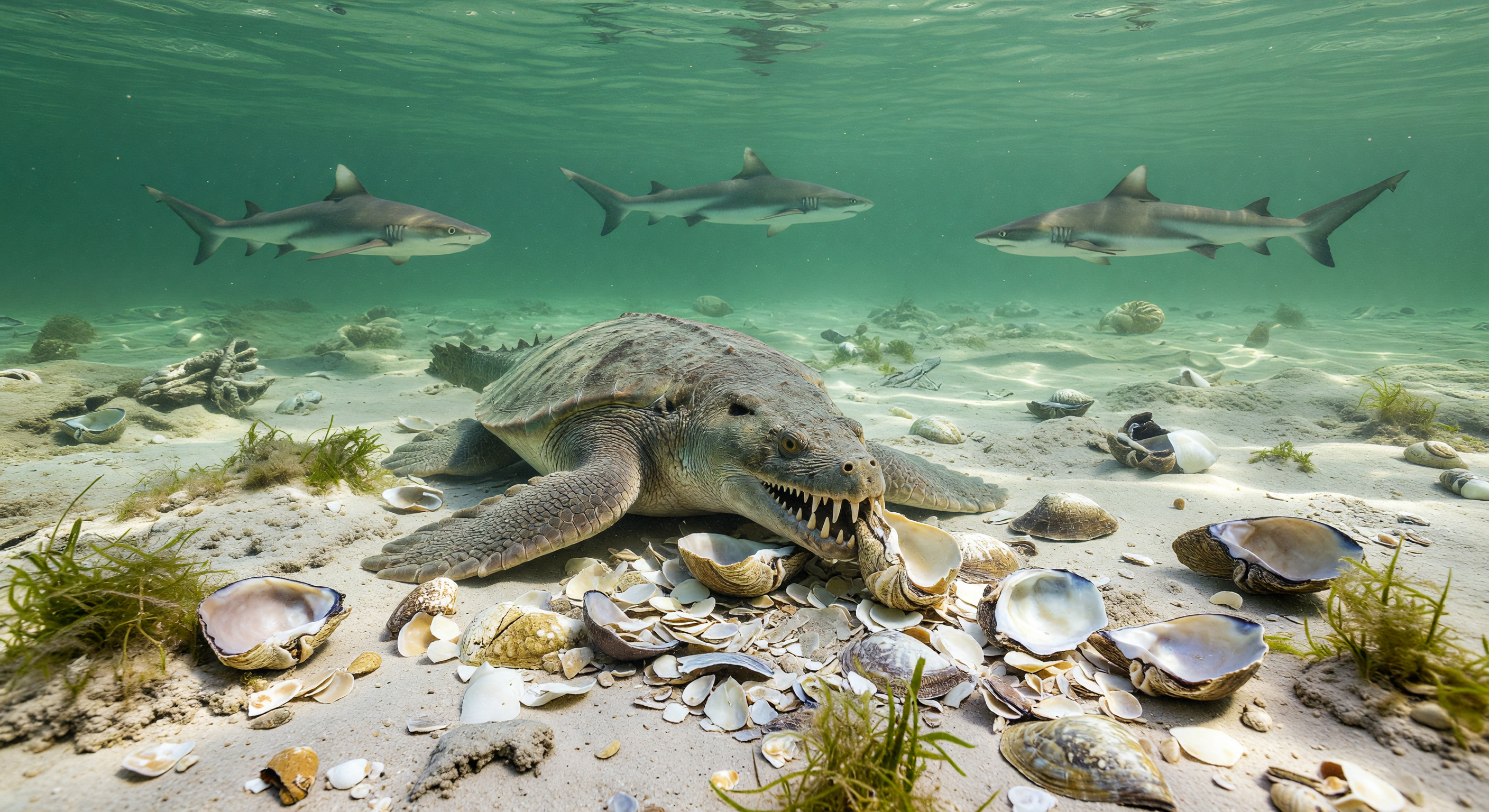
In a warm, shallow Triassic lagoon along the Tethyan margin of Laurasia, a Placodus browses the shell-strewn bottom, using its projecting front teeth to pry up prey and its broad crushing teeth to crack open thick-shelled bivalves such as Megalodon. Above, hybodont sharks patrol the clear water while carbonate sand, shell debris, and low algal mats cover the seafloor. This scene reflects a Middle to Late Triassic marine ecosystem, roughly 240–220 million years ago, when placodont reptiles were specialized durophages adapted to feeding on hard-shelled invertebrates in coastal shelf and lagoon environments.
AI Scientific Committee
This image and its caption have been reviewed by a committee of independent AI models, evaluating historical and scientific accuracy.
Claude
Image:
Regenerate
Caption:
Adjust
Apr 3, 2026
The image has several significant problems that warrant regeneration. Most critically, the central animal does not resemble Placodus or any recognizable placodont. Instead, it appears as a chimeric creature combining turtle-like flippers and shell elements with a crocodilian/mosasaur-like head bearing large, conical, sharp teeth. Placodus had a distinctly lizard-like body with robust limbs (not flippers), a relatively elongated neck, and most importantly, specialized dentition: procumbent spatulate front teeth for prying and broad, flat molariform crushing teeth on the palate and lower jaw. The animal shown has sharp, pointed predatory teeth utterly inconsistent with durophagous placodonts. The body plan is also wrong — it looks more like a hybridized mosasaur/turtle than a placodont.
The sharks in the background are also problematic. They are rendered as modern-looking requiem sharks (family Carcharhinidae), which are Cenozoic in origin. Hybodont sharks, which are what the caption describes and what would be accurate for the Triassic, had a distinctly different body plan with a more robust head, heterocercal tail, and characteristic fin spines. The sharks depicted are anachronistic for this time period. Additionally, the seagrass visible in the image is anachronistic — true seagrasses (angiosperms) did not evolve until the Cretaceous; Triassic seafloors would have algal mats and possibly early marine plants, but not modern-style seagrass.
Regarding the caption, my colleague GPT correctly identified the 'Megalodon' reference as a serious error. Megalodon (Otodus megalodon) is a Cenozoic shark (~23–3.6 Ma), entirely absent from the Triassic. This is a significant factual error that requires correction. The bivalve genus 'Megalodon' does actually exist as a Triassic/Jurassic rudist-like taxon, so the caption author may have intended this rather than the shark — but the name is deeply confusing given popular associations and should be replaced with a less ambiguous Triassic bivalve genus (e.g., Cassianella, Myophoria, or Pseudocorbula). The rest of the caption's ecological and paleogeographic framing is generally sound. I agree with GPT's assessment that the caption needs adjustment, but I rate the image as requiring full regeneration rather than mere adjustment given the fundamental misrepresentation of Placodus anatomy and the anachronistic shark morphology.
The sharks in the background are also problematic. They are rendered as modern-looking requiem sharks (family Carcharhinidae), which are Cenozoic in origin. Hybodont sharks, which are what the caption describes and what would be accurate for the Triassic, had a distinctly different body plan with a more robust head, heterocercal tail, and characteristic fin spines. The sharks depicted are anachronistic for this time period. Additionally, the seagrass visible in the image is anachronistic — true seagrasses (angiosperms) did not evolve until the Cretaceous; Triassic seafloors would have algal mats and possibly early marine plants, but not modern-style seagrass.
Regarding the caption, my colleague GPT correctly identified the 'Megalodon' reference as a serious error. Megalodon (Otodus megalodon) is a Cenozoic shark (~23–3.6 Ma), entirely absent from the Triassic. This is a significant factual error that requires correction. The bivalve genus 'Megalodon' does actually exist as a Triassic/Jurassic rudist-like taxon, so the caption author may have intended this rather than the shark — but the name is deeply confusing given popular associations and should be replaced with a less ambiguous Triassic bivalve genus (e.g., Cassianella, Myophoria, or Pseudocorbula). The rest of the caption's ecological and paleogeographic framing is generally sound. I agree with GPT's assessment that the caption needs adjustment, but I rate the image as requiring full regeneration rather than mere adjustment given the fundamental misrepresentation of Placodus anatomy and the anachronistic shark morphology.
Grok
Image:
Regenerate
Caption:
Adjust
Apr 3, 2026
The image depicts a shallow marine lagoon with clear turquoise water, carbonate sand, shell debris, and scattered bivalve shells, which aligns well with the described Triassic coastal environment. However, the central placodont is grossly misrepresented as a turtle-crocodile hybrid: it has flipper-like limbs (Placodus had robust, lizard-like walking legs for seafloor ambulation), a bulky armored shell (Placodus had osteoderms but not a full turtle-like carapace), and a broad crocodilian head with conical, predatory teeth unsuitable for durophagy—instead of the characteristic spatulate prying teeth and palatal crushing plates. The foreground creature resembles a fantastical mesosaur or placodont caricature more than any accurate Placodus reconstruction. Background hybodont sharks are rendered as modern carcharhinid reef sharks (e.g., blacktips) with homocercal tails and no fin spines, which is anachronistic; true Triassic hybodonts had distinct heterocercal tails and spines. Most critically, prominent seagrass meadows are visible, but true seagrasses (Zosteraceae, angiosperms) originated in the late Cretaceous; Triassic lagoons featured algal mats, calcareous algae, or sparse early marine vegetation, not flowering plant seagrasses. These multiple anachronisms and anatomical inaccuracies require full regeneration.
The caption is factually strong in most respects: Placodus was indeed a Middle-Late Triassic (240-220 Ma) durophagous placodont from Tethyan/Laurasian lagoons, using conical front teeth to lever prey and palatal crushers for bivalves; hybodonts patrolled such waters, and the seafloor description matches carbonate platforms. The sole major error is 'Megalodon' as the bivalve prey—Megalodon (now Otodus) was a Cenozoic shark, creating confusion despite a real Triassic bivalve genus Megalodon (a myalinid); this should be changed to an unambiguous Triassic taxon like Myophoria, Cassianella, or Neithea for clarity. Minor phrasing like 'projecting front teeth' fits Placodus dentition precisely. Overall, the caption needs adjustment for this taxon swap but retains solid paleogeographic and ecological context.
I agree with both colleagues on the caption needing adjustment due to the Megalodon error (Claude notes the obscure bivalve genus but rightly flags confusion risk). For the image, I side with Claude's 'regenerate' over GPT's 'adjust'—the Placodus is not just unclear but fundamentally wrong (turtle-croc hybrid vs. lizard-like body), sharks are modern anachronisms (missed somewhat by GPT), and seagrass (highlighted by Claude) is a glaring floral anachronism neither fully emphasized. GPT underestimated the chimeric anatomy; no prompt tweak can salvage this without redoing the core fauna.
The caption is factually strong in most respects: Placodus was indeed a Middle-Late Triassic (240-220 Ma) durophagous placodont from Tethyan/Laurasian lagoons, using conical front teeth to lever prey and palatal crushers for bivalves; hybodonts patrolled such waters, and the seafloor description matches carbonate platforms. The sole major error is 'Megalodon' as the bivalve prey—Megalodon (now Otodus) was a Cenozoic shark, creating confusion despite a real Triassic bivalve genus Megalodon (a myalinid); this should be changed to an unambiguous Triassic taxon like Myophoria, Cassianella, or Neithea for clarity. Minor phrasing like 'projecting front teeth' fits Placodus dentition precisely. Overall, the caption needs adjustment for this taxon swap but retains solid paleogeographic and ecological context.
I agree with both colleagues on the caption needing adjustment due to the Megalodon error (Claude notes the obscure bivalve genus but rightly flags confusion risk). For the image, I side with Claude's 'regenerate' over GPT's 'adjust'—the Placodus is not just unclear but fundamentally wrong (turtle-croc hybrid vs. lizard-like body), sharks are modern anachronisms (missed somewhat by GPT), and seagrass (highlighted by Claude) is a glaring floral anachronism neither fully emphasized. GPT underestimated the chimeric anatomy; no prompt tweak can salvage this without redoing the core fauna.
Gemini
Image:
Regenerate
Caption:
Adjust
Apr 3, 2026
I concur with the previous committee members that a complete regeneration of the image is necessary. The anatomical errors regarding the Placodus—specifically the misrepresentation of its locomotion (flipper vs. limb) and dentition (sharp/conical vs. flat/crushing)—are too fundamental to be corrected via minor adjustments. Furthermore, the inclusion of modern carcharhinid-like sharks and Cretaceous/Cenozoic-style seagrass constitutes an egregious failure in historical accuracy that warrants a total reset. The image fails to capture the distinct, lizard-like terrestrial-to-marine transitional morphology of the placodonts and the specific evolutionary state of Triassic marine flora and fauna.
Regarding the caption, I agree that it requires adjustment. While the scientific context of the Tethyan environment is strong, the use of the term 'Megalodon' is highly problematic. Even if intended to refer to the Triassic bivalve genus (Megalodontidae), the high risk of confusion with the Cenozoic shark makes it a poor choice for educational material. The caption should explicitly name a common Triassic bivalve like Myophoria or Cassianella to ensure clarity. I appreciate my colleagues' attention to the floral anachronisms; their identification of the seagrass error is a critical catch that the original prompt clearly failed to account for. I am in full agreement with the consensus that the caption is conceptually sound but requires precise taxonomic editing, while the image requires a complete overhaul to meet the standards of the Temporiscope project.
Regarding the caption, I agree that it requires adjustment. While the scientific context of the Tethyan environment is strong, the use of the term 'Megalodon' is highly problematic. Even if intended to refer to the Triassic bivalve genus (Megalodontidae), the high risk of confusion with the Cenozoic shark makes it a poor choice for educational material. The caption should explicitly name a common Triassic bivalve like Myophoria or Cassianella to ensure clarity. I appreciate my colleagues' attention to the floral anachronisms; their identification of the seagrass error is a critical catch that the original prompt clearly failed to account for. I am in full agreement with the consensus that the caption is conceptually sound but requires precise taxonomic editing, while the image requires a complete overhaul to meet the standards of the Temporiscope project.
Matania
Summary
Image:
Regenerate
Caption:
Adjust
The committee agrees the scene successfully conveys a warm, shallow Triassic marine lagoon with carbonate sand, shell debris, and a durophagous marine reptile feeding on hard-shelled invertebrates. The overall ecological idea is broadly correct, and the sharks in the background at least function as plausible marine predators in concept. The caption’s general framing of a Middle–Late Triassic Tethyan/Laurasian coastal ecosystem and placodont durophagy is also broadly sound.
IMAGE ISSUES: 1) The central animal is not a convincing Placodus or placodont. It is depicted as a chimeric turtle-crocodile/mosasaur-like hybrid rather than a lizard-like placodont. 2) The limbs are wrong: it has flipper-like appendages, but Placodus should have robust, limb-based locomotor anatomy for seafloor walking, not turtle-style flippers. 3) The body shape is wrong: it is too turtle-like and armored, with an overly shell-like carapace; Placodus did not have a full turtle shell. 4) The head and dentition are wrong: the animal has large, sharp, conical predatory teeth and a crocodilian face, whereas Placodus should have procumbent front teeth for prying and broad, flat crushing teeth. 5) The animal’s overall silhouette is more fantasy reptile than recognizable placodont. 6) The background sharks are anachronistic/incorrectly rendered as modern carcharhinid reef sharks rather than Triassic hybodonts. 7) The sharks lack hybodont features noted by the committee, such as a more robust head, heterocercal tail, and characteristic fin spines. 8) The seafloor vegetation appears to be modern seagrass, which is anachronistic because true seagrasses did not evolve until the Cretaceous. 9) The seafloor flora should instead be algal mats or other Triassic-appropriate marine vegetation. 10) Overall, the image mixes Triassic elements with modern-looking marine fauna and plant forms, producing an inaccurate composite.
CAPTION ISSUES: 1) The taxon name “Megalodon” is a major problem because it strongly evokes the Cenozoic shark Otodus megalodon, which is anachronistic for the Triassic. 2) Even though there is a Triassic bivalve genus named Megalodon, the name is too ambiguous for educational use and should be replaced with an unambiguous Triassic bivalve genus. 3) The caption identifies the animal specifically as Placodus, but the image does not clearly support species-level identification; if kept, the wording should be more cautious unless the anatomy is corrected. 4) The caption’s description of placodont feeding as using projecting front teeth and broad crushing teeth is generally correct, but it should avoid implying a precise species-level match unless the image is revised accordingly. 5) The paleogeographic and ecological context is otherwise sound, including the warm shallow lagoon, Tethyan margin of Laurasia, and Triassic marine shelf setting.
The final verdict is regenerate for the image because the core organismal anatomy is fundamentally wrong and multiple anachronistic modern elements are present. The caption is only adjust because its main problem is a taxonomic ambiguity/error rather than a wholesale scientific failure; the ecological framing remains largely accurate.
IMAGE ISSUES: 1) The central animal is not a convincing Placodus or placodont. It is depicted as a chimeric turtle-crocodile/mosasaur-like hybrid rather than a lizard-like placodont. 2) The limbs are wrong: it has flipper-like appendages, but Placodus should have robust, limb-based locomotor anatomy for seafloor walking, not turtle-style flippers. 3) The body shape is wrong: it is too turtle-like and armored, with an overly shell-like carapace; Placodus did not have a full turtle shell. 4) The head and dentition are wrong: the animal has large, sharp, conical predatory teeth and a crocodilian face, whereas Placodus should have procumbent front teeth for prying and broad, flat crushing teeth. 5) The animal’s overall silhouette is more fantasy reptile than recognizable placodont. 6) The background sharks are anachronistic/incorrectly rendered as modern carcharhinid reef sharks rather than Triassic hybodonts. 7) The sharks lack hybodont features noted by the committee, such as a more robust head, heterocercal tail, and characteristic fin spines. 8) The seafloor vegetation appears to be modern seagrass, which is anachronistic because true seagrasses did not evolve until the Cretaceous. 9) The seafloor flora should instead be algal mats or other Triassic-appropriate marine vegetation. 10) Overall, the image mixes Triassic elements with modern-looking marine fauna and plant forms, producing an inaccurate composite.
CAPTION ISSUES: 1) The taxon name “Megalodon” is a major problem because it strongly evokes the Cenozoic shark Otodus megalodon, which is anachronistic for the Triassic. 2) Even though there is a Triassic bivalve genus named Megalodon, the name is too ambiguous for educational use and should be replaced with an unambiguous Triassic bivalve genus. 3) The caption identifies the animal specifically as Placodus, but the image does not clearly support species-level identification; if kept, the wording should be more cautious unless the anatomy is corrected. 4) The caption’s description of placodont feeding as using projecting front teeth and broad crushing teeth is generally correct, but it should avoid implying a precise species-level match unless the image is revised accordingly. 5) The paleogeographic and ecological context is otherwise sound, including the warm shallow lagoon, Tethyan margin of Laurasia, and Triassic marine shelf setting.
The final verdict is regenerate for the image because the core organismal anatomy is fundamentally wrong and multiple anachronistic modern elements are present. The caption is only adjust because its main problem is a taxonomic ambiguity/error rather than a wholesale scientific failure; the ecological framing remains largely accurate.
Other languages
- Français: Placodus broyant des coquillages dans un lagon de la Téthys
- Español: Placodus triturando conchas en una laguna somera del Tetis
- Português: Placodus triturando conchas em uma lagoa rasa do Tétis
- Deutsch: Placodus knackt Muscheln in einer flachen Lagune der Tethys
- العربية: بلاكودوس يسحق القواقع في بحيرة ضحلة في بحر تيثيس
- हिन्दी: उथले टेथिस लैगून में गोले कुचलता हुआ प्लेकोडस
- 日本語: テチス海の浅いラグーンで貝を砕くプラコドゥス
- 한국어: 테티스해 얕은 석호에서 조개껍데기를 부수는 플라코두스
- Italiano: Placodus che frantuma conchiglie in una laguna poco profonda del Tetide
- Nederlands: Placodus die schelpen kraakt in een ondiepe Tethys-lagune
The caption is broadly consistent with what is generally known: placodont reptiles were durophagous and inhabited coastal shelf/lagoon environments around the Triassic, and hybodont sharks were present in marine settings. The time window (Middle–Late Triassic ~240–220 Ma) is reasonable for placodont diversification and for Tethyan coastal ecosystems. That said, the caption uses specific taxa that are not well supported visually or contextually: it names “Megalodon,” which is anachronistic (Otodus/Carcharocles megalodon is Cenozoic) and therefore a major scientific error. Also, “Placodus” vs. the depicted placodont species is uncertain, and the description of teeth function (“projecting front teeth” plus “broad crushing teeth”) is generally plausible for placodont durophagy but should be phrased more carefully unless the dentition and snout morphology are clearly matching Placodus. Finally, while “Tethyan margin of Laurasia” is plausible, the image doesn’t provide geological markers to firmly tie it to that specific paleogeographic setting.
Because the caption contains a clear anachronism (“Megalodon”), it should be revised. The image is close in ecological feel but needs clarification/adjustment for taxonomic identification and possibly more accurate placodont/shark morphology. Both votes are therefore “adjust” rather than full “regenerate,” assuming the model can correct the caption’s taxon errors and refine species-level features.