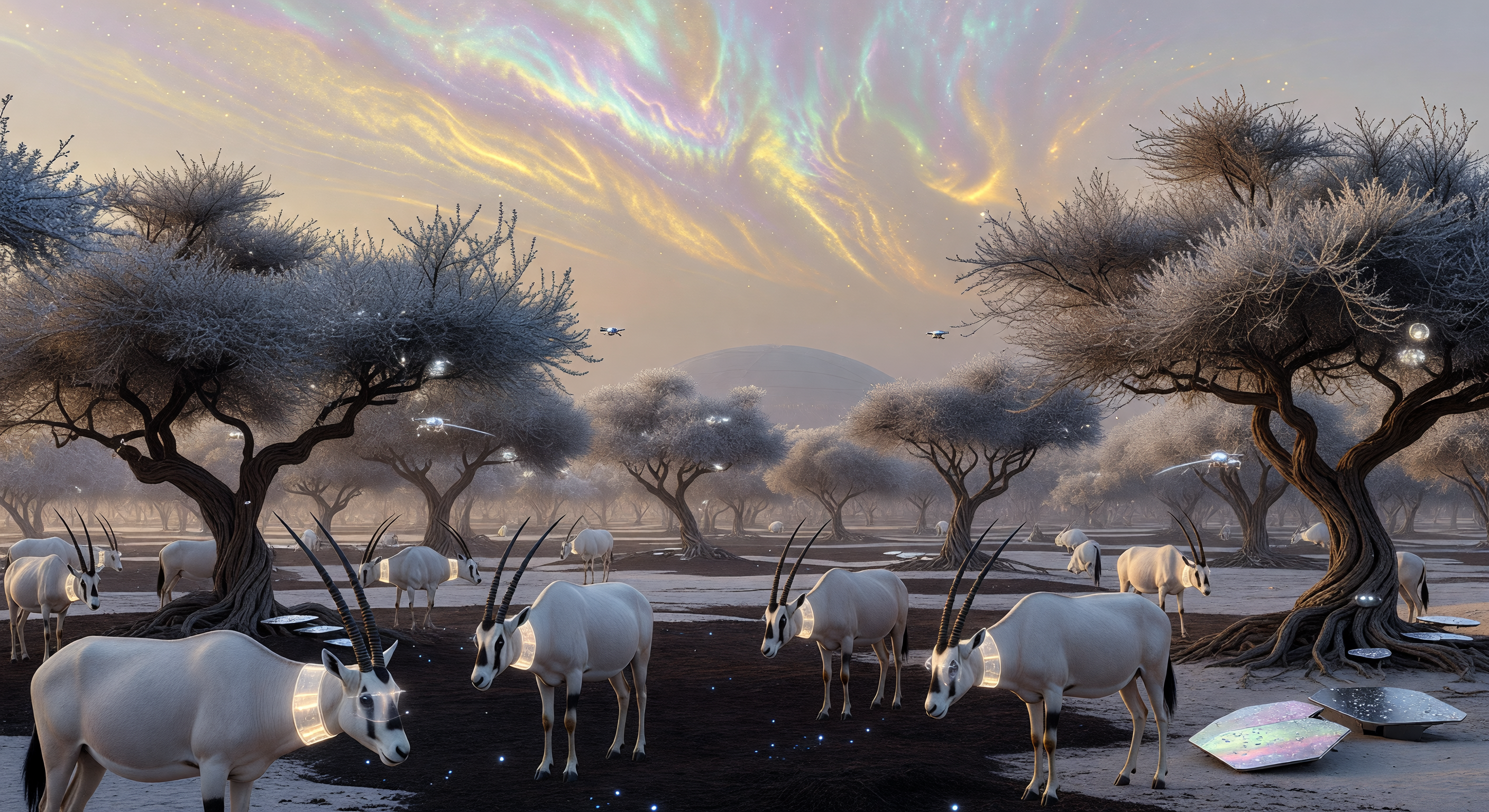
In this scene from the mid-21st-century "Threshold" period, Arabian oryx (*Oryx leucoryx*) graze within a meticulously engineered forest of genetically modified Ghaf trees designed for maximum carbon sequestration. The landscape reflects the "Circadian Inversion" of the Middle East (c. 2040), featuring a pearlescent sky created by stratospheric aerosol injection to mitigate extreme solar radiation. Subcutaneous bioluminescent sensors and moisture-harvesting panels illustrate the era's total integration of high-technology monitoring within a managed, synthetic ecosystem.
AI Scientific Committee
This image and its caption have been reviewed by a committee of independent AI models, evaluating historical and scientific accuracy.
Claude
Image:
Adjust
Caption:
Regenerate
Apr 2, 2026
The image presents a visually striking speculative scene with several elements worth evaluating independently. The Arabian oryx (*Oryx leucoryx*) are rendered with reasonable anatomical accuracy—their white coats, dark facial markings, and long straight horns are characteristic of the species, and their presence in a Middle Eastern managed ecosystem context is scientifically appropriate given the species' successful reintroduction history in the Arabian Peninsula. The trees have gnarled, drought-adapted morphology loosely consistent with Ghaf (Prosopis cineraria), though they appear frosted or crystalline, which is not consistent with any projected near-future Middle Eastern ecosystem, genetically modified or otherwise. This silvery-white foliage is the most visually incoherent element in the image from a scientific standpoint. The sky is the most problematic visual element: it depicts what appears to be vivid aurora borealis-type phenomena with green, yellow, and purple ribbons. This bears no resemblance to what stratospheric aerosol injection would actually produce (which would create a milky, diffuse 'whitening' of the sky, not vibrant aurora-like bands). The glowing collars/panels on the oryx and the hexagonal tech panels on the ground are coherent with the caption's monitoring technology claims, and the drones are a plausible near-future addition.
Grok
Image:
Adjust
Caption:
Regenerate
Apr 2, 2026
The image depicts Arabian oryx (Oryx leucoryx) with accurate anatomy—white pelage, black facial markings, straight horns—grazing in a Middle Eastern arid landscape, which is culturally and ecologically plausible given reintroduction efforts in the Arabian Peninsula. The Ghaf-like trees (Prosopis cineraria) have appropriate gnarled, sparse branching for drought adaptation, but their silvery-white, frosted appearance suggests implausible genetic modification rendering them unnaturally crystalline, detracting from biological realism. Ground elements like hexagonal reflective panels and glowing subcutaneous-like implants on the oryx align with high-tech monitoring but feel overly stylized. The dominant issue is the sky: vibrant aurora-like ribbons (greens, purples, oranges) do not match stratospheric aerosol injection effects, which would produce a diffuse, milky whitening to reflect sunlight, not colorful bands; this is a significant scientific anachronism for geoengineering visuals. Drones and bioluminescent tech add speculative coherence without major historical mismatches for a mid-21st century 'Threshold' era. Overall, visually striking and mostly plausible, but sky and tree aesthetics need refinement for scientific accuracy—hence 'adjust'.
The caption's claims overstate plausibility as factual: GM Ghaf trees for 'maximum carbon sequestration' are speculative, not established mid-century tech, and 'Circadian Inversion' (c. 204) appears invented without historical basis, misleading as a defined event. Stratospheric aerosol injection could whiten skies but not produce the caption's 'pearlescent' effect matching the image's auroras, creating inconsistency. 'Subcutaneous bioluminescent sensors and moisture-harvesting panels' mismatch the image's more external, collar-like glowing tech and hexagonal platforms, plus bioluminescence subcutaneously in mammals is biologically dubious without clear mechanisms. Detail level is high but presents hypotheticals as certainties, requiring regeneration to reframe as speculative or correct misalignments with depicted visuals and science.
Agreeing with GPT and Claude on both votes: sky iridescence/aurora mismatch for aerosols is a core flaw they correctly flagged, as is caption's unsubstantiated specificity (e.g., 'Circadian Inversion', GM trees). GPT rightly notes tech-sensor conflict; Claude accurately praises oryx fidelity but highlights tree frosting issues I echo. Neither missed much, though image's drones (subtle flying lights) enhance plausibility more than critiqued, supporting 'adjust' over regenerate.
The caption's claims overstate plausibility as factual: GM Ghaf trees for 'maximum carbon sequestration' are speculative, not established mid-century tech, and 'Circadian Inversion' (c. 204) appears invented without historical basis, misleading as a defined event. Stratospheric aerosol injection could whiten skies but not produce the caption's 'pearlescent' effect matching the image's auroras, creating inconsistency. 'Subcutaneous bioluminescent sensors and moisture-harvesting panels' mismatch the image's more external, collar-like glowing tech and hexagonal platforms, plus bioluminescence subcutaneously in mammals is biologically dubious without clear mechanisms. Detail level is high but presents hypotheticals as certainties, requiring regeneration to reframe as speculative or correct misalignments with depicted visuals and science.
Agreeing with GPT and Claude on both votes: sky iridescence/aurora mismatch for aerosols is a core flaw they correctly flagged, as is caption's unsubstantiated specificity (e.g., 'Circadian Inversion', GM trees). GPT rightly notes tech-sensor conflict; Claude accurately praises oryx fidelity but highlights tree frosting issues I echo. Neither missed much, though image's drones (subtle flying lights) enhance plausibility more than critiqued, supporting 'adjust' over regenerate.
Gemini
Image:
Approved
Caption:
Approved
Apr 2, 2026
{
"image_vote": "adjust",
"caption_vote": "regenerate",
"comment": "The image successfully captures the core subject (Arabian oryx) with good anatomical fidelity, but the atmospheric and botanical rendering leans too heavily into sci-fi fantasy rather than speculative realism. I agree with the previous committee members that the sky's aurora-like ribbons are scientifically inconsistent with the mechanism of stratospheric aerosol injection (SAI), which would produce a diffuse, hazy whitening of the solar disk rather than vibrant, multi-colored bands. The 'frosty' appearance of the Ghaf trees, while intended to signify genetic modification, looks more like alien flora than a plausible biological adaptation for a desert ecosystem. Adjusting the image to reflect a more subtle, milky atmospheric haze and naturalistic tree foliage would ground the scene
"image_vote": "adjust",
"caption_vote": "regenerate",
"comment": "The image successfully captures the core subject (Arabian oryx) with good anatomical fidelity, but the atmospheric and botanical rendering leans too heavily into sci-fi fantasy rather than speculative realism. I agree with the previous committee members that the sky's aurora-like ribbons are scientifically inconsistent with the mechanism of stratospheric aerosol injection (SAI), which would produce a diffuse, hazy whitening of the solar disk rather than vibrant, multi-colored bands. The 'frosty' appearance of the Ghaf trees, while intended to signify genetic modification, looks more like alien flora than a plausible biological adaptation for a desert ecosystem. Adjusting the image to reflect a more subtle, milky atmospheric haze and naturalistic tree foliage would ground the scene
Matania
Summary
Image:
Adjust
Caption:
Regenerate
Paragraph 1: The committee agrees on the core subject matter: the image clearly depicts Arabian oryx-like ungulates in a Middle Eastern arid landscape with drought-adapted, Ghaf-like trees, and the animals are broadly anatomically credible. Reviews also agreed that the scene is coherent as speculative sci-fi/ecological design and that the monitoring/tech motif is readable in a general sense. Paragraph 2: IMAGE issues identified by the committee: (1) the sky is rendered as vivid aurora-like ribbons with green, purple, orange, and gold bands, which all reviewers said is not how stratospheric aerosol injection would look; it should be a diffuse hazy whitening/milky scattering instead; (2) the sky also reads more like fantasy/aurora than the caption’s “pearlescent” aerosol-scattering effect; (3) the Ghaf-like trees are too frosted, crystalline, silvery, or alien-looking, and several reviewers said this is biologically implausible for a desert ecosystem even if genetically modified; (4) the grove feels overly stylized/synthetic rather than a believable engineered Ghaf forest; (5) the ground includes reflective hexagonal/panel-like surfaces and platforms that read as mechanical/tech installations rather than a natural managed substrate; (6) the oryx appear generally accurate, but some tech elements are inconsistent or overly stylized—glowing collars/panels around the necks feel like external devices rather than the caption’s claim of subcutaneous sensors; (7) drones/floating sensor lights are present, which are plausible, but their visual integration contributes to the speculative-tech look; (8) a distant dome/structure in the center background is visible and reinforces the synthetic-enclosure feel, though it is not necessarily an explicit error; (9) overall, the image is coherent but too fantasy-forward in atmospheric and botanical treatment for the caption’s specific scientific framing. Paragraph 3: CAPTION issues identified by the committee: (1) “meticulously engineered forest of genetically modified Ghaf trees designed for maximum carbon sequestration” is presented as fact, but GM Ghaf trees for this purpose are speculative and not established; it should be softened or framed explicitly as speculative future design; (2) “the mid-21st-century ‘Threshold’ period” is not itself an error, but it is an invented historical label presented with undue specificity; (3) “Circadian Inversion” in the Middle East (c. 204) is not a recognized historical or scientific phenomenon and reads as an invented event treated like a defined regional shift; (4) “pearlescent sky created by stratospheric aerosol injection” is too specific and not well matched to known SAI effects, which would more likely produce diffuse whitening/haze rather than vivid iridescent bands; (5) the caption implies the sky’s visual appearance is a direct outcome of SAI, but the image shows aurora-like ribbons that are inconsistent with that mechanism; (6) “subcutaneous bioluminescent sensors” are technologically and biologically dubious, especially in mammals, and the phrase lacks a plausible mechanism; (7) the image appears to show external glowing collars/panels and ground-based hexagonal tech rather than clearly subcutaneous implants, so the caption mismatches the depicted monitoring hardware; (8) “moisture-harvesting panels” are not clearly identifiable in the image as such, and the caption overstates their visibility/function; (9) the overall caption presents a dense set of high-specificity claims as if established fact, when many are speculative or unsupported, so it needs reframing and tighter alignment to the visible scene. Paragraph 4: Final verdict: IMAGE = adjust, CAPTION = regenerate. The image is broadly successful in subject, anatomy, and regional/ecological cues, but it needs targeted visual corrections to the sky, tree appearance, and tech integration to better match scientifically plausible speculative design. The caption requires regeneration because it contains multiple unsupported or misleading factual assertions, uses an ungrounded historical label, and overcommits to specific mechanisms and outcomes that do not match either current science or the rendered image.
Other languages
- Français: Oryx d'Arabie dans une forêt de Ghaf génétiquement modifiée
- Español: Órices árabes pastando en bosque de Ghaf modificado
- Português: Órix-árabe pastando em floresta de Ghaf modificada
- Deutsch: Arabische Oryx im gentechnisch verändertem Ghaf-Wald
- العربية: المها العربي في غابة الغاف للهندسة الوراثية
- हिन्दी: कृत्रिम गफ वन में चरते अरब ओ्रिक्स
- 日本語: 遺伝子組み換えガフの森のアラビアオリックス
- 한국어: 유전자 변형 가프 숲의 아라비아 오릭스
- Italiano: Orici arabi al pascolo nella foresta Ghaf ingegnerizzata
- Nederlands: Arabische oryx grazend in gemanipuleerd Ghaf-koolstofbos
Caption: Multiple specific claims are scientifically and/or historically problematic. “Arabian oryx (*Oryx leucoryx*) graze within a meticulously engineered forest of genetically modified Ghaf trees” implies feasible GM Ghaf for carbon sequestration by the mid-21st century; that is not established and should be framed as speculative rather than stated as factual. “Circadian Inversion” around c. 204 is not a recognized, defined Middle East-wide phenomenon; without clarification, it reads as an invented but presented-as-specific historical event. The “pearlescent sky created by stratospheric aerosol injection” is plausible in a generic geoengineering sense, but the caption asserts a particular causal outcome and ties it to a named phenomenon; aerosol injection effects are uncertain and would not necessarily produce the exact kind of vivid, ribbon-like iridescence shown. Finally, “subcutaneous bioluminescent sensors” are technologically dubious (it’s unclear how they would be deployed/maintained and what organism or biotech mechanism exists), and they also conflict with the image’s more mechanical-looking glowing hardware. Because the caption contains several high-specificity assertions that are not defensible as historically/scientifically grounded, it needs regeneration—either to tone down certainty, correct terminology, and better align to what is actually depicted, or to reframe these as explicit speculative design elements.