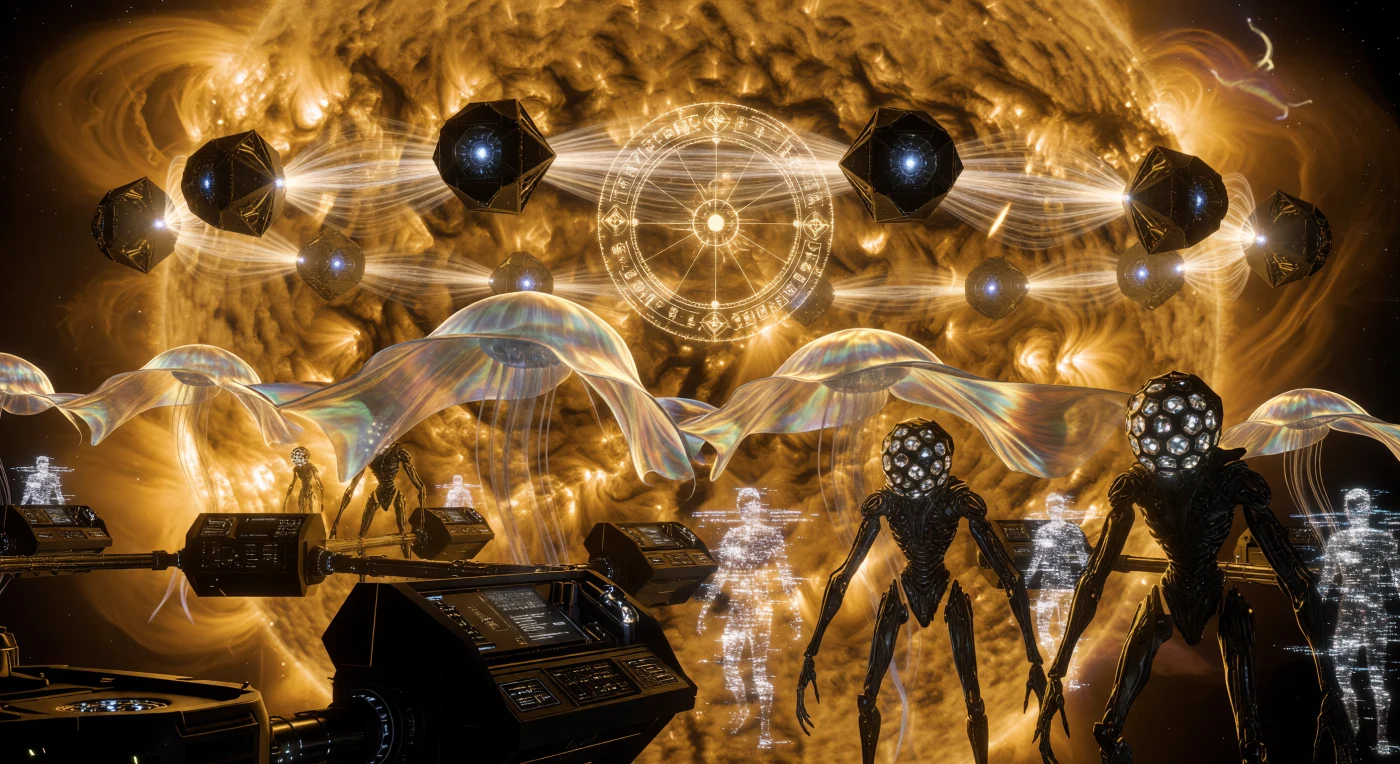
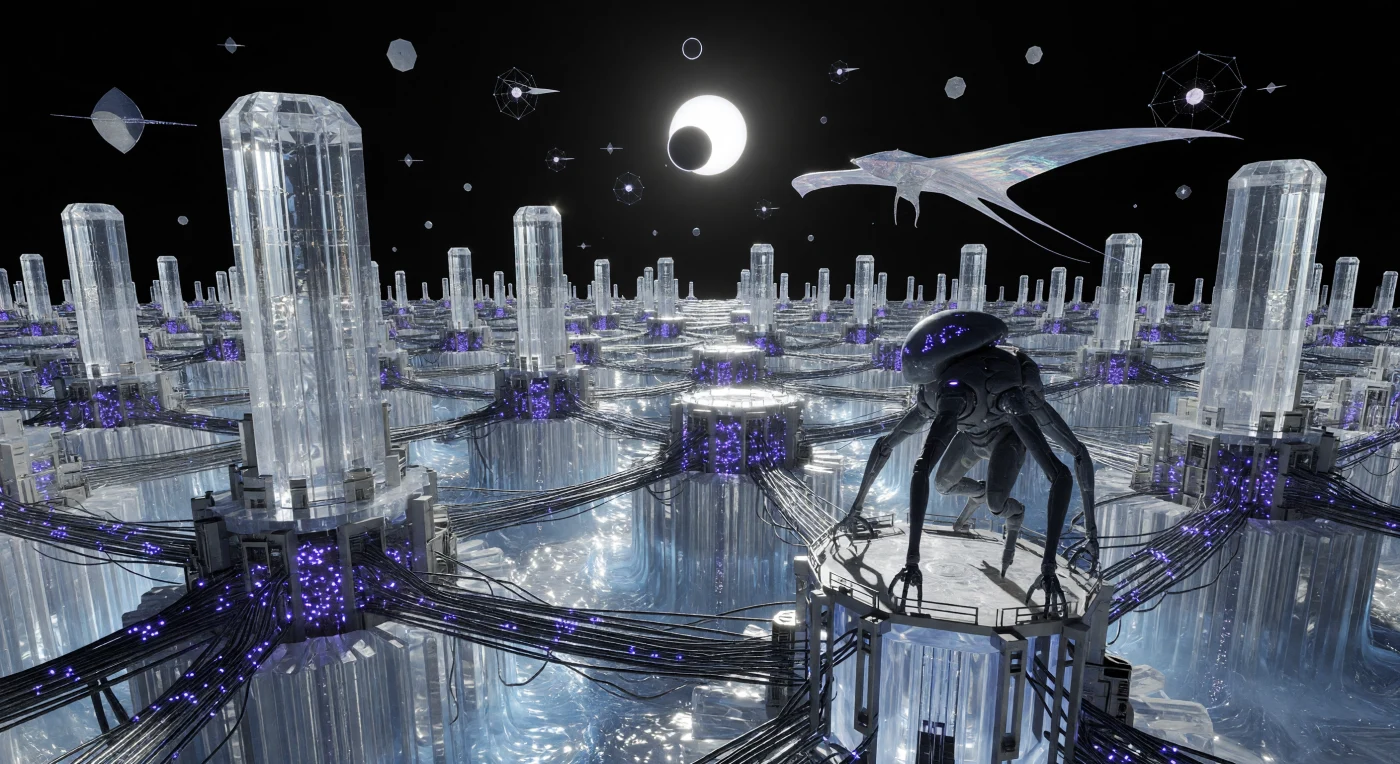
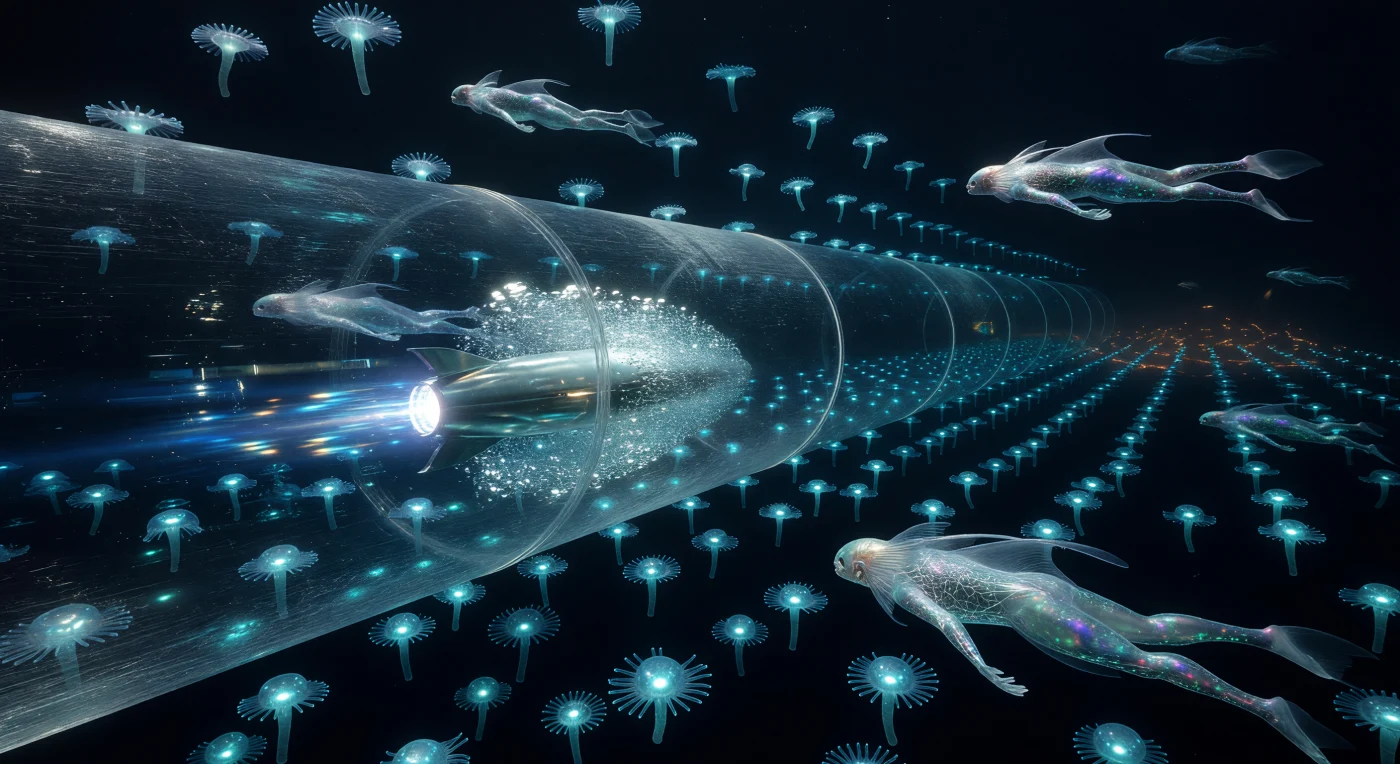
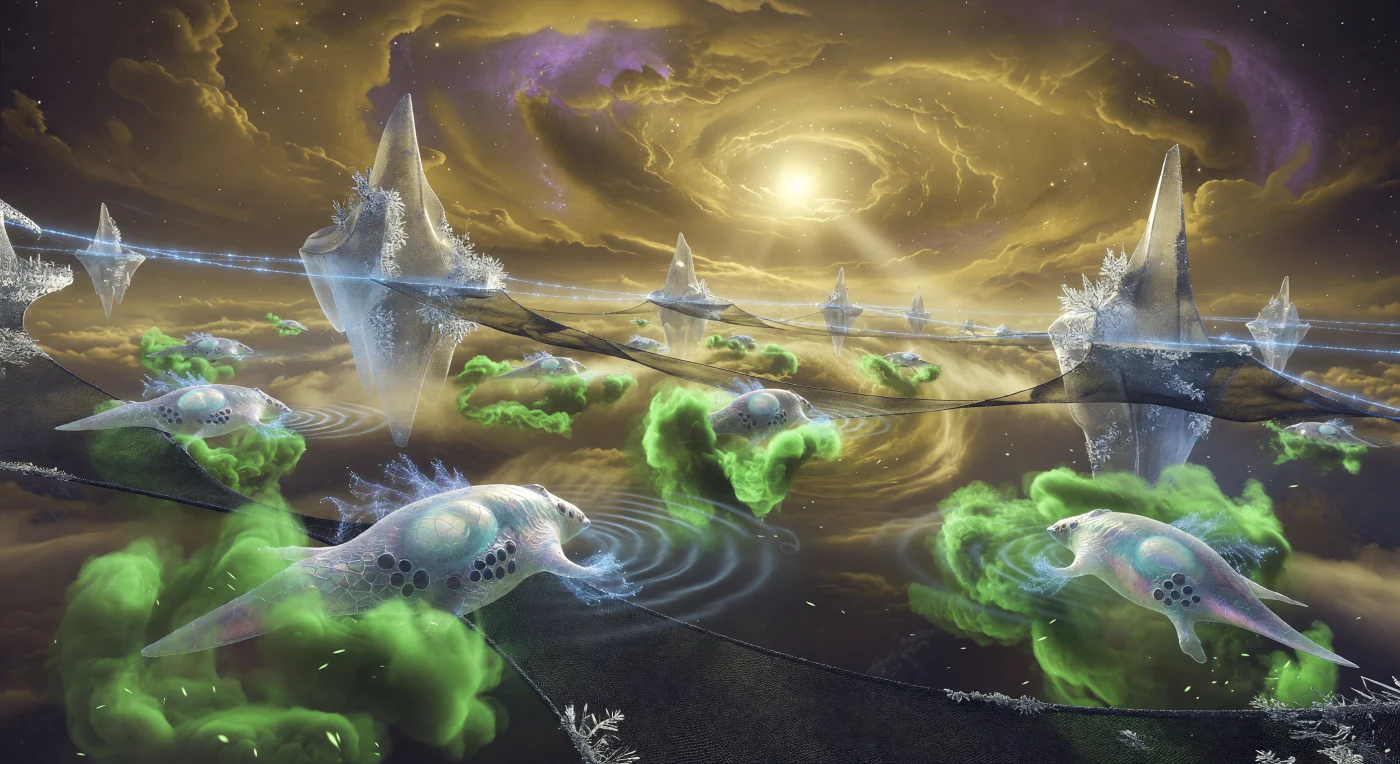
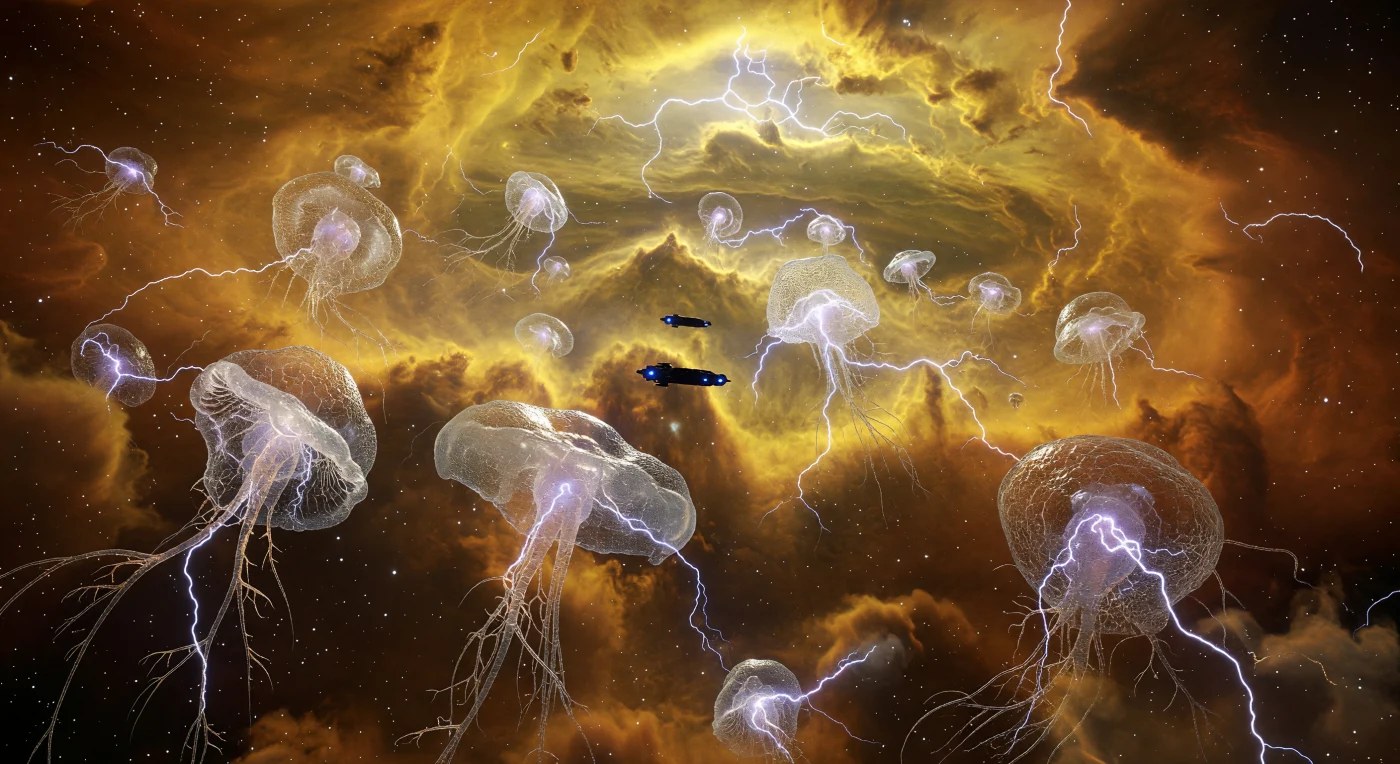
This scene captures a cluster of Synaptic Pods drifting within a vibrant nebula during the Galactic Age, approximately 5,000 to 20,000 CE. These 50-meter translucent diamondoid structures serve as highly personalized habitats for Post-Sapiens entities, whose neural rhythms are synchronized with the iridescent programmable matter rippling across the pods' surfaces. Tethered by magnetic plasma ribbons near a blue supergiant star, these habitats represent the pinnacle of interstellar urbanism, marking the era when sentient life transitioned from planetary surfaces to permanent, deep-space computational environments.

Set within the vast chasm of Valles Marineris during the Galactic Age (5,000–20,000 CE), this scene illustrates the Dendritic Urban Nexus, a testament to the era’s fusion of biology and advanced engineering. At the center stands a five-kilometer-tall diamondoid processing core, from which iridescent iridium transport tubes branch out to residential synapses grown from ceramic-hard mycelial composites. The inhabitants, adapted to the 0.38g Martian gravity through centuries of physiological shifts, exhibit elongated limbs and translucent skin, sharing the city with post-biological entities under a protective, violet-tinted plasma dome. This sophisticated ecosystem reflects a future where humanity has transitioned from simple planetary survival to stellar-scale civilization, utilizing molecular assembly and programmable matter to thrive in the thin Martian atmosphere.

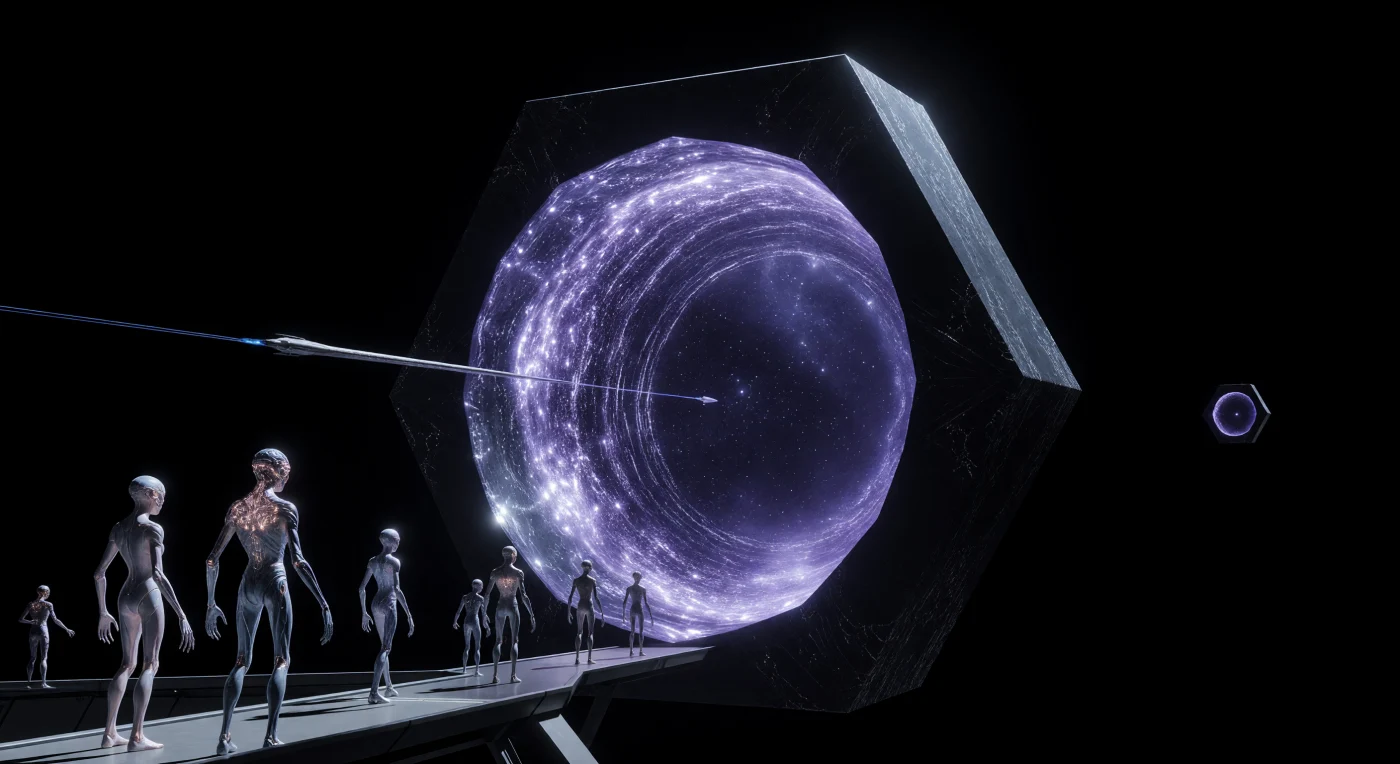
This reconstruction depicts a Singularity Shrine during the Galactic Age (5,000–20,000 CE), a period defined by the transition of sentient life from planetary surfaces to stellar-scale engineering. Positioned within the last stable orbit of the supermassive black hole Sagittarius A*, the 500-kilometer obsidian hyper-cube serves as a center for the "Great Computation," utilizing the immense gravitational energy of the singularity to process cosmic-scale data. The scene illustrates the extreme gravitational lensing of the golden accretion disk and the specialized physiology of post-biological entities, whose three-meter-tall, programmable-matter forms have evolved to thrive in the high-radiation and variable-gravity environments of the galactic center.
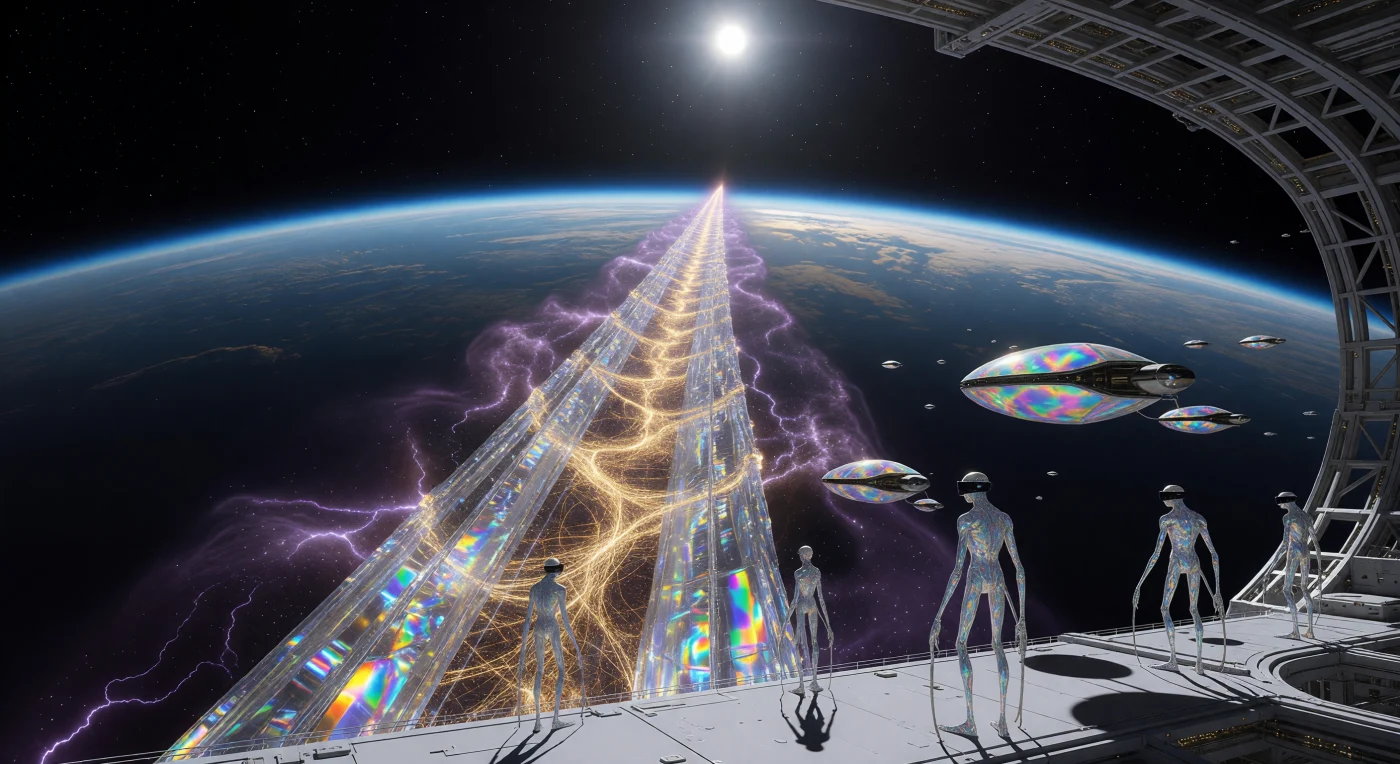
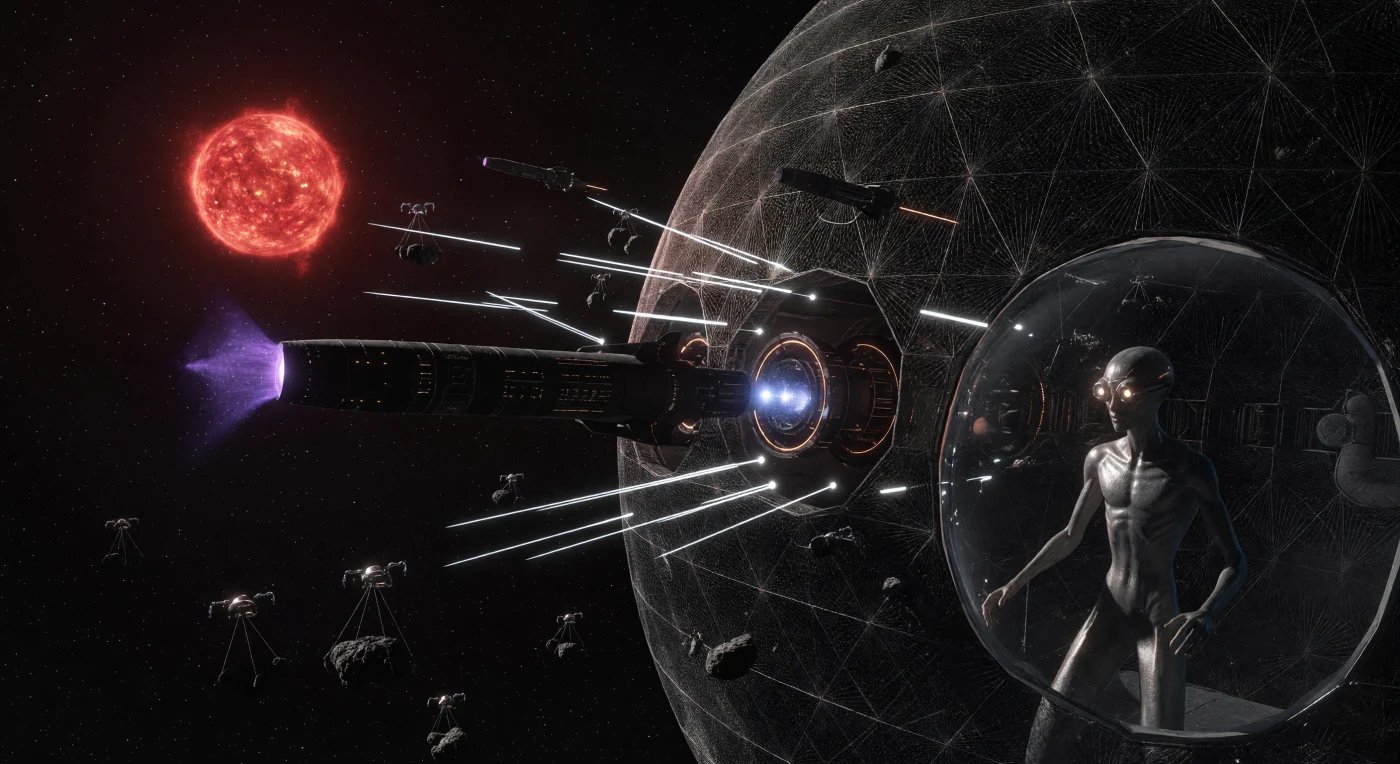
This high-orbital view captures the Pillar of Sol, a 36,000-kilometer space elevator constructed from translucent monatomic carbon during the Galactic Age (5,000–20,000 CE). The structure’s core pulses with golden fiber-optic data streams, shielded by a protective violet plasma sheath that deflects cosmic debris above a terraformed Earth. Spindly, post-biological entities adapted for low-gravity environments are seen managing molecular assembly drones on a platform of programmable matter, showcasing the era's transition from planetary life to stellar-scale engineering.

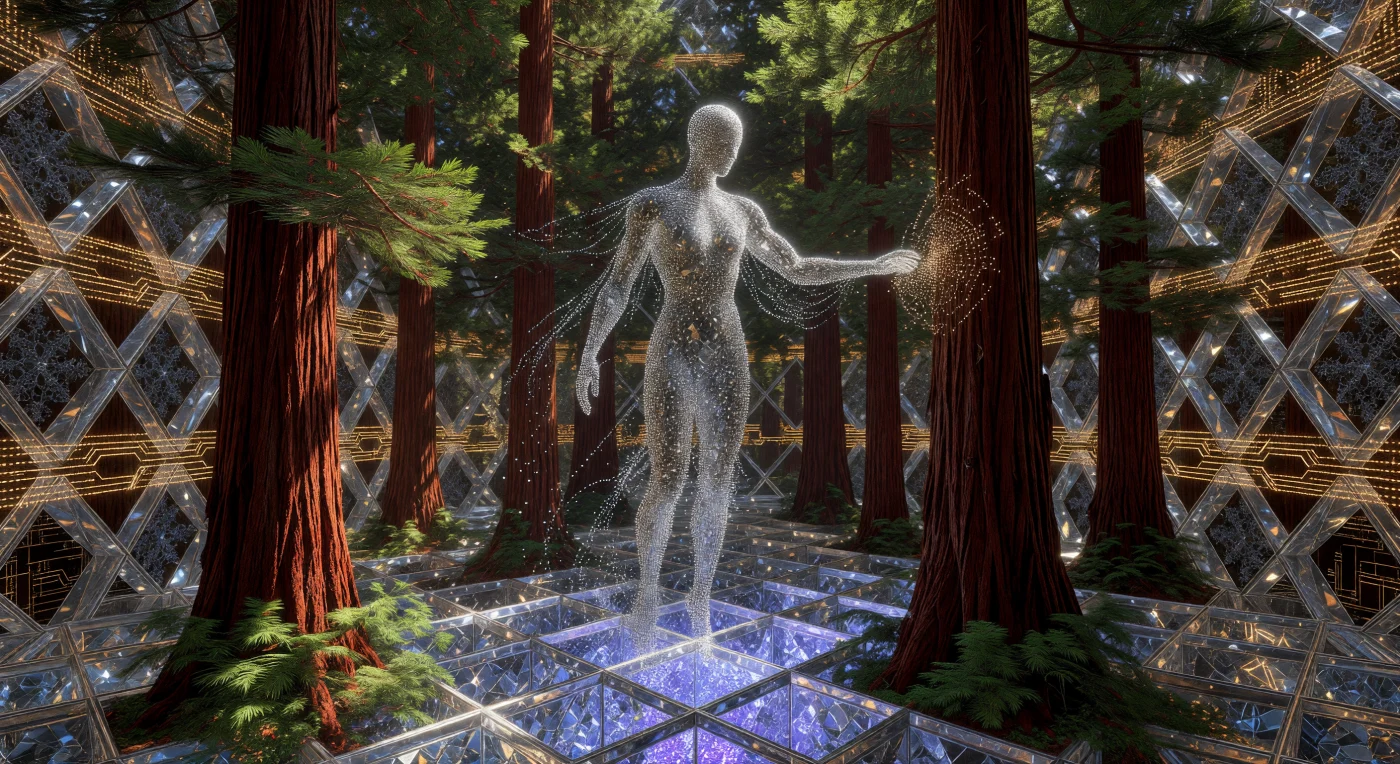
This 30-kilometer-long O’Neill Cylinder habitat exemplifies the advanced urbanism of the Galactic Age (5,000–20,000 CE), where centrifugal force and gravitic steering allow massive "Upward Waterfalls" to arc toward a central fusion plasma sun. The landscape is dominated by engineered "Arbor-vitreous" trees with diamondoid trunks designed to filter cosmic radiation, while ovoid "Synaptic Pods" serve as neural-interfaced residences for the era's post-biological inhabitants. These gracile, synthetic beings represent the pinnacle of post-planetary evolution, living within self-repairing ecosystems maintained by constant swarms of microscopic constructor-drones.

Suspended within the Cygnus-X region, this 100-kilometer Wormhole Nexus represents the pinnacle of interstellar architecture during the Galactic Age (5,000–20,000 CE). The gargantuan diamondoid ring, shielded by a shimmering layer of superfluid helium, stabilizes a central aperture of exotic matter that warps spacetime into a luminous Einstein Ring, revealing a distant starburst galaxy. In the foreground, bioluminescent Synaptic Pods—neural-interfaced vessels for post-biological pilots—demonstrate the era's transition from planetary living to stellar-scale engineering and Type II Kardashev civilization.

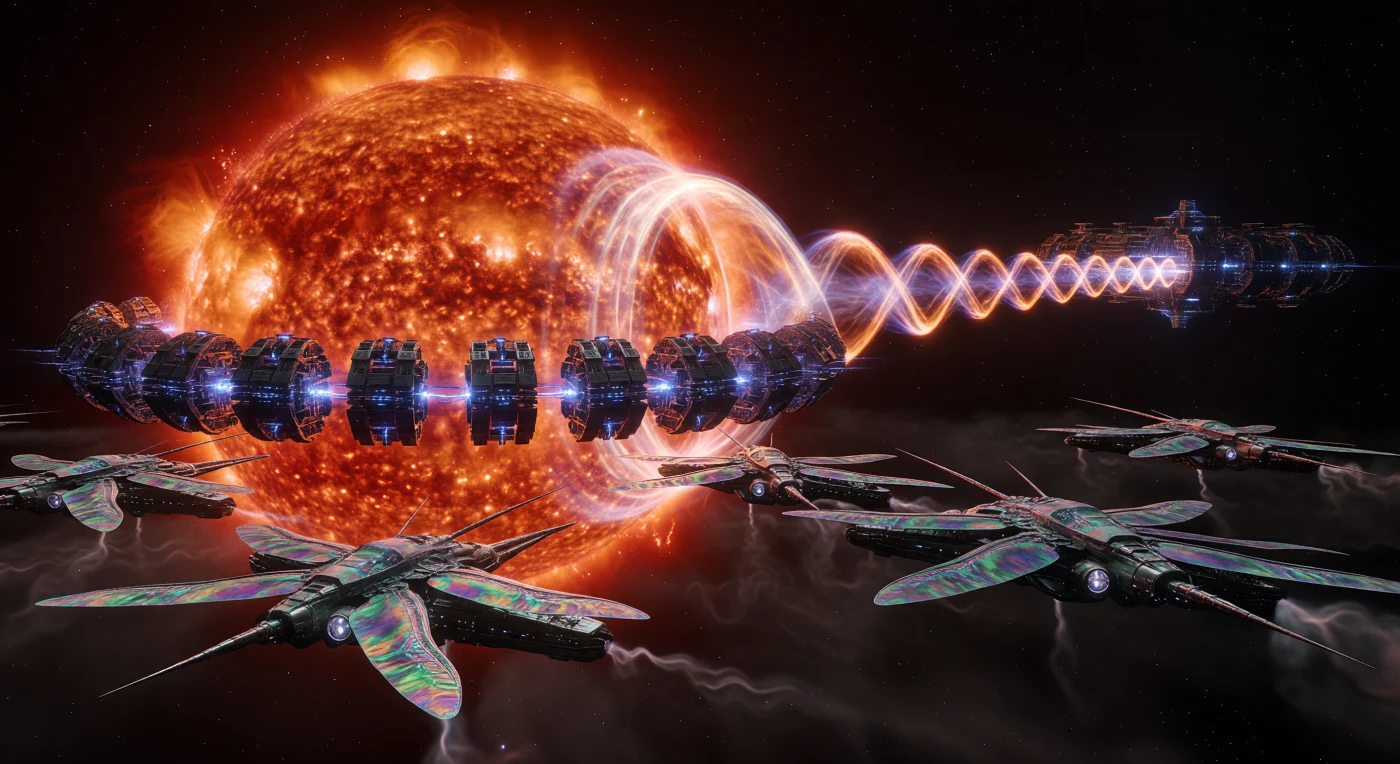
This colossal Stellar Forge, a skeletal lattice of brushed iridium and diamondoid, encapsulates a hyper-active G-type star during the Galactic Age (c. 5,000–20,000 CE). The image captures the process of stellar lifting, where shimmering violet magnetic conduits siphon heavy-element plasma from the star’s roiling photosphere into dark assembly bays for material synthesis. Clinging to the hundred-kilometer-thick struts are ovoid "Synaptic Pod" residential clusters, illustrating the scale of a post-biological civilization that has transitioned from planetary surfaces to permanent life among the stars.

In this vista from the Galactic Age (5,000–20,000 CE), a colossal planetary engine embedded within a 500-kilometer crater vents a pillar of iridescent cyan-blue ionized gas to adjust the moon's orbit toward a habitable zone. The structure utilizes a dendritic lattice of diamondoid and carbon-nanotube composites, illustrating the era's mastery of stellar-scale engineering and molecular assembly. In the foreground, 50-meter-wide ovoid Synaptic Pods—the standard neural-interfaced residences of the period—provide a sense of scale against the massive magnetic containment rings of the thruster. This celestial repositioning reflects a transition where sentient life reshapes entire planetary bodies to ensure long-term stability across the star system.