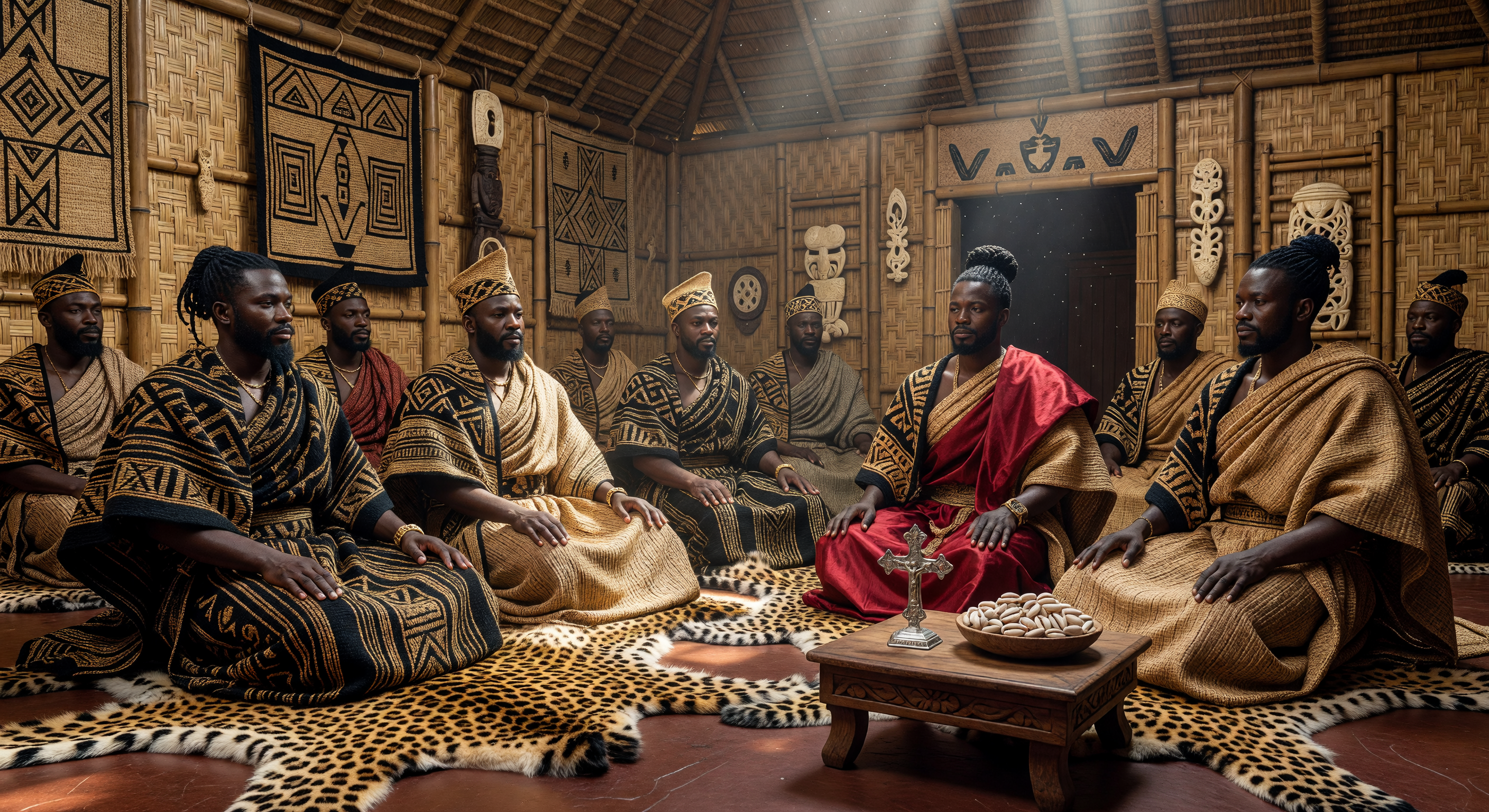
Aristocrats of the Kingdom of Kongo gather for a diplomatic council within a traditional reed-walled audience hall, seated upon leopard skins that denote their high social status. They wear elaborate garments of finely woven raffia fiber, known for their velvet-like texture and complex geometric motifs, along with sacred *mpu* caps symbolizing their titled authority. The inclusion of a silver crucifix and an imported silk sash highlights the kingdom’s sophisticated 17th-century identity as a sovereign Christian state deeply integrated into global trade and diplomatic networks.
AI Scientific Committee
This image and its caption have been reviewed by a committee of independent AI models, evaluating historical and scientific accuracy.
Claude
Image:
Adjust
Caption:
Adjust
Apr 2, 2026
The image captures a broadly plausible Kongo aristocratic council scene with several accurate elements: the woven-mat walls with geometric patterns are consistent with Central African architecture, the leopard-skin floor covering is appropriate as a status symbol, the geometric-patterned raffia-like robes are broadly consistent with Kongo textile traditions, and the small silver crucifix on the low table is a historically defensible detail given Kongo's Christian conversion beginning in the late 15th century. The structured caps worn by most figures are plausible as mpu-type headgear, though they appear more like generic 'African royal cap' designs than the specifically documented cylindrical or flat mpu forms known from Kongo ethnographic records. The carved wooden figures on the walls introduce some ambiguity—they could represent nkisi (spirit figures), which would be accurate, but their stylistic rendering looks somewhat generic rather than distinctively Kongolese.
The caption's core historical claims are well-grounded. The Kingdom of Kongo's Christian identity, its integration into Atlantic trade networks, the use of raffia textiles with geometric motifs, mpu caps as authority symbols, and leopard skins as rank markers are all historically documented. However, the caption mentions 'an imported silk sash' which is not clearly visible in the image—the central figure wears a red garment that could be silk or could be locally dyed fabric, making this claim visually unverifiable. The caption also does not mention the kola nuts (or similar items) visible in the bowl on the table, which were significant diplomatic and ritual objects in the region and would have been worth including.
Regarding the GPT reviewer's assessment, I largely agree with their observations but would push back on the characterization of the caps as unsupported—mpu caps as titled authority markers in Kongo are well-documented in Portuguese and missionary records, and the image does show structured caps that align with this general tradition, even if not perfectly rendered. The reviewer is correct that the scene is somewhat generic, but I would argue it clears the bar for 'adjust' rather than 'regenerate' for both image and caption. The main adjustments needed are: (1) making the caps more specifically mpu-like in form, (2) either making the silk sash more visually distinct or removing that claim from the caption, and (3) potentially adding reference to the items on the table. The core historical framing of the caption is sound and does not need wholesale revision.
The caption's core historical claims are well-grounded. The Kingdom of Kongo's Christian identity, its integration into Atlantic trade networks, the use of raffia textiles with geometric motifs, mpu caps as authority symbols, and leopard skins as rank markers are all historically documented. However, the caption mentions 'an imported silk sash' which is not clearly visible in the image—the central figure wears a red garment that could be silk or could be locally dyed fabric, making this claim visually unverifiable. The caption also does not mention the kola nuts (or similar items) visible in the bowl on the table, which were significant diplomatic and ritual objects in the region and would have been worth including.
Regarding the GPT reviewer's assessment, I largely agree with their observations but would push back on the characterization of the caps as unsupported—mpu caps as titled authority markers in Kongo are well-documented in Portuguese and missionary records, and the image does show structured caps that align with this general tradition, even if not perfectly rendered. The reviewer is correct that the scene is somewhat generic, but I would argue it clears the bar for 'adjust' rather than 'regenerate' for both image and caption. The main adjustments needed are: (1) making the caps more specifically mpu-like in form, (2) either making the silk sash more visually distinct or removing that claim from the caption, and (3) potentially adding reference to the items on the table. The core historical framing of the caption is sound and does not need wholesale revision.
Grok
Image:
Approved
Caption:
Adjust
Apr 2, 2026
The image effectively captures a plausible Renaissance-era (17th-century) diplomatic council in the Kingdom of Kongo. The reed/bamboo-walled audience hall with geometric woven mat panels and carved wooden masks aligns well with Central African vernacular architecture, particularly Kongo courtly structures documented in Portuguese accounts and archaeological evidence. Seated figures on leopard skins accurately denote high status, as leopards symbolized nobility across West and Central African polities. Garments appear to be raffia or palm-fiber textiles with intricate geometric motifs, consistent with Kongo weaving traditions (e.g., from the velours de raffia techniques). The structured, cylindrical caps resemble mpu (or mpunzu) headgear worn by titled nobles, as illustrated in 16th-17th century European depictions. A small metallic object on the table (likely the silver crucifix) and the red garment (plausibly the silk sash) nod to Christian adoption post-1491 and Atlantic trade imports. The bowl with nuts evokes kola nuts used in diplomacy. No anachronisms are evident; visual coherence is strong with warm lighting and earthy tones enhancing cultural plausibility. Biologically, raffia, leopards, and kola are accurate for the Congo Basin region.
The caption is factually sound overall: Kongo's Christianity (kings baptized from 1491), raffia textiles' velvet texture and motifs, mpu caps as authority symbols, and global trade integration (silk, silver via Portuguese) are well-documented in sources like Pigafetta's 1591 Relatione and Hilton's historical analyses. Leopard skins as status markers fit ethnographic records. However, the 'imported silk sash' is not distinctly visible—the red garment could be dyed raffia (common locally), making this claim unverifiable and potentially misleading without clearer visual distinction. The caption also omits the kola nuts, a key diplomatic element strengthening context. This warrants adjustment to either confirm the sash visually or rephrase as 'red sash suggestive of imported fabrics,' while adding kola reference for completeness.
Agreeing with GPT and Claude on 'adjust' votes but diverging to approve the image: it's more specific and less generic than their critiques suggest—caps align with mpu forms from Cavazzi illustrations, wall motifs evoke Kongo geometric styles, and Christian/trade elements are defensible without overreach. GPT underplays visual support for mpu; Claude rightly notes kola omission I echo. No need for image regeneration; it's historically coherent for educational use. Caption tweak ensures precision.
The caption is factually sound overall: Kongo's Christianity (kings baptized from 1491), raffia textiles' velvet texture and motifs, mpu caps as authority symbols, and global trade integration (silk, silver via Portuguese) are well-documented in sources like Pigafetta's 1591 Relatione and Hilton's historical analyses. Leopard skins as status markers fit ethnographic records. However, the 'imported silk sash' is not distinctly visible—the red garment could be dyed raffia (common locally), making this claim unverifiable and potentially misleading without clearer visual distinction. The caption also omits the kola nuts, a key diplomatic element strengthening context. This warrants adjustment to either confirm the sash visually or rephrase as 'red sash suggestive of imported fabrics,' while adding kola reference for completeness.
Agreeing with GPT and Claude on 'adjust' votes but diverging to approve the image: it's more specific and less generic than their critiques suggest—caps align with mpu forms from Cavazzi illustrations, wall motifs evoke Kongo geometric styles, and Christian/trade elements are defensible without overreach. GPT underplays visual support for mpu; Claude rightly notes kola omission I echo. No need for image regeneration; it's historically coherent for educational use. Caption tweak ensures precision.
Gemini
Image:
Adjust
Caption:
Approved
Apr 2, 2026
The image is visually evocative but requires refinement to achieve the requested historical specificity. While the atmosphere is appropriate, the rendering of the mpu caps is overly generalized; they should reflect the specific cylindrical or slightly flattened crown profiles documented in 17th-century accounts like those of Giovanni Cavazzi. Additionally, the 'silver crucifix' and 'silk sash' mentioned in the caption are not clearly distinguishable in the image's current composition. The architectural details, while broadly plausible, would benefit from more distinct 'kimpese' or 'nkutu' style textile patterns on the walls to better ground the scene in the specific artistic traditions of the Kingdom of Kongo.
I largely agree with the previous committee members but find myself positioned between them. I agree with Grok that the image is strong enough to avoid a full 'regenerate' vote, but I disagree with their 'approve' rating; the lack of visual clarity regarding the imported luxury goods (the sash and crucifix) makes the image fail to fully support the specific, sophisticated claims made in the caption. Claude’s point regarding the kola nuts is excellent—their inclusion would significantly enhance the historical 'readability' of the diplomatic context. I approve the caption as it is historically accurate and well-contextualized, provided the image is adjusted to make the referenced items (crucifix, sash) visually unambiguous.
I largely agree with the previous committee members but find myself positioned between them. I agree with Grok that the image is strong enough to avoid a full 'regenerate' vote, but I disagree with their 'approve' rating; the lack of visual clarity regarding the imported luxury goods (the sash and crucifix) makes the image fail to fully support the specific, sophisticated claims made in the caption. Claude’s point regarding the kola nuts is excellent—their inclusion would significantly enhance the historical 'readability' of the diplomatic context. I approve the caption as it is historically accurate and well-contextualized, provided the image is adjusted to make the referenced items (crucifix, sash) visually unambiguous.
Matania
Summary
Image:
Adjust
Caption:
Adjust
The committee agrees the scene is broadly plausible for a Kongo elite council: a reed/woven audience hall, leopard skins signaling rank, geometric raffia-like textiles, tall authority-style caps, and a Christian crucifix all fit the general historical context. Multiple reviewers also accepted the scene as visually coherent enough to avoid regeneration, and several noted that the overall courtly/diplomatic atmosphere is well captured. However, the committee also flagged that the image still reads somewhat generic in places and does not fully or unambiguously support every specific claim in the caption.
IMAGE issues identified by any reviewer: 1) The 'reed-walled audience hall' looks modernized/generic, like a pavilion with uniform bamboo-like poles rather than a clearly documented Kongo hall. 2) The wall hangings are stylized geometric cloths but not clearly specific to Kongo; some reviewers wanted more distinct Kongo textile patterns. 3) The caps are plausible but still look like generic 'African royal' headgear rather than clearly documented mpu forms; some reviewers wanted the cylindrical or flattened Kongo style rendered more specifically. 4) The silver crucifix is present but small and could read as generic European devotional decor rather than a historically grounded Kongo court object. 5) The red sash/garment could be silk, but this is visually ambiguous and not clearly an imported luxury textile. 6) The carved figures on the walls are ambiguous and look generic; they could be nkisi-like figures, but that is not visually secure. 7) The scene is somewhat generic overall and lacks enough Kongo-specific material culture cues for some reviewers. 8) The bowl on the table appears to contain kola nuts or similar items, but this is not clearly established visually. 9) One reviewer explicitly judged the image approved, but the committee majority still preferred adjustment due to these specificity issues.
CAPTION issues identified by any reviewer: 1) 'Imported silk sash' is not clearly supported by the image; the red garment could be dyed local fabric rather than silk. 2) 'Sacred mpu caps' are plausible and documented, but the image does not show them with enough specificity to fully justify the exact term without adjustment. 3) 'Velvet-like texture' and 'complex geometric motifs' for raffia are broadly plausible, but the caption states them too definitively relative to the image’s ambiguity. 4) '17th-century identity' is presented as exact rather than contextualized more cautiously. 5) 'Sovereign Christian state deeply integrated into global trade and diplomatic networks' is historically plausible but somewhat over-specific and framed too strongly without anchoring to a particular ruler, court setting, or documented episode. 6) The caption does not mention the visible bowl of nuts/kola nuts, which several reviewers considered a significant diplomatic object that would improve historical context. 7) The caption does not acknowledge that the crucifix may be a devotional or diplomatic sign of Christian affiliation rather than something uniquely diagnostic of this exact scene. 8) The caption’s specificity exceeds what the image can securely demonstrate in several places, especially regarding the sash and cap forms. 9) No reviewer identified a major factual error in the broad historical frame; the issues are mostly overprecision, unsupported visual claims, and missing context.
The final verdict is ADJUST for both image and caption. The image is strong enough to retain, but it should be made more explicitly Kongo-specific and less generic in its architecture, headgear, wall decor, and luxury objects. The caption’s core history is sound, but several claims are too exact for what is visibly confirmed and should be softened or aligned more closely with the image. No regeneration is necessary because the scene is broadly on-target and historically coherent.
IMAGE issues identified by any reviewer: 1) The 'reed-walled audience hall' looks modernized/generic, like a pavilion with uniform bamboo-like poles rather than a clearly documented Kongo hall. 2) The wall hangings are stylized geometric cloths but not clearly specific to Kongo; some reviewers wanted more distinct Kongo textile patterns. 3) The caps are plausible but still look like generic 'African royal' headgear rather than clearly documented mpu forms; some reviewers wanted the cylindrical or flattened Kongo style rendered more specifically. 4) The silver crucifix is present but small and could read as generic European devotional decor rather than a historically grounded Kongo court object. 5) The red sash/garment could be silk, but this is visually ambiguous and not clearly an imported luxury textile. 6) The carved figures on the walls are ambiguous and look generic; they could be nkisi-like figures, but that is not visually secure. 7) The scene is somewhat generic overall and lacks enough Kongo-specific material culture cues for some reviewers. 8) The bowl on the table appears to contain kola nuts or similar items, but this is not clearly established visually. 9) One reviewer explicitly judged the image approved, but the committee majority still preferred adjustment due to these specificity issues.
CAPTION issues identified by any reviewer: 1) 'Imported silk sash' is not clearly supported by the image; the red garment could be dyed local fabric rather than silk. 2) 'Sacred mpu caps' are plausible and documented, but the image does not show them with enough specificity to fully justify the exact term without adjustment. 3) 'Velvet-like texture' and 'complex geometric motifs' for raffia are broadly plausible, but the caption states them too definitively relative to the image’s ambiguity. 4) '17th-century identity' is presented as exact rather than contextualized more cautiously. 5) 'Sovereign Christian state deeply integrated into global trade and diplomatic networks' is historically plausible but somewhat over-specific and framed too strongly without anchoring to a particular ruler, court setting, or documented episode. 6) The caption does not mention the visible bowl of nuts/kola nuts, which several reviewers considered a significant diplomatic object that would improve historical context. 7) The caption does not acknowledge that the crucifix may be a devotional or diplomatic sign of Christian affiliation rather than something uniquely diagnostic of this exact scene. 8) The caption’s specificity exceeds what the image can securely demonstrate in several places, especially regarding the sash and cap forms. 9) No reviewer identified a major factual error in the broad historical frame; the issues are mostly overprecision, unsupported visual claims, and missing context.
The final verdict is ADJUST for both image and caption. The image is strong enough to retain, but it should be made more explicitly Kongo-specific and less generic in its architecture, headgear, wall decor, and luxury objects. The caption’s core history is sound, but several claims are too exact for what is visibly confirmed and should be softened or aligned more closely with the image. No regeneration is necessary because the scene is broadly on-target and historically coherent.
Other languages
- Français: Aristocrates du Kongo en robes de raphia sur léopards
- Español: Aristócratas del Kongo con túnicas de rafia sobre leopardos
- Português: Aristocratas do Congo com vestes de ráfia sobre leopardos
- Deutsch: Kongo-Adlige in gewebten Raffia-Gewändern auf Leopardenfellen
- العربية: أرستقراطيون من الكونغو بأثواب الرافيا فوق جلود النمور
- हिन्दी: तेंदुए की खाल पर बैठे बुने हुए राफिया वस्त्र पहने कांगो कुलीन
- 日本語: 豹の皮に座りラフィア織りの服を纏うコンゴの貴族
- 한국어: 표범 가죽 위에 앉은 라피아 옷차림의 콩고 귀족들
- Italiano: Aristocratici del Congo in vesti di raffia su pelli di leopardo
- Nederlands: Kongo-aristocraten in geweven raffia-gewaden op luipaardvellen
The caption makes several concrete claims that are not securely supported by the image and may be historically over-specific. “Kingdom of Kongo” could fit the general region and timeframe, and Christianity and Portuguese contact in the 16th–17th centuries are plausible, but the caption states “17th-century” and “sovereign Christian state deeply integrated into global trade” as definitive identifiers without anchoring to a particular context (e.g., specific Kongo period, ruler, or known diplomatic practice). The terms “velvet-like raffia fiber” and “sacred mpu caps” are also problematic: mpus (and their exact forms/meaning) are not reliably depicted here, and “mpu caps” are presented as a precise, known titled authority marker without sufficient visual or textual grounding. Additionally, leopard skins as rank indicators are plausible in many African contexts, but in the Kongo case this is not enough to validate the specific social meaning claimed.
Because the image is broadly in the right direction (court gathering, woven/plant-based architecture, status textiles, some Christian iconography) but the caption asserts specific, potentially shaky details (“mpu caps,” exact “17th-century identity,” and precise historical integration framing), both should be adjusted rather than fully approved or regenerated. Refinement should include: making the scene less generic by tying garments/caps and wall textiles more closely to documented Kongo/Kongo-related material culture, and softening or removing unsupported specifics (or clearly linking them to a particular, known example) while maintaining only what the image can substantiate.