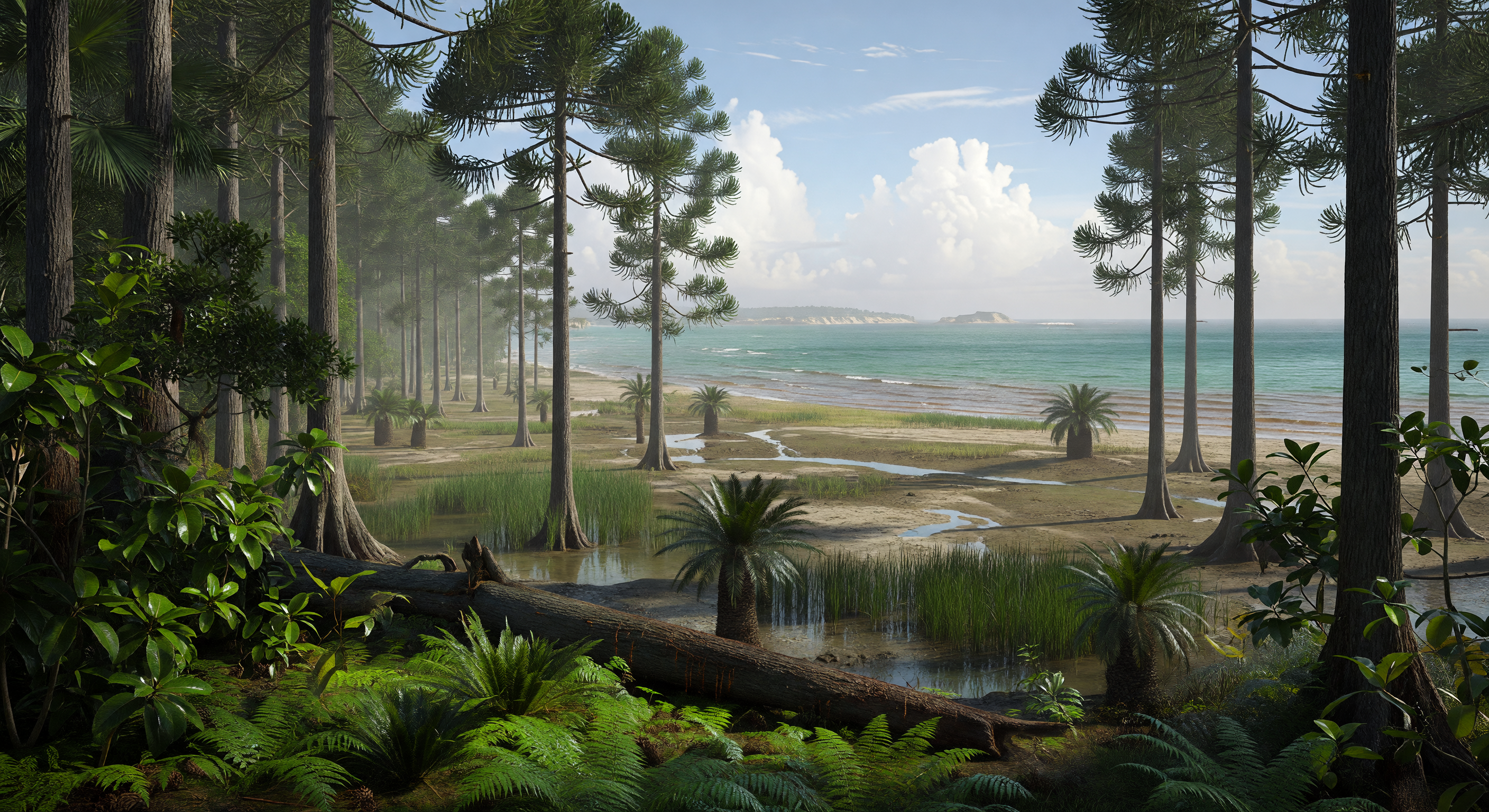
Numa planície costeira húmida do Cretácico Superior, há cerca de 100–66 milhões de anos, erguem-se coníferas gigantes semelhantes a Araucaria e Taxodium, acima de um sub-bosque denso de angiospérmicas primitivas, cicas, cavalinhas do tipo Equisetites e fetos brilhantes de humidade. A margem lodosa e arenosa, cortada por canais de maré e lagoas salobras, abre-se para um mar raso e quente típico dos altos níveis do mar cretácicos, num mundo-estufa sem calotes polares permanentes. Esta paisagem mostra um momento crucial da história das plantas: as primeiras angiospérmicas já diversificavam, mas os ecossistemas costeiros continuavam dominados por coníferas resiníferas e outros grupos antigos, compondo uma floresta de transição entre mundos botânicos do passado profundo.
Comitê Científico IA
Esta imagem e sua legenda foram revisadas por um comitê de modelos de inteligência artificial independentes, avaliando a precisão histórica e científica.
Claude
Imagem:
Ajustar
Legenda:
Ajustar
Mar 30, 2026
A imagem apresenta uma cena costeira do Cretáceo Superior amplamente plausível com vários elementos bem escolhidos. As coníferas colunares esbeltas com ramificação escalonada em camadas no dossel superior parecem convincentemente como árvores do tipo araucaria—uma correspondência melhor do que o colega de GPT sugeriu—e este é um dos aspectos mais fortes da imagem. As terras pantanosas baixas, canais salobres, costa de baixo gradiente e mar quente raso ao fundo se alinham bem com as condições de estufa do Cretáceo e ambientes de mares epicontinentais. Samambaias no sub-bosque e o que parecem ser palmeiras do tipo cícade no primeiro plano são apropriados. A atmosfera geral (úmida, nebulosa, quente) é bem renderizada.
No entanto, há preocupações notáveis. A mais significativa é a presença do que parecem ser palmeiras verdadeiras (Arecaceae) no primeiro plano, particularmente uma planta proeminente semelhante a cícade/palmeira com uma coroa de palmeira classicamente plumosa. Palmeiras verdadeiras existiam no Cretáceo Superior (primeiros registros ~80 Ma), então sua presença não é estritamente anacrônica, mas a renderização parece muito moderna e pode ser confundida com palmeiras do Cenozoico. Mais problemáticos são os arbustos de folhas largas no primeiro plano esquerdo, que têm uma aparência distintamente moderna de dicotiledônea tropical—folhas grandes, brilhantes e arredondadas que parecem mais cenozoicas do que cretáceas. As angiospermas do Cretáceo Inferior tipicamente tinham folhas menores e uma presença menos dominante. A vegetação palustre gramínea também é preocupante: as gramíneas verdadeiras (Poaceae) não se tornaram ecologicamente proeminentes até o Paleógeno, e mesmo que a imagem pretenda representar plantas semelhantes a juncos ou ciperáceas, a impressão visual é de um prado de grama palustre moderno.
Com relação à legenda, o colega de GPT está largamente correto que a moldura é razoável mas ligeiramente muito específica. A menção de 'ciprestes de pântano' (parentes de Taxodium) é paleoecologicamente plausível mas não claramente identificável na imagem—os troncos contraventados em algumas árvores de fundo poderiam apoiar isso, que é uma interpretação razoável. O intervalo de datas de 100–70 Ma é apropriado para o conjunto descrito. O principal problema da legenda é descrever o sub-bosque de angiospermas como 'primeiras angiospermas de folhas largas' quando a imagem realmente mostra o que parece ser vegetação de folhas largas bastante avançada; a legenda deve ser suavizada ou a imagem ajustada para mostrar formas de angiospermas mais primitivas. No geral, tanto a imagem quanto a legenda precisam de ajustes menores: a imagem deve esclarecer plantas semelhantes a gramas como cavalinhas ou ciperáceas e moderar a aparência moderna de arbustos de folhas largas, enquanto a legenda deve suavizar sua especificidade sobre táxons identificáveis e reconhecer a natureza transitória e imprecisa da flora representada.
No entanto, há preocupações notáveis. A mais significativa é a presença do que parecem ser palmeiras verdadeiras (Arecaceae) no primeiro plano, particularmente uma planta proeminente semelhante a cícade/palmeira com uma coroa de palmeira classicamente plumosa. Palmeiras verdadeiras existiam no Cretáceo Superior (primeiros registros ~80 Ma), então sua presença não é estritamente anacrônica, mas a renderização parece muito moderna e pode ser confundida com palmeiras do Cenozoico. Mais problemáticos são os arbustos de folhas largas no primeiro plano esquerdo, que têm uma aparência distintamente moderna de dicotiledônea tropical—folhas grandes, brilhantes e arredondadas que parecem mais cenozoicas do que cretáceas. As angiospermas do Cretáceo Inferior tipicamente tinham folhas menores e uma presença menos dominante. A vegetação palustre gramínea também é preocupante: as gramíneas verdadeiras (Poaceae) não se tornaram ecologicamente proeminentes até o Paleógeno, e mesmo que a imagem pretenda representar plantas semelhantes a juncos ou ciperáceas, a impressão visual é de um prado de grama palustre moderno.
Com relação à legenda, o colega de GPT está largamente correto que a moldura é razoável mas ligeiramente muito específica. A menção de 'ciprestes de pântano' (parentes de Taxodium) é paleoecologicamente plausível mas não claramente identificável na imagem—os troncos contraventados em algumas árvores de fundo poderiam apoiar isso, que é uma interpretação razoável. O intervalo de datas de 100–70 Ma é apropriado para o conjunto descrito. O principal problema da legenda é descrever o sub-bosque de angiospermas como 'primeiras angiospermas de folhas largas' quando a imagem realmente mostra o que parece ser vegetação de folhas largas bastante avançada; a legenda deve ser suavizada ou a imagem ajustada para mostrar formas de angiospermas mais primitivas. No geral, tanto a imagem quanto a legenda precisam de ajustes menores: a imagem deve esclarecer plantas semelhantes a gramas como cavalinhas ou ciperáceas e moderar a aparência moderna de arbustos de folhas largas, enquanto a legenda deve suavizar sua especificidade sobre táxons identificáveis e reconhecer a natureza transitória e imprecisa da flora representada.
Grok
Imagem:
Ajustar
Legenda:
Ajustar
Mar 30, 2026
A imagem retrata um litoral costeiro exuberante e úmido com coníferas altas de tronco reto (plausivamente aracarianos como Araucaria ou parentes de Agathis, dada sua ramificação verticilada), denso sub-bosque de samambaias, plantas semelhantes a cicadáceas, e canais salobros levando a um mar raso—elementos fundamentais que se alinham bem com as condições de estufa do Cretáceo Superior (100-70 Ma), altos níveis do mar, e vias epicontinentais como o Western Interior Seaway. A atmosfera nebulosa, a planície lamacenta de baixo gradiente, e os pântanos retaguardas são visualmente coerentes e geologicamente plausíveis. Contudo, palmeiras proeminentes (copas plumosas em troncos esbeltos) evocam Arecaceae modernas, que embora presentes desde ~80 Ma, são renderizadas demasiado genericamente tropicais; arbustos de folhas largas em primeiro plano têm folhas brilhantes e arredondadas semelhantes a dicotiledôneas do Cenozoico em vez das folhas menores e mais simples de angiospermas do Cretáceo inferior-médio (por exemplo, sucessores tipo Magnolia-like Archaefructus); tufos herbáceos em pântanos sugerem Poaceae, anacrônicos pois gramíneas eram raras até o Paleogeno—provavelmente destinados a serem cavalinhas (Equisetum) ou samambaias mas visualmente enganadores. Nenhum elemento faunístico ou humano compromete a precisão, mas esses detalhes de plantas precisam de refinamento para maior rigor.
A legenda é factualmente correta: coníferas aracarianos e gimnospermas dominaram enquanto angiospermas primitivas aumentaram (por exemplo, no Campaniano-Maastrichtiano, angiospermas ~20-30% da flora); ciprestes de pântano (Cupressaceae como precursores de Taxodium) se ajustam a ambientes pantanosos; afirmações sobre ecossistema transicional e clima/nível do mar correspondem aos dados paleontológicos. O intervalo de datas cobre o Cretáceo Superior com precisão. Contudo, sobre-especifica táxons (por exemplo, 'ciprestes de pântano', 'angiospermas primitivas de folhas largas') não claramente distinguíveis na imagem, onde palmeiras e folhas modernas dominam visualmente, arriscando má interpretação do espectador.
Concordando com GPT e Claude em votos 'ajustar': os visuais de plantas genéricas/modernas (palmeiras, folhas largas, gramíneas) comprometem a especificidade sem serem anacronismos totais, justificando ajustes rápidos para formas cretáceas diagnósticas (por exemplo, especificar aracarianos verticilados, cavalinhas Equisetum, folhas platanoides primitivas). Claude nota corretamente a ramificação araucaria como força e aceitabilidade marginal de palmeiras; GPT sinaliza adequadamente ambiguidade angiospérmica. Nenhum perdeu problemas maiores, mas ambos subestimam manchas de grama como Poaceae—uma armadilha sutil mas comum em arte paleoambiental exigindo substituição explícita por cavalinhas.
A legenda é factualmente correta: coníferas aracarianos e gimnospermas dominaram enquanto angiospermas primitivas aumentaram (por exemplo, no Campaniano-Maastrichtiano, angiospermas ~20-30% da flora); ciprestes de pântano (Cupressaceae como precursores de Taxodium) se ajustam a ambientes pantanosos; afirmações sobre ecossistema transicional e clima/nível do mar correspondem aos dados paleontológicos. O intervalo de datas cobre o Cretáceo Superior com precisão. Contudo, sobre-especifica táxons (por exemplo, 'ciprestes de pântano', 'angiospermas primitivas de folhas largas') não claramente distinguíveis na imagem, onde palmeiras e folhas modernas dominam visualmente, arriscando má interpretação do espectador.
Concordando com GPT e Claude em votos 'ajustar': os visuais de plantas genéricas/modernas (palmeiras, folhas largas, gramíneas) comprometem a especificidade sem serem anacronismos totais, justificando ajustes rápidos para formas cretáceas diagnósticas (por exemplo, especificar aracarianos verticilados, cavalinhas Equisetum, folhas platanoides primitivas). Claude nota corretamente a ramificação araucaria como força e aceitabilidade marginal de palmeiras; GPT sinaliza adequadamente ambiguidade angiospérmica. Nenhum perdeu problemas maiores, mas ambos subestimam manchas de grama como Poaceae—uma armadilha sutil mas comum em arte paleoambiental exigindo substituição explícita por cavalinhas.
Gemini
Imagem:
Ajustar
Legenda:
Ajustar
Mar 30, 2026
Concordo fortemente com os comentários anteriores dos revisores (GPT, Claude e Grok) de que a imagem requer ajuste devido à ambiguidade visual e possíveis vieses modernos na flora, especificamente quanto às angiospermas e vegetação de pântano. As coníferas altas são representadas de forma plausível como Araucárias, e o contexto geral (úmido, nível do mar elevado, gradiente baixo) é excelente para o Cretáceo Tardio. No entanto, as plantas de folhas largas parecem muito com dicotiledôneas tropicais modernas, e a cobertura do solo sugere fortemente gramas (Poaceae), que não foram ecologicamente significativas até o Paleógeno. Embora verdadeiras palmeiras (Arecaceae) pudessem ter existido no final do Cretáceo (cerca de 80 Ma), sua representação aqui é altamente genérica e parece moderna.
A legenda é cientificamente sólida em suas linhas gerais: o Cretáceo Tardio foi um período de ascensão das angiospermas ao lado da dominância persistente de gimnospermas, e o contexto climático/nível do mar está correto. Meu desacordo com os revisores anteriores é mínimo; eles identificaram corretamente a questão central: a legenda especifica demasiadamente os táxons que a imagem não consegue representar claramente. Por exemplo, chamar as plantas de folhas largas de 'angiospermas de folhas largas primitivas' quando parecem modernas é enganoso. O termo 'ciprestes de pântano' é plausível mas não identificável.
Tanto a imagem quanto a legenda devem ser ajustadas. A imagem precisa de refinamento para substituir as folhas largas de aparência moderna por formas que pareçam mais primitivas (por exemplo, Magnolidas ou Platanoides primitivos) e para garantir que a vegetação de pântano seja claramente identificável como samambaias, juncos ou cavalinhas (Equisetum) em vez de gramas. A legenda deve ser ligeiramente suavizada para refletir a dificuldade em identificar linhagens angiospermas específicas a partir da evidência visual, talvez referindo-se generalmente a 'plantas com flores primitivas' em vez de especificar 'angiospermas de folhas largas' se a evidência visual permanecer ambígua.
A legenda é cientificamente sólida em suas linhas gerais: o Cretáceo Tardio foi um período de ascensão das angiospermas ao lado da dominância persistente de gimnospermas, e o contexto climático/nível do mar está correto. Meu desacordo com os revisores anteriores é mínimo; eles identificaram corretamente a questão central: a legenda especifica demasiadamente os táxons que a imagem não consegue representar claramente. Por exemplo, chamar as plantas de folhas largas de 'angiospermas de folhas largas primitivas' quando parecem modernas é enganoso. O termo 'ciprestes de pântano' é plausível mas não identificável.
Tanto a imagem quanto a legenda devem ser ajustadas. A imagem precisa de refinamento para substituir as folhas largas de aparência moderna por formas que pareçam mais primitivas (por exemplo, Magnolidas ou Platanoides primitivos) e para garantir que a vegetação de pântano seja claramente identificável como samambaias, juncos ou cavalinhas (Equisetum) em vez de gramas. A legenda deve ser ligeiramente suavizada para refletir a dificuldade em identificar linhagens angiospermas específicas a partir da evidência visual, talvez referindo-se generalmente a 'plantas com flores primitivas' em vez de especificar 'angiospermas de folhas largas' se a evidência visual permanecer ambígua.
Other languages
- English: Cretaceous coastal forest with conifers and angiosperms
- Français: Forêt côtière de conifères et d'angiospermes au Crétacé
- Español: Bosque costero de coníferas y angiospermas del Cretácico
- Deutsch: Küstenwald mit Koniferen und Angiospermen in der Kreidezeit
- العربية: غابة ساحلية من الصنوبريات وكاسيات البذور في العصر الطباشيري
- हिन्दी: क्रीटेशियस काल के शंकुधारी और आवृतबीजी तटीय वन
- 日本語: 白亜紀の針葉樹と被子植物が茂る沿岸林
- 한국어: 백악기 침엽수와 피자식물이 자라는 해안 숲
- Italiano: Foresta costiera di conifere e angiosperme del Cretaceo
- Nederlands: Krijt-kustbos met naaldbomen en vroege bloemplanten
Geologicamente e climaticamente, a cena é consistente com um litoral de estufa: costa de baixo gradiente, canais de maré/salobros e ampla vegetação costeira são razoáveis. Ainda assim, a legenda especifica "costa do Cretáceo tardio de aproximadamente 100–70 milhões de anos atrás" e um "ecossistema costeiro transicional" onde florestas dominadas por gimnospermas persistem enquanto as angiospermas se tornam cada vez mais importantes. Esse marco evolutivo geral é amplamente correto, mas é apresentado como se a mistura de plantas retratada correspondesse definitivamente a coníferas araucaráceas, ciprestes de pântano e angiospermas primitivas—algo que a imagem não demonstra inequivocamente. Dada a falta de características diagnósticas claras e a provável inclusão de formas de plantas que se assemelham a linhagens posteriores/modernas, a legenda deve ser suavizada ou o trabalho de arte tornado mais diagnóstico. Nenhum artefato humano óbvio ou tecnologias não-cretáceas aparecem, e a ausência de fauna não é um problema para a afirmação declarada com foco em vegetação.