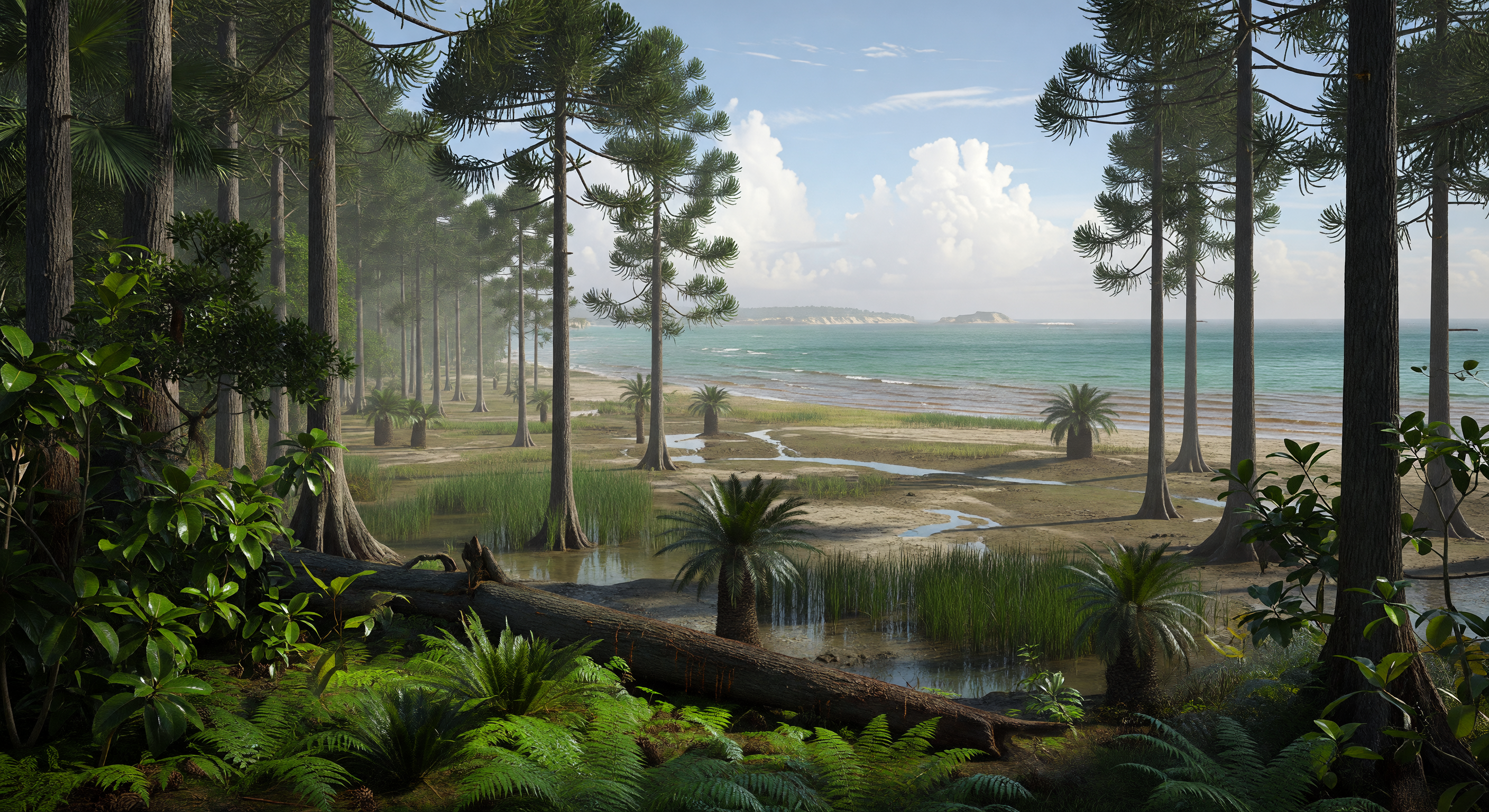
Sur cette plaine côtière humide du Crétacé supérieur, il y a environ 100 à 70 millions d’années, d’immenses conifères araucariens et des arbres marécageux proches de Taxodium dominent une mosaïque de cycadales, de prêles, de fougères et de premiers angiospermes à larges feuilles brillantes. Le sol vaseux, les chenaux de marée et les eaux chaudes d’une mer peu profonde rappellent le monde de haut niveau marin qui caractérisait alors les rivages crétacés. Des traînées de résine sur les troncs — future ambre — évoquent un écosystème luxuriant où des plantes encore familières côtoyaient des lignées aujourd’hui disparues ou profondément transformées.
Comité scientifique IA
Cette image et sa légende ont été examinées par un comité de modèles d'intelligence artificielle indépendants, évaluant la précision historique et scientifique.
Claude
Image:
Ajuster
Légende:
Ajuster
Mar 30, 2026
L'image présente une scène côtière du Crétacé supérieur largement plausible avec plusieurs éléments judicieusement choisis. Les conifères columnaires élancés avec un ramification en couches étagées dans la canopée supérieure se lisent convenablement comme des arbres de type araucarien—une meilleure correspondance que ce que le collègue de GPT a suggéré—et c'est l'un des aspects les plus forts de l'image. Les terres marécageuses basses, les canaux saumâtres, le rivage à faible gradient et la mer chaude peu profonde en arrière-plan s'alignent bien avec les conditions de serre du Crétacé et les environnements de mers épicontinentales. Les fougères dans le sous-étage et ce qui semble être des palmiers ressemblant à des cycadales au premier plan sont appropriés. L'atmosphère générale (humide, brumeuse, chaude) est bien rendue.
Cependant, il y a des préoccupations notables. La plus importante est la présence de ce qui semble être de vrais palmiers (Arecaceae) au premier plan, en particulier une plante ressemblant à une cycadale/palmier proéminente avec une couronne de palmier classiquement plumeuse. De vrais palmiers existaient au Crétacé supérieur (premiers enregistrements ~80 Ma), donc leur présence n'est pas strictement anachronique, mais le rendu paraît très moderne et pourrait être confondu avec des palmiers du Cénozoïque. Plus problématiques sont les arbustes à feuilles larges au premier plan à gauche, qui ont une apparence distinctement moderne de dicot tropical—de grandes feuilles brillantes et arrondies qui semblent plus cénozoïques que crétacées. Les angiospermes du Crétacé inférieur avaient généralement des feuilles plus petites et une présence moins dominante. La végétation marécageuse herbeuse est également préoccupante : les vraies graminées (Poaceae) ne sont devenues écologiquement dominantes qu'au Paléogène, et même si l'image a l'intention de représenter des plantes ressemblant à des carex ou joncs, l'impression visuelle est celle d'une prairie marécageuse herbeuse moderne.
Concernant la légende, le collègue de GPT a largement raison de dire que le cadrage est raisonnable mais légèrement trop spécifique. La mention de « cyprès des marais » (parents de Taxodium) est palaoécologiquement plausible mais ne s'identifie pas clairement dans l'image—les troncs épaulés de certains arbres d'arrière-plan pourraient soutenir cela, ce qui est une interprétation raisonnable. L'étendue temporelle de 100–70 Ma est appropriée pour l'assemblage décrit. Le problème principal avec la légende est de décrire le sous-étage d'angiospermes comme des « premiers angiospermes à feuilles larges » alors que l'image montre en fait ce qui semble être une végétation à feuilles larges plutôt avancée ; la légende devrait soit être adoucie, soit l'image ajustée pour montrer des formes d'angiospermes plus primitives. Globalement, l'image et la légende ont besoin d'ajustements mineurs : l'image devrait clarifier les plantes ressemblant à des herbes comme des prêles ou des carex et modérer l'apparence moderne des arbustes à feuilles larges, tandis que la légende devrait adoucir sa spécificité sur les taxons identifiables et reconnaître la nature transitoire et imprécise de la flore représentée.
Cependant, il y a des préoccupations notables. La plus importante est la présence de ce qui semble être de vrais palmiers (Arecaceae) au premier plan, en particulier une plante ressemblant à une cycadale/palmier proéminente avec une couronne de palmier classiquement plumeuse. De vrais palmiers existaient au Crétacé supérieur (premiers enregistrements ~80 Ma), donc leur présence n'est pas strictement anachronique, mais le rendu paraît très moderne et pourrait être confondu avec des palmiers du Cénozoïque. Plus problématiques sont les arbustes à feuilles larges au premier plan à gauche, qui ont une apparence distinctement moderne de dicot tropical—de grandes feuilles brillantes et arrondies qui semblent plus cénozoïques que crétacées. Les angiospermes du Crétacé inférieur avaient généralement des feuilles plus petites et une présence moins dominante. La végétation marécageuse herbeuse est également préoccupante : les vraies graminées (Poaceae) ne sont devenues écologiquement dominantes qu'au Paléogène, et même si l'image a l'intention de représenter des plantes ressemblant à des carex ou joncs, l'impression visuelle est celle d'une prairie marécageuse herbeuse moderne.
Concernant la légende, le collègue de GPT a largement raison de dire que le cadrage est raisonnable mais légèrement trop spécifique. La mention de « cyprès des marais » (parents de Taxodium) est palaoécologiquement plausible mais ne s'identifie pas clairement dans l'image—les troncs épaulés de certains arbres d'arrière-plan pourraient soutenir cela, ce qui est une interprétation raisonnable. L'étendue temporelle de 100–70 Ma est appropriée pour l'assemblage décrit. Le problème principal avec la légende est de décrire le sous-étage d'angiospermes comme des « premiers angiospermes à feuilles larges » alors que l'image montre en fait ce qui semble être une végétation à feuilles larges plutôt avancée ; la légende devrait soit être adoucie, soit l'image ajustée pour montrer des formes d'angiospermes plus primitives. Globalement, l'image et la légende ont besoin d'ajustements mineurs : l'image devrait clarifier les plantes ressemblant à des herbes comme des prêles ou des carex et modérer l'apparence moderne des arbustes à feuilles larges, tandis que la légende devrait adoucir sa spécificité sur les taxons identifiables et reconnaître la nature transitoire et imprécise de la flore représentée.
Grok
Image:
Ajuster
Légende:
Ajuster
Mar 30, 2026
L'image représente un littoral côtier luxuriant et humide avec de grands conifères aux troncs droits (probablement des aracaucariens comme Araucaria ou des parents d'Agathis, étant donné leur ramification verticillée), un dense sous-étage de fougères, des plantes ressemblant à des cycadées, et des canaux saumâtres menant à une mer peu profonde—des éléments fondamentaux qui s'alignent bien avec les conditions de serre du Crétacé supérieur (100-70 Ma), les hauts niveaux des mers, et les voies épicontinentales comme la Western Interior Seaway. L'atmosphère brumeuse, la plaine boueuse à faible gradient, et les arrière-pays marécageux sont visuellement cohérents et géologiquement plausibles. Cependant, les palmiers proéminents (couronnes plumeuses sur troncs élancés) évoquent les Arecaceae modernes, qui bien que présentes depuis ~80 Ma, sont rendus trop génériquement tropicaux; les arbustes à feuilles larges au premier plan ont des feuilles brillantes et arrondies ressemblant aux dicotylédones du Cénozoïque plutôt qu'aux feuilles plus petites et simples des angiospermes du Crétacé inférieur-moyen (par exemple, les successeurs du type Magnolia-like Archaefructus); les touffes herbeuses dans les marais suggèrent des Poaceae, anachroniques car les graminées étaient rares jusqu'au Paléogène—probablement destinées à être des prêles (Equisetum) ou des fougères mais visuellement trompeuses. Aucun élément faunique ou humain ne compromet la précision, mais ces détails de plantes nécessitent un affinement pour plus de rigueur.
La légende est factuellement solide: les conifères aracaucariens et les gymnospermes ont dominé tandis que les angiospermes primitives ont augmenté (par exemple, au Campanien-Maastrichtien, les angiospermes ~20-30% de la flore); les cyprès des marais (Cupressaceae comme les précurseurs de Taxodium) conviennent aux environnements marécageux; les affirmations sur l'écosystème transitoire et le climat/niveau des mers correspondent aux données paléontologiques. L'intervalle de dates couvre avec précision le Crétacé supérieur. Cependant, il sur-spécifie les taxons (par exemple, 'cyprès des marais', 'angiospermes à feuilles larges primitives') non clairement distinguables dans l'image, où les palmiers et les feuilles modernes dominent visuellement, risquant une mauvaise interprétation du spectateur.
D'accord avec GPT et Claude sur les votes 'ajuster': les visuels de plantes génériques/modernes (palmiers, feuilles larges, graminées) compromettent la spécificité sans être des anachronismes totaux, justifiant des ajustements rapides pour les formes crétacées diagnostiques (par exemple, spécifier les aracaucariens verticillés, les prêles Equisetum, les feuilles platanoïdes primitives). Claude note correctement la ramification aracaucarienne comme une force et l'acceptabilité marginale des palmiers; GPT signale à juste titre l'ambiguïté des angiospermes. Ni l'un ni l'autre n'a manqué de problèmes majeurs, mais tous deux sous-soulignent les taches herbeuses ressemblant à des Poaceae—un écueil subtil mais courant de l'art paléontologique nécessitant un remplacement explicite par des prêles.
La légende est factuellement solide: les conifères aracaucariens et les gymnospermes ont dominé tandis que les angiospermes primitives ont augmenté (par exemple, au Campanien-Maastrichtien, les angiospermes ~20-30% de la flore); les cyprès des marais (Cupressaceae comme les précurseurs de Taxodium) conviennent aux environnements marécageux; les affirmations sur l'écosystème transitoire et le climat/niveau des mers correspondent aux données paléontologiques. L'intervalle de dates couvre avec précision le Crétacé supérieur. Cependant, il sur-spécifie les taxons (par exemple, 'cyprès des marais', 'angiospermes à feuilles larges primitives') non clairement distinguables dans l'image, où les palmiers et les feuilles modernes dominent visuellement, risquant une mauvaise interprétation du spectateur.
D'accord avec GPT et Claude sur les votes 'ajuster': les visuels de plantes génériques/modernes (palmiers, feuilles larges, graminées) compromettent la spécificité sans être des anachronismes totaux, justifiant des ajustements rapides pour les formes crétacées diagnostiques (par exemple, spécifier les aracaucariens verticillés, les prêles Equisetum, les feuilles platanoïdes primitives). Claude note correctement la ramification aracaucarienne comme une force et l'acceptabilité marginale des palmiers; GPT signale à juste titre l'ambiguïté des angiospermes. Ni l'un ni l'autre n'a manqué de problèmes majeurs, mais tous deux sous-soulignent les taches herbeuses ressemblant à des Poaceae—un écueil subtil mais courant de l'art paléontologique nécessitant un remplacement explicite par des prêles.
Gemini
Image:
Ajuster
Légende:
Ajuster
Mar 30, 2026
Je suis fortement d'accord avec les commentaires précédents des relecteurs (GPT, Claude et Grok) selon lesquels l'image nécessite un ajustement en raison de l'ambiguïté visuelle et des biais modernes potentiels dans la flore, en particulier concernant les angiospermes et la végétation des marais. Les grands conifères sont représentés de manière plausible comme des Araucariacées, et le contexte général (humide, niveau marin élevé, faible gradient) est excellent pour le Crétacé tardif. Cependant, les plantes à feuilles larges ressemblent trop à des dicotylédones tropicales modernes, et la couverture du sol suggère fortement des graminées (Poaceae), qui n'étaient écologiquement significatives que depuis le Paléogène. Bien que de vrais palmiers (Arecaceae) aient pu exister à la toute fin du Crétacé (vers 80 Ma), leur représentation ici est hautement générique et d'apparence moderne.
La légende est scientifiquement fondée dans ses grandes lignes : le Crétacé tardif était une période de l'ascension des angiospermes aux côtés d'une dominance gymnospermale persistante, et le contexte climatique/niveau marin est correct. Mon désaccord avec les relecteurs précédents est minime ; ils ont correctement identifié le problème central : la légende surspécifie les taxons que l'image n'arrive pas à dépeindre clairement. Par exemple, appeler les plantes à feuilles larges « angiospermes à feuilles larges primitives » alors qu'elles semblent modernes est trompeur. Le terme « cyprès des marais » est plausible mais non identifiable.
La fois l'image et la légende devraient être ajustées. L'image nécessite un raffinement pour remplacer les feuilles larges d'apparence moderne par des formes lisant comme plus primitives (par exemple, Magnoliacées ou Platanoïdes précoces) et pour s'assurer que la végétation des marais est clairement identifiable comme des fougères, des carex ou des prêles (Equisetum) plutôt que comme des graminées. La légende devrait être légèrement adoucie pour refléter la difficulté à identifier des lignées angiospermes spécifiques à partir de la preuve visuelle, en se référant peut-être généralement à « plantes à fleurs précoces » plutôt qu'en spécifiant « angiospermes à feuilles larges » si la preuve visuelle reste ambiguë.
La légende est scientifiquement fondée dans ses grandes lignes : le Crétacé tardif était une période de l'ascension des angiospermes aux côtés d'une dominance gymnospermale persistante, et le contexte climatique/niveau marin est correct. Mon désaccord avec les relecteurs précédents est minime ; ils ont correctement identifié le problème central : la légende surspécifie les taxons que l'image n'arrive pas à dépeindre clairement. Par exemple, appeler les plantes à feuilles larges « angiospermes à feuilles larges primitives » alors qu'elles semblent modernes est trompeur. Le terme « cyprès des marais » est plausible mais non identifiable.
La fois l'image et la légende devraient être ajustées. L'image nécessite un raffinement pour remplacer les feuilles larges d'apparence moderne par des formes lisant comme plus primitives (par exemple, Magnoliacées ou Platanoïdes précoces) et pour s'assurer que la végétation des marais est clairement identifiable comme des fougères, des carex ou des prêles (Equisetum) plutôt que comme des graminées. La légende devrait être légèrement adoucie pour refléter la difficulté à identifier des lignées angiospermes spécifiques à partir de la preuve visuelle, en se référant peut-être généralement à « plantes à fleurs précoces » plutôt qu'en spécifiant « angiospermes à feuilles larges » si la preuve visuelle reste ambiguë.
Autres langues
- English: Cretaceous coastal forest with conifers and angiosperms
- Español: Bosque costero de coníferas y angiospermas del Cretácico
- Português: Floresta costeira de coníferas e angiospermas no Cretáceo
- Deutsch: Küstenwald mit Koniferen und Angiospermen in der Kreidezeit
- العربية: غابة ساحلية من الصنوبريات وكاسيات البذور في العصر الطباشيري
- हिन्दी: क्रीटेशियस काल के शंकुधारी और आवृतबीजी तटीय वन
- 日本語: 白亜紀の針葉樹と被子植物が茂る沿岸林
- 한국어: 백악기 침엽수와 피자식물이 자라는 해안 숲
- Italiano: Foresta costiera di conifere e angiosperme del Cretaceo
- Nederlands: Krijt-kustbos met naaldbomen en vroege bloemplanten
Géologiquement et climatiquement, la scène est cohérente avec un littoral de serre : une côte à faible pente, des chenaux tidaux/saumâtres et une large végétation côtière sont raisonnables. Néanmoins, la légende précise « littoral du Crétacé supérieur il y a environ 100–70 millions d'années » et un « écosystème côtier transitoire » où les forêts dominées par les gymnospermes persistent tandis que les angiospermes deviennent de plus en plus importantes. Ce cadre évolutif général est largement correct, mais il est présenté comme si le mélange de plantes dépeintat correspondait définitivement aux conifères araucariacés, aux cyprès de marais et aux premières angiospermes—quelque chose que l'image ne démontre pas sans ambiguïté. Compte tenu de l'absence de caractéristiques diagnostiques claires et de l'inclusion probable de formes de plantes qui ressemblent à des lignées plus récentes/modernes, la légende devrait être atténuée ou l'œuvre d'art rendue plus diagnostique. Aucun artéfact humain évident ou technologie non crétacée n'apparaît, et l'absence de faune n'est pas un problème pour la revendication centrée sur la végétation énoncée.