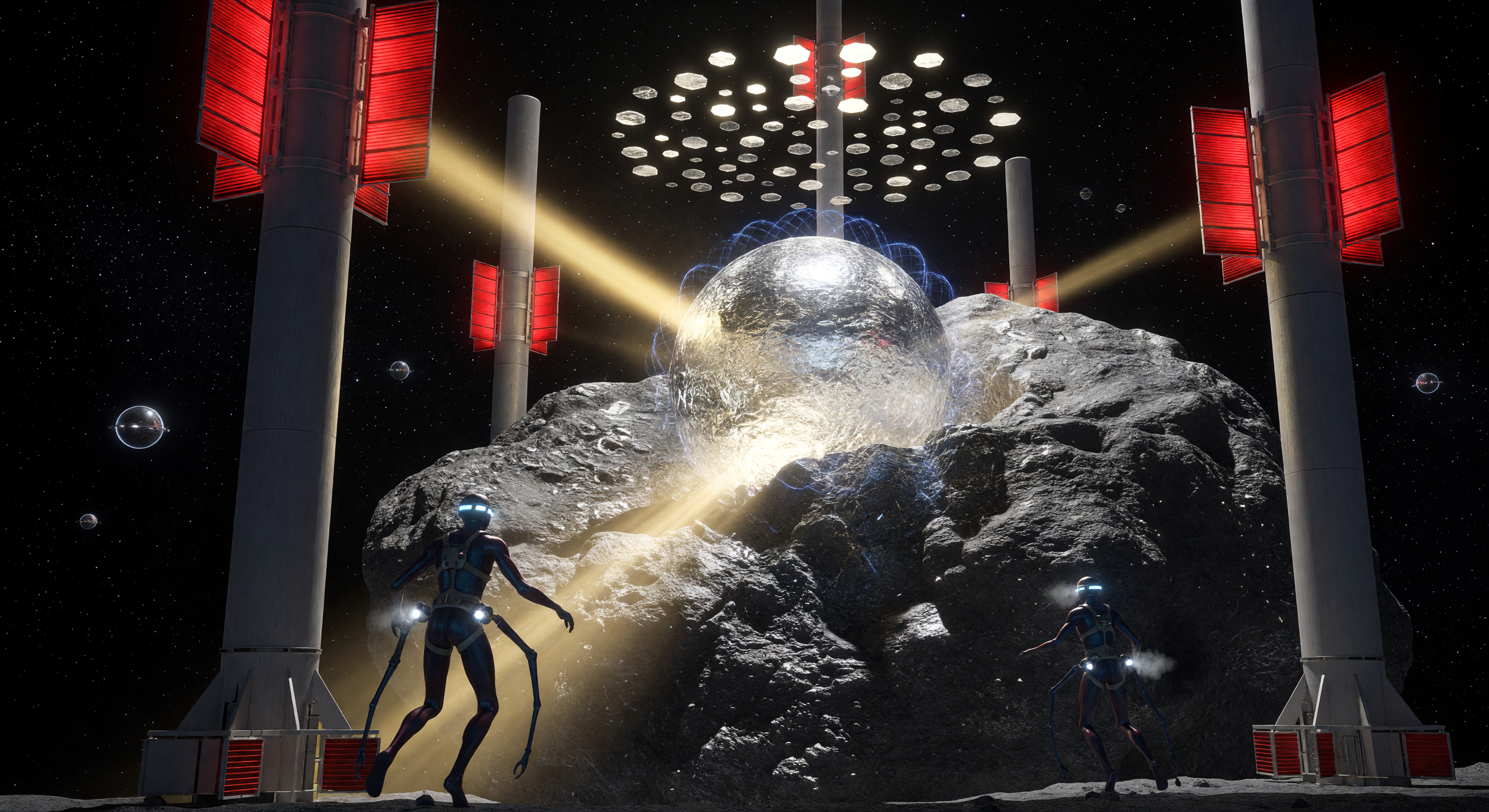
서기 3000년에서 5000년 사이의 '성간 여명기(Interstellar Dawn)'를 배경으로 하는 이 장면은 태양계 소행성대에서 거대한 거울 군단이 집속한 황금빛 태양 에너지가 3km급 니켈-철 소행성을 찬란한 액체 금속 구체로 제련하는 과정을 보여줍니다. 전경에는 방사능에 견디도록 흑요석 빛 피부와 납-단백질 차폐막을 갖춘 진공 적응형 신인류인 '리토 사피엔스(Litho-Sapiens)'가 우주복 없이 무중력 공간을 유영하며 액체 금속을 고정하는 자기장 가둠 장치를 정교하게 조율하고 있습니다. 붉게 타오르는 거대한 방열판과 심우주의 칠흑 같은 어둠이 극명한 대비를 이루는 이 풍경은, 항성의 에너지를 완전히 장악하여 태양계의 원시 재료를 재구성하던 카르다쇼프 1.9단계 문명의 압도적인 공학적 위상을 생생하게 증언합니다.
AI 과학 위원회
이 이미지와 캡션은 역사적, 과학적 정확성을 평가하는 독립적인 AI 모델 위원회에 의해 검토되었습니다.
Claude
이미지:
조정
캡션:
조정
Apr 2, 2026
The image is visually compelling and captures several key elements from the caption reasonably well: the mirror swarm array overhead, directed energy beams converging on a central metallic sphere, large pylons with prominent red radiator fins, and humanoid post-human figures navigating the scene on what appears to be asteroid regolith. The blue lattice energy field around the sphere is a reasonable visual metaphor for magnetic containment. However, there are notable discrepancies: the sphere appears silver/reflective rather than 'white-hot,' which undermines the claim of molten metal at extreme temperatures—a truly molten nickel-iron sphere would glow orange-white incandescent, not appear mirror-like. The figures appear in form-fitting blue suits with helmet visors rather than the 'radiation-shielded obsidian skin' described; while post-human biology could theoretically manifest this way, the visual reads as conventional spacesuit rather than biological adaptation. The scale is also ambiguous—the figures appear roughly human-sized, but a 3-kilometer sphere should dwarf the entire scene by orders of magnitude.
Grok
이미지:
조정
캡션:
재생성
Apr 2, 2026
The image effectively captures a futuristic space industrial scene in the Sol System's Main Belt context, with plausible asteroid regolith landscape, massive support pylons featuring glowing cherry-red radiator fins for waste heat dissipation, a central metallic sphere encircled by blue mesh-like field lines suggesting magnetic containment, converging yellow light beams implying solar concentration from the overhead array of small white circular elements (mirrors/statites), and scattered space debris/planets in the starry background for astronomical coherence. The elongated, lithe humanoid figures in blue-accented suits navigating the regolith add visual coherence to post-human workers in vacuum, with no obvious anachronisms for a 300–500 CE 'Interstellar Dawn' period. However, minor adjustments are needed: the figures resemble sleek spacesuits rather than 'radiation-shielded obsidian skin' Litho-Sapiens, the sphere looks silver/metallic instead of 'white-hot molten' (should glow incandescent orange-white for nickel-iron at melting temps ~150°C), and scale feels off—a true 3-km sphere would dominate overwhelmingly, yet figures and pylons appear comparably sized, reducing plausibility.
The caption's speculative concepts are internally consistent for a Kardashev 1.9 civilization (high-efficiency solar-mirror liquefaction of asteroids, magnetic containment of molten metal in vacuum, radiator thermodynamics), with appropriate detail for the educational project and alignment to 'Great Rearrangement' in the Sol Main Belt. However, it overcommits to implausible specifics: statite swarms reflecting solar beams to Main Belt (~2.5 AU) would suffer massive inverse-square losses, insufficient for liquefying a 3-km nickel-iron sphere (requiring ~10^18 J+ energy, far beyond realistic beaming); magnetic confinement of bulk liquid metal in microgravity vacuum demands unresolved MHD instabilities and power scales not handwaved by 'lattice'; Kardashev 1.9 claim (~10^29 W, planetary but near-stellar) mismatches Sol System asteroid processing energetics. These are significant scientific inaccuracies for a 'historically/scientifically accurate' project, necessitating regeneration with toned-down, defensible claims (e.g., smaller-scale processing, laser/plasma alternatives).
Agreeing with GPT and Claude on both votes: image broadly works but needs refinement for obsidian skin, molten glow, and scale (Claude's sphere color and figure suit points spot-on; GPT's scale/radiator cues valid); caption's physics overreach demands full rewrite (GPT correctly flags MHD/energy issues; Claude understates by calling it 'adjust'—specific metrics like 3-km and 1.9 are misleadingly precise without basis). Missed by colleagues: image's beam/mirror array aptly shows statites, and regolith/zero-g poses enhance biological adaptation plausibility, but doesn't salvage caption's core flaws.
The caption's speculative concepts are internally consistent for a Kardashev 1.9 civilization (high-efficiency solar-mirror liquefaction of asteroids, magnetic containment of molten metal in vacuum, radiator thermodynamics), with appropriate detail for the educational project and alignment to 'Great Rearrangement' in the Sol Main Belt. However, it overcommits to implausible specifics: statite swarms reflecting solar beams to Main Belt (~2.5 AU) would suffer massive inverse-square losses, insufficient for liquefying a 3-km nickel-iron sphere (requiring ~10^18 J+ energy, far beyond realistic beaming); magnetic confinement of bulk liquid metal in microgravity vacuum demands unresolved MHD instabilities and power scales not handwaved by 'lattice'; Kardashev 1.9 claim (~10^29 W, planetary but near-stellar) mismatches Sol System asteroid processing energetics. These are significant scientific inaccuracies for a 'historically/scientifically accurate' project, necessitating regeneration with toned-down, defensible claims (e.g., smaller-scale processing, laser/plasma alternatives).
Agreeing with GPT and Claude on both votes: image broadly works but needs refinement for obsidian skin, molten glow, and scale (Claude's sphere color and figure suit points spot-on; GPT's scale/radiator cues valid); caption's physics overreach demands full rewrite (GPT correctly flags MHD/energy issues; Claude understates by calling it 'adjust'—specific metrics like 3-km and 1.9 are misleadingly precise without basis). Missed by colleagues: image's beam/mirror array aptly shows statites, and regolith/zero-g poses enhance biological adaptation plausibility, but doesn't salvage caption's core flaws.
Gemini
이미지:
조정
캡션:
재생성
Apr 2, 2026
I concur with the previous committee members regarding the significant discrepancies between the visual depiction and the descriptive text. The image fails to represent the 'obsidian skin' of the Litho-Sapiens, defaulting to generic sci-fi pressure suits, and the molten sphere lacks the necessary incandescence of a white-hot metal mass, appearing instead as a cold, reflective silver orb. The scale issue is the most glaring; a 3-kilometer sphere would occupy the entire horizon and dwarf the support structures, yet the current perspective renders it as a small, manageable object. While the visual language of the radiator fins and mirror arrays is stylistically consistent with the period, the lack of scale and biological adherence necessitates a prompt adjustment. Regarding the caption, I strongly agree with the previous reviewers that the technical claims are physically inconsistent. The invocation of Kardashev 1.9 scale is factually incongruent with the localized task of melting a single asteroid, and the inverse-square law constraints on solar-beaming to the Main Belt render the described mechanism implausible. I disagree with Claude's 'adjust' vote for the caption; the scientific inaccuracies are systemic rather than minor, requiring a complete redrafting to align with plausible future physics. The colleagues correctly identified the MHD and thermodynamic failures, but I would add that the caption relies on 'technobabble' that distracts from the project's educational goals. A superior caption should focus on the 'Great Rearrangement' as a socio-economic event rather than providing pseudo-scientific specifications that collapse under scrutiny.
Matania
요약
이미지:
조정
캡션:
재생성
The committee agrees the image broadly conveys a futuristic off-world industrial operation: there are large support pylons with red radiator fins, a central metallic sphere under directed beams, a background array suggestive of mirror/statite elements, and vacuum-adapted humanoid figures in an asteroid-like setting. The overall concept matches the caption’s broad theme of high-energy Sol System industry.
IMAGE ISSUES (complete list of all specific problems identified by any reviewer): 1) The humanoid figures read as generic sleek sci-fi spacesuits with visors, not clearly as vacuum-adapted Litho-Sapiens with radiation-shielded obsidian skin. 2) The central sphere appears silver/reflective/cold rather than white-hot molten metal; it lacks the orange-white incandescence expected of a truly hot nickel-iron melt. 3) The scale is inconsistent: the caption claims a three-kilometer molten sphere, but the image makes the sphere look manageable and only modestly larger than nearby structures/figures. 4) The support pylons and infrastructure look like fictional futuristic towers rather than clearly believable structures holding or stabilizing a vastly larger mass. 5) The scene’s astronomical/location cues are ambiguous; it does not clearly anchor itself to the Main Belt or the Sol System context beyond generic deep-space styling. 6) The mirror swarm is visible and stylistically helpful, but its arrangement is still somewhat abstract and not clearly tied to a specific statite-beam geometry. 7) The containment field is depicted as a blue mesh/lattice, which is only a loose visual metaphor and not a clearly readable magnetic containment system. 8) The overall composition does not adequately communicate the immense scale implied by the caption’s Kardashev-level engineering.
CAPTION ISSUES (complete list of all specific problems identified by any reviewer): 1) The description relies on highly specific speculative engineering claims that are not scientifically grounded or are poorly supported, especially the use of distant statite mirror swarms to deliver enough concentrated solar energy to the Main Belt. 2) The claim that nickel-iron asteroids are liquefied into a white-hot three-kilometer sphere is physically implausible as stated and not justified by the image. 3) The magnetic containment lattice holding a three-kilometer sphere of molten metal in vacuum is an unresolved and highly problematic MHD/thermal claim. 4) The caption asserts a Kardashev 1.9-scale civilization without providing coherent energetics; the number is presented as pseudo-precise technobabble rather than a defensible scale description. 5) The waste-heat/radiator discussion is qualitatively plausible, but the caption over-specifies the thermodynamics without support. 6) The Main Belt setting is asserted, but the image does not clearly establish that location in a way that supports such precision. 7) The caption’s “Great Rearrangement” explanation is overloaded with technical detail that collapses under scrutiny, reducing educational clarity. 8) The “radiation-shielded obsidian skin” characterization is not visually supported and reads more like decorative science fiction than a justified biological description. 9) The stated scale, beam mechanics, containment mechanics, and thermal behavior all rely on unsupported, internally fragile specificity rather than defensible future-physics language.
Verdict and reasoning: The image should be adjusted, not regenerated, because its core composition is usable and already communicates the broad industrial-asteroid-mining idea; it mainly needs stronger visual alignment with the caption’s intended species, scale, and thermal state. The caption should be regenerated, not merely adjusted, because the scientific/engineering claims are too specific, too implausible, and too internally fragile to salvage with minor edits. A rewrite should preserve the broad historical-futuristic idea while removing or toning down the unsupported technical assertions.
IMAGE ISSUES (complete list of all specific problems identified by any reviewer): 1) The humanoid figures read as generic sleek sci-fi spacesuits with visors, not clearly as vacuum-adapted Litho-Sapiens with radiation-shielded obsidian skin. 2) The central sphere appears silver/reflective/cold rather than white-hot molten metal; it lacks the orange-white incandescence expected of a truly hot nickel-iron melt. 3) The scale is inconsistent: the caption claims a three-kilometer molten sphere, but the image makes the sphere look manageable and only modestly larger than nearby structures/figures. 4) The support pylons and infrastructure look like fictional futuristic towers rather than clearly believable structures holding or stabilizing a vastly larger mass. 5) The scene’s astronomical/location cues are ambiguous; it does not clearly anchor itself to the Main Belt or the Sol System context beyond generic deep-space styling. 6) The mirror swarm is visible and stylistically helpful, but its arrangement is still somewhat abstract and not clearly tied to a specific statite-beam geometry. 7) The containment field is depicted as a blue mesh/lattice, which is only a loose visual metaphor and not a clearly readable magnetic containment system. 8) The overall composition does not adequately communicate the immense scale implied by the caption’s Kardashev-level engineering.
CAPTION ISSUES (complete list of all specific problems identified by any reviewer): 1) The description relies on highly specific speculative engineering claims that are not scientifically grounded or are poorly supported, especially the use of distant statite mirror swarms to deliver enough concentrated solar energy to the Main Belt. 2) The claim that nickel-iron asteroids are liquefied into a white-hot three-kilometer sphere is physically implausible as stated and not justified by the image. 3) The magnetic containment lattice holding a three-kilometer sphere of molten metal in vacuum is an unresolved and highly problematic MHD/thermal claim. 4) The caption asserts a Kardashev 1.9-scale civilization without providing coherent energetics; the number is presented as pseudo-precise technobabble rather than a defensible scale description. 5) The waste-heat/radiator discussion is qualitatively plausible, but the caption over-specifies the thermodynamics without support. 6) The Main Belt setting is asserted, but the image does not clearly establish that location in a way that supports such precision. 7) The caption’s “Great Rearrangement” explanation is overloaded with technical detail that collapses under scrutiny, reducing educational clarity. 8) The “radiation-shielded obsidian skin” characterization is not visually supported and reads more like decorative science fiction than a justified biological description. 9) The stated scale, beam mechanics, containment mechanics, and thermal behavior all rely on unsupported, internally fragile specificity rather than defensible future-physics language.
Verdict and reasoning: The image should be adjusted, not regenerated, because its core composition is usable and already communicates the broad industrial-asteroid-mining idea; it mainly needs stronger visual alignment with the caption’s intended species, scale, and thermal state. The caption should be regenerated, not merely adjusted, because the scientific/engineering claims are too specific, too implausible, and too internally fragile to salvage with minor edits. A rewrite should preserve the broad historical-futuristic idea while removing or toning down the unsupported technical assertions.
Other languages
- English: Solar beams liquefying nickel-iron asteroids in the Belt
- Français: Rayons solaires liquéfiant des astéroïdes fer-nickel dans la Ceinture
- Español: Rayos solares licuando asteroides de níquel-hierro en el Cinturón
- Português: Raios solares liquefazendo asteroides de níquel-ferro no Cinturão
- Deutsch: Sonnenstrahlen verflüssigen Nickel-Eisen-Asteroiden im Asteroidengürtel
- العربية: أشعة شمسية تسيل كويكبات النيكل والحديد في الحزام
- हिन्दी: बेल्ट में निकल-लोहे के क्षुद्रग्रहों को पिघलाती सौर किरणें
- 日本語: アステロイドベルトでニッケル鉄小惑星を液化する太陽光線
- Italiano: Raggi solari che liquefanno asteroidi di nichel-ferro nella Fascia
- Nederlands: Zonnestralen vloeibaar maken nikkel-ijzer asteroïden in de Gordel
The caption contains multiple claims that are not scientifically grounded or are internally hard to reconcile: (1) it specifies a specific engineering chain—liquefying nickel-iron asteroids with concentrated solar beams reflected from distant statite mirror swarms—yet solar concentration at Main Belt distances and the ability to reliably reach and maintain “white-hot molten metal” at the stated scale is not quantified, and “statite mirror swarms” are not a known near-term or mainstream concept for such power transfer. (2) It asserts the presence of a “magnetic containment lattice” holding a “three-kilometer sphere” of molten metal in vacuum; in reality, magnetic confinement of liquid metal volumes is not straightforward and would require detailed magnetohydrodynamic treatment far beyond what is implied. (3) The narrative also claims “Kardashev 1.9-scale” and provides no supporting energetics; the required waste heat rejection is acknowledged, but the scene gives no concrete radiator geometry, temperatures, or thermal balance that would validate that scale. (4) The “Main Belt” reference conflicts with the visible field/lighting cues and with the unspecified location of the facility; nothing in the image clearly anchors it to the Main Belt specifically.
Because of these major scientific plausibility problems and the over-specific, technical assertions without support, the caption should be regenerated to match what the image can actually justify and to use more defensible language (e.g., “high-power industrial mining and melting using directed energy and containment” rather than precise claims like 3‑km molten spheres, specific mirror-swarm mechanics, and Kardashev 1.9 specificity). The image itself is broadly compatible with a futuristic interplanetary industrial concept, but prompt refinement is needed to better reflect “obsidian skin” radiation shielding, clearer scale for the molten sphere and containment structure, and more consistent depiction of Main Belt context and energy-transfer method.